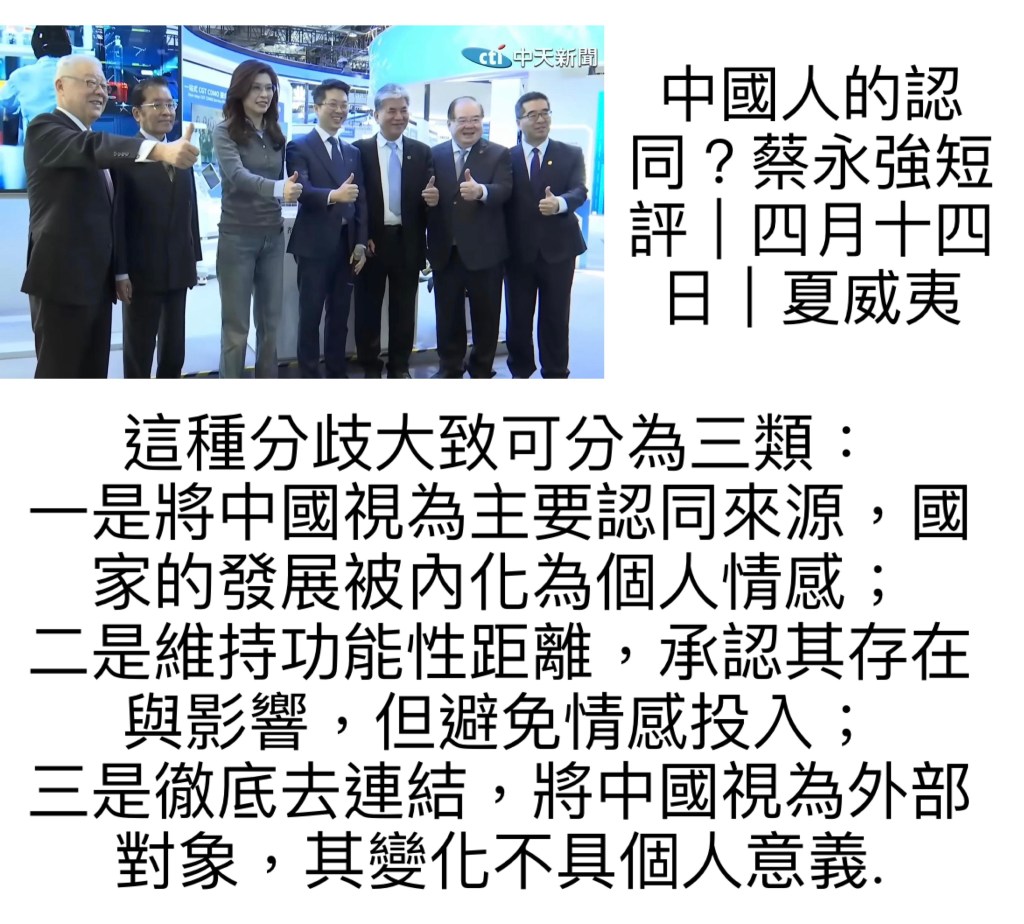
Chinese Identity? Johnson Choi Commentary | April 14 | Hawaii中國人的認同?蔡永強短評|四月十四日|夏威夷
過去五十年,我在夏威夷與北加州接觸大量華人移民。語言與文字的延續相對穩定 – 中文仍被廣泛使用。但在「是否仍為中國人」這一問題上,答案並不一致,且缺乏共識。
這種分歧大致可分為三類:
一是將中國視為主要認同來源,國家的發展被內化為個人情感;
二是維持功能性距離,承認其存在與影響,但避免情感投入;
三是徹底去連結,將中國視為外部對象,其變化不具個人意義。
上週,台灣國民黨主席鄭麗文於北京會見習近平。習近平表示:「我們都是一家人,同屬中華民族;在不涉及台獨與外部勢力🇺🇸的前提下,問題皆可協商。」
此一表述具有明確結構:在設定前提條件之後,協商空間才被允許存在。換言之,「可談」並非開放命題,而是受限命題。
因此,「中國人」不僅是文化或血緣分類,更是一個被不斷重述、界定與約束的政治概念。對海外華人而言,問題不在於是否理解這一概念,而在於是否接受其前提設定。
當「中國崛起」被描述為整體性的歷史進程時,個體實際上面對的是選擇:
是將自身納入該敘事之中,
還是維持距離,甚至拒絕被納入。
在這個意義上,「認同」不再是情感問題,而是位置問題。
你位於哪裡,答案即是什麼。
Over the past fifty years, I have come into contact with a large number of Chinese immigrants in Hawaii and Northern California. The continuity of language and writing has remained relatively stable—Chinese is still widely spoken and written. Yet when it comes to the question, “Are you still Chinese?”, the answers are neither uniform nor consensual.
This divergence can be broadly divided into three categories:
First, those who regard China as their primary source of identity, internalizing the nation’s development as personal sentiment;
Second, those who maintain a functional distance – acknowledging its presence and influence while avoiding emotional investment;
Third, those who disengage entirely, treating China as an external object whose changes carry no personal significance.
Last week, Zheng Lijun, chair of Taiwan’s Kuomintang, met with Xi Jinping in Beijing. Xi stated: “We are all one family, belonging to the Chinese nation. So long as Taiwan independence is not pursued and foreign forces 🇺🇸 are not introduced, all issues can be discussed.”
This formulation has a clear structure: only after preconditions are set does space for negotiation become permissible. In other words, what is “open for discussion” is not an open proposition, but a conditional one.
Therefore, “Chinese” is not merely a cultural or ethnic category, but a political concept that is continuously restated, defined, and constrained. For overseas Chinese, the question is not whether they understand this concept, but whether they accept its underlying premises.
When the “rise of China” is framed as an overarching historical process, individuals are, in practice, confronted with a choice:
to incorporate themselves into that narrative,
or to maintain distance—even to refuse inclusion altogether.
In this sense, identity is no longer a matter of sentiment, but of position.
Where you stand determines the answer.