A panel of experts will discuss America’s and China’s relationship in the context of the tech economy. On top of the issues arising from the the trade dispute, the pandemic response, and other sources of bilateral tension, both sides are now rethinking their approach to regulating the tech economy, have growing concerns about their citizens’ data being held outside their border, and worry about how social media can affect politics, among other tech-related issues.
This conversation is an affiliate of the CHINA Town Hall from the National Committee on US-China Relations, and follows a talk at 4PM Pacific Time by Fareed Zakaria. To register for Zakaria’s talk, click here https://www.ncuscr.org/event/CTH-2021-fareed-zakaria
This event is hosted by the China Business Studies Initiative in the USF School of Management and co-sponsored by the Bay Area Council.
Video: The US Military Industrial Complex & War Propaganda funding US medias outlets to brainwash Americans into more wars. 美國軍事工業綜合體和戰爭宣傳為美國媒體提供巨額資金,以將美國人洗腦,使其捲入更多戰爭Daniel Dumbrill’s speech on the Military Industrial Complex & War Propaganda from “The Propaganda War Against China” panel organized by the Friends of Socialist China group.
LinkedIn, the Microsoft-owned social media network for job-hunters and recruiters, announced that it will soon shut down its operations in China, after facing intense criticism for years over its decision on anti-China stands, banning users, censoring China friendly posts on its Chinese site.
China, Russia hold joint naval drill in Sea of Japan, display ‘higher level of trust, capability’ by Guo Yuandan and Liu Xuanzun Oct 14 2021
The Nanchang large destroyer sails in the Sea of Japan during the China-Russia Naval Interaction-2021 joint drill in October. Photo: Courtesy of Li Tang
With China’s advanced Type 055, a 10,000 ton-class large destroyer, for the first time joining an exercise with a foreign navy, China and Russia on Thursday kicked off a joint naval drill in the Sea of Japan, in a move that Chinese experts said not only displays the two sides’ high level of strategic mutual trust, but also will enhance their capability to jointly deal with maritime security threats and safeguard regional peace and stability, at a time when Western countries are building antagonistic regional security organizations like the Quad and AUKUS.
The Naval Interaction-2021 maritime military exercise started in waters near Russia’s Peter the Great Gulf in the Sea of Japan on Thursday, with the Chinese People’s Liberation Army (PLA) sending advanced warships including the Type 055 large destroyer Nanchang, the Type 052D destroyer Kunming, the Type 054A frigates Binzhou and Liuzhou, and the Type 903A comprehensive supply ship Dongpinghu, as well as fixed wing anti-submarine warfare aircraft and vessel-borne helicopters from the Eastern, Southern and Northern Theater Commands, while Russia will deploy large anti-submarine ships, frigates and aircraft, the Global Times learned from the PLA Navy on the day.
During the drill, which is a normal and annually scheduled arrangement but is also held amid many profound changes and the pandemic, the Chinese and Russian navies will practice communications, sea mine countermeasures, air defense, live-fire shooting at maritime targets, joint maneuvering and joint anti-submarine missions, according to the PLA Navy.
The goal of the joint drill is to enhance the two navies’ friendly, pragmatic cooperation, hone the capabilities to fight and enhance their capabilities to jointly deal with maritime security threats and safeguard regional peace and stability, Zhang Junshe, a senior research fellow at the PLA Naval Military Studies Research Institute, told the Global Times on Thursday.
It will also examine the PLA Navy’s far sea capabilities, including those in command, air defense, anti-ship, anti-submarine, reconnaissance, early warning, communication and navigation, Zhang said.
The Chinese vessels did not conduct assembly or rehearsal and started the drill directly, which is closer to real combat and will contribute to their capabilities in safeguarding the security of far sea transport lanes and other maritime interests.
As the largest maritime drill series between China and Russia, the Naval Interaction has been held nine times since 2012.
This is the first time China’s 10,000 ton-class large destroyer has participated in a drill abroad.
Zhang said that the Type 055 large destroyer will be the command ship in the fleet during the drill, and it will display its outstanding comprehensive capabilities including long-range detection, early warning and intelligence integration.
This is also the third time in 2021 the Type 055 has entered the Sea of Japan. The first time was in March, and the second time in August.
This reflects that the PLA’s far sea training in the region is becoming routine, as it is becoming more and more confident with its growing capabilities, Shi Hong, executive chief editor of the Chinese magazine Shipborne Weapons, told the Global Times on Thursday.
Just like the J-20 stealth fighter jet, which for the first time participated in the China-Russia Zapad/Interaction-2021 joint exercise in August, the Type 055 is another one of the PLA’s most powerful tools. This displays a new high of military mutual trust between the two countries, Song Zhongping, a Chinese military expert and TV commentator, told the Global Times on Thursday.
The Naval Interaction-2021 drill comes at a time when the US, India, Australia and Japan are holding Malabar naval drill in the Bay of Bengal, and also shortly after six countries including the US, the UK and Japan held drills in the South China Sea and surrounding areas.
New regional security organizations like Quad and AUKUS are serious threats to both China and Russia, and the joint drill between the two countries will contribute to regional peace and stability, Song said.
Li Shuyin, an expert at the PLA Academy of Military Sciences, told the Global Times previously that the joint drills between China and Russia have become routine and are completely normal, and if other countries see them as threats, they must have guilty consciences and want to stigmatize China and Russia.
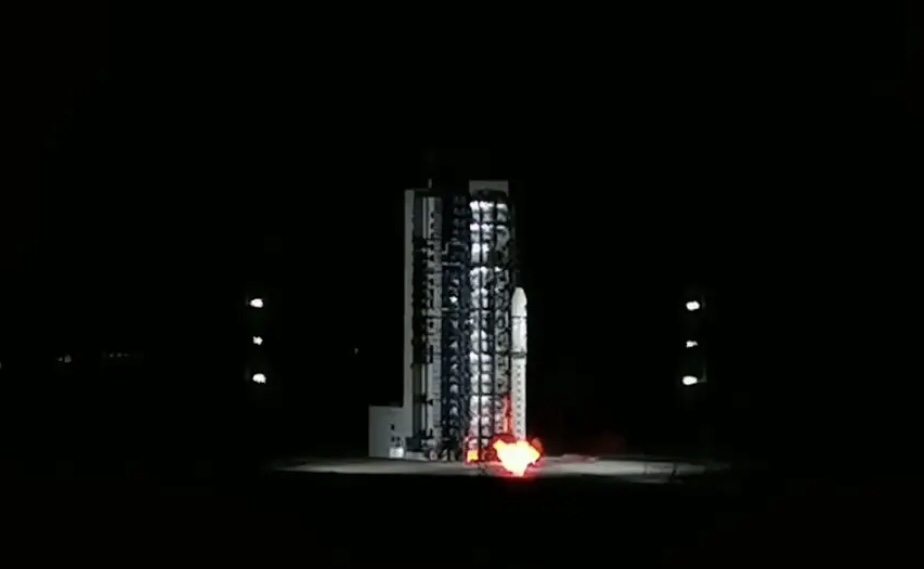
China on Thursday evening successfully launched the country’s first Sun-probing science and technology experiment satellite into designated orbit, which will enable the world’s first imaging spectrometer observation of the H-alpha band of the Sun, marking the country’s advancement into the solar exploration era.
The satellite was launched into space with other 10 satellites in a single launch performed by the liquid-fueled Long March-2D carrier rocket from Taiyuan Satellite Launch Center in North China’s Shanxi Province at around 7 pm on Thursday.
Shanghai Academy of Spaceflight Technology (SAST), the designer and manufacturer of the satellite, told the Global Times in a statement that the satellite weighs 510 kilograms, and will operate at an altitude of 517 kilometers in the dusk-dawn sun-synchronous orbit.
It’s equipped with an imaging spectrometer, which will be the first in the world to conduct spectral imaging observations of the H-alpha band of the Sun.
The H-alpha band is one of the best spectral lines to study solar activity. By analyzing the data of this line, we can obtain changes of physical quantities such as atmospheric temperature and velocity during a solar eruption, and study the dynamical process and physical mechanism of the solar eruption.
Also marking a first, the satellite will apply magnetic levitation technology in orbit to increase accuracy and stability during operation.
The “gold-medal rocket,” scoring its perfect performances that delivered all of its 54 launch missions in success in the past 30 years, has a liftoff thrust of 300 tons that is capable of carrying 1.2 tons of loads to the 700-kilometer sun-synchronous circular orbit, and is able to launch multiple satellites with different orbital requirements in one go.
Over the past 30 years, Long March-2D has sent a variety of heavyweights in China’s satellite history, including the Quantum Experiments at Space Scale nicknamed Mozi, Dark Matter Particle Explorer “Wukong” or “Monkey King,” and carbon dioxide monitoring satellite TanSat.
The rocket will also test the first attempt to use waffle-like grid fins to accurately guide fallen rocket pieces to Earth. It will control the attitude of the first stage of the rocket while it returns to Earth. It’s capable of reducing the landing area by more than 80 percent, making the vehicle’s landing point more accurate and controllable, greatly improving the safety of the surrounding environment.
Another highlight of the mission is that the satellite uses laser and microwave communication methods to set up a 5G high-speed communication channel, which further enhances the efficiency and reliability of inter-satellite communication.
Video call between Xi and Merkel highlights deep friendship, ‘paves good way’ for further China-EU talks by Cao Siqi Oct 13 2021
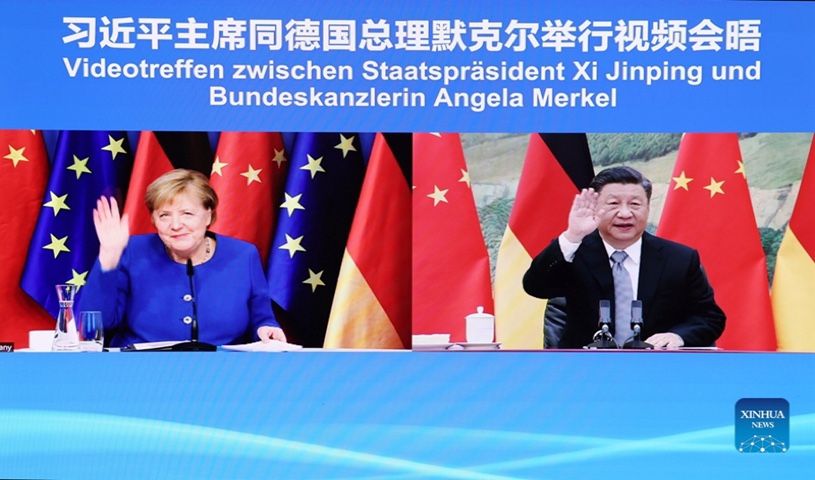
Chinese President Xi Jinping meets with German Chancellor Angela Merkel via video link in Beijing, capital of China, Oct. 13, 2021.
Chinese President Xi Jinping spoke highly of German Chancellor Angela Merkel’s contributions to promoting China-Germany and China-EU relations during her tenure when Xi met Merkel via video link on Wednesday. Xi said China’s doors are always open to Merkel as the Chinese people always value friendship and will never forget old friends.
“Since I met you during my visit to Germany in 2009, we have had in-depth exchanges on bilateral relations, major international and regional issues and governance experience. Together, we have pushed forward bilateral relations and promoted China-Germany cooperation in addressing global challenges. You have a deep understanding of China-Germany relations, China-Germany cooperation and China. I can feel your interest in China and your interest in different places, including Malatang [a hot and spicy soupy dish of meat and vegetables] in Sichuan Province. Next year marks the 50th anniversary of the establishment of diplomatic ties between China and Germany. We really hope this could continue,” Xi said.
In the spirit of mutually beneficial cooperation, China and Germany have made full use of their economic complementarities and achieved win-win results. This proves that countries can avoid zero-sum games, and this should be the main tone of China-Germany relations, Xi stressed.
As Germans’ “Mutti (mother)” and Europe’s “crisis manager,” Merkel is about to leave from the post she has held for 16 years, making her the country’s second-longest-serving chancellor and the first chancellor to leave power by choice.
Her leaving the post comes at a critical moment for Europe, which has plunged into a dilemma of refugees, an aging population, rampant far-right forces and being hit head-on by the US’ constant betrayal. The world is curious about whether there will be another Merkel that can lead Europe to fend off risks.
Cui Hongjian, director of the Department of European Studies at China Institute of International Studies, said it is rare to see the Chinese president speak so highly of a Western leader in recent years, and such evaluation was based on the steady and sound development of China-Germany relations over the past 16 years.
It shows that China hopes Merkel’s successor could follow in her footsteps and make continuous contributions to the stability of bilateral relations. The video call, an important stop of Merkel’s farewell tour, could set a good example to the leaders of other European countries, Cui told the Global Times on Wednesday.
“After stepping down from the post, Merkel is also widely expected to continue to make a difference in bilateral relations and China-EU relations in new positions,” Cui noted.
President Xi pointed out that China and Germany could expand cooperation in the fields of green energy and digital economy, and the two sides should view China-EU relations from a broad, objective and comprehensive perspective, and handle differences in a rational, peaceful and constructive manner.
“We hope that the EU will uphold its independence, truly safeguard its own interests and the solidarity of the international community, and work with China and other countries to resolve the ‘challenge of the century’ – peace and development,” Xi said.
Merkel said she always believes that the EU should develop its relations with China independently and the two sides can strengthen dialogue and exchanges on issues on which they have differences. “I believe that EU-China relations will continue to grow despite various complicated factors,” she said.
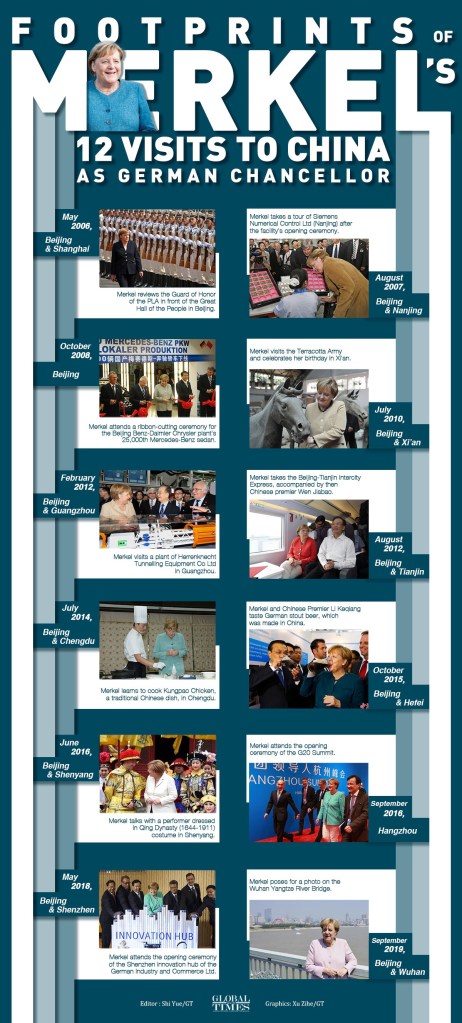
Footprints of Merkel’s 12 visits to China as German Chancellor
Chinese experts believe that China will continue to take an independent diplomatic policy free from other countries’ interference. But the contact this time will surely bear some fruits.
China-EU relations have witnessed a downward spiral in recent months. On March 22, the European Union joined the US, the UK and Canada in announcing sanctions against Chinese officials for alleged human rights abuses in Xinjiang. China immediately announced countermeasures against 10 individuals and four entities, including several members of the European Parliament.
The European Parliament later formally froze the China-EU Comprehensive Agreement on Investment, citing Beijing’s counter-sanctions. Chinese State Councilor and Foreign Minister Wang Yi criticized the EU for politicizing economic and trade issues but still sent a friendly message to the EU after the freeze, stressing that China always views the EU as a partner, not an adversary.
“China has maintained good cooperation with member countries of the EU, but has always encountered some hurdles in dealing with the organization. It is time to face the hurdles and address the problems,” Cui said.
The EU should know that confrontation would only lead to a dead end, and shifting the focus from conflicts to cooperation is a smarter move, Cui said, noting that the video call on Wednesday will pave a good way for further China-EU talks.
On September 28, Wang Yi and Josep Borrell, the EU’s High Representative for Foreign Affairs and Security Policy, decided to strengthen coordination on the new round of high-level economic, trade and digital dialogue and continue to advance cooperation in science and technology innovation, finance and energy during the 11th round of high-level strategic dialogue between China and the EU via video link.
One day earlier, Chinese Vice Premier Han Zheng stressed that China and the EU should make full use of the high-level dialogue platform on climate to further deepen green cooperation between the two sides and enhance mutual understanding and trust when he met with executive vice president of the European Commission for the European Green Deal via video link.
The South China Morning Post reported on Monday that the Chinese president will conduct a telephone call with European Council President Charles Michel on Friday, citing an EU official familiar with the plan.
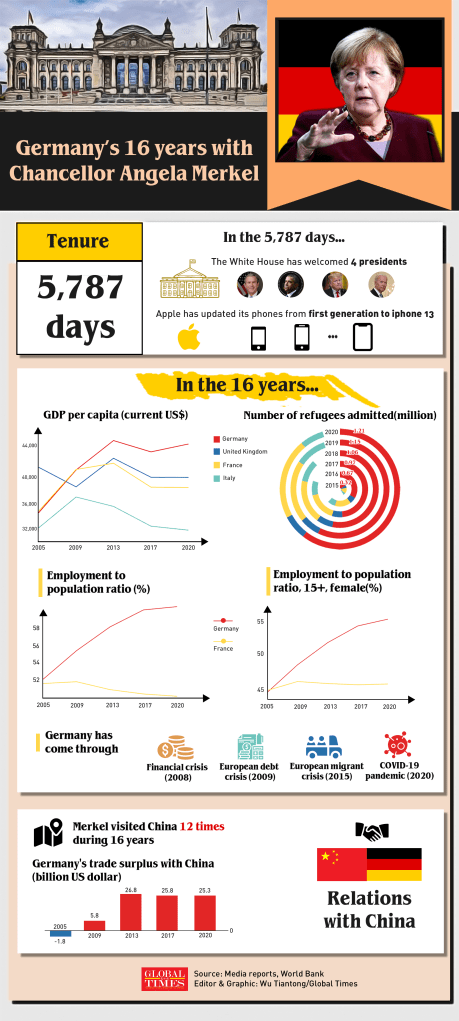
Germany’s 16 years with Chancellor Angela Merkel. Graphic: Wu Tiantong/GT
The US’ so-called China hand Gordon Chang, who has been advocating the “collapse of China” for over 20 years, has continued bad-mouthing China. Gordon Chang’s idea to address empty shelves would see a ‘collapse’ in the US, not in China by Lu Xue Oct 13 2021
When talking about the empty shelves in stores of the US, he once again attributed it to China.
“Americans, for the first time in their lives, are seeing empty shelves in stores. This isn’t right. We need to cut China out of our supply chains by producing locally,” Chang tweeted on Tuesday.
If the US follows what he said, Chang would surely see a “collapse” in the near future, but it would take place in the US, instead of in China. If doing it would help the US and hurt China, former US president Donald Trump would have done so. Even Trump would not resort to such ill-advised practices. One can imagine how crazy this idea is, which is without any logic or common sense.
Chang is hyping the anxiety toward China to cater to some so-called US elites to earn a living. This is all his remaining value and role in the US. When he predicted “the collapse of China” in 2001 in his sensational book The Coming Collapse of China, he drew worldwide attention. Yet for two decades, this prediction has constantly turned out to be wrong. Rather than “collapsing,” China is booming at a rapid pace. Long gone are Chang’s “golden days,” and even many Americans sniff at his predictions of the “collapse of China.” Now, he is on stage for a “clown performance.”
His bad-mouthing of China, or his demand to “cut China out of our supply chains,” is not out of the national interests of the US, but out of his own ill intention to get public attention, and to serve his own interests.
He notices the “empty shelves” and is clearly aware of the US dependence on China on supply chains. But his solutions and interpretations are illogic and far-fetched.
“There is no inevitable causal relationship between ’empty shelves’ and the US’ dependence on China in terms of supply chains. ‘Empty shelves’ is the result of the US’ problems with the purchase, supply channels and distribution. But Chang cannot interpret the ’empty shelves’ according to this logic. Instead, he tends to direct at China any problems the US is confronted with.” Shen Yi, a professor at the School of International Relations and Public Affairs of Fudan University, told the Global Times.
Shen continued, “Chang is just like the Roman senator Cato the Elder, who ended every one of his speeches with the catchphrase that, ‘Carthage must be destroyed!’ regardless of whether he had been speaking about the city of Carthage. Chang has become obsessed and paranoid.”
It is not surprising to see some Americans still agreeing with Chang about cutting China out of the US supply chains when we reviewed the responses to this tweet. Chang is extremely self-centered, as he believes he is correct about everything. If it turns out that he is wrong, it must be someone else’s fault. Shen said that “these characteristics are the inevitable outcome of the radicalization of the individual-centered liberalism in the US. Against this backdrop, his rhetoric will resonate with some Americans.”
But he will have egg on his face once again, just as he did when his “collapse of China” prediction turned out to be totally wrong. It will be proven that under the current international environment, China-US economic ties will only grow increasingly close. This can explain why US Trade Representative Katherine Tai used the term “recoupling” instead of “decoupling” when delivering remarks on China-US bilateral trade relations on October 4.
Russian govt reps voice support for China’s Xinjiang policy, slam Western lies by Fan Anqi Oct 13 2021
“However white the cotton, however red the tomatoes, to them they are all black,” said Chinese Ambassador to Russia Zhang Hanhui about the malicious fabrications and sanctions imposed by some Western countries over China’s Xinjiang policy on Wednesday. Zhang was speaking at a virtual promotional event for Xinjiang, winning wide support from Russian officials, media and organizations.
Themed “Xinjiang is a beautiful place,” the event was hosted by the Chinese Embassy in Russia on Wednesday.
Ambassador Zhang started off by introducing some of the historic feats that Xinjiang has achieved over the years. In 2020, Xinjiang shook off absolute poverty as all of the province’s 32 poverty-stricken counties and more than 3.08 million registered impoverished residents have been lifted out of poverty, the Global Times learned at the meeting.
Zhang noted that under the continuous efforts of local security departments, Xinjiang has not seen one single terrorist attack in more than four years, after years of turbulence that had badly haunted local people’s normal work and lives.
“However, some anti-China forces have been blatantly distorting and smearing China’s Xinjiang policy, making up fake stories about so-called forced labor and genocide. They do not really care about human rights, but only use it as an excuse to obstruct China’s development,” Zhang said.
“The vitriol has dismayed and enraged every Chinese citizen,” he said, expressing absolute opposition to the West’s double standards and interference.
At the event, a number of Xinjiang residents shared their stories, and refuted Western accusations about “concentration camps,” “forced sterilization” and “religion blockade.”
The owner of a car-selling company in Yecheng county named Aihebaiti spoke about how he managed to get rid of extremist thoughts and realized the horrible deeds of extremists by studying in a local training and education center.
“Not only was I able to shake off extremism through learning on anti-terrorism courses, but I learned many skills such as car repair that prompted me to open up this company,” Aihebaiti said at the event. “I am very grateful that the center helped me back on the right track, and gave me such a promising and happy life.”
Zeligulmayr, the owner of a beauty and skincare center in Kashi told attendees stories of her three children. Zeligulmayr said that the local government paid most of the fees when she gave birth at hospitals, and sent her nutrition bags regularly. School tuition fees are also paid by the government, the Global Times learned.
“I am leading a satisfied, happy life thanks to the support of the government, and claims of so-called genocide are a complete insult to our Xinjiang people. Stop talking nonsense and don’t disturb our lives,” she said.
Deputy of the Russian State Duma Sergei Gavrilov acknowledged Xinjiang’s rapid socioeconomic development over the years, as well as the strong and effective measures in safeguarding the region against terrorism.
He appreciated the extended cooperation on the border between the two countries in Xinjiang, and called for a deepened relationship in fighting against foreign interference in each other’s internal affairs.
In late September, 65 countries delivered a joint statement against interference in China’s internal affairs under the pretext of human rights at the 48th session of the Human Rights Council, stressing non-interference in China’s internal affairs including Hong Kong, Xinjiang and Tibet-related issues.
In addition, six member states of the Gulf Cooperation Council (GCC) issued a joint letter supporting China’s position. More than 20 countries expressed their support for China in their national statements. All together, nearly 100 countries expressed their understanding and support for China’s position.