The rapid collapse of the US-backed government in Afghanistan and the chaotic evacuation of Americans from Kabul could not only be “a powerful shock” for Washington’s allies and partners in Asia, but also complicate China’s challenges in its regional rivalry with the US, say observers. 美國支持的阿富汗政府的迅速垮台以及美國人從喀布爾的混亂撤離,不僅可能對華盛頓的亞洲盟友和合作夥伴構成“強烈衝擊”,而且還會使中國在與美國的地區競爭中面臨的挑戰複雜化。 觀察員。
China could participate in post-war reconstruction in Afghanistan: experts 中國可以參與阿富汗戰後重建:專家 by Yang Sheng Aug 15 2021
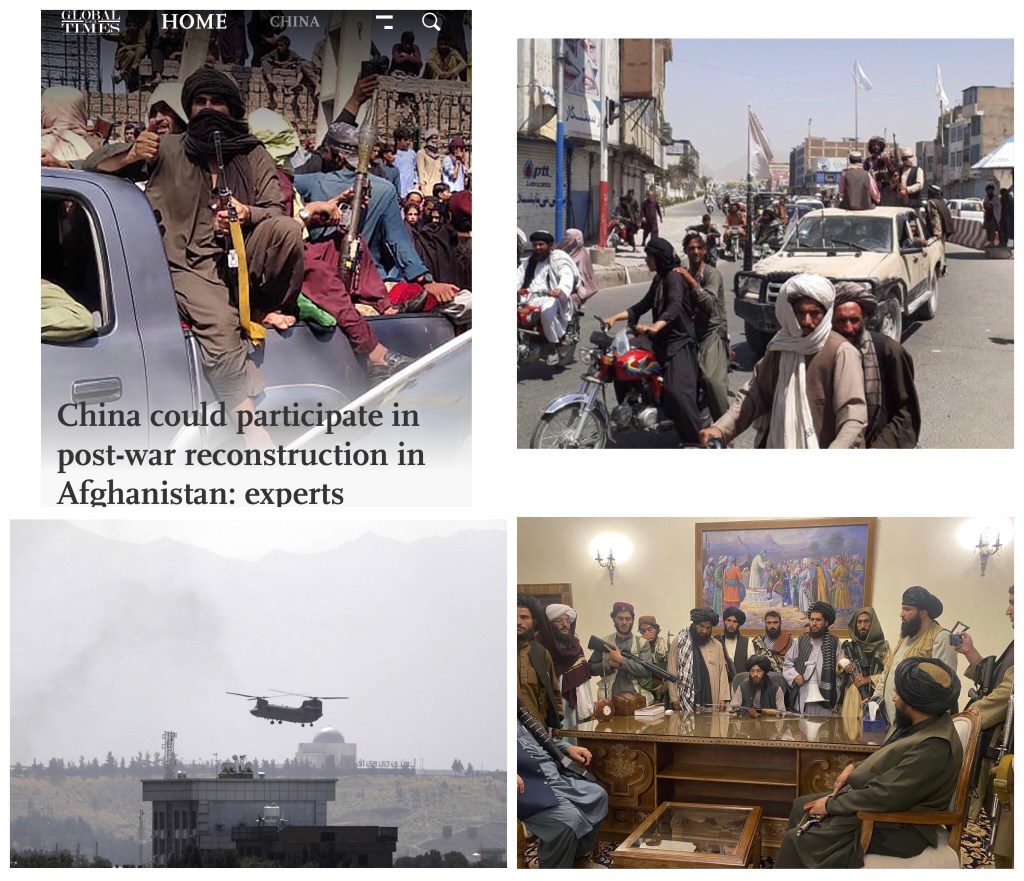
Taliban militants are seen inside the Kandahar city, southern Afghanistan, Aug. 13, 2021. Taliban militants on Friday claimed to have taken control over key southern Afghan cities of Lashkar Gah and Kandahar, after weeks of heavy clashes between the Taliban and government forces.
The Afghan Taliban’s military offensive has been moving faster than observers worldwide have expected, and it looks like it is just a matter of time before Kabul is taken, as latest reports from foreign media showed that the Taliban fighters have entered the capital and are negotiating with Afghan government officials on a peaceful transition of power.
Although some voices from the West are expecting China to play a bigger role in Afghanistan after the sudden US pullout, even are speculating that China might send troops to fill the vacuum left by the US, Chinese experts said such speculation is totally groundless, and the most China can do is to evacuate Chinese nationals if a massive humanitarian crisis occurs, or to contribute to post-war reconstruction and development, pushing forward projects under the China-proposed Belt and Road Initiative (BRI) when safety and stability are restored in the war-torn country.
The US can’t just leave and take no more responsibility in the region, and if Afghanistan encounters serious humanitarian problems, such as a refugee crisis, Washington should cooperate with other regional countries and at least provide economic assistance, because it was the US that has created this mess, experts noted.
If the Taliban builds a new country after it takes complete control, it should keep its promise to cut off all ties with terrorists, extremists and separatists – the “Three Evils” – in the region, and make sure Afghanistan does not become a breeding ground for those forces. Only by doing so can it win more recognition worldwide than it had before the US invasion after 9/11, Chinese analysts said. They noted that if Afghanistan becomes a breeding ground for the “Three Evils,” the UN Security Council may consider sending a UN peacekeeping force into the country.
US humiliation
According to AP, Taliban fighters entered Kabul on Sunday and sought the unconditional surrender of the central government, officials said, as Afghans and foreigners alike raced for the exit, signaling the end of a 20-year Western experiment aimed at remaking Afghanistan.
Afghan President Ashraf Ghani and First Vice President Amrullah Saleh have left the country and headed to Tajikistan, from where they are going to a third country, media reported.
The beleaguered Afghan central government, meanwhile, hopes for an interim administration, but increasingly had few cards to play… Helicopters buzzed overhead, some apparently evacuating personnel at the US Embassy. Several other Western missions were also preparing to get staff out, AP reported.
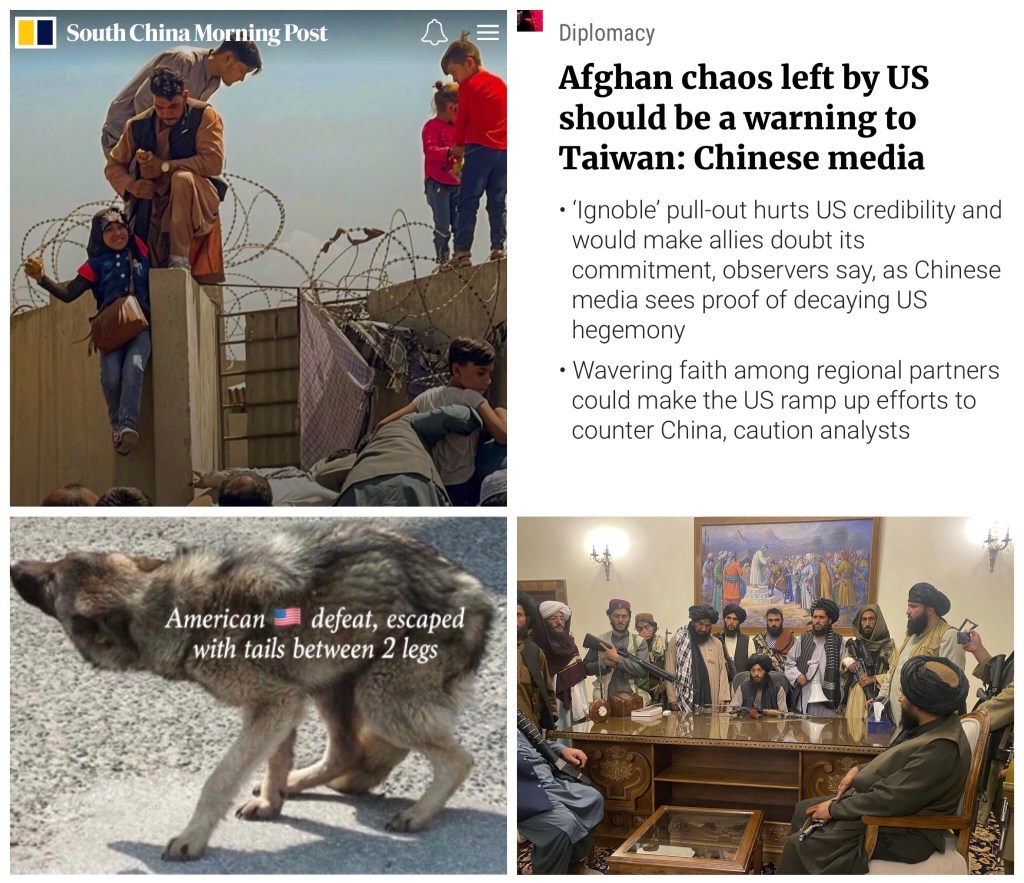
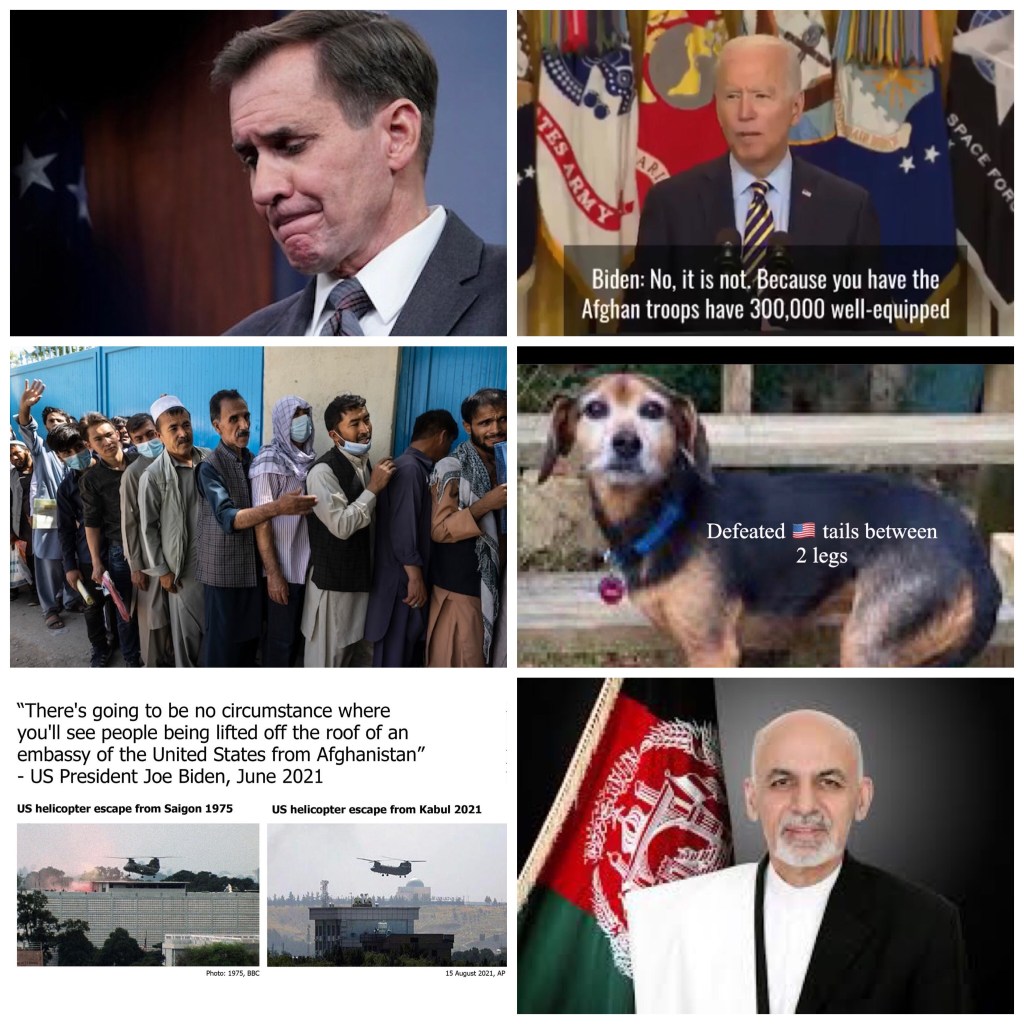
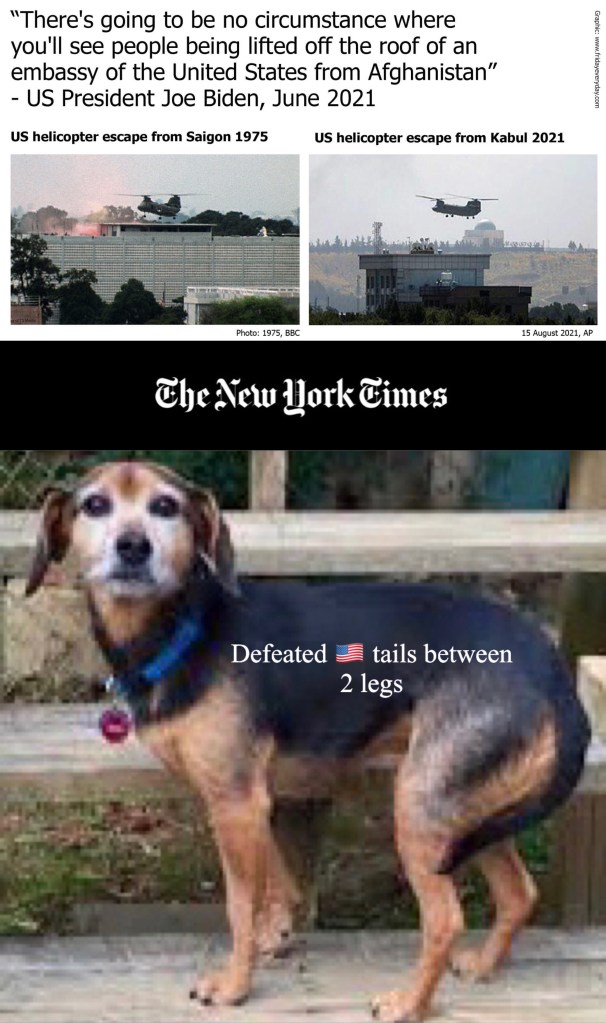
Many netizens worldwide compared the current situation with the US evacuation from Saigon (now called Ho Chi Minh City), Vietnam in 1975, to mock the US failure and pointless military actions in the developing world, as well as those people who still have wishful thinking when it comes to the US government.
Some Chinese web users said on China’s Twitter-like social media platform Sina Weibo that “those people who deeply believe in the US never learn the lesson, they just get abandoned by Americans like rubbish,” and “the 20-year war ends like a joke. American soldiers died for nothing, the Taliban returned, and the only change is more people have died and American taxpayers have wasted their money to feed the US military-industrial tycoons.”
Earlier the same day, according to Al Jazeera, the Taliban had taken control of Afghanistan’s Jalalabad without a fight, according to officials and a resident, effectively leaving the capital Kabul as the last major urban area under government control.
Zhu Yongbiao, director of the Center for Afghanistan Studies in Lanzhou University, told the Global Times on Sunday that “the Taliban’s progress is faster than expected. Previously, many observers worldwide expressed concern that the Taliban’s military actions would cause a massive humanitarian crisis, but in fact, the Taliban’s performance has not been bad so far.”
“We didn’t see massacres or women get abused, and most major cities were captured without a fight. There are some accusations against the Taliban, but we didn’t see hard evidence yet. The US embassy’s evacuation also didn’t get interrupted or attacked even though the Taliban troops have already entered Kabul. All of this shows that the war won’t end violently,” Zhu said.
On July 28, 2021, Chinese State Councilor and Foreign Minister Wang Yi met in Tianjin with the visiting delegation led by head of the Afghan Taliban Political Commission Mullah Abdul Ghani Baradar. The heads of the Afghan Taliban’s religious council and publicity committee were also part of the delegation.
Wang pointed out, “We hope the Afghan Taliban will make a clean break with all terrorist organizations including ETIM (East Turkestan Islamic Movement) and resolutely and effectively combat them to remove obstacles, play a positive role and create enabling conditions for security, stability, development and cooperation in the region.”
Baradar told Wang in Tianjin that “the Afghan Taliban will never allow any force to use the Afghan territory to engage in acts detrimental to China. The Afghan Taliban believes that Afghanistan should develop friendly relations with neighboring countries and the international community.”
Zhu said that the world needs to be prepared to deal with a new Afghanistan under Taliban control, and the key is whether the Taliban would keep its promise to make sure no force can use their country’s soil to threaten other countries in the region, and be more inclusive rather than extreme, and then more countries will recognize the country.
A US Chinook helicopter flies over the U.S. Embassy in Kabul, Afghanistan on Sunday. Helicopters are landing at the US embassy there as diplomatic vehicles leave the compound as the Taliban advance on the Afghan capital.
What can China do?
In Tianjin last month, Wang also said that “the hasty withdrawal of the US and NATO troops from Afghanistan actually marks the failure of the US policy on Afghanistan. The Afghan people now have an important opportunity to achieve national stability and development.”
But some voices from the West still want to make excuses for the US’ humiliation. Reuters published an analysis on Sunday entitled: As Taliban advances, China lays groundwork to accept an awkward reality.
The article said the Taliban’s momentum as US forces withdraw is awkward for China, which has blamed religious extremism as a destabilizing force in its western Xinjiang region and has long worried that Taliban-controlled territory would be used to harbor separatist forces.
In fact, the US is the one that should have felt embarrassed and awkward, said Chinese analysts, and the reason why some Western media or analysts made such comments is that they want China to repeat the mistake made by the US – “stepping on the ground of the graveyard of empires.”
Zhu said the West is trying to set traps for China. “The current situation is a mess for the US, and will impact countries in the region, and then the impact will come to us [China]. If the Taliban controls the country immediately and brings about stability, this would not be bad news. Extremism and terrorism would be restrained in a stable country that realizes a peaceful transfer without chaos.”
Of course, some “Three Evils” forces in the region will be encouraged, but Afghanistan’s impact on China should not be exaggerated, and the US is the one with the headache, Zhu said. He noted that other anti-government armed forces in the region are unlikely to replicate the progress that Taliban has made in Afghanistan.
Pan Guang, a senior expert on counter-terrorism and Afghan studies at the Shanghai Academy of Social Sciences, told the Global Times on Sunday that “in order to prevent the situation from spilling over, China has already started counter-terrorism cooperation with other countries in the region including Tajikistan and Pakistan to strengthen border control.”
What China could do is participate in the post-war reconstruction and provide investment to help the country’s future development, Pan said.
“The US can’t just run away. It should also take responsibility to rebuild the country and provide assistance. Washington should be supportive of international cooperation on anti-drug and refugee issues,” Pan said. “If Afghanistan encounters a huge crisis in the future, the UN Security Council would need to be united and pass a resolution to send a peacekeeping force, and this would need the US to be supportive and responsible as well.”
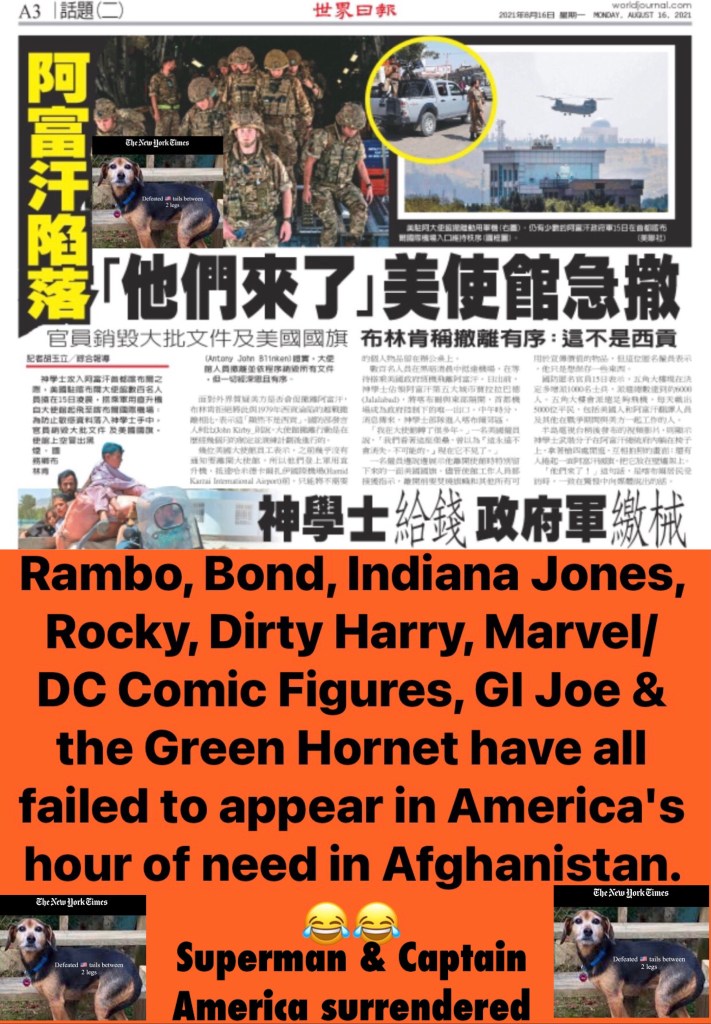
Afghanistan collapse, US consulate QUICK exit claimed not Saigon Vietnam in 1975. Really? Where are the American’s superheroes come to the rescue? Are they fake like the freedom democracy human rights and the rules of laws Americans are selling to the world? 阿富汗崩潰,美國領事館人員逃跑聲稱不是1975年的越南西貢, 真的嗎? 美國人的超級英雄在哪裡?也跑了的嗎? 它們是否像美國向世界出售的自由民主人權和法律規則一樣是虛假的? 美國加州舊金山世界日報 World Journal Newspaper San Francisco, August 16 2021
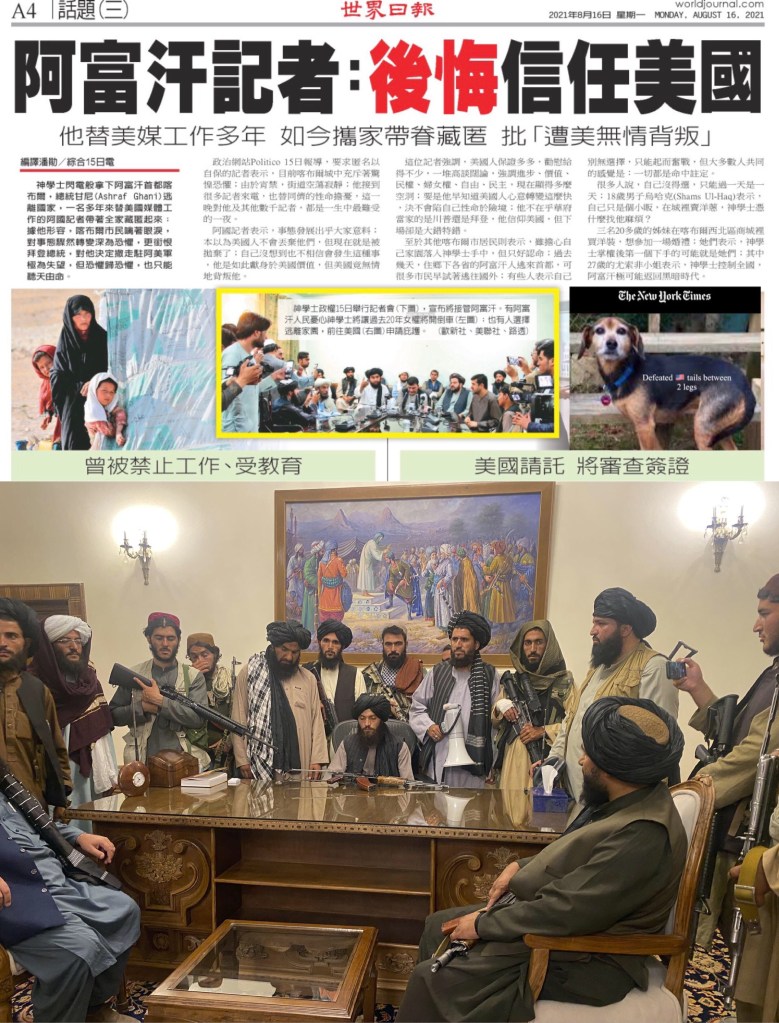
Afghan reporter: regrets to have trusted US. Huffpost in San Francisco: 20-YEAR ‘NATION-BUILDING’ COLLAPSES IN DAYS 阿富汗記者:後悔信任美國. 舊金山的赫芬頓郵報:20 年的“國家建設”在幾天內崩潰
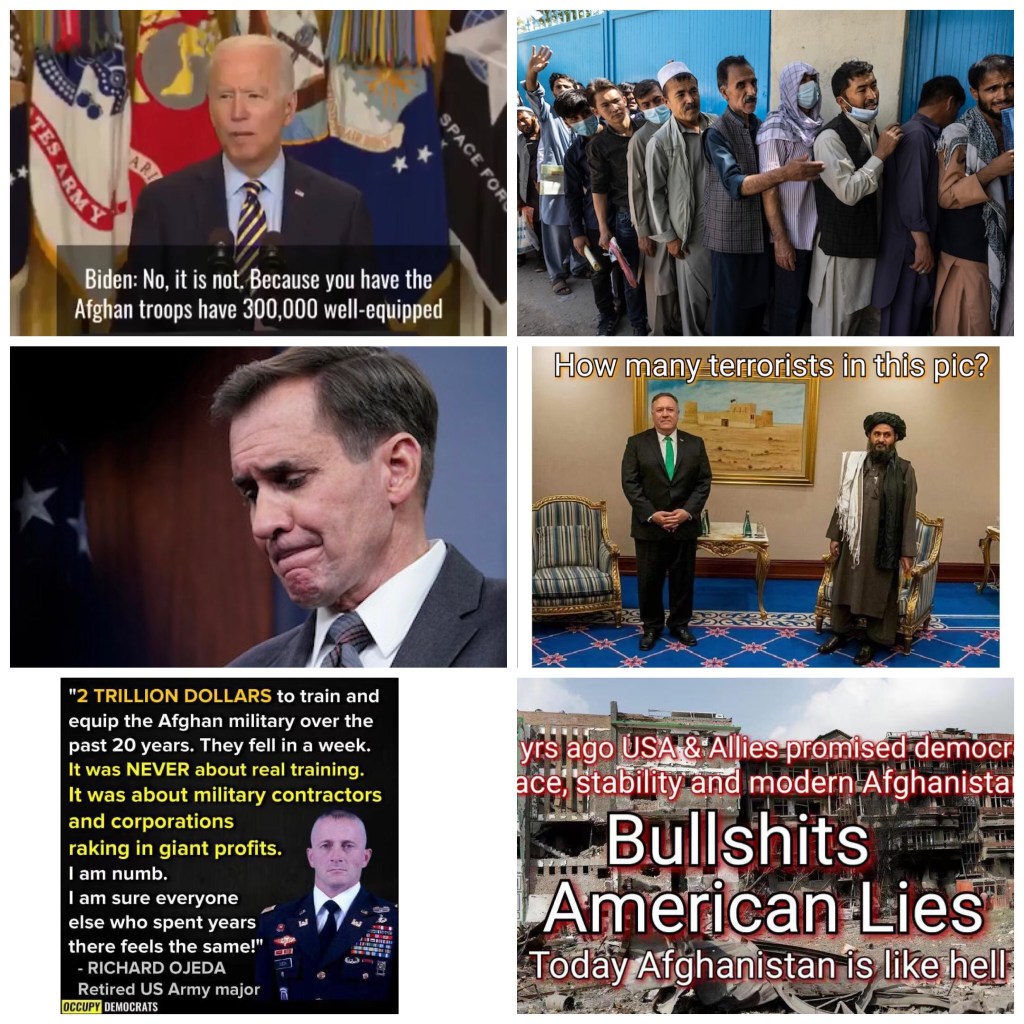
We are witnessing a mirror image of Taipei at Kabul. Taiwan Province arm force will lay down their arms to welcome PLA just like in Afghanistan. And English Tsai and her gang will escape like Afghanistan President. Washington Post: Afghanistan’s collapse leaves allies questioning U.S. resolve on other fronts. 我們正在喀布爾目睹台北的鏡像。 台灣省軍隊將像在阿富汗一樣放下武器迎接解放軍。 而蔡英文和她的團伙會像阿富汗總統一樣逃走. 華盛頓郵報:阿富汗的崩潰讓盟國質疑美國在其他方面的決心. by Liz Sly August 16 2021
LONDON — The Taliban’s stunningly swift advances across Afghanistan have sparked global alarm, reviving doubts about the credibility of U.S. foreign policy promises and drawing harsh criticisms even from some of the United States’ closest allies.
As Taliban fighters entered Kabul and the United States scrambled to evacuate its citizens, concerns grew that the unfolding chaos could create a haven for terrorists, unleash a major humanitarian disaster and trigger a new refugee exodus.
U.S. allies complain that they were not fully consulted on a policy decision that potentially puts their own national security interests at risk — in contravention of President Biden’s promises to recommit to global engagement.
And many around the world are wondering whether they could rely on the United States to fulfill long-standing security commitments stretching from Europe to East Asia.
“Whatever happened to ‘America is back’?” said Tobias Ellwood, who chairs the Defense Committee in the British Parliament, citing Biden’s foreign policy promise to rebuild alliances and restore U.S. prestige damaged during the Trump administration.
“People are bewildered that after two decades of this big, high-tech power intervening, they are withdrawing and effectively handing the country back to the people we went in to defeat,” Ellwood said. “This is the irony. How can you say America is back when we’re being defeated by an insurgency armed with no more than [rocket-propelled grenades], land mines and AK-47s?”
As much as its military capabilities, the United States’ decades-old role as a defender of democracies and freedoms is again in jeopardy, said Rory Stewart, who was Britain’s minister for international development in the Conservative government of Theresa May. “The Western democracy that seemed to be the inspiration for the world, the beacon for the world, is turning its back,” Stewart said.
Britain has voiced some of the bluntest criticisms of the pullout, which is unusual for a country that regards itself as the United States’ closest ally. Britain made the biggest contribution to the U.S.-led war in Afghanistan and suffered the highest number of casualties after the United States.
In comments Friday, British Defense Secretary Ben Wallace predicted civil war and the return of al-Qaeda, the terrorist organization whose attacks on Sept. 11, 2001, prompted the U.S.-led intervention in Afghanistan.
“I feel this was not the right time or decision to make,” he told Sky News. “Of course al-Qaeda will probably come back, and certainly it would like that kind of breeding ground.”
“Strategically, it causes a lot of problems, and as an international community, it’s very difficult . . . what we’re seeing today,” he added.
Rivals of the United States also have expressed dismay. Among them is China, which fears that the ascent of an extremist Islamist government on its western border will foster unrest in the adjoining province of Xinjiang, where Beijing has waged sweeping crackdowns on the Uyghur population that have been denounced by the West.
Washington “bears an unavoidable responsibility for the current situation in Afghanistan,” Col. Wu Qian, a spokesman for China’s Ministry of National Defense, said earlier this month. “It cannot leave and shed the burden on regional countries.”
Secretary of State Antony Blinken rejected criticisms that the withdrawal damages U.S. credibility. He said staying mired in a conflict that is not in the “national interest” would do far more damage.
“Most of our strategic competitors around the world would like nothing better than for us to remain in Afghanistan for another year, five years, 10 years, and have those resources dedicated to being in the midst of a civil war,” Blinken told CNN. “It’s simply not in our interest.”
But the manner and implementation of the withdrawal has left allies feeling betrayed, said Cathryn Clüver Ashbrook, director of the German Council on Foreign Relations. Germany’s government, which withdrew its troops in June and is evacuating its embassy, has refrained from overt criticism of the U.S. withdrawal.
Nonetheless, some German officials and lawmakers are seething at Washington’s failure to consult coalition partners such as Berlin, Clüver Ashbrook said. Germany is particularly concerned about the potential for an exodus of Afghan refugees similar to the influx of 2015, when more than 1 million migrants, spurred largely by the war in Syria, surged into Europe, with many headed for Germany.
“The Biden administration came to office promising an open exchange, a transparent exchange with its allies. They said the transatlantic relationship would be pivotal,” she said. “As it is, they’re playing lip service to the transatlantic relationship and still believe European allies should fall into line with U.S. priorities.”
“We’re back to the transatlantic relationship of old, where the Americans dictate everything. . . . ‘Yes we want to partner with you, but in reality, we want to be able to tell you what to do and when,’ ” she added.
The United States’ Arab allies, which have long counted on the U.S. military to come to their aid in the event of an attack by Iran, also have faced questions over whether they will be able to rely on the United States.
“What’s happening in Afghanistan is raising alarm bells everywhere,” said Riad Kahwaji, who heads the Inegma security consultancy in the United Arab Emirates, which hosts one of the biggest American military contingents in the Middle East.
“The U.S.’s credibility as an ally has been in question for a while,” he said. “We see Russia fighting all the way to protect the Assad regime [in Syria], and now the Americans are pulling out and leaving a big chaos in Afghanistan.”
Clüver Ashbrook said Biden’s plan to build an alliance of democracies to counter the influence of China and Russia is also in doubt, now that the West will no longer maintain a significant presence in Central Asia.
For China and Russia, there is opportunity as well as concern in the departure of U.S. troops. Both Moscow and Beijing have hosted Taliban delegations in recent weeks in an attempt to pave the way for a post-American future in the region.
The humiliating conclusion of the two-decade U.S. venture into Afghanistan will aid their efforts to persuade many governments to seek out relationships elsewhere, analysts say.
In a commentary directed at Hong Kong, China’s state-run Global Times cited Afghanistan in a signal to democracy activists not to heed repeated American promises to “stand by” Hong Kong. “It has been proven repeatedly that whomever U.S. politicians claim to stand with will face bad luck, plunge into social unrest and suffer severe consequences,” the commentary said.
Russia has been struck by the speed of the unraveling of the U.S.-installed government in Kabul, said Fyodor Lukyanov, the chairman of Russia’s Council on Foreign and Defense Policy and editor in chief of the magazine Russia in Global Affairs.
The decade-long Soviet occupation of Afghanistan, which ended in 1989, is widely remembered as a failure, one that leaves Russia in no mood to reengage too closely with Afghanistan, he said. But at least, Lukyanov noted, the government left behind by the Soviets survived for three years after the withdrawal of Red Army forces. “We believe our failure was big, but it seems the Americans achieved an even bigger failure,” he said.
John Hudson in Washington contributed to this report.
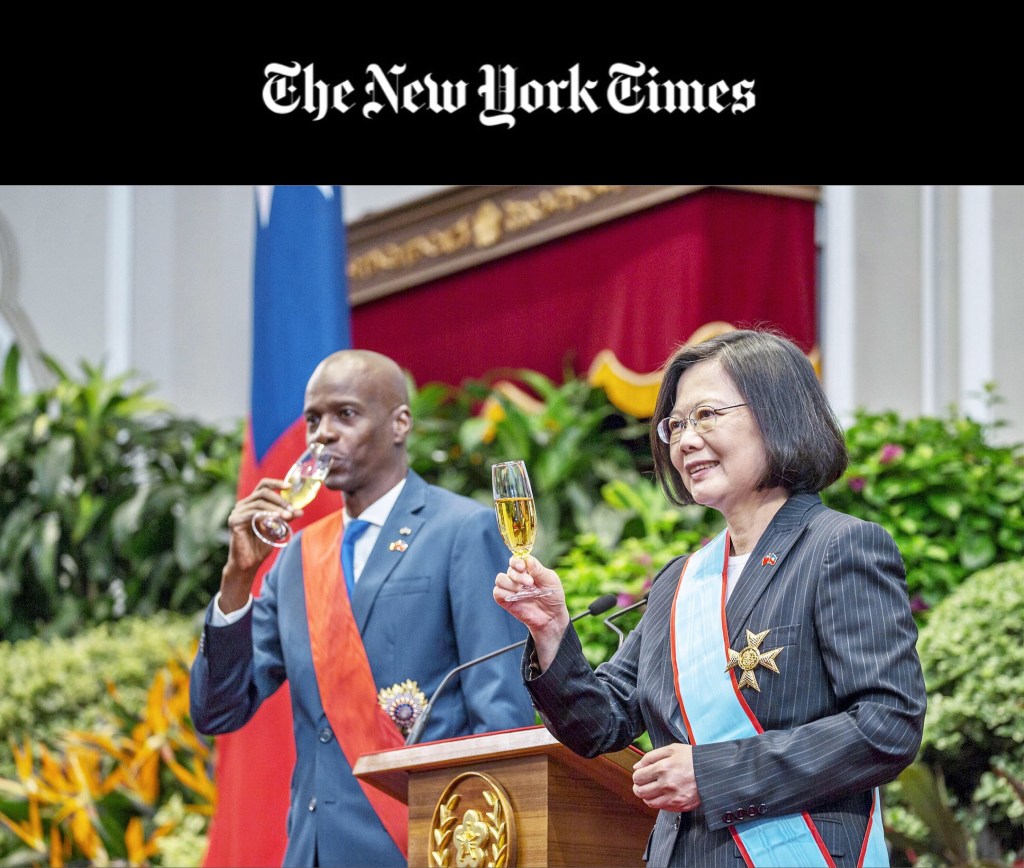
New York Times BREAKING NEWS – A day after a magnitude-7.2 earthquake killed an estimated 1,300 in Haiti, the country struggled to help the wounded despite a dire lack of doctors. Where is Taiwan? Tsai Government has full diplomatic relationships with Haiti! 紐約時報突發新聞 – 在海地發生 7.2 級地震後一天,估計有 1,300 人死亡,儘管嚴重缺乏醫生,該國仍在努力幫助傷員。 台灣在哪裡? 蔡政府與海地有全面外交關係!Sunday, August 15, 2021
The main airport of the city of Les Cayes was overwhelmed Sunday with people trying to evacuate their loved ones to Port-au-Prince, the capital, about 80 miles to the east.
With just a few dozen doctors available in a region that is home to one million people, the quake aftermath was turning increasingly dire.
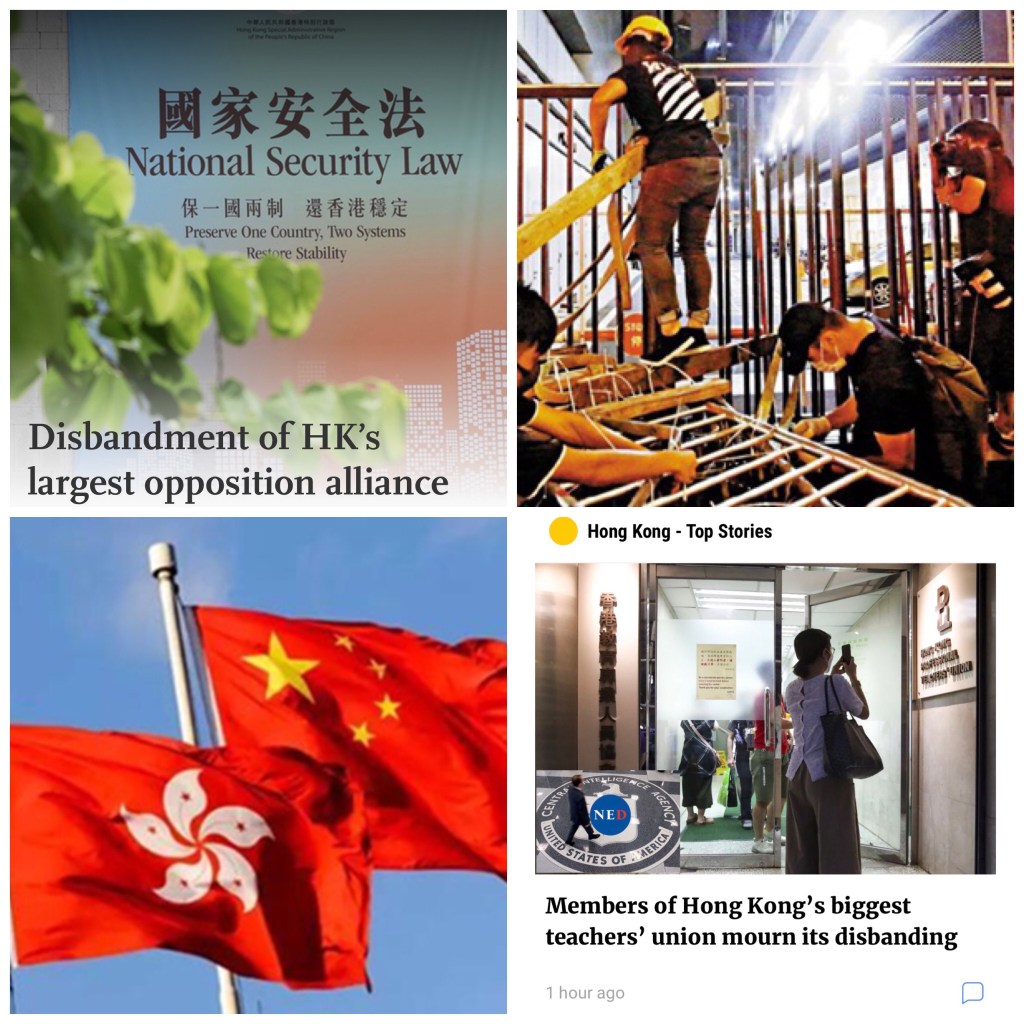
Disbandment of HK’s largest opposition alliance sounds warning to the rest of radicals by Chen Qingqing and Cui Fandi Aug 15 2021
Rioters damage facilities outside the headquarters of the Hong Kong Police Force in Wan Chai after a protest organized by Civil Human Rights Front on June 9, 2019.
Hong Kong’s Civil Human Rights Front (CHRF), the biggest opposition alliance in the city, announced in a statement that it will disband following a unanimous resolution, starting Sunday.
The dissolution, however, will not help them escape from their legal responsibility as the Hong Kong police would continue their probe of this anti-China group that has been provoking chaos and instigating anti-China sentiment for many years.
While the central authorities – the State Council’s Hong Kong and Macao Affairs Office and the central government’s liaison office in Hong Kong – hailed the result as highly expected, claiming that under the national security law for Hong Kong, any individual or organization that insists on an anti-China stance of provoking riots will have “no way to go,” experts in both Hong Kong and the Chinese mainland forecast that more radical opposition groups including the Hong Kong Alliance in Support of Patriotic Democratic Movements of China (known as Hong Kong Alliance), a journalist association and the Hong Kong Association of Falun Gong cult are likely to follow suit.
Meanwhile, the Hong Kong Police Force (HKPF) said in a public statement on Sunday that police are actively taking follow-up action on the CHRF’s violation of the Societies Ordinance, under which any unlawful society may face an imprisonment for three years, according to the local law in Hong Kong.
With palpable positive changes in the city’s political life under the national security law for Hong Kong over the past year, which effectively plugged the legal loopholes, it is time for the rest of the radical groups to reconsider their purposes and operations, as those acts challenging both the legal and political bottom lines will not be accepted and will always be held to account, experts and official warned.
Disbandment inevitable
The CHRF said in a statement published on Sunday noon that representatives of a handful of its member groups attended a meeting on Friday and had unanimously decided to dissolve with immediately effect.
The CHRF said that its secretariat can no longer operate because its convener Figo Chan Ho-wun is incarcerated over numerous cases. Since no one has indicated they will take over, the CHRF has no choice but to disband, according to the CHRF statement.
Chan is currently serving an 18-month jail term for organizing an unauthorized assembly on October 1, 2019 and is facing multiple charges.
Established in 2002 and as one of the key opposition groups in Hong Kong, the CHRF has been involved in many major anti-government events over the past few years such as the illegal “Occupy Central” in 2014 and the radical anti-extradition bill protests that turned into a months-long social turmoil, both of which were considered by experts as well-plotted attempts of “color revolution.”
In March, when reports said the CHRF was investigated by police for allegedly violating the law, many core member groups, including the Democratic Party and the Hong Kong Professional Teachers’ Union (PTU), scrambled to withdraw from the CHRF and clear their boundaries. Some of the key figures of the CHRF were also arrested for allegedly violating the national security law for Hong Kong.
The CHRF’s disbandment was inevitable, as it had a flawed registration, is suspected of being involved in money laundering, and has long been involved in radical activities that constantly damaged social stability and national sovereignty in Hong Kong, according to experts.
The CHRF has always been an illegal organization without even registering locally, and by using the excuse of “peaceful, rational and non-violent” protests, it has been colluding with various anti-China rioters in order to confront the central government and make troubles in Hong Kong, the spokesperson of the State Council’s Hong Kong and Macao Affairs Office said on Sunday.
At the moment of dissolution, the group has not yet shown any regret, continuing with the disguise of the so-called human rights, democracy and freedom in attempt to gain public sympathy and instigate public opinion. “Such a deathbed struggle is hateful, contemptible and ridiculous,” the spokesperson noted.
The liaison office of the central government in Hong Kong also listed a number of misdeeds of the CHRF over the past 19 years such as its opposition to Article 23 and to the high-speed railway, its plot of “Occupy Central” in 2014 and anti-extradition actions, turning protests into violence against the police, and attacks against passersby, storming the Legislative Council and advocating for “Hong Kong independence” by asking for the help of foreign consulates in Hong Kong.
“Despite claiming they are legal, peaceful and rational, they are completely the root of the chaos in Hong Kong,” the liaison office said.
The Return of Hong Kong
To be held accountable
The dissolution does not mean the CHRF will be exempt from criminal responsibility. The group’s principle personnel such as committee chairman, vice chairman, secretary and committee members who have participated in any CHRF decision to coordinate unlawful assembly or unauthorized assembly are personally liable, legal experts said.
In a statement the HKPF released on Sunday, the police reiterated that an organization and its member(s) remain criminally liable for the offence committed, regardless of the disbandment of the organization or the resignation of its member(s).
The HKPF said that the CHRF was an illegally operating organization, as it had never been legally registered since its establishment in 2002. Also, the police requested the CHRF to submit information of its members, activities and funding in accordance with section 15 of the Societies Ordinance in April. Yet the CHRF failed to submit the requested information to the Societies Officer within the designated period of time. The police are now actively taking follow-up action on the CHRF’s violation of the Societies Ordinance.
The HKPF must have collected evidence that the CHRF incited, aided, abetted, counseled or procured unlawful assembly or unauthorized assembly, Lawrence Ma, barrister and chairman of the Hong Kong Legal Exchange Foundation, told the Global Times on Sunday.
“Dissolution does not absolve criminal responsibility as the criminal law affixes liability on individual acts and conduct. The individual defendant cannot use a corporate shield to evade criminal charge,” he said.
According to the penalties on office-bearers of an unlawful society, any person managing or assisting in the management of any unlawful society shall be guilty of an offence and shall be liable on conviction on indictment to a fine at level 6, which equals to HK$100,000 ($12,848) and imprisonment for three years.
The CHRF’s disbandment came shortly after the Hong Kong Professional Teachers’ Union (PTU), city’s biggest teachers’ union which has been recognized as a de facto political body, announced its disbandment on Tuesday. The PTU is considered by some experts to be a major supporter behind the CHRF.
According to media reports, at least 13 organizations announced dissolution and canceled their accounts on social media platforms in late June and early July – around the first anniversary of the implementation of the national security law for Hong Kong.
By disbanding themselves, these groups are attempting to evade prosecution, Fan Peng, a research fellow at the Chinese Academy of Social Sciences’ Institute of Political Sciences, told the Global Times in an earlier interview. “Later, when the authorities monitor these organizations, it may be more difficult to dispose of personnel and assets because they have been disbanded.”
Consecutive announcements of the disbandment of a number of radical oppositions show that the national security law for Hong Kong has effectively plugged the previous legal loopholes in Hong Kong, establishing the bottom line for society, some experts said, noting that it is time for other radical organizations to evaluate their behaviors and the potential danger of those behaviors to society.
“The dissolutions one after the other sound a warning bell to the rest of the radical opposition groups, which have to draw a clear line from their past behaviors as it’s time for them to realize that if their purposes and operations go against national security, they would be definitely punished,” a Beijing-based senior expert specializing in Hong Kong affairs told the Global Times on Sunday on condition of anonymity.
To follow suit
While the national security law for Hong Kong has already ushered the city’s political life into a new era, and anti-China rioting forces no longer exist, local officials pointed out that with all these positive changes, Hong Kong will not be a hotbed for secessionist forces and radical opposition that aims to subvert power.
All organizations that are detrimental to national security and the stability of Hong Kong society should not continue to operate, Tam Yiu-chung, a Hong Kong member of the National People’s Congress Standing Committee, told the Global Times on Sunday.
More radical political groups that have been involved in secessionist activities may announce disbandment in the future given the legal risks they face, some experts forecast.
The Hong Kong Alliance is highly likely to announce disbandment soon, Lau Siu-kai, vice-president of the Chinese Association of Hong Kong and Macao Studies, told the Global Times on Sunday.
“The Hong Kong Journalists Association and the Hong Kong Association of Falun Gong cult may also follow suit,” Lau said.
The expert explained that these groups may have been in violation of the national security law for Hong Kong and local laws. “They will weigh the risks themselves and choose to disband. They do not want to be banned by the government, because it will be more detrimental to the group itself and its members,” he noted.
In order to ensure their cooperation with the government and maintain licensing as well as supervision, organizations like the Law Society of Hong Kong and Hong Kong Bar Association should stop being entangled in political disputes, Lau said.
 Johnson Choi Biz