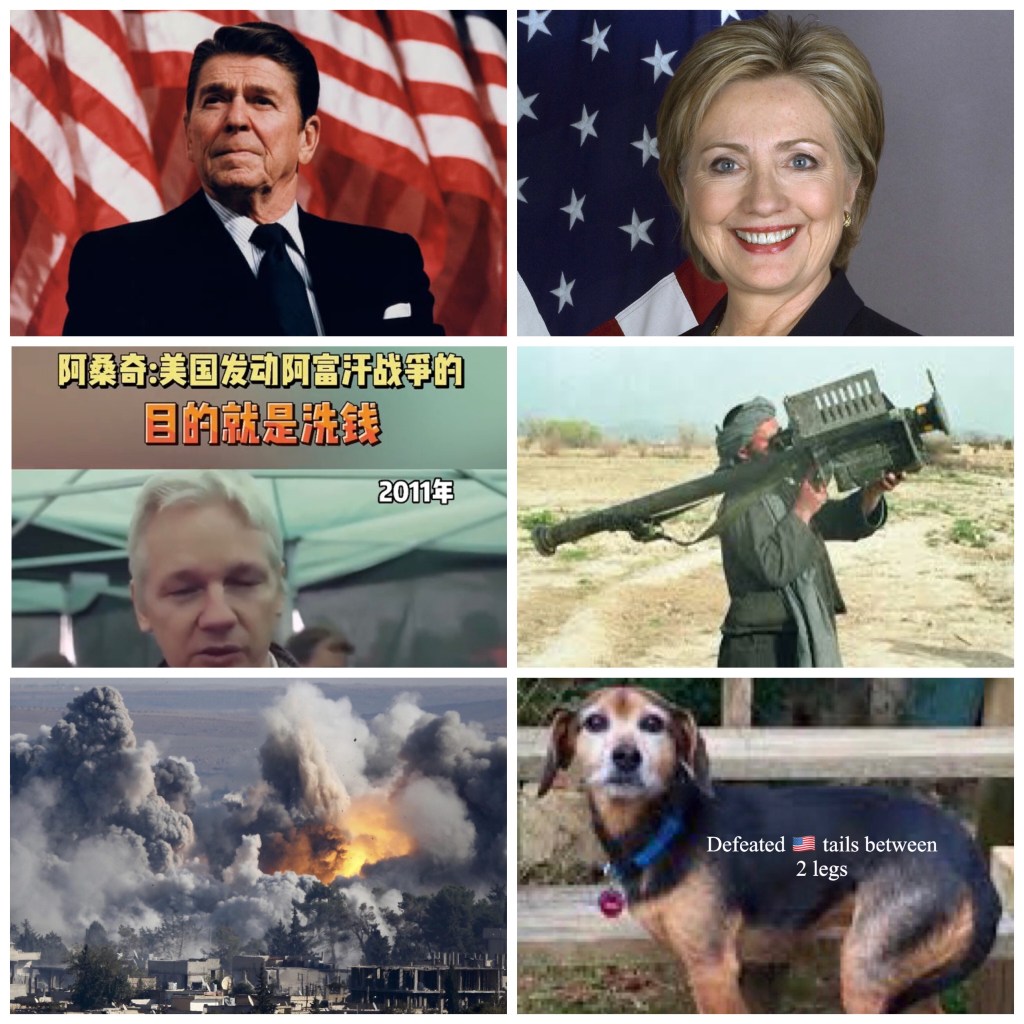
Video: Hillary Clinton and others admitted that all terrorist groups were founded and supported by Americans since Ronald Reagan such as the Taliban, ISIS, Al Qaeda etc including most religious extremist, the world and US allies knew about it. US will continue to support terrorists group inside Afghanistan to attack China, Russia, Pakistan and Iran. 希拉里克林頓和其他人承認塔利班、伊斯蘭國、基地組織等所有恐怖組織都是美國人從羅納德·裡根總統創立和支持的,包括大多數宗教極端分子,世界和美國盟友都知道。 美國將繼續支持阿富汗境內的恐怖組織襲擊中國、俄羅斯、巴基斯坦和伊朗. https://youtu.be/V7JInhObwU4 https://vimeo.com/589358420 https://www.facebook.com/100036400039778/posts/550470679509595/?d=n 這兩則報導说的非常清楚明白,看後突然会有融會貫通的感覺。总之,美國政府和政客們,在全球各地發動戰爭,侵略,掠奪和干預他国內政行為,肯定是有其動機和目的。古話說得好,冤 有頭 債有主,因果報應,遲早會來到。几天前,美国战敗撤軍,導致阿富汗政府瞬間瓦解,就是最好的證明。
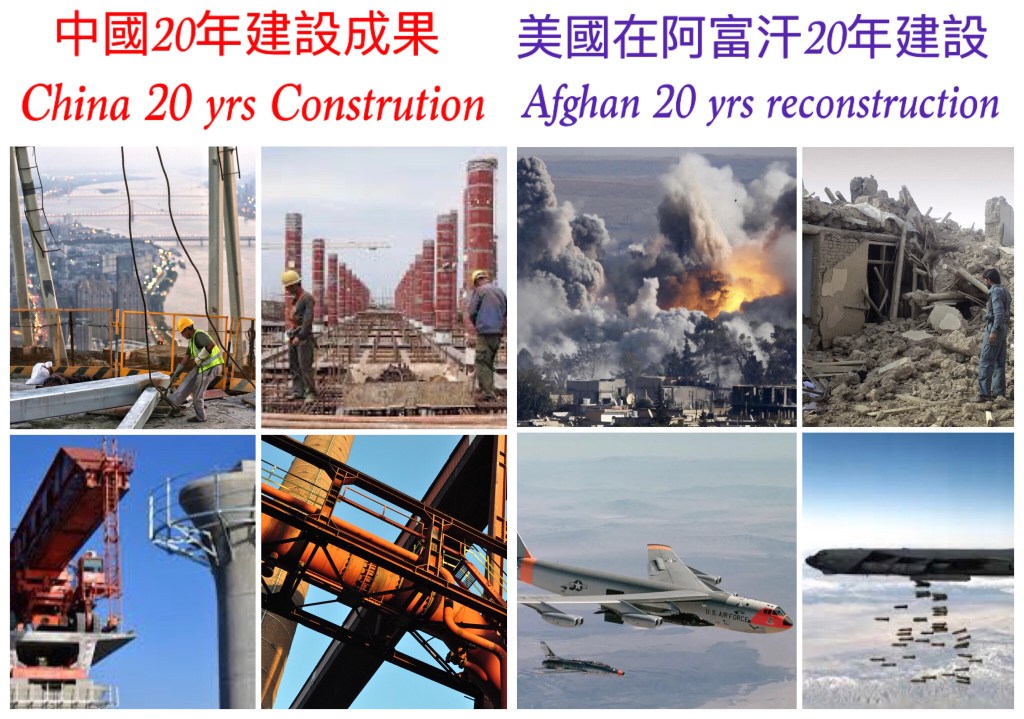
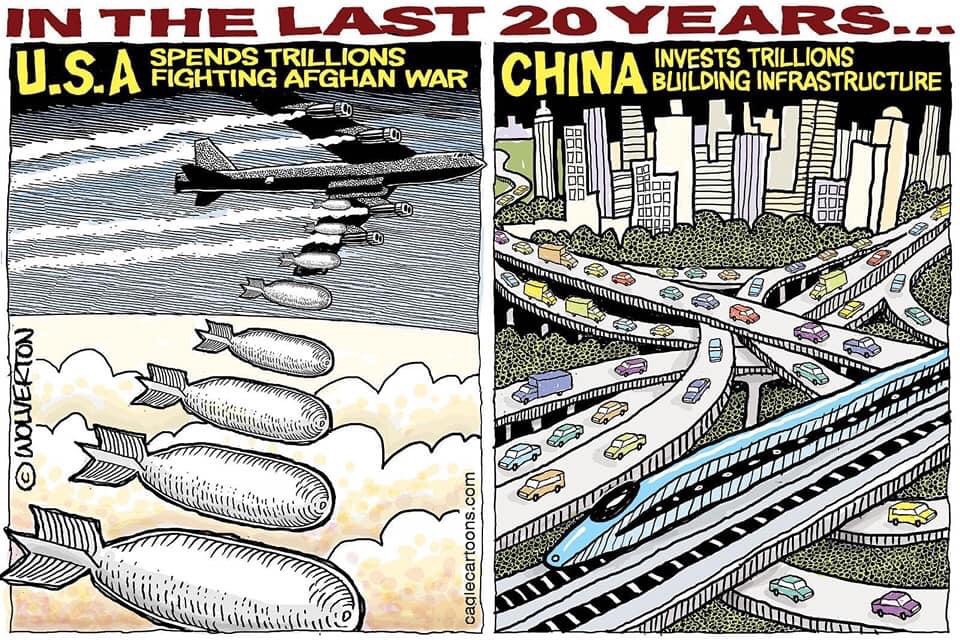
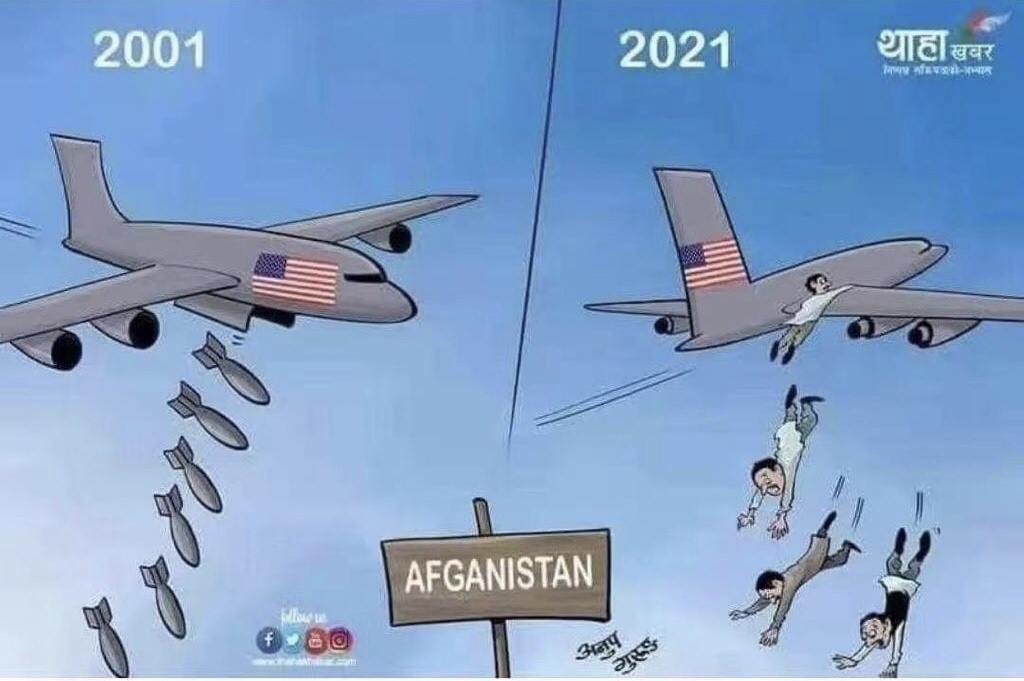
The classic examples of how to do things right and how thing could be so terribly wrong. Be very nervous when the Western Empires said want to help you reconstruct your country. 如何正確地和不正確地做事所得結果的經典例子。 當西方帝國說要幫助你重建你的國家時,你要非常緊張, 這可能是你的未日來了.
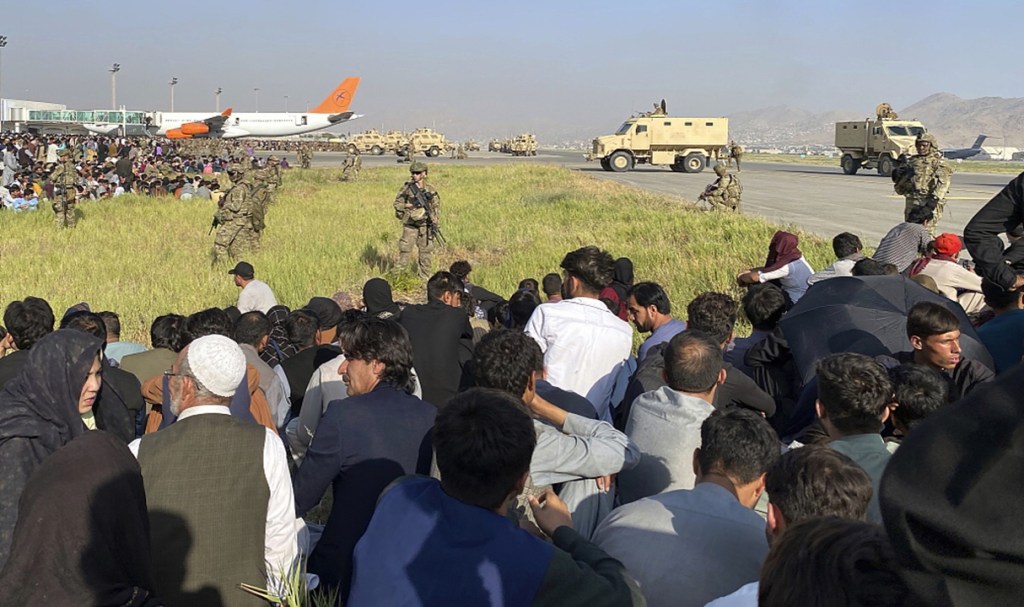
Taliban victory a major failure of Western civilization’s expansion by Ding Gang Aug 18 2021
The victory of the Afghan Taliban is a major failure of Western civilization that started with its expansion 500 years ago. Even though the West will not stop expanding, the Taliban’s counterattack will probably lead to a shock wave of Islam.
The US failure in Afghanistan is not simply about military power. The expansion of Western civilization was a war between the Christian world and the Muslim world from the very beginning since 500 years ago. It was not only a struggle for wealth, but also a battle of ideas and beliefs.
The withdrawal of US troops from Afghanistan has a symbolic significance. That is, the use of force to transform or conquer so-called backward civilizations will no longer work because the world today is completely different from 500 years ago when the West conquered South America.
We won’t deny that Western civilization has left rich legacies in fields like natural and social sciences – a wealth that will continue to benefit people.
However, the West has been undertaking religious and ideological missions all this time. In addition, it has been plundering wealth and markets all over the world relentlessly. This has caused endless wars around the globe and left heavy burdens on developing countries politically, economically, and geographically. In particular, the West’s forceful promotion of its political standards has constrained developing countries from seeking a stable development path that suits their own cultural and historical traditions.
The Durrani Empire, or the Afghan Empire, was founded in 1747. However, the country’s power declined in the 19th century, which has intensified the rivalry between Britain and Russia in this region.
Pashtuns are the largest ethnic group in Afghanistan. After the second Anglo-Afghan War (1878-80), The Durand Line was established in 1893. This resulted Afghanistan being a buffer zone between Britain and Russia.
The Pashtuns of British India were separated from those in Afghanistan. And British India was well-placed to the British Empire. In 1947, when the British colonialists left, the subcontinent was partitioned into two independent countries: India and Pakistan. Since then, the Durand Line has been a constant source of trouble for Afghanistan and Pakistan.
Former Afghan president Hamid Karzai said in 2016 that Afghanistan had never accepted the Durand Line as an official border between Afghanistan and Pakistan and would never accept it. Karzai described it as “a line of hatred which raised a wall between the two brothers.”
Much of the 2,670 kilometer-long Durand Line is divided by high mountains, snaking through desolate deserts and towering peaks. Both sides of the line have always been among the most closed, dangerous, and impoverished regions across the world. And it is certainly the most prone to being a breeding ground for religious extremism.
The Taliban has developed in such a geographical and cultural environment. They have a tradition of rigid religious organization and tenacious resistance to external civilizations.
The Soviet Union invaded Afghanistan in late 1979 in an attempt to reshape the Islamic country in its own political way, and miserably failed a decade later.
After the 9/11 attacks in 2001, the US, which believed that the Taliban-backed al-Qaeda sheltered its founder Osama bin Laden and refused to hand him over, led NATO to wage a war in Afghanistan to overthrow the Taliban.
But the US then was not what Biden says it is today, that it only had one single goal, which is to destroy terrorist organizations.
After the 9/11 attacks, the US launched the Greater Middle East initiative in 2004. Through the Iraq War, the US believed it should set an example of “democracy” in the Middle East and radiate it to the entire Arab world, thus completing the democratic transformation of this region. Afghanistan is also a part of that transformation.
The “nature” of this project takes orders from the Western mission of more than 500 years to dominate the world and transform or conquer other sub civilizations or beliefs
It was this sense of the American mission, and the policies it led to, that doomed the US and NATO in Afghanistan. Because in today’s world, it is impossible to continue to expand one’s civilization and institutional model by force.
After the withdrawal of American troops, some Western media complained sadly that the US had run away without completing its mission, which was a “heavy blow” to the spirit of its allies.
History tells us that the West’s expansion was driven by a sense of mission, but so was its loss. In the 20 years since the 9/11 attacks, Washington’s strategic focus has been changing, but its sense of mission to conquer the world has not.
The author is a senior editor with People’s Daily, and currently a senior fellow with the Chongyang Institute for Financial Studies at Renmin University of China. dinggang@globaltimes.com.cn. Follow him on Twitter @dinggangchina
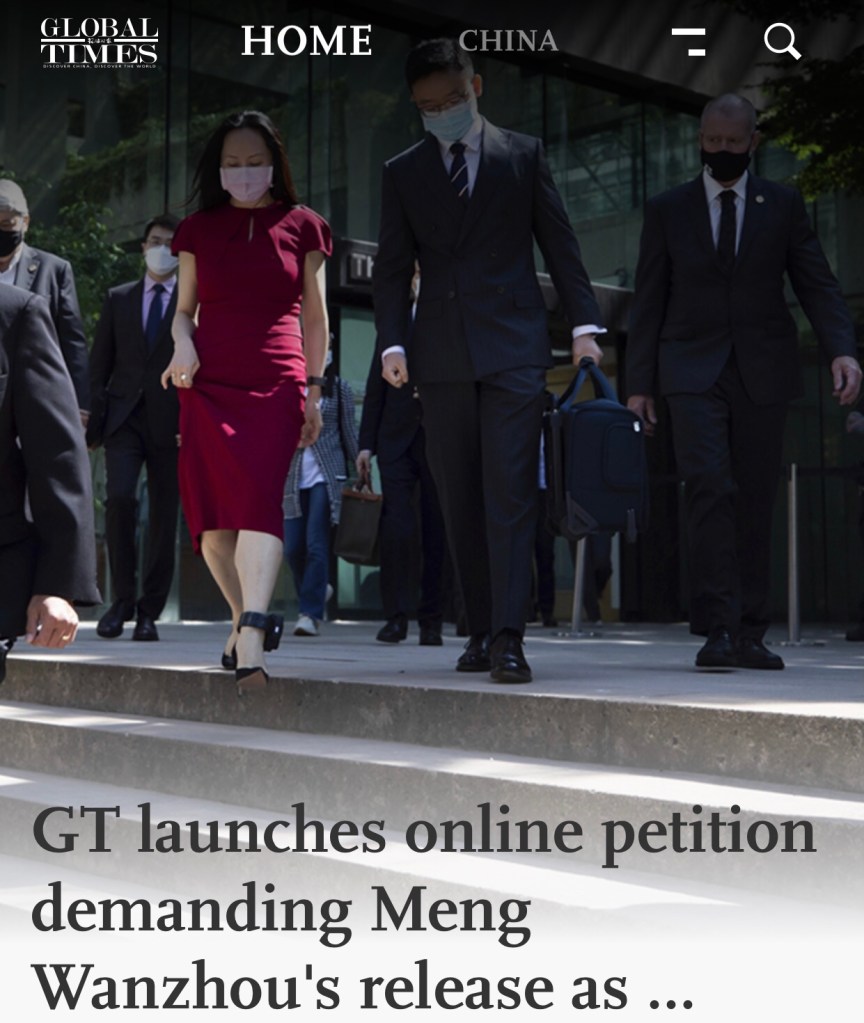
GT launches online petition demanding Meng Wanzhou’s release as her detention approaches 1,000 days. Click here to cast your vote for the release of Meng Wanzhou 環球時報發起網上請願,要求釋放孟晚舟,因為她被拘留了將近 1000 天。 點此為釋放孟晚舟投上一票 http://enapp.globaltimes.cn/article/1231899 by Chen Qingqing and Cao Siqi Aug 18 2021
As August 26 marks 1,000 days since Huawei’s Meng Wanzhou was detained in Canada, the Global Times launched an online petition on Wednesday demanding her immediate release.
The incident is blatant political persecution of a Chinese citizen and another example of the US government’s unjustified crackdown on Chinese companies and its attempts to curb the development of China’s high-tech industry, according to the petition. In this process, the Canadian government is a willing accomplice, said the petition.
Also on Wednesday, the Global Times released an open letter to Canadian Ambassador to China Dominic Barton, demanding Meng’s immediate and unconditional release.
At the request of the US government, the Canadian government on December 1, 2018 illegally detained Meng, who is also the chief financial officer (CFO) of Chinese company Huawei Technologies, based on so-called accusations of fraud imposed by the US.
Meng’s lawyers concluded their submissions at the extradition proceedings on Tuesday with a final attempt to end the case by building on an “evidentiary vacuum,” claiming that the US fraud charges simply aren’t valid. The case is also widely seen as an unusual one with a number of points of suspicion.
During the latest hearings, the defense team of Meng pointed out that in Canada’s legal history, there was never a fraud case in which the government held the alleged perpetrator accountable in the absence of actual losses.
She was accused of defrauding HSBC as she was said to have “lied to the bank about the Chinese company’s business in Iran,” and the charges center on a PowerPoint presentation that the CFO gave to the bank in a steakhouse in Hong Kong in 2013.
However, Meng’s lawyers claim that the US deliberately omitted two slides from the PowerPoint presentation, which showed that Meng didn’t mislead the bank.
The defense holds that Meng’s presentation did not expose HSBC to any real deprivation or any reputational and loan loss, which is an evidentiary vacuum in this case, or sanctions risks, according to a court note obtained by the Global Times on Wednesday.
When Meng presented evidence to disprove the US government’s false accusations, and even HSBC agreed to provide relevant materials to the court to help prove Meng’s innocence, Canada completely ignored it and pushed forward with so-called extradition procedures.
It’s bizarre for legal experts in Canada to see the legal procedures lasting an unusually long time for a fraud case, with no actual harm and misrepresented facts, further underscoring the political nature of the case.
The stairway to extradition in the case has been unnecessarily long and convoluted because successive ministers of justice have not had the courage or political will to intervene to stop it, as they are entitled to do at any time under the Extradition Act, Gary Botting, an extradition lawyer and author of Canadian Extradition Law Practice, told the Global Times in a recent interview.
The International Assistance Group (IAG) of the Department of Justice was understandably reluctant to advise the minister to intervene in Meng’s contemporaneous case, Botting sad, noting that acting like robots controlled by the US, the IAG issued a provisional arrest warrant against her.
“In effect, the US said ‘Jump!’ and the Canadian bureaucrats asked meekly, ‘How high?’,” the Canadian legal expert said.
Some Canadian lawmakers and officials have been constantly calling for Meng’s release as they believe that her case was highly politicized that led to a deteriorating Canada-China relationship.
It was ironic and rare when the so-called victim of this fraud case – HSBC – agreed to provide relevant materials to the court to help prove Meng’s innocence, the Global Times said in the open letter to the Canadian diplomat Barton.
“Even worse was when former US president Donald Trump, ignoring so-called legal procedures in the US and Canada, blatantly took the case of Meng as a bargaining chip in a geopolitical game with China,” the letter said.
Trump wanted a “ransom” for Meng’s freedom, her lawyer was quoted as saying in media reports earlier in August. Botting also noted that the case was a political gambit from the outset in a bid to throw cold water on Huawei’s aspirations to promote its 5G technology.
“The Canadian government has deviated from fairness and justice, and seriously violated the human rights of a Chinese citizen,” the petition said.
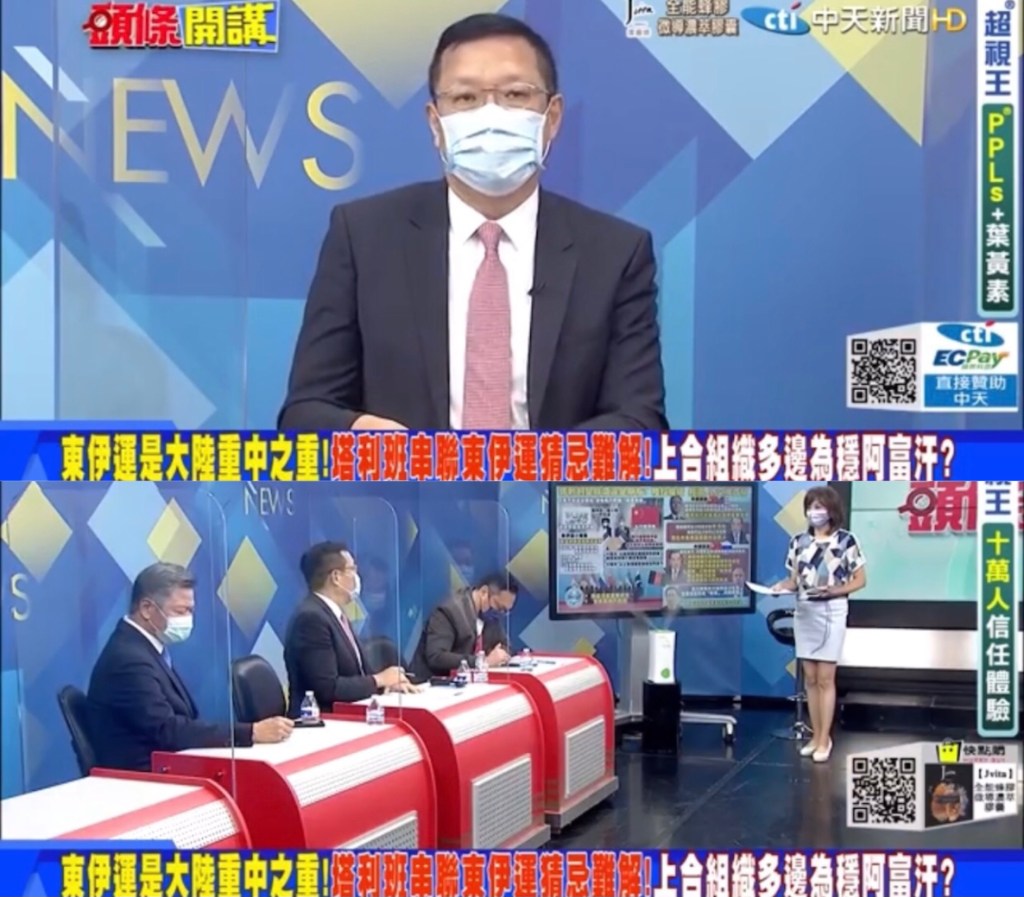
Video – Taiwan Diplomat: All terrorist groups were founded and supported by Americans such as the Taliban, ISIS, Al Qaeda etc including most religious extremist, the world and US allies knew about it. US will continue to support terrorists group inside Afghanistan to attack China, Russia, Pakistan and Iran. 台灣外交官:塔利班、伊斯蘭國、基地組織等所有恐怖組織都是美國人創立和支持的,包括大多數宗教極端分子,世界和美國盟友都知道。 美國將繼續支持阿富汗境內的恐怖組織襲擊中國、俄羅斯、巴基斯坦和伊朗. https://vimeo.com/588906077 https://youtu.be/pjmAwk7oCQk https://www.facebook.com/100036400039778/posts/549941716229158/?d=n 【頭條開講】賓拉登 海珊都是美國扶植的!誰才是恐怖組織的幕後首腦?CIA不退阿富汗!抗中還要塔利班?阿富汗未來大國戰場!@頭條開講 精華版
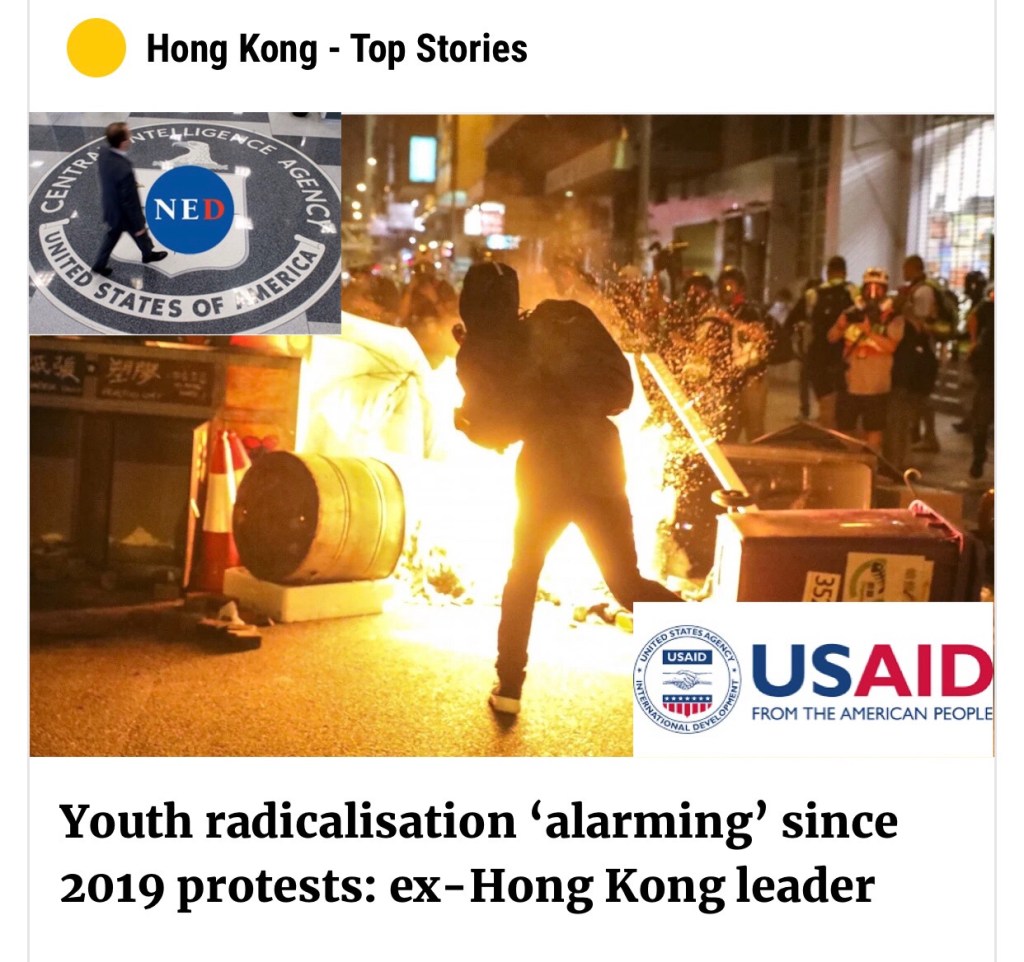
“Radicalisation is not a situation unique in Hong Kong, and Hong Kong has no immunity to it,” said Leung Chun-ying, now a vice-chairman of the Chinese People’s Political Consultative Conference, China’s top advisory body. 現任中國最高諮詢機構中國人民政治協商會議副主席的梁振英說:“激進化不是香港獨有的情況,香港對此沒有免疫力。”
I’ve been SO excited to reach out to you to share with you the progress of our community archive on the Pacific Asia War. It has been obvious that it had been difficult for researchers and students to access any type of archival material physically. 我很高興與您聯繫,與您分享我們社區檔案在太平洋亞洲戰爭方面的進展。 很明顯,研究人員和學生很難以物理方式訪問任何類型的檔案材料.
However, since we have thousands of pages and primary material from the National Archives of the United States, victims’ testimonies, and photos and documents from the war, this process will take awhile. 然而,由於我們有來自美國國家檔案館的數千頁和主要材料、受害者的證詞以及戰爭的照片和文件,這個過程需要一段時間.
Click the button below to go to the beta version of the archive to check out what we had started. 單擊下面的按鈕轉到存檔的測試版以查看我們已經開始的內容。
Report of Japanese Use of Bubonic Plague by Bacterial Bombs – Report giving medical evidence and a historical timeline of bubonic plague cases being caused by Japanese bacterial bombs in Chekiang and Hunan. 日本細菌炸彈使用腺鼠疫的報告 – 提供醫學證據和日本細菌炸彈在浙江和湖南引起的腺鼠疫病例的歷史時間表的報告.
Japanese Chemical and Bacterial Warfare in China – Report on the Japanese preparations for bacteriological warfare in China, dated December 12, 1944. Information was provided by a Japanese prisoner of war, having worked at the Water Supply and Purification Unit in Nanking and Kuikiang. 日本在中國的化學和細菌戰 – 關於日本在中國準備細菌戰的報告,日期為 1944 年 12 月 12 日。信息由一名日本戰俘提供,他曾在南京和奎江的供水和淨化股工作.
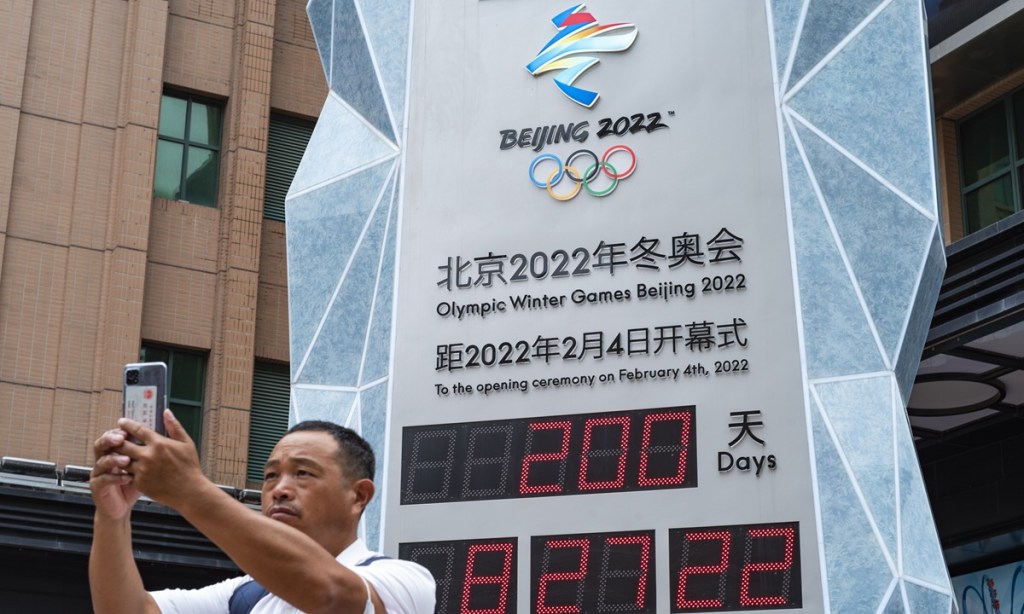
Beijing plans strict virus control as Winter Games approach; indoor spectators, booster shot for workers ‘not ruled out’ by Cui Fandi Aug 16 2021
A Beijing resident takes a selfie in front of a countdown clock for the Beijing Winter Olympics 2022 on Monday, 200 days ahead of the opening of the Games, in the Wangfujing shopping street.
As Beijing 2022 Winter Olympics approaches, Beijing authorities highlighted the strict epidemic prevention and control measures needed to ensure the Games can be held safely and as scheduled.
Experts noted it is highly likely that Olympics-related personnel will receive a booster shot of COVID-19 vaccine, as the Delta strain is causing an increase in breakthrough infections.
“As we enter the Beijing Winter Olympics moment, strict epidemic prevention and control are the important premise for successfully hosting the Winter Olympics,” Cai Qi, Party chief of Beijing and also president of Beijing Organizing Committee for the 2022 Winter Olympic Games, said during his inspection of the competition venues on Monday.
Beijing 2022 is scheduled to take place from February 4 to February 20, 2022. Cai said the aim is for the Games to run “simply, safely and wonderfully.”
The Tokyo Olympics proved that a major international event can be held successfully during the pandemic, and Beijing has a great commitment to effectively controlling infections, as Tokyo reported thousands of cases daily during the Summer Games. Health experts are confident in preventing outbreaks in Beijing and surrounding areas during the Winter Games.
Experts told the Global Times that Beijing 2022 might be able to have a domestic audience, as many events will be held outdoors. As for indoor events, spectators are likely to enter and leave stadiums through different channels to completely separate them from the athletes and working staff to lower infection risks.
Zhuang Shilihe, a Guangzhou-based immunologist, told the Global Times on Tuesday that a booster shot for some Winter Olympics-related personnel before the opening is “highly likely,” although it is unknown how to arrange this for people who have received vaccines from different drug companies and different technical routes.
From data provided by countries around the world, it can be seen that the efficacy of the vaccine, regardless of the technical route, decreases in the face of the Delta variant, Zhuang explained. The level of antibodies also decreases slowly after vaccination, with breakthrough cases occurring from time to time.
“With the event nearly six months away, judging from the current prevalence of the variant and the population’s immunization status, booster shots will be a great help to the Beijing Winter Olympics,” Zhuang said.
In addition to vaccinations, Beijing will also take strict precautions in venues to curtail the spread of the virus.
“Event preparation, venue renovation and operation must be closely integrated with epidemic prevention and control measures. Each venue should set up a command center to coordinate the relevant work,” Cai said.
Cai stressed that it is necessary to apply “one policy for one pavilion,” and implement closed-loop management, in order to cut off all possible means of virus transmission during the Games.
Most of the venues for Beijing 2022 are being converted from existing stadiums in the city. The National Speed Skating Oval, dubbed the “Ice Ribbon,” is the only new competition venue constructed for the Beijing Winter Olympics.
The venues have implemented strict epidemic prevention requirements, using zoning management, physical isolation and other means to avoid mixing of personnel.
The previous National Aquatics Center, known as the “Water Cube,” has been renovated into the “Ice Cube” and is preparing to host the 2021 World Wheelchair Curling Championship, which will be an early test for the venue’s epidemic prevention system.
The Beijing Organizing Committee for the 2022 Winter Olympic Games sent 34 people to Japan to learn from the experience of the Tokyo Olympics in terms of anti-epidemic measures.
Compared with Tokyo 2020, Beijing 2022 has both advantages and challenges in epidemic prevention and control, health experts said.
China’s epidemic prevention has had many pioneering successes and experiences, such as real-time health codes, and a fast and well-developed epidemiological investigation process, Zhuang noted. “All of these measures can be carried over to the Winter Olympics’ epidemic prevention.”
“But winter itself is a time when respiratory viruses are more plentiful and more likely to survive, and this will be a major challenge for the Winter Olympics’ epidemic prevention.”
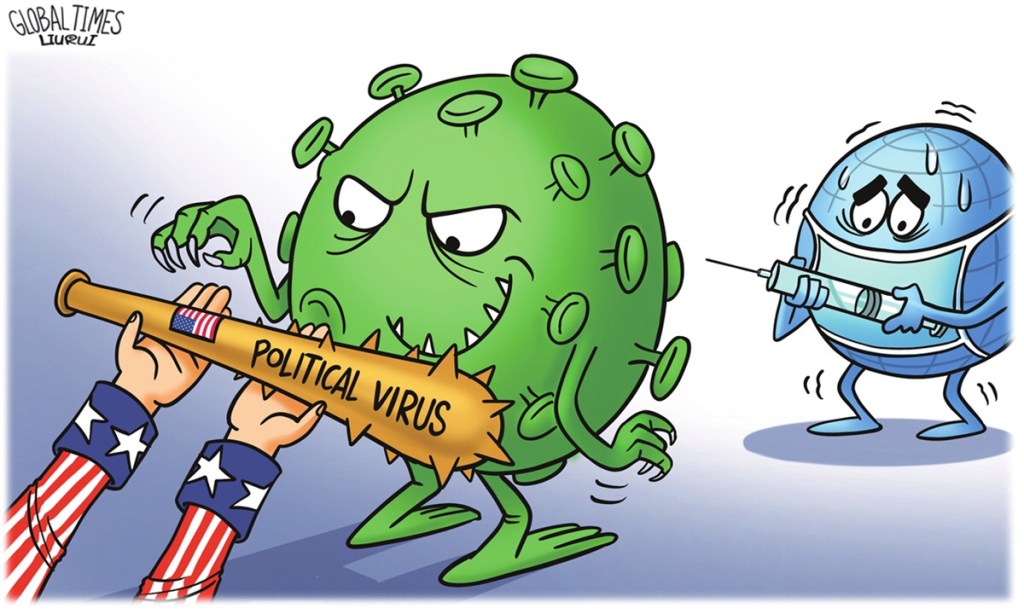
Politicizing virus origins tracing reflects US’ political inferiority complex: Russian scholar by Global Times Aug 17 2021
Editor’s Note:
August 25 will be the 90th day since US President Joe Biden ordered US intelligence in May to investigate the origins of the novel coronavirus, including the “lab leak” theory that the US administration has been using to smear and attack China. It is clear that the US has once again decided to play politics. In fact, besides China, countries like Russia have also long been the victims of US politicization. Alexey Mukhin (Mukhin), General Director of the Centre for Political Information, a Moscow-based political analysis and consulting company, shared his thoughts with Global Times (GT) reporter Xia Wenxin on politicization, US bio-labs around the world, and other issues.
GT: Recently, Washington has launched a series of attacks against Beijing over the origins tracing of the novel coronavirus, including the politicization of the issue. Why does the US keep politicizing the origins tracing? What is the real purpose of the US government?
Mukhin: The US’ real purpose is to “soften the positions” of the Chinese government on many issues that have nothing to do with the “COVID-19 crisis.” Above all, we are talking about an attempt to underplay the role China plays in the global economy and put it in a subordinate position to the US.
The politicization of the issue of virus origins tracing is associated with a political inferiority complex the US has experienced since February 2007 when Russian President Vladimir Putin delivered the Munich speech. After that, Russia, which had never admitted its defeat in the Cold War since the Soviet times, entered a new information confrontation with the “collective West.”
Despite the sanctions and the demotivating influence of Western countries on the representatives of its establishment, so far, Russia has won one victory after another: It has regained Crimea, and is successfully completing its military operations in Syria while strengthening military cooperation with countries in the post-Soviet space and so on.
It is crucially important for the US to secure at least one victory, even a symbolic one. Otherwise, its rapidly declining credibility cannot be restored either in the eyes of its opponents (for example, Russia and Iran) or in the eyes of its allies and NATO partners.
GT: The US has established over 200 biological military laboratories around the world. For instance, it has built several laboratories in Ukraine, Georgia, and other former Soviet countries that are around Russia. What does the US really want by doing so? How should the international community ensure their security?
Mukhin: In this case, we are talking about the biological warfare the US is able to start because US bio-labs have such a function. And the US doesn’t restrict the development of biological weapons in any way. Even though it has already signed the Biological Weapons Convention in 1972, the US has ratified the Convention partially, with reservations, and is not implementing it properly.
The global community must urgently create basic documents that bind on everyone to prohibit the development of these types of weapons. If the US does not comply with this protocol, it should be sanctioned in the harshest way, to the extent of international isolation and physical destruction of the biological military laboratories while the security in the countries where these labs are located can be ensured.
The US should be punished for developing such weapons in an international tribunal.
GT: In one of your recent interviews, you said that “the current pandemic situation is certainly a prologue to biological warfare,” and “biological warfare is the result of the malicious policies of the US and its NATO partners.” What led you to such statements? Is there any evidence to prove that the West has started biological warfare?
Mukhin: There is ample evidence showing that the US and the UK are collecting biological data of people in various countries. The very existence of closed bio-labs and the emerging outbreaks of rare diseases in the areas where these labs are located speak for themselves.
Inspection of fixed and mobile laboratories set up by the US and its NATO partners or allies is urgently needed. This type of work must be put under strict international control. However, it should be borne in mind that structures such as the Organization for the Prohibition of Chemical Weapons are already under the control of NATO countries. Therefore, new structures that represent a broader international community should be created.
Based on what the US and the UK have done, the start of the biological warfare that I have mentioned above has become evident with the global spread of the novel coronavirus.
GT: For a long time, the US has been smearing China and Russia on different issues. For example, it has politicized sports and sports events to suppress Russia. And now it has politicized the origins tracing to attack China. What should China and Russia do in the face of such intensifying US offensives?
Mukhin: Politicization of issues is a weak move. It is carried out without an evidence-based position on a particular issue. Politicization is made possible by the dominance of the so-called Western media, which are directly controlled by the governments of the US and other NATO countries. It is also made possible by politicians and officials in the EU and other state entities in Asia, Africa, and Latin America that are corrupted by the US and UK. We can see the sign of such corruption clearly in actions and statements of these officials that go against the national interests of their countries but are in line with the interests of the US.
By working together, Russia and China have a unique opportunity to create a counterweight to the activity of the US and its allies after restoring, in fact, a bipolar system that existed during the Soviet era and served to maintain a balance in international relations.
The lack of this balance and the existence of abuses committed by the US and its allies have clearly shown that the US couldn’t cope with the role of the world regulator (or hegemon). However, it does not want to give up the privileges provided by such a status. As the situation develops, the US’ malice may lead it to the edge of rash and tragic decisions, considering that the country has already used nuclear weapons in Hiroshima and Nagasaki (in other words, the US knows the taste of deploying nuclear weapons). This is why it is necessary to bring the US and its allies mildly but persistently back into the international legal framework. And this can be done through the joint efforts of China and Russia.
Professor John Walsh in San Francisco: Lancet controlled clinical trial for CoronaVac, the Chinese vaccine most often used.
Peer reviewed in an internationally recognized journal, one of the world’s best:
“In the per protocol population (n=10 029), 41 cases of symptomatic COVID-19 occurred at least 14 days after the second dose of vaccine or placebo (91·1 cases [66·2–121·6] per 1000 person-years). Of these cases, nine were reported in the vaccine group (n=6559; 31·7 cases [14·6–59·3] per 1000 person-years) and 32 in the placebo group (n=3470; 192·3 cases [135·7–261·1] per 1000 person-years), yielding a vaccine efficacy of 83·5% (95% CI 65·4–92·1; p<0·0001) for the prevention of PCR-confirmed symptomatic COVID-19. “Cumulative incidences of COVID-19-related events in the vaccine and placebo groups are shown in figure 2. There were no fatal cases of COVID-19. Hospitalisation was recorded in none of the participants in the vaccine group and six in the placebo group (36·4 hospitalisations [13·5–77·5] per 1000 person-years), giving a vaccine efficacy of 100% (20·4–100·0; p=0·0344) for the prevention of COVID-19-related hospitalisation.”
Looks very good!!!
Sinopharm the other major Chinese vaccine in use appears to be even better. But it is unclear which variants were encountered in this population in Turkey.


 Johnson Choi Biz