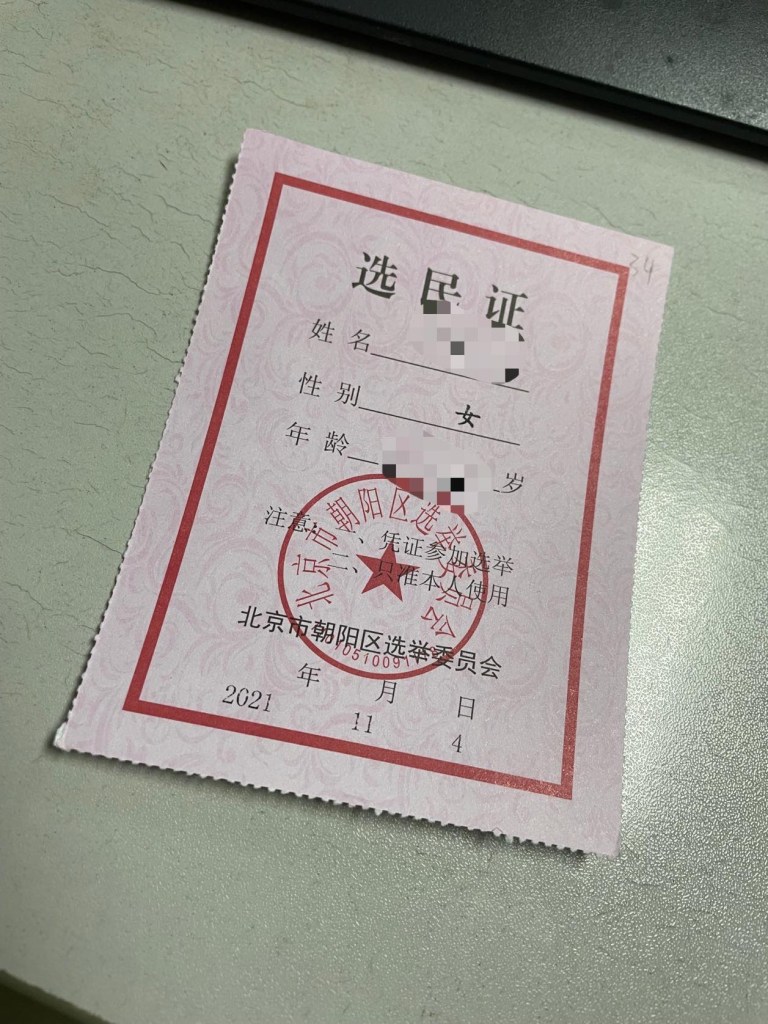
Who said China has no democracy! Rita Bai in Beijing: Got my voter card today as Beijing is electing deputies to the district-level people’s congress, not familiar with China’s political system, individual citizens directly elect deputies to the people’s congresses at the city/district levels 誰說中國沒有民主! 今天拿到選民證,因為北京正在選舉區級人大代表,不熟悉中國的政治制度,公民個人直接選舉市/區級人大代表.
this is a good (2 min) video by Political scientist Mark Triffitt, explaining why Western “democracy” is outdated and can’t work, is inapplicable to China, and why China’s system of democratic centralism with its intense, recursive process of feedback and consultation is the future of good governance. https://www.youtube.com/watch?v=KZAx8bJkruU
Triffitt also points out the stupidity and hypocrisy of trying to “export” the US’s failed “liberal democracy” to other countries:“Jawboning China to adopt more democratic practices likewise reflects the same bizarre tendency among many of America’s political and policy elites to promote what are damaged goods at home as being somehow “ripe for export”.” https://theconversation.com/us-democracy-trumps-all-as-a-dysfunctional-disgrace-52858 This failure is the failure of the Western Liberalism itself (note its 7 rearguard actions as it retreats in ignominy): The biggest barrier to understanding Western liberalism’s regression is liberalism itself. Liberalism does not seem to be, nor sees itself, as an ideology. There are no goose-stepping armies or Little Red Books. Yet it is ideology because it presents a totalising view of the world. Only its political and economic systems can deliver universal progress, harmony and happiness. The problem with ideologies is they convince us—their adherents—to believe they cannot fail. This leads us inevitably to blame failure on leaders, not the delivery system. https://meanjin.com.au/essays/the-wests-age-of-retreat/ More detail on how and why Liberalism failed:“While liberal market crises as well as malaise within liberal democratic systems have been manifested before, this thesis argues that post-1990s dysfunctions go beyond mere statistics and other descriptive information that relate to specific problems occurring within both systems. The overall crisis for 21st century liberal systems is unprecedented because they derive from a basic, systemic inability on the part of both systems to decipher the de-linear world around it. Thus the unprecedented and intractable nature of the overall crisis is shaped by liberal systems being fundamentally unsuited for the world they are hegemonically charged with ordering. The unprecedented nature of the crisis is further shaped by the incapacity of the liberal order to understand and acknowledge the systematic nature of its systems’ problems, thus rendering it unable to strategically address them… This thesis has highlighted China’s contemporary political and economic development – arguably the most significant development in the world economy and polity over the last two decades – for two reasons. First, to further demonstrate how the dynamics of political and economic activity have become intensely delinear by positing China’s recent development at the heart of Radical Modernity and second, to demonstrate liberalism’s growing inability to understand the nature of China’s development in a way which speaks to its growing incapacity to explain the 21st century political and economic world overall. According to liberal theory and discourse, China is an exception writ large. On the one hand, liberal theory and discourse argues that without liberal democracy to support its liberalising economy, China must inevitably collapse. Yet this line of arguments runs counter to the other dominant discourse regarding early 21st century China that asserts that China is carving out a new and unique direction in managing political and economic activity which is more strategic and superior to that of the liberal West. These accounts are not only incorrect in the sense that they provide a highly un-nuanced and empirically challenged view of China’s development. They are also conceptually unsustainable. The unprecedented size, speed and complexity of its transformation into one of the worlds’ most dynamic and largest political economies means that China, by definition, cannot be an exception. https://minerva-access.unimelb.edu.au/handle/11343/39778 https://minerva-access.unimelb.edu.au/bitstream/handle/11343/39778/311453_Mark%20Triffitt%20PhD%20thesis.pdf?sequence=1&isAllowed=y
GT Exclusive: ‘I’m lucky to be alive.’ Xinjiang police officer recalls 56-day manhunt for terrorists in mountains “我很幸運能活著。” 新疆警員召回山區追捕恐怖分子56天by Wang Wenwen and Fan Lingzhi in Aksu, Xinjiang Nov 05 2021
The dazzling sunshine in late September shines upon the craggy foothills of the Tianshan Mountains. The unique natural landscape is undoubtedly attractive to hikers, but to Xinjiang police officers who have shed blood on the land they love, the place carries special significance.
“Even breathing is a fortune for me now,” said Dilxat Mutallip, a Xinjiang police officer who was almost shot to death by a terrorist during a manhunt mission.
Dilxat still remembers every detail of the hard-won battles against the brutal terrorists in 2015. Eventually, a total of 28 terrorists were killed and one surrendered. During the attack and manhunt, 11 civilians and five police officers were killed, and 18 were injured.
Authorities have given official account of the terror attack that year. But apparently, Western media outlets were not satisfied. They were reluctant to acknowledge that those brutal attackers were indeed terrorists – a New York Times article, when reporting on the attack, described them as “armed with ‘only’ knives.”
When reporting on China’s counter-terrorism efforts, Western media have played on double standards and tried to undermine China’s efforts. But what they’ve rarely known and what has rarely been told are the sacrifices of the police officers and their deep affection for their homeland.
Xinjiang, the frontline of China’s counter-terrorism efforts, has seen no terror attacks in almost five years, as police officers like Dilxat hold onto the faith and the spirit of their deceased colleagues and safeguard the northwest territory of the country.
56-day battles
In the early morning of September 18, 2015, a group of terrorists, wielding knives, struck a coal mine in the remote area of Baicheng county, Aksu prefecture, killing security guards and miners. It was one of the deadliest acts of terror in Xinjiang in recent years. Then the terrorists fled into the craggy foothills of the Tianshan Mountains.
Characterized by oddly shaped rocks, rough pinnacles, rugged cliffs and deep ravines, the mountains served as natural shelter for terrorists. What was worse, with guns in hand, the terrorists were familiar with the environment on the mountains and good at trekking the mountain path. Tens of thousands of police forces and locals were mobilized to search for them within 1,300 square kilometers on the mountains. Surrounded by danger, they were liable to encounter a life-or-death battle at any time.
Dilxat received the order to enter the mountains and join the manhunt a few days after the deadly terror attack. Embarking on the path that was not friendly on horseback either, Dilxat and his colleagues prepared some food and supplies and mounted their horses. One of the horses just fell off the mountains in front of him on their ascendance.
Then they met a group of colleagues descending the mountains. Some of them carried the remains of two dead police officers who had been killed by the terrorists during a clash a few hours after the attack. Six terrorists were shot dead by the police.
“We often saw from news sources that police officers sacrificed their lives during their operations. But when it had just happened to someone you know, the feeling was different,” said Dilxat.
With deep sorrow and the determination to seize the terrorists, Dilxat continued climbing the mountains to join the team.
It took several days for the police to trace the whereabouts of terrorists, as the footprints were either obscured or pointed in the wrong direction. Dilxat would engage in clandestine operations in a certain spot for a whole week. Meanwhile elsewhere, troops rappelled from helicopters and border guards patrolled on horseback.
The turning point was the death of Mamatjan Tohtiniyaz, then deputy director of the Public Security Bureau of Aksu prefecture.
On October 13, 2015, Mamatjan happened to learn from a herdsman that the terrorists might have been hiding in a big cave under a precipice. He led a few police officers and herdsmen to approach that cave.
Unfortunately, the herdsmen lost contact with them and were abducted by the terrorists. While Mamatjan looked for those herdsmen, he was attacked and also abducted by the terrorists.
“The herdsmen are innocent. Release them! Aren’t you looking for the police? I’m the police!”
These were the last few words by Mamatjan, according to media reports.
Mamatjan tried to persuade the terrorists to surrender. He was tortured and killed by the terrorists, in a way so horrific that even Dilxat prefers not to recall.
“Extremely cruel,” Dilxat told the Global Times.
Qadirya Mamatjan, the elder daughter of Mamatjan, told the Global Times that she was alarmed when she saw her father’s remains.
“He was so skinny that I almost couldn’t recognize him,” said Qadirya as she burst into tears. “I couldn’t believe that in modern society, some people were brutal to such an extent.”
Mamatjan’s death pointed toward the whereabouts of terrorists. A number of 40 policemen were deployed to search around the area where he was killed. Around 10 days later, local herdsmen found several pairs of drying shoes near a cave suspected to belong to the terrorists. They informed the police right away. Dilxat and other fellow policemen were sent out there to apprehend the terrorists.
Only when he got there did he realize that the place where the 13 terrorists had been hiding was not a cave in the literal sense. A huge 10-meter-tall stone stood parallel to a cliff and the terrorists hid behind a blind angle by the huge stone, which made them difficult to spot.
The confrontation between the terrorists and the police lasted for 24 hours. The police threw tear gas and flash bombs into the cave, but still couldn’t force the terrorists out.
“I shouted and asked the terrorists not to act as cowards, while they cried out jihad slogans. They also dug for the whole night, trying to shore up their defenses. Since they had guns, we didn’t rashly move in,” recalled Dilxat.
On the early morning of October 28, 2015, Dilxat and his colleagues decided to launch an offensive. Eventually, all the 13 hiding terrorists were shot dead.
“Only then did our fury, stemmed from the death of director Mamatjan and the other colleagues, get released somehow,” said Dilxat.
Still, a number of terrorists fled into the deeper hills. The search continued. The last battle occurred on November 12, 2015, a day Dilxat will never forget.
On that day, some old footprints were founded. Dilxat and four other police officers received the order and searched for that area. Dilxat was about to check some trash thrown under a pine tree, but just as he stepped onto it, he was shot.
He suddenly fell to the ground, which he described as a “tactic response.” He then realized that he had been shot by a terrorist. He felt the blue sky gradually became dark like a closing curtain.
“I lay for 10 to 20 minutes, and my colleagues thought I was dead. But suddenly I sat up, and fired toward the direction from where I had been shot at,” Dilxat said.
Dilxat heard his colleagues and the terrorists exchange fire. He fell to the ground again, and asked one of his colleagues to move him to one of his sides.
“Then, I started to feel the blood running in torrents from my shoulder. I was thirsty, and what I only wanted to do was to sleep,” said Dilxat.
He was eventually airlifted by helicopter by eight fellow policemen. The day he battled with death was also the day of victory of the 56-day battles against terrorists – all the 28 terrorists were shot dead, and one surrendered.
Untold sacrifices
It was the victory of one of the toughest counter-terrorism battles in Xinjiang. For Qi Feng, a team leader at the Aksu Public Security Bureau, he felt grieved each time he entered the foothills, as it reminded him of deceased colleagues. For Ali Ibrahim, a herdsman who helped the police trace the footprint of the terrorists, he still has lingering fear.
For Dilxat, it meant the start of the more-than-one-year struggle with physical pains. The bullet shot by a terrorist punctured his left arm and left chest, fracturing three of his ribs. While one rib punctured his left lung, he underwent an operation to excise half his left lung. His left hand lost tactile sensation as well. To recover, he had to take medicines and undergo physiotherapy every day. “The doctor injected some kind of red liquid medicine into my body, which I could feel running toward my head and my toes. It really hurt,” said Dilxat.
Beside that, during that period, he had to take shock therapy to get his left hand to work – two pinheads would be plunged into his left arm to generate electricity in between so that his left hand would move. “If I didn’t persist, my hand would have been paralyzed,” said Dilxat. “You have to struggle with yourself.”
He said that when one dons the police uniform, it means he has to be dedicated, especially in places like Xinjiang.
“If my generation does not take on the responsibility, the future generation may not enjoy true stability and peace. When needed, we are always ready,” said Dilxat.
For Qadirya, daughter of Mamatjan, she used to have complaints about her father. There was no family photo, because her father was too busy to take one. The only family photo hanging on the wall of their home now is a composed one. There were countless times that the family needed him, but the only thing in his mind was work. She had not expected that she would never see her father again when he just told them that he was to go for a “business trip.” Till now, Qadirya did not tell her grandma how her beloved son really died.
Perhaps the best way to remember one’s father is to become like him. Qadirya was a teacher previously, but after her father’s death, both she and her younger sister decided to join the police force. Her younger sister, who was then studying at an agricultural university, later transferred to a police college. Now Qadirya is a police officer with the Aksu Public Security Bureau.
“I used to think that my father became the hero of the region and the country, but he left the family behind. Since my father’s death, there has always been a fire in my heart that prompted me to contribute to counter-terrorism and maintaining the stability of Xinjiang,” said Qadirya. “Now I’m a policewoman, and I understand him.”
China could do it focusing on benefiting entire nation and all 56 races. America called United States but not united at all except against People of Color, focus only on individualism nor sharing common values. Worst when US controlled by less than 1% of the elites and Military Industrial Complex and the country runs by lawyers, not engineers, expect endless infighting and chaos. America worst enemy is herself. 中國可以專注於造福整個國家和所有56個種族。 美國根本不團結,只關注個人主義,除了歧視有色人種外, 沒有分享共同的價值觀。 最糟糕的是,當美國由不到 1% 的精英和軍事工業綜合體控制,而這個國家由律師而非工程師管理時,預計會出現無休止的內鬥和混亂。 美國最大的敵人是她自己.
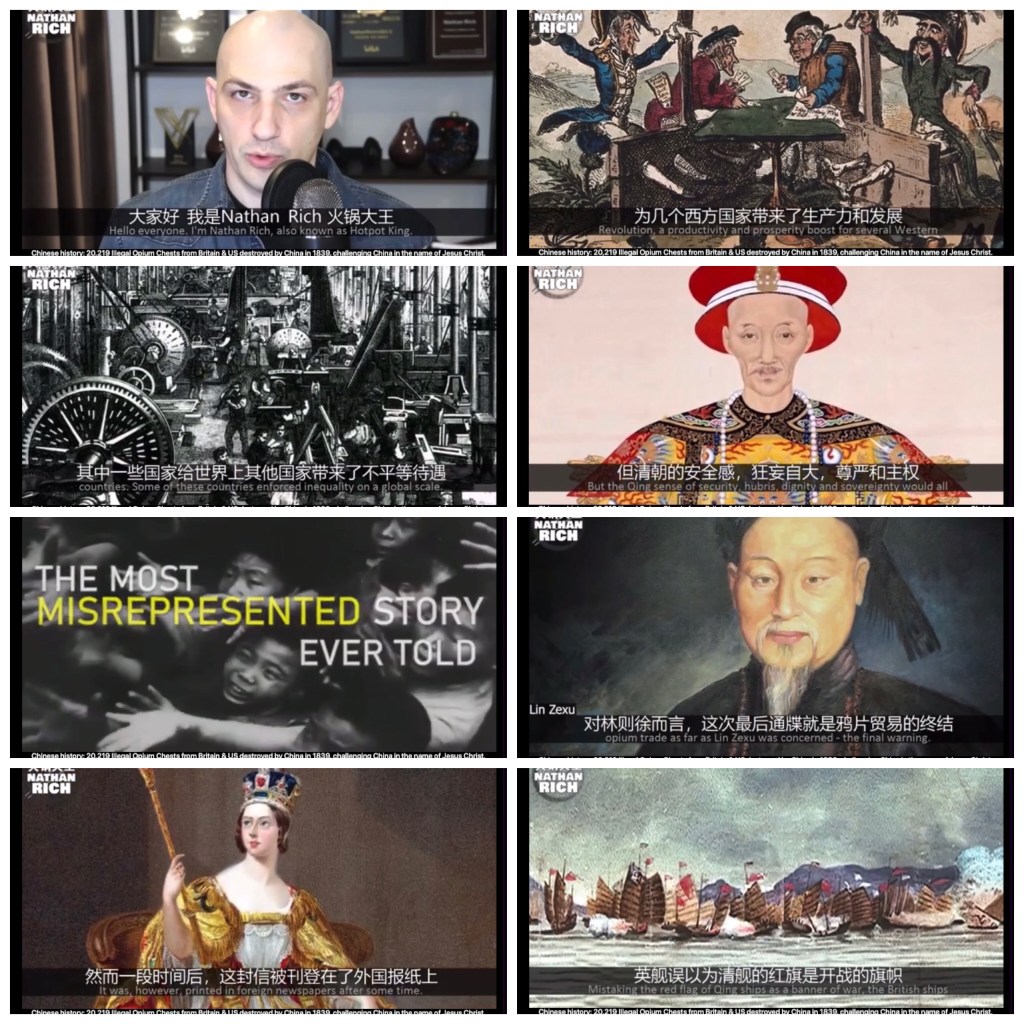
Video: Chinese history: 20,219 Illegal Opium Chests from Britain & US destroyed by China in 1839, challenging China in the name of Jesus Christ. 中國歷史:1839年中國摧毀20219個英國和美國非法鴉片箱,他們聯合起來以耶穌基督的名義挑戰中國.
Today, US wanted to repeat the 1839 sweet dream, will 1.4 billions Chinese allowing it to happen? 今天,美國要重演1839年的美夢,14億中國人會允許嗎?
In 1839, The Qing Dynasty sought to reason with Britain (“The Lion”), to stop its illegal cartel opium smuggling operations. 1839 was the last year in history that China was completely free of official foreign interventionism. 1839年,清朝尋求與英國(“獅子”)講道理,以阻止其非法卡特爾走私鴉片活動。 1839年是歷史上中國完全擺脫官方外來干涉的最後一年.
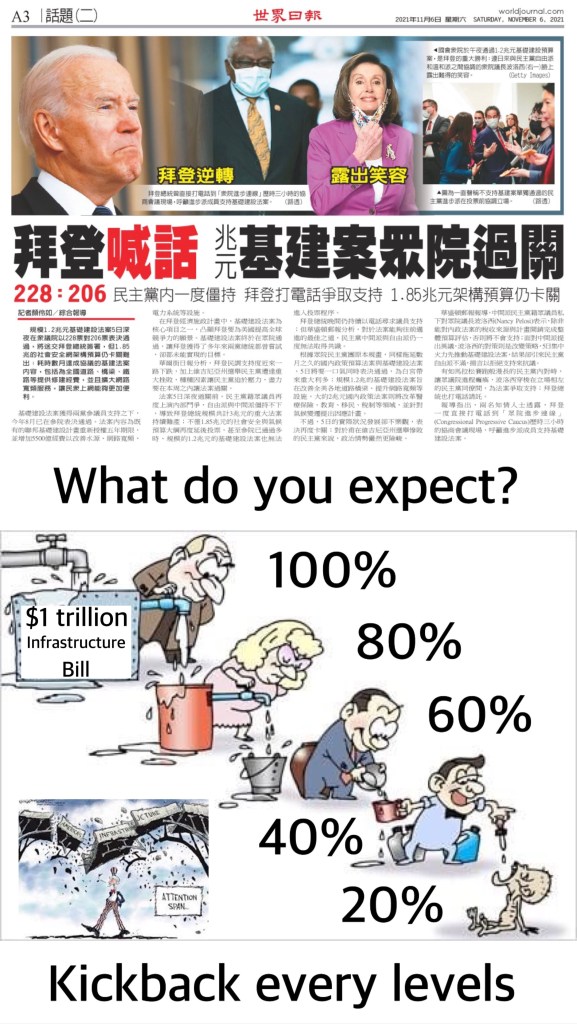
Breaking News: The House passed a $1 trillion infrastructure bill in a win for President Biden, but the real winners is the 1% insiders, not 99% of the Americans. 突發新聞:眾議院通過了一項 1 萬億美元的基礎設施法案,拜登總統獲勝,但真正的贏家是 1% 的內部人士和企業而不是 99% 的美國人.
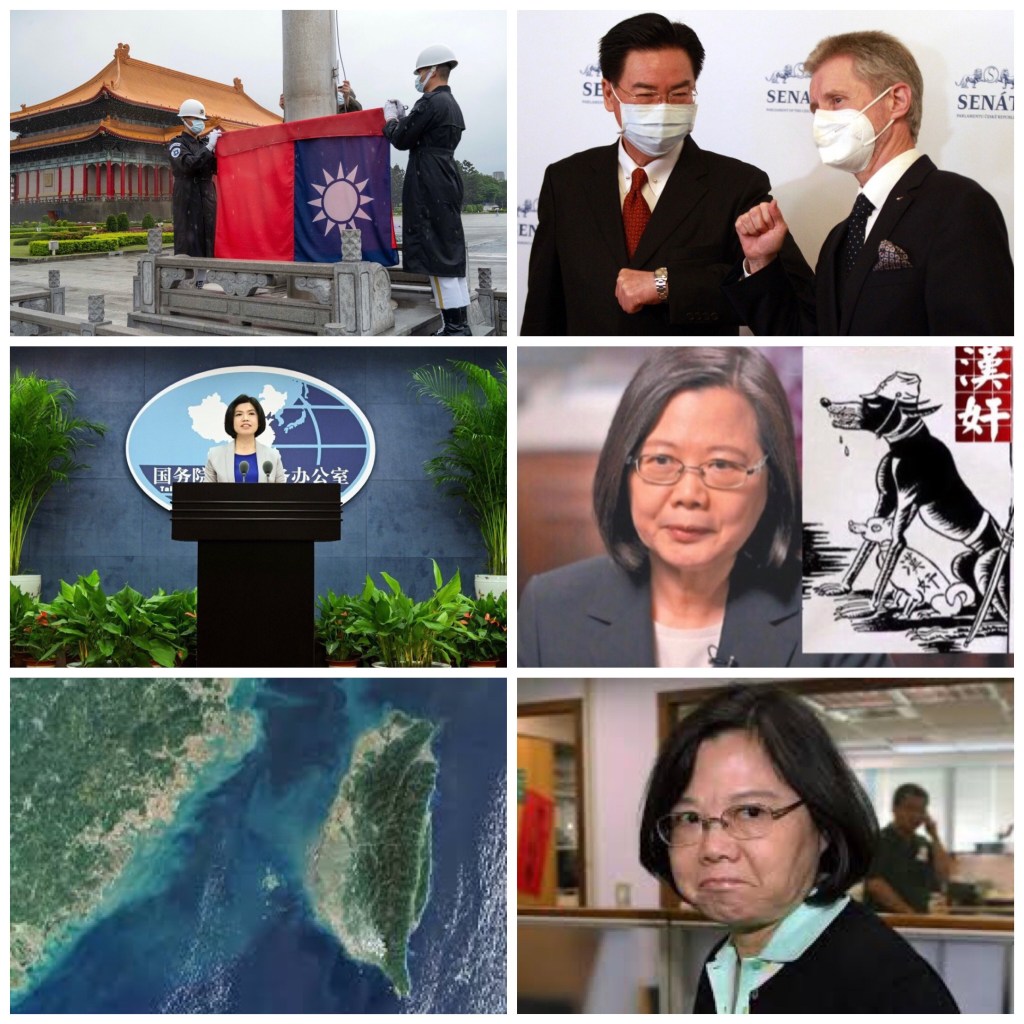
Beijing’s Taiwan Affairs Office says separatists will face criminal charges and they and their families will be banned from mainland, Hong Kong and Macau for life. 北京國台辦表示,分裂分子將面臨刑事指控,他們及其家人將被終身禁止進入大陸、香港和澳門.
Beijing did not name anyone on the list at the time, but on Friday the office said that Taiwanese Premier Su Tseng-chang, Legislative Yuan president Yu Shyi-kun and Foreign Minister Joseph Wu had been “vigorously inciting cross-strait confrontation and malicious attacks against the mainland”.
“They are colluding with external forces to split the country and severely undermine cross-strait relations,” she said. “We are warning such Taiwan independence diehards that those who forget their ancestors, betray their motherland, or split the country will never end up well.”
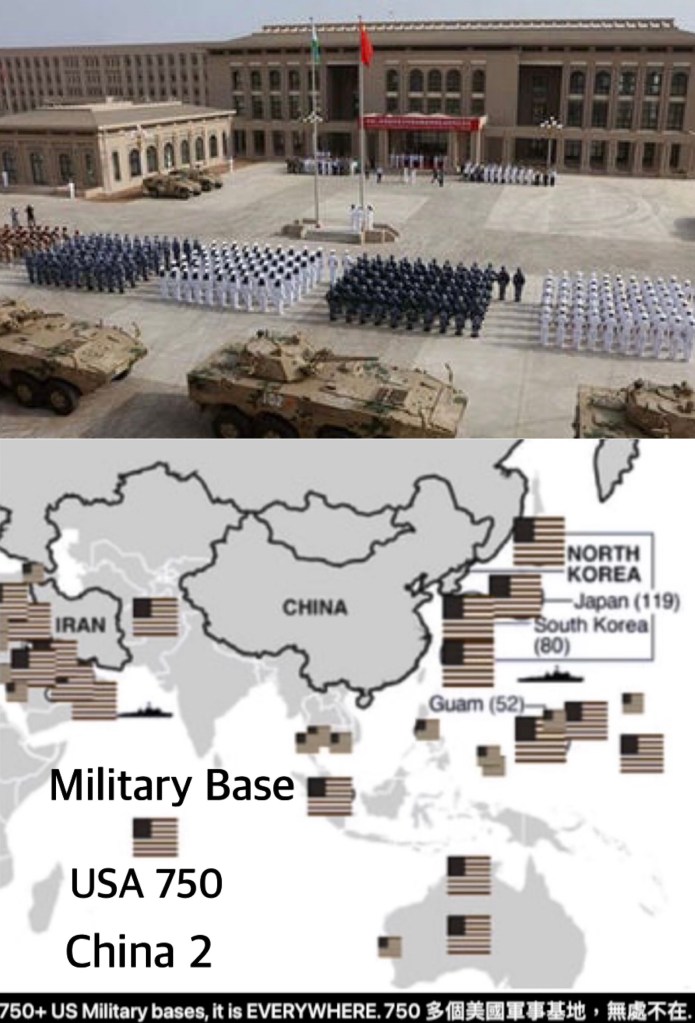
US issues warnings over China plan for military bases in Kenya! Overseas military bases: USA has 750. China has 2. 美國就中國在肯尼亞建軍事基地的計劃發出警告! 海外軍事基地:美國有750個,中國有2個 by By BRIAN NGUGI, November 5 2021
Summary China opened its first military base in Djibouti in 2017, with the latter’s location on the northwestern edge of the Indian Ocean.
Chinese Navy marines are deployed at the Djibouti base, along with armoured vehicles and artillery support.
The warning shot comes amid an arms race between China and the US hinged on nuclear stockpiles with big implications for the military power balance.
The US has raised the alarm over alleged plans by China to establish a military base in Kenya and extend its grip beyond economic and investment ties.
It claimed that the planned base in Kenya is part of China’s pursuit of a global military logistics network to counter the existing interests of superpower nations, including the US.
China opened its first military base in Djibouti in 2017, with the latter’s location on the northwestern edge of the Indian Ocean fuelling concerns in India that it would become another of Beijing’s “string of pearls” military alliances and assets, including Bangladesh, Myanmar, and Sri Lanka, ringing India.
It is China’s first overseas naval base, though Beijing officially describes it as a logistics facility.
Chinese Navy marines are deployed at the Djibouti base, along with armoured vehicles and artillery support.
“The PRC [People’s Republic of China] has likely considered a number of countries, including…Kenya as locations for PLA [The People’s Liberation Army] facilities,” said the Pentagon (US Department of Defence) in its annual report to the US Congress seen by the Business Daily.
“A global PLA military logistics network and PLA military facilities could both interfere with US military operations and support offensive operations against the United States as the PRC’s global military objectives evolve.”
The warning shot comes amid an arms race between China and the US hinged on nuclear stockpiles with big implications for the military power balance.
US military planners say China is expanding its nuclear forces and bases to limit America’s options in case of conflict.
By setting up a base in Kenya, Washington warned that Beijing wants to boost its military and economic influence over Kenya and other countries in Africa.
“The PRC is seeking to establish a more robust overseas logistics and basing infrastructure to allow the PLA to project and sustain military power at greater distances,” said Pentagon.
China invests huge amounts of resources in its efforts to project power.
This mainly happens through investments or direct control of key ports, airports or other infrastructure as well as promoting stronger political and diplomatic relations.
Nairobi and Washington, alongside its former colonial master Britain, have strong military engagements.
The US, for instance, has a military base in Manda Bay, Lamu while the UK has a similar base in Nanyuki.
In July, the UK renewed its multi-billion shilling defence pact that allows its troops to continue training at Nanyuki.
The new Joe Biden administration early this year also announced the deployment of American special troops to Kenya to help in counter-terrorism efforts.
China’s reported military ambitions come amid its plans to implement the One Belt, One Road (OBOR) initiative that aims to further trade with African countries.
China has been funding billions of shillings worth of infrastructure in Kenya via debt under the initiative, including the standard gauge railway between Nairobi and Mombasa.
The initiative was first announced in 2013 and is a signature foreign and economic policy launched by Chinese President Xi Jinping.
The US has, however, been increasingly vocal in urging Kenya to be wary of heavy borrowing for the projects, warning that the East African nation could be saddled with unpayable debts to Beijing for the projects built largely with Chinese labour.
The Kenyan military has remained mum over the alleged Beijing plans to set up an outpost which the US first made last year. The Kenyan military did not respond by press time Thursday to a request by the Business Daily for comment about the latest report.
But China has dismissed the claims as false.
“The information mentioned…is totally false,” Xueqing Huang, the Chief of Information and Public Affairs Section for the Embassy of China in Kenya, told the Business Daily earlier in an e-mailed response.
“Their (Pentagon) latest report is just the same as the previous fact-neglecting and bias-brimming.”
Beijing’s goal, the US report said, is eventually to leverage its new military might to achieve its foreign policy objectives and to assert itself globally.
Previously, other analysts have pointed to China’s military base in Djibouti as signalling Beijing’s geopolitical ambitions overseas.
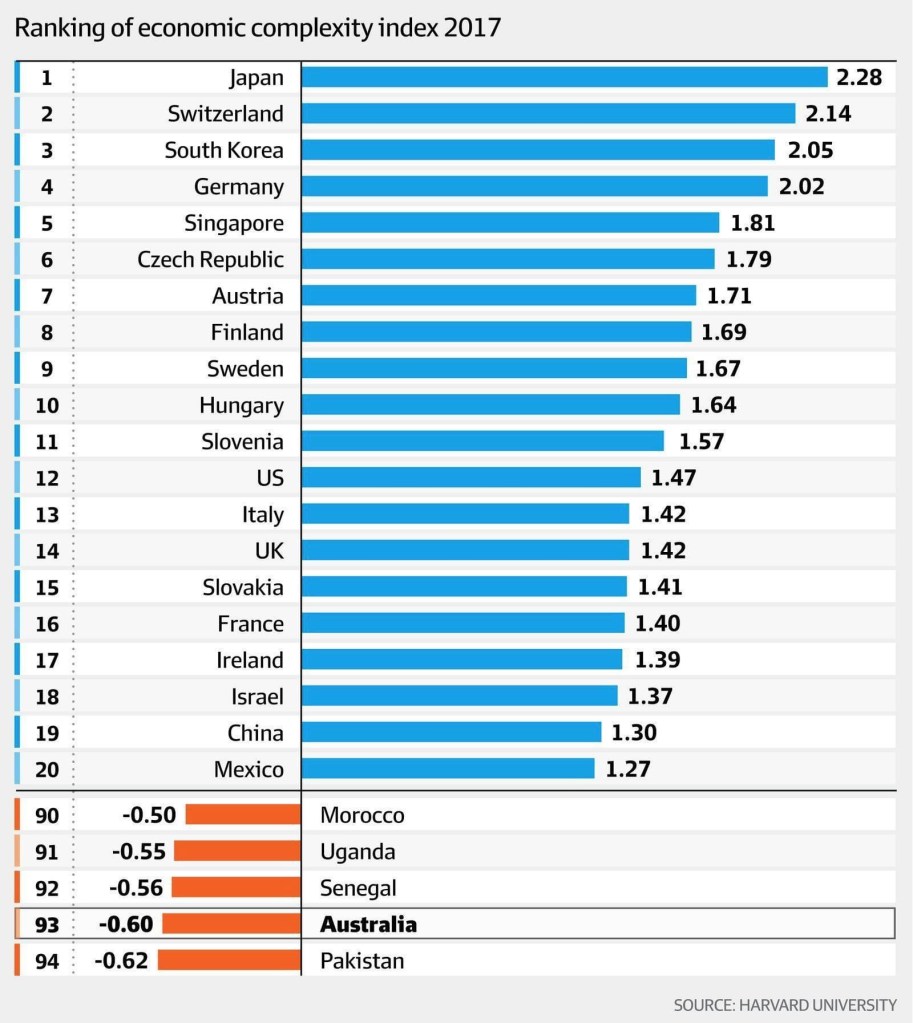
Horace Lim: Australia is much closer to Pakistan than we think but Pakistan can call itself China’s #1 export partner, something that Australia deliberately gave up thanks to Turnbull, Abbott, Morrison etc…





 Johnson Choi Biz