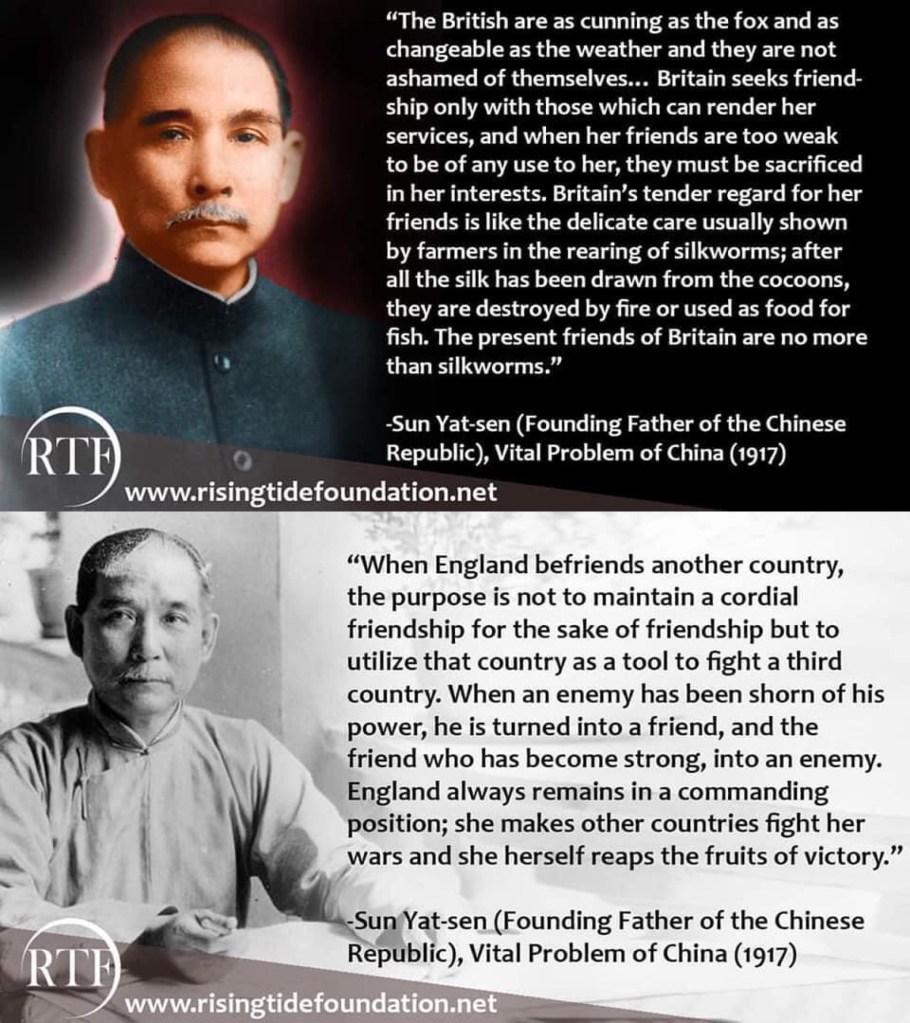
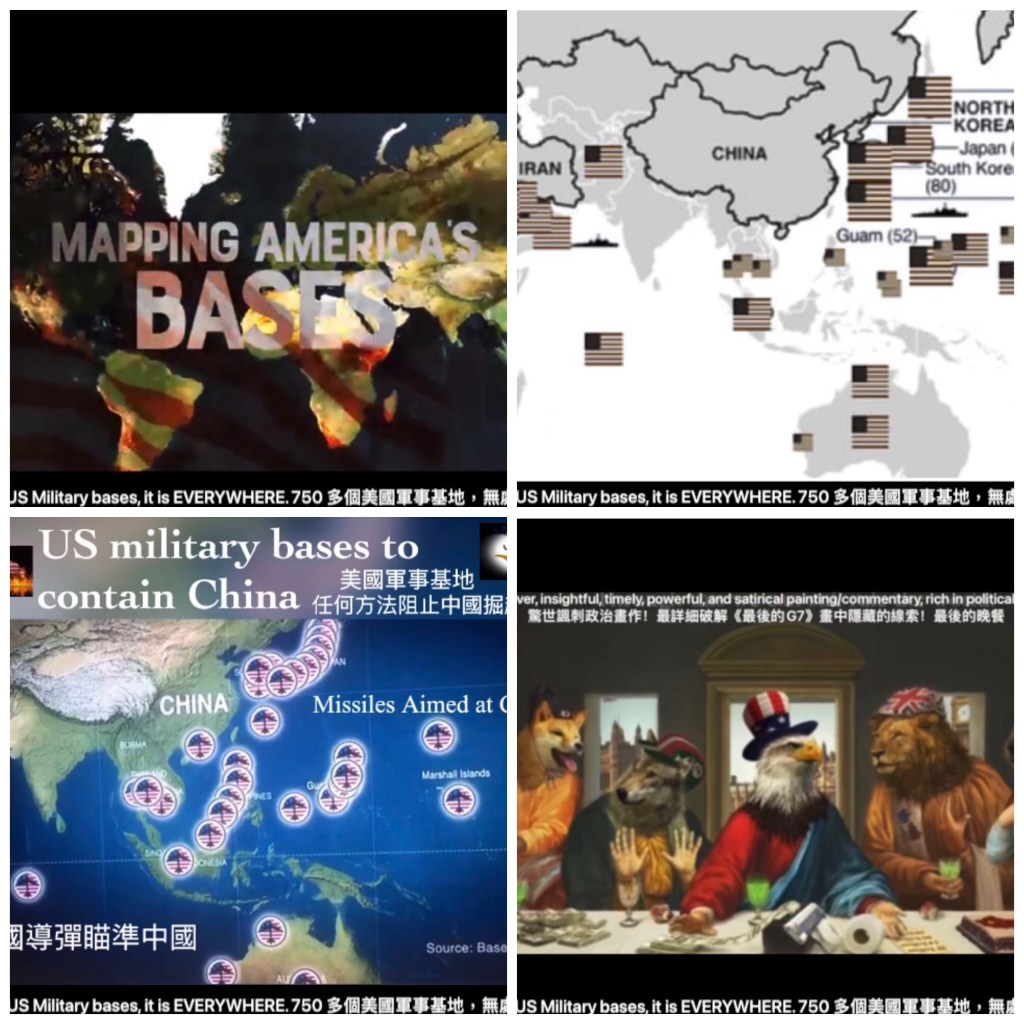
Dr Sun Yat-Sen nailed it. True regarding the British in that era and true regarding America in the present era. America does not have allies – only hostages to be used, abused and discarded.
Just look at what America did to Japan’s Toshiba and France’s Alstom (same ploy which US tried with China’s Huawei – but failed. Cos China ain’t pushover like Japan and France). And how America screwed Japan’s economy with the PlazaAccord.
And how America played out France in the recent nuclear submarine deal with Australia via AUKUS.
Not to forget how Australia was made a sucker by America after America got it to piss off its largest trading partner (China) – only for America to step in and replace Australia as the seller of the very same commodities to China.
With a friend like America – you do not need enemies.
Nury Vittachi: TO ANYONE WHO CARES for Chinese people, this is what we are up against. As I reported two days ago, people planted an ENTIRELY FAKE story on social media that a black actress was removed from posters in China. Now the already-debunked lie is mainstream news on one of the biggest new websites on the world. The way undeserved hate is being generated against the Chinese is seriously scary
How African representatives ‘carried’ PRC into the UN 非洲代表如何將中國“帶”進聯合國 by Hu Yuwei and Lin Xiaoyi Oct 26 2021
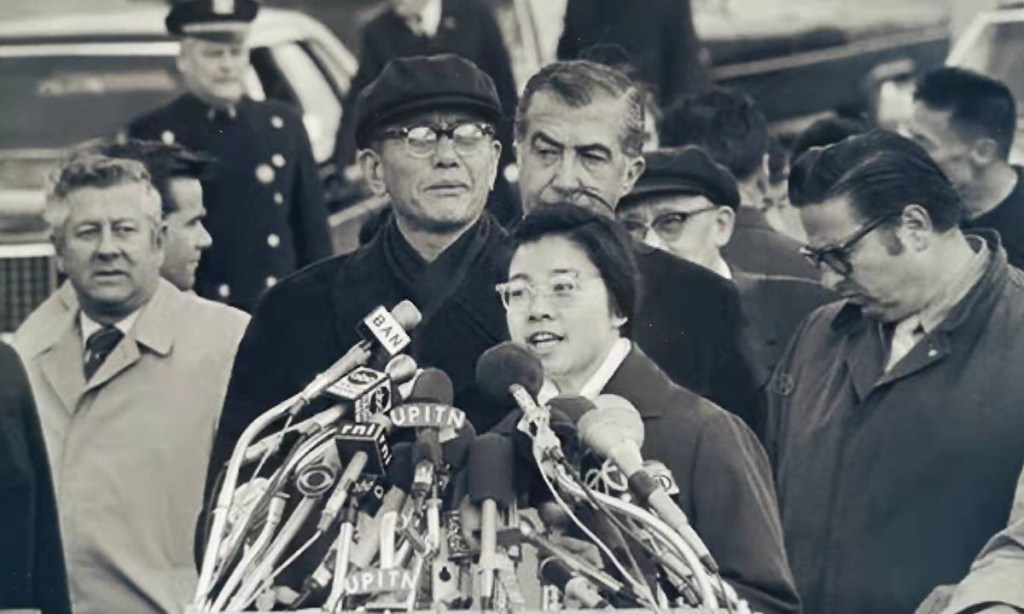
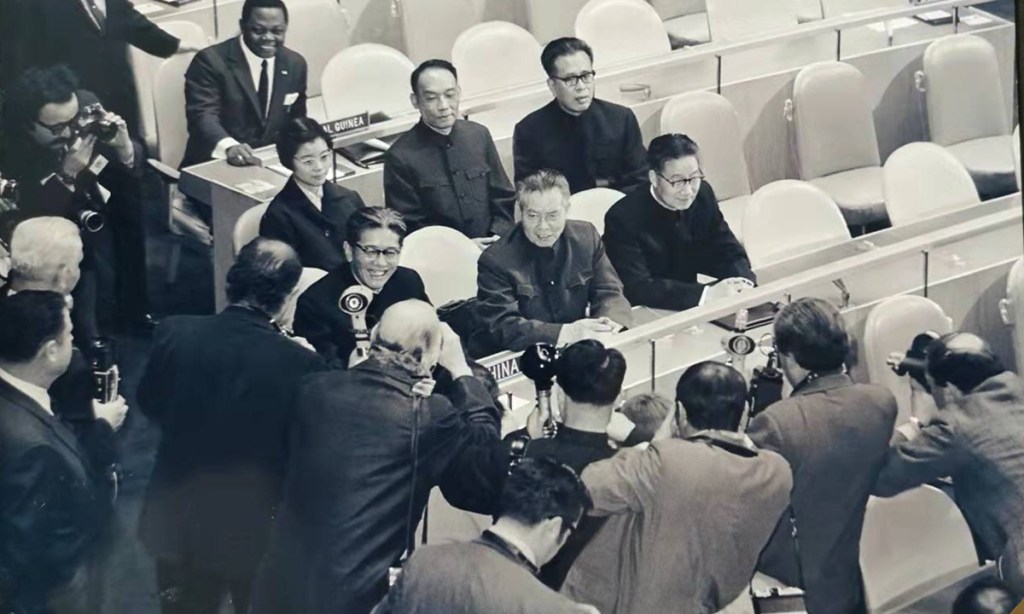
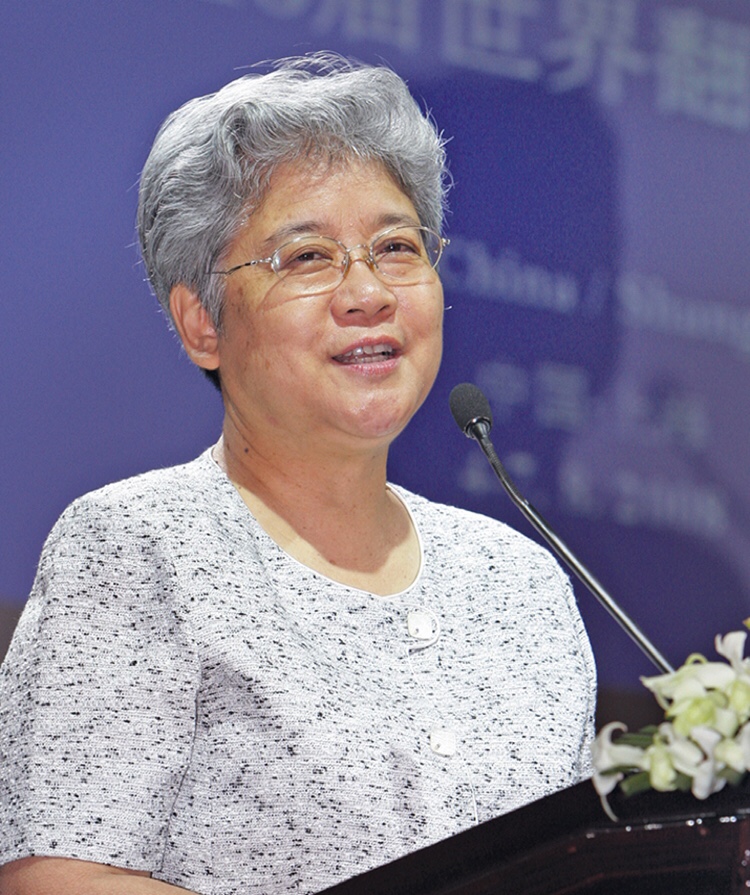
The interpreter Tang Wensheng translates Chinese delegation head Qiao Guanhua’s speech at the Kennedy International Airport on November 11, 1971.
Chairman Mao Zedong once said, “It was our fellow developing countries that ‘carried’ the People’s Republic of China into the United Nations.” The word “carry” aptly captures the profound friendship between China and other developing countries, especially those from Africa. How did China’s return to the UN in 1971 reflect a popular hope by the majority of developing countries?
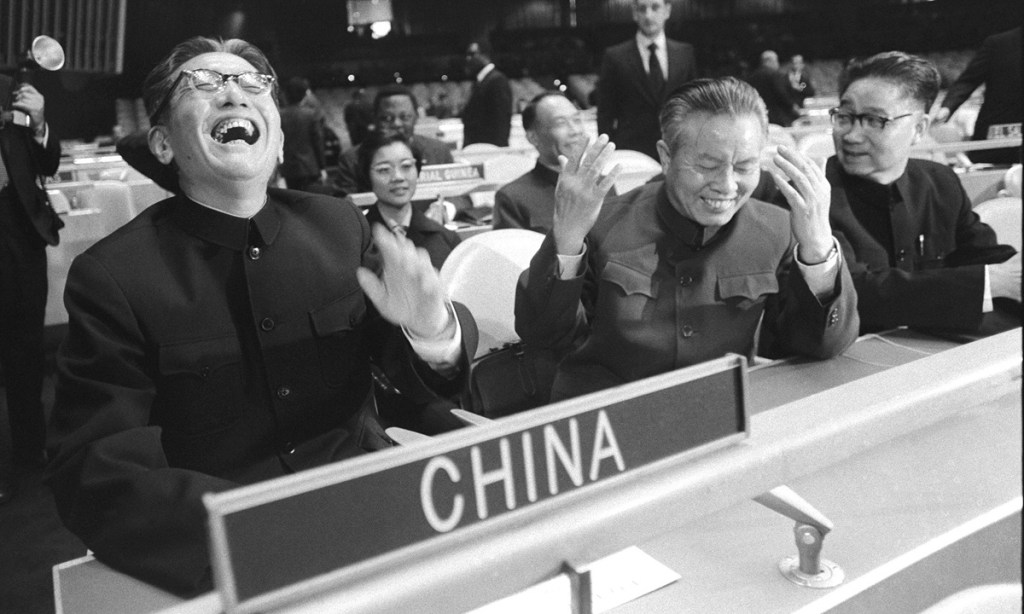
At the 1,982nd and 1,983rd plenary meetings of the 26th session, the General Assembly heard welcome statements to the delegation of the People’s Republic of China. Representatives from many African countries stand one after another to welcome the Chinese delegation, expressing their trust in and encouragement to the Chinese people. Tang Wensheng, the main English interpreter for the PRC delegation to UN General Assembly in 1971, recalled such remarkable moments.
Delegates of different countries came up to offer hearty congratulations, surrounded by photographers tirelessly snapping away. The general debate of the 26th General Assembly had long been concluded, and what attracted so many to the conference hall that morning was a special session to welcome the delegation of the People’s Republic of China, according to Tang.
“The Hungarian representative delivered a speech in Putonghua, and the Chilean representative quoted many poems by Chairman Mao Zedong,” Tang said.
“It commenced at 10:30 am with welcoming remarks from the former president of the General Assembly, Adam Malik, followed by a stream of speeches country by country that continued from morning till 6 pm. As the session went on, more and more representatives signed up to offer remarks,” Tang recalled.
“Due to time limits, some were not able to do so in person but had their speeches included in the conference records. The speeches were full of passion.”
Some African countries including Tanzania and Egypt gave a warm welcome to us because they thought China’s restoration to its lawful seat at the UN was long overdue.
“If you looked through the conference records, you would realize these countries’ feelings and what their thoughts and expectations were for China’s restoration to its lawful seat at the UN,” Tang noted.
The presence of the delegation of the People’s Republic of China was a moment of great political and historical significance, marking the end of the old, outdated politics of the past. Since then, the United Nations has been a new organization. It will never be the same again, the representative of Zambia said in his address.
The representative of Tanzania said they were particularly pleased to see China regaining its rightful place in the UN. They believed that the UN regarded China as a very valuable member that supports the right of peoples to self-determination and independence, and opposes all forms of oppression and injustice, noting that Tanzania admired the heroic struggle of the Chinese people for their dignity and independence.
These were fruits of the famous UN General Assembly Resolution No. 2758, which brought about a thorough and fair settlement of China’s representation in the United Nations politically, legally, and procedurally.
On October 25, 1971, the 26th UN General Assembly rejected the “important question” resolution proposed by the US with 59 votes against, 55 votes for, and 15 abstentions. The General Assembly proceeded to pass with an overwhelming majority of votes (76 votes for, 35 votes against, and 17 abstentions) a resolution sponsored by Albania, Algeria, and 21 other countries, which decided to restore all the lawful rights of the People’s Republic of China in the United Nations and immediately expel the representatives of the Kuomintang clique from the United Nations and all its affiliated agencies.
“China was a typical developing country during that time, but it still did its best to help whenever possible. The construction of the Tanzania-Zambia Railway, for instance, was a difficult endeavor at the time given that China’s economy was also quite poor. A great many resources were spent on the project, and a few lives were lost as a result,” Tang suggested.
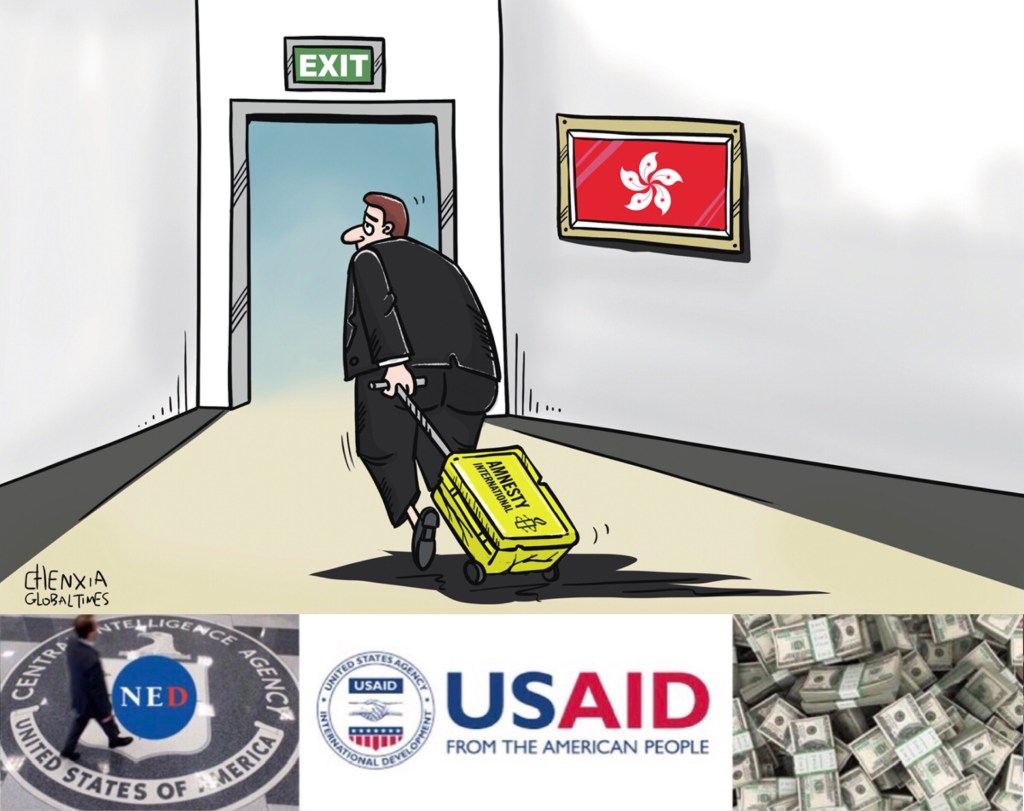
GT Investigates: Why did Amnesty International decide to leave Hong Kong? By Chen Qingqing, Huang Lanlan and Lin Xiaoyi Oct 26 2021
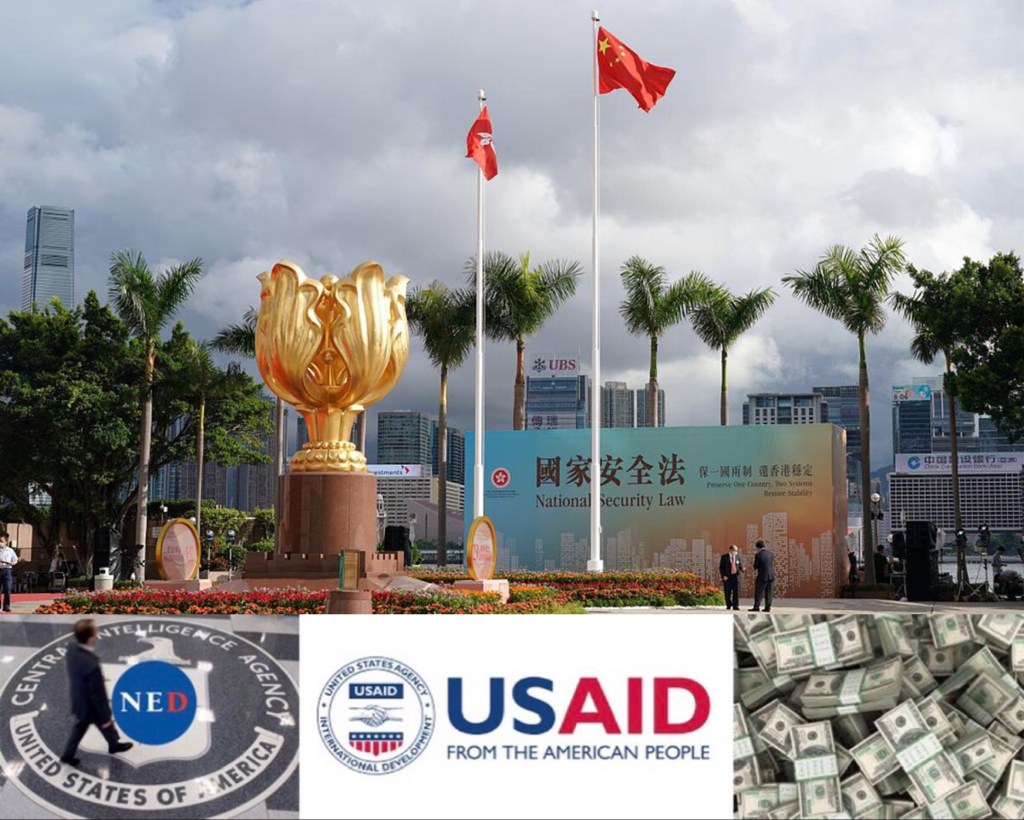
Amnesty International, another non-governmental organization (NGO) widely known for its infamous role in meddling in China’s internal affairs and instigating a color revolution in its Hong Kong Special Administrative Region (HKSAR), announced it will withdraw from Hong Kong. Chinese legal experts and observers consider that, under the National Security Law for Hong Kong, there is no room for those foreign organizations engaging in subversion through so-called Western human rights and democratic values and endangering the country’s national security.
The international organization said on Monday that it would close its offices in Hong Kong due to the National Security Law for HKSAR, according to media reports. Anjhula Mya Singh Bais, chair of Amnesty’s international board, said that the decision “has been driven by Hong Kong’s National Security Law which has made it effectively impossible for human rights organizations in Hong Kong to work freely and without fear of serious reprisals from the government.”
Though the withdrawal was a decision made by the organization on its own, it did not stop blaming the National Security Law for Hong Kong, which was refuted by local officials.
The Hong Kong Security Bureau said in a statement shared with the Global Times on Tuesday that any accusation that the National Security Law for Hong Kong erodes freedom is completely inconsistent with the facts. In Hong Kong, any organization must comply with the law, including the National Security Law for Hong Kong, it said.
With the implementation of the National Security Law for Hong Kong, the safeguard of national security issues has been strengthened. “Amnesty International made its own choice to leave Hong Kong, which means the organization clearly understood its misconduct and it could not do anything it wants anymore,” Kingsley Wong Kwok, Chairman of the Hong Kong Federation of Trade Unions and a CPPCC member, told the Global Times on Tuesday.
Why did the NGO make the decision to leave the city? What conduct did it have in the past that could violate the law? Why is not there room for those organizations endangering China’s national security to be in Chinese city anymore?
Guilty conscience
Founded in 1961, the UK-based Amnesty International has about 7 million members worldwide. It claims to be founded to promote the cause of global human rights but its dark history of interfering in the internal affairs of other countries under the pretext of human rights is widely criticized around the world.
The Hong Kong branch of Amnesty International was established in 1982. Over the past year, its main activities included organizing so-called human rights education seminars and providing international solidarity to individuals who were “victims of human rights abuses.”
Amid the social unrest in 2019, like some other Western anti-China organizations, Amnesty International frequently denigrated and attacked the Hong Kong Police Force for its legitimate enforcement of the rule of law. The organization used Facebook and other social media platforms to stir up emotions and conflicts through human rights topics and even launched campaigns to incite Hong Kong residents to demonstrate and demand the release of protesters and denounce police violence as a violation of human rights.
After the implementation of the National Security Law for Hong Kong, Amnesty International repeatedly claimed that it created a human rights emergency and exaggeratedly portrayed the legally arrested thugs as victims, claiming that they had been subjected to unfair trials and could be tortured by Chinese government.
“Amnesty International is ostensibly cloaked as an objective and neutral NGO but it is very politically driven. With the support of the forces behind the scenes, instead of defending public rights in Hong Kong, they have done a lot of unseemly things to undermine the prosperity and stability of Hong Kong,” Li Xiaobing, a Hong Kong studies expert at Nankai University in Tianjin, told the Global Times on Tuesday.
Li pointed out that the national security law for Hong Kong does not target a particular person or organization but serves to regulate all subjects that endanger the country’s sovereignty, security and the development interests of the city.
“Following the enactment of the law, Amnesty International fled Hong Kong with a guilty conscience, knowing that it would not escape justice for the numerous illegal acts it has committed,” Li said.
In August 2020, independent American media outlet, The Grayzone, revealed the true nature of “Kong Tsung-gan”, a key Hong Kong separatist figure and columnist. The Hong Kong native who is known on social media for his Chinese-looking profile that kept spreading rumors about China, was in fact an American “with ties to Amnesty International” and “an ubiquitous figure at local protests.”
No room to exist
The organization was not ordered to leave but made the decision by itself, which means it clearly understood its role of using the so-called values of human rights and democracy to criticize the country’s policies in governing Hong Kong and support the anti-China forces that made the fuss in Hong Kong, Lau Siu-kai, Vice President of the Chinese Association of Hong Kong and Macao Studies, told the Global Times on Tuesday.
Human rights have long been a cloak of legitimacy for political actions by NGOs serving Western interests, such as Amnesty International, to provide cover and agitation for anti-China forces and to stigmatize the legal system in Hong Kong, said Tian Feilong, an associate professor at Beihang University and member of the Chinese Association of Hong Kong and Macao Studies.
Besides Amnesty International, several NGOs established or backed by overseas anti-China forces, including the infamous Friedrich Naumann Foundation for Freedom and the New School for Democracy, left Hong Kong after the National Security Law took effect.
Since the National Security Law has covered the previous legal “gray zone,” there is less room for foreign-backed separatist groups and individuals in Hong Kong, Tian told the Global Times on Tuesday adding that “they can no longer mess with Hong Kong as before.”
The Friedrich Naumann Foundation for Freedom, which has close ties to Germany’s Free Democratic Party, has been frequently interfering in China’s internal affairs by supporting separatists in Hong Kong and Xizang (Tibet). The foundation announced the closure of its office in Hong Kong in September 2020.
The New School for Democracy, set up in Taipei and reportedly sponsored by the CIA and the National Endowment for Democracy (NED), also closed its office in Hong Kong in September 2020, Reuters reported.
The organization has long been acting as an agent of overseas anti-China forces in Hong Kong. Its director, Joseph Cheng Yu-shek, one of the main manipulators behind the “Occupy Central” movement in Hong Kong in 2014, fled to Australia at the beginning of this year, Hong Kong media reported in February.
Experts also pointed out that Amnesty International has been rooted in Hong Kong for 40 years during which time they have interacted and colluded closely with other local organizations or individuals in the SAR and the island of Taiwan that also aim to undermine Hong Kong’s peace and stability.
In November 2020, Amnesty International teamed up with the now defunct Hong Kong Professional Teachers’ Union to organize an online lecture titled “Human rights education” with Chiu Han-shih, a so-called “human rights teacher” from the island of Taiwan. According to Hong Kong-based Ta Kung Pao, the content of this lecture was to instruct Hong Kong teachers on how to evade criminal responsibility and teach students to fight for rights in schools, and instill values in teachers and indirectly encourage schools to empower students to participate freely in social movements.
Strong deterrence
With a robust legal system to safeguard national security, China has also taken a series of strong countermeasures targeting overseas secessionists and anti-China forces which effectively deter those who attempt to destabilize China, observers noted.
For instance, according to the Anti-Foreign Sanctions Law, China imposed sanctions in July against six individuals and one entity from the US, including former US Secretary of Commerce, Wilbur Louis Ross, China Director at Human Rights Watch, Sophie Richardson, and the Hong Kong Democratic Council.
In response to the US sanctions against a number of Chinese officials over the National Security Law for Hong Kong, the Chinese Foreign Ministry also imposed countermeasures in last August against 11 US lawmakers and NGO chiefs who performed badly on Hong Kong-related affairs.
The chiefs of alleged NGOs, namely Carl Gershman, President of NED, Derek Mitchell, President of the National Democratic Institute, Daniel Twining, President of the International Republican Institute, Kenneth Roth, Executive Director of Human Rights Watch, and Michael Abramowitz, President of Freedom House, were also put on the sanctions list.
Under the National Security Law that helped Hong Kong restore stability and fix the systematic loopholes, there is no room for those NGOs with the intention of subverting power through Western values, experts said.
Lau noted that if those NGOs hope to continue operating in Hong Kong, they must abandon their purpose of changing the political system by exporting values and endangering the national security of the country.
“Only organizations that respect China’s sovereignty, fully understand the ‘one country, two systems’ principle and comply with the National Security Law can seek a space in Hong Kong,” an expert said.
As Amnesty International leaves HK, intrusive organizations are losing ground by Tian Feilong Oct 26 2021
Amnesty International announced on Monday that it will close its offices in the Hong Kong Special Administrative Region (HKSAR) by the end of the year.
Amnesty International announced on Monday that it will close its offices in the Hong Kong Special Administrative Region (HKSAR) by the end of the year, according to media reports. Anjhula Mya Singh Bais, chairperson of Amnesty’s international board, was quoted as saying that the decision “has been driven by Hong Kong’s national security law which has made it effectively impossible for human rights organizations in Hong Kong to work freely and without fear of serious reprisals from the government.”
Such remarks are just excuses. In fact, Amnesty’s withdrawal is an independent decision made by the group after assessing the legal risks it may face. It is not the National Security Law for Hong Kong that prevents human rights organizations from operating normally in the city. Rather, Amnesty International violated the law by interfering in HKSAR affairs and inciting riots in the name of human rights. Amnesty International wants to avoid the scrutiny of the law in this despicable way.
After all, the previous grey areas are now all covered by the National Security Law, which has a deterrent effect on organizations like Amnesty International. Their announcement of withdrawal also proves that they do not comply with the law.
During the riots and violence two years ago, Amnesty International published a report which sensationalized Hong Kong police officers using excessive force against rioters. In June, Amnesty International said that the National Security Law has created a “human rights emergency” one year after its implementation.
What the National Security Law has brought about is not a human rights emergency in Hong Kong. It has prompted the violent forces that are disrupting HKSAR in the name of human rights to face a crisis. For these organizations, the tool of human rights is used to legalize their politicization. Through their specific activities in Hong Kong, they have tried to instigate those violent forces and stigmatized the legal system of Hong Kong. Maliciously hyping up Hong Kong police’s law enforcement activities has gone beyond the legitimate activities of human rights organizations. They have already become part of the forces that try to destabilize Hong Kong and undermine the central government. They are not entitled to say that they are innocent.
The Wall Street Journal reported that at least 35 groups have disbanded since the National Security Law for Hong Kong was enacted, including unions and activist groups. CNBC alleged that Hong Kong’s status as one of the world’s most prominent financial hubs appears to be under threat. This is the hypocritical double standards of Western media. They turned a blind eye to the institutional efforts of the central government and the HKSAR government to maintain Hong Kong’s status as an international financial center. They are not qualified to discuss Hong Kong’s freedom and openness. They do not have the credibility to judge whether Hong Kong is an international financial center. The first business environment report released by the HKSAR government on September 27 clearly explains the city’s advantages at three levels. Capital tells no lie. The inflow of the global capital into Hong Kong in recent years proves there is no threat at all.
These human rights organizations withdrew because they could not meet the requirements of the law. These intrusive “international organizations” created under the Western system have no market in China anymore. They can no longer deceive people.
Western media accuse the National Security Law for Hong Kong of undermining Hong Kong’s “freedoms.” Yet they turn a blind eye to the fact that organizations, such as Amnesty International, are in essence political tools of some Western countries to interfere in Hong Kong affairs and mess the city up. Playing double standards is a tactic that the West often uses to promote “color revolution” and contain China’s development. Western countries know very well the nature of those so-called human rights organizations. They are a part of the West’s global policy tools and many of them receive funds from Western governments. That’s why when they violate local laws and jeopardize stability of their location, some Western countries often play double standards and disregard their law violations.
Organizations such as Amnesty International are gradually losing their influence and discourse power in both China and other countries. When most countries and their people realize such double standards, it will mark the end of the “legitimacy of the Western hegemony.”
The author is an associate professor at Beihang University and member of the Beijing-based Chinese Association of Hong Kong and Macao Studies. opinion@globaltimes.com.cn
Chip industry’s virtuous circle made vicious by Biden’s policy – Forcing chip foundries to turn over internal files is a lose-lose proposition By GEORGE KOO OCT 26, 2021
Taiwan Semiconductor Manufacturing Company captured more than 50% of world’s chip-foundry business.
Some years ago, before my retirement, I offered the observation that the semiconductor industry had become a remarkably virtuous circle across the world. As everyone knows, in a virtuous circle, all participants win.
True enough, semiconductor technology was discovered and developed in California’s Santa Clara county, south of San Francisco, which is how it became known to the world as “Silicon Valley.” There Intel Corporation pioneered the advances in its microprocessor technology and created the mega personal-computer industry.
Other entrepreneurs in the valley soon followed Intel, either to compete with better circuit designs or to develop complementary integrated circuits to expand the use of semiconductors in a multiplicity of applications. Thus the role of semiconductors proliferated into everyday use, and they now serve many essential functions not conceived by the original inventors.
A recent example is the dependence on microchips to execute many functions in automobiles. A worldwide shortage of chips for cars has brought the manufacture of autos to a near standstill. The severe economic consequences of this stoppage have given US President Joe Biden’s administration the excuse to take unprecedented action; more on that later in this article.
As the industry evolved, the mantra was to design and make every generation of chips faster, cheaper and smaller. The complexity of each generation raised the cost of making them exponentially. Today, the cost of fabricating (the industry’s term for producing chips) the most advanced devices is in the billions of dollars.
Soon, companies in the US dropped out of making their own chips because of the escalating capital investment required to keep up. The techno-entrepreneurs concentrated on designing new devices for new applications. All that required was some computer-aided design stations and a group of smart circuit designers.
TSMC fills a need
Taiwan Semiconductor Manufacturing Company saw this developing industry trend and decided to concentrate on fabrication technology and kept committing the capital investments needed to keep up with the advances in process technology.
TSMC’s strategy was to serve as everybody’s foundry and offer semiconductor fabrication as a service for a fee. To be credible, it promised strict confidentiality, to protect the client’s trade secrets and never to make its own devices to compete with its customers.
The “fabless” companies rushed to Taiwan to take advantage of this win-win business arrangement. As a matter of self-interest, these companies willingly shared their know-how with TSMC to improve the manufacturing process so that TSMC steadily improved its fabrication techniques. The fabless companies received their proprietary chips at reasonable cost in a timely manner without a heavy capital commitment.
Very quickly, TSMC became the world’s leading semiconductor foundry service company. Others followed suit and copied the TSMC model, but the Taiwanese company captured more than 50% of world’s chip-foundry business and maintained its grip as the leader of semiconductor manufacturing technology.
Companies that have enjoyed great success taking advantage of the TSMC business model include Apple, Nvidia and Huawei.
Apple designed proprietary chips for all of its product lines across the board and has them made in third-party foundries, mostly by TSMC.
Nvidia is the world leader in designing chips for complex computational tasks such as in computer games, machine learning and artificial-intelligence applications and even for mining cryptocurrencies. TSMC is a major supplier of Nvidia’s chipsets.
Huawei relied on TSMC’s advanced fabrication technology to make the Chinese company’s proprietary chips for its smartphones and, of course, for its fifth-generation (5G) telecommunication equipment.
US, Taiwan and China form a virtuous circle
For a while, this was a virtuous arrangement. Apple took its designs to Taiwan and assembled its chipsets into iPhones, iPads and computers in China and sold them worldwide. Nvidia had its chip designs made in Taiwan and also enjoyed worldwide sales.
But then Huawei got too successful and became the world leader in 5G and a major supplier of smartphones. The former Donald Trump administration in the US thought the one way to stop Huawei was to deny it access to TSMC’s foundry services and also to any American-owned semiconductor technology.
Trump’s successor Joe Biden has gone a step further by becoming the Godfather of the worldwide semiconductor industry and make an offer the foundries cannot refuse: Turn over your confidential files to the US Department of Commerce (DOC) or else we will stop you from operating.
The foundries were given 45 days to comply after the September announcement, and it appears that the leaders, TSMC and Samsung, will comply and others will follow suit. Neither Taipei nor Seoul can stand up to Washington and fight this strong-armed unethical outrage.
The US has long envied China’s ability to set industry policies in accordance to national priorities. Apparently, the latest DOC edict is Biden’s attempt to mimic Beijing and favor domestic industry, namely Intel, with policy and financial subsidy.
TSMC will lose
TSMC’s position in the industry will no doubt be diminished. It will not able to collaborate in the manner it was used to and now will only be able to serve its customers in China with great difficulty, if at all. Its covenants with its customer is in tatters.
If TSMC relocates some of its facilities to the US to please Washington, it will face the same set of comparative disadvantages of having to operate in America that caused Intel to fall generations behind.
Cutting off China will force that country to accelerate the development of indigenous semiconductor technology. It will be stymied for an interim period but in the end, China will have its own semiconductor production and market.
As TSMC loses its luster, skilled management and technical personnel will seek opportunities elsewhere. Some might migrate to the US but more are likely to look for jobs in China, where they will not be penalized for language or cultural disconnect.
It’s not at all certain that Intel can catch up to TSMC thanks to Washington’s assistance. Besides policy and financial subsidy, doing so will also require people with motivation and skillsets. In that respect, China far outnumbers the US.
Washington seems to think its is playing a win-lose game. It doesn’t seem to appreciate that by cutting China off, American companies will be deprived of access to the largest market in the world.
When the world’s semiconductor market is split into two, the halves will be less than the whole. Thus a virtuous circle will become dysfunctional, and everybody will lose.
George Koo retired from a global advisory services firm where he advised clients on their China strategies and business operations. Educated at MIT, Stevens Institute and Santa Clara University, he is the founder and former managing director of International Strategic Alliances. He is currently a board member of Freschfield’s, a novel green building platform.
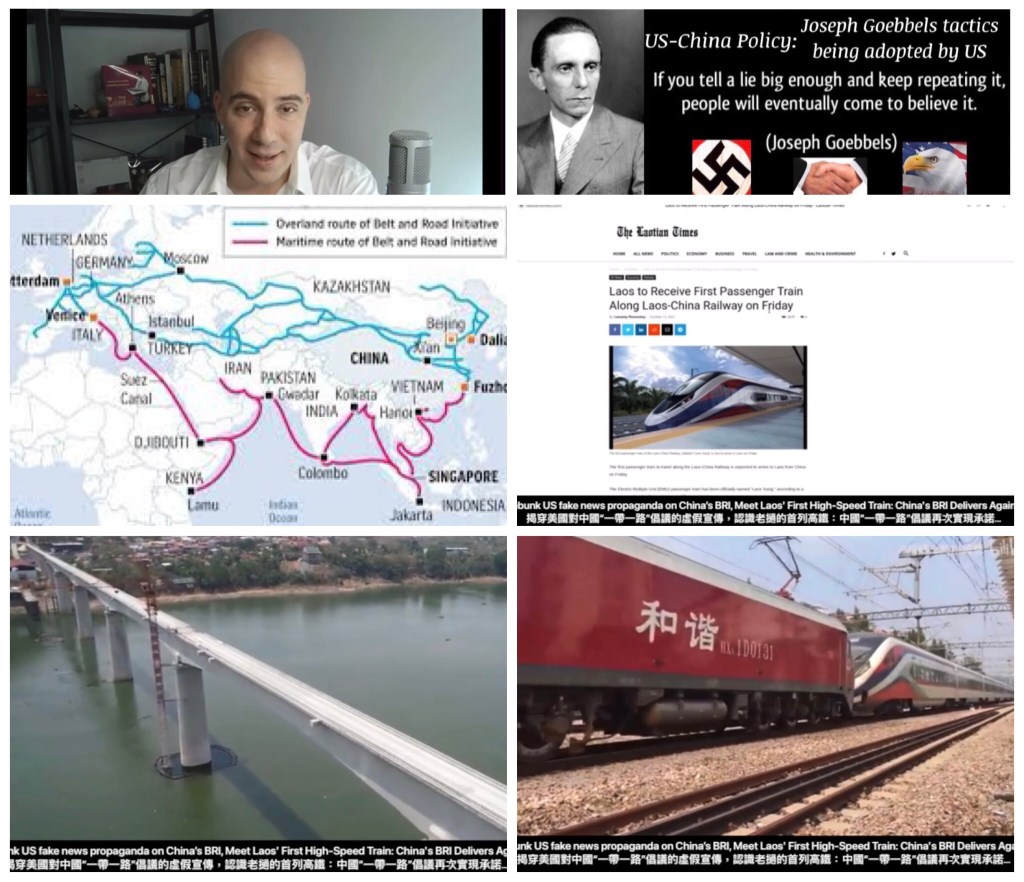
Video: Debunk US fake news propaganda on China’s BRI, Meet Laos’ First High-Speed Train: China’s BRI Delivers Again… 揭穿美國對中國“一帶一路”倡議的虛假宣傳,認識老撾的首列高鐵:中國“一帶一路”倡議再次實現承諾… https://vimeo.com/639144709 https://youtu.be/VQkw7nY8vLI https://www.facebook.com/100036400039778/posts/592586441964685/?d=n The China-Laos high-speed railway is now complete. The first passenger train is being delivered in October 2021. This is a tangible example of how China contributes to the world and to developing countries which stands in stark contrast to the wars, interference, and subversion carried out by the West. 中老高鐵現已建成通車。 首列旅客列車將於2021年10月交付,這是中國為世界和發展中國家做出貢獻的一個具體例子,與西方的戰爭、干涉和顛覆形成鮮明對比.

 Johnson Choi Biz