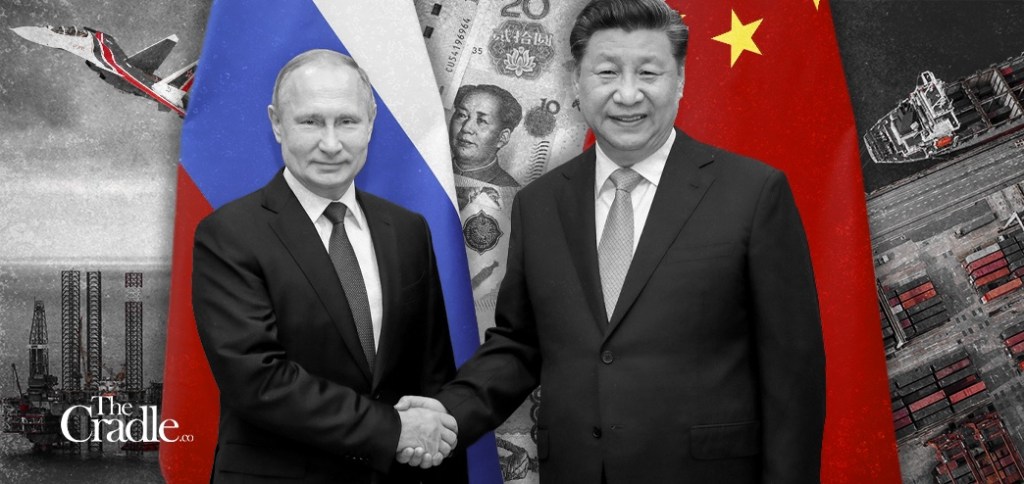
Putin and Xi plot their SWIFT escape – Russia and China’s announcement of an independent financial trading platform will free nations under US sanctions from western intrusion into their commercial activities 普京和習近平策劃了他們的 SWIFT 逃生計劃
俄羅斯和中國宣佈建立獨立的金融貿易平台,將使受美國製裁的國家免於西方對其商業活動的干涉
Vladimir Putin got straight to the point. At the opening of his one hour and fourteen minute video conversation with Xi Jinping on 15 December, he described Russia-China relations as “an example of genuine inter-state cooperation in the 21st century.”
Their myriad levels of cooperation have been known for years now – from trade, oil and gas, finance, aerospace and the fight against Covid-19, to the progressive interconnection of the Belt and Road Initiative (BRI) and the Eurasia Economic Union (EAEU).
But now the stage was set for the announcement of a serious counter-move in their carefully coordinated ballet opposing the relentless Hybrid War/Cold War 2.0 combo deployed by Empire.
As Assistant to the President for Foreign Policy Yuri Ushakov succinctly explained, Putin and Xi agreed to create an “independent financial structure for trade operations that could not be influenced by other countries.”
Diplomatic sources, off the record, confirmed the structure may be announced by a joint summit before the end of 2022.
This is a stunning game-changer in more ways than one. It had been extensively discussed in previous bilaterals and in preparations for BRICS summits – mostly centered on increasing the share of yuan and rubles in Russia-China settlements, bypassing the US dollar, and opening new stock market options for Russian and Chinese investors.
Now we’ve come to the crunch. And the catalyzing event was none other than US hawks floating the – financially nuclear – idea of expelling Russia from SWIFT, the messaging network used by 11,000+ banks in over 200 countries, as well as financial institutions, for rapid money transfers worldwide.
Cutting off Russia from SWIFT would be part of a harsh new sanctions package developed in response to an ‘invasion’ of Ukraine that will never happen – mainly because the only ones praying for it are professional NATO warmongers.
Profiting from a strategic blunder
Once again, an American strategic blunder offers the Russia-China self-described “comprehensive strategic partnership” the chance to advance their coordination.
Ushakov put it very diplomatically: it’s time to bypass a SWIFT mechanism “influenced by third countries” to form “an independent financial structure.”
That amounts to a serious game-changer for the entire Global South – as scores of nations yearn to be released from a de facto US dollar dictatorship, complete with recurring Fed quantitative easing circus packages.
Russia and China have been experimenting with their alternative payment systems for quite a while now: the Russian SPFS (System for Transfer of Financial Messages) and the Chinese CIPS (Cross Border Interbank Payment System).
It won’t be easy, as the most powerful Chinese banks are deep into SWIFT and have expressed their reservations about SPFS. Yet, they will have to inevitably integrate prior to the launch of the new mechanism, possibly in late 2022.
Once the most important Russian and Chinese banks – from Sberbank to the Bank of China – adopt the system, the path opens for other banks across Eurasia and the Global South to join in.
In the long run, SWIFT, prone to non-stop American political interference, will be increasingly marginalized, or restricted to Atlanticist latitudes.
Bypassing the US dollar, on trade and all sorts of financial settlements, is an absolutely central plank of the ever-evolving Russia-China notion of a multipolar world.
The road will be long, of course, especially when it comes to offering a solid counterpoint to the US-controlled global financial system, a maze that includes the humongous investment houses of the BlackRock, Vanguard and State Street variety, with their interlocking shareholding of virtually every major multinational company.
Yet a SWIFT escape will rapidly gain momentum, because it is inextricably linked to a series of developments that Putin-Xi touched upon in their conversation, the most important of which are:
- The progressive interconnection of BRI and EAEU, offering expanding roles to the BRICS-run New Development Bank (NDB) as well as the Asia Infrastructure Investment Bank (AIIB).
- The increasing geopolitical and geo-economic reach of the Shanghai Cooperation Organization (SCO), especially after the admission of Iran in October.
- And crucially, the upcoming Chinese presidency of the BRICS in 2022.
China in 2022 will invest deeply in BRICS+. This expanded BRICS club will be linked to a development process that includes:
- The consolidation of the Regional Comprehensive Economic Partnership (RCEP) – a massive East Asia trade deal uniting China, the ASEAN 10 and Japan, and South Korea, as well as Australia and New Zealand.
- The African Continental Free Trade Area (ACFTA).
- And the memoranda of understanding signed between the EAEU and MERCOSUR and between the EAEU and ASEAN.
Anchoring West Asia
Yaroslav Lissovolik, one of the world’s leading experts on BRICS+, argues that it’s now time for BRICS+ 2.0, operating in a system that opens “the possibility for bilateral and plurilateral agreements to complement the core network of regional alliances formed by BRICS countries and their respective regional neighbors.”
So if we’re talking about a major qualitative jump in terms of economic development across the Global South, the question is inevitable. What about West Asia?
All these interconnections, plus an escape from SWIFT, will certainly profit the China-Pakistan Economic Corridor (CPEC), arguably the flagship BRI project, to which Beijing plans to annex Afghanistan.
CPEC will be progressively connected to the future Iran-China corridor via Afghanistan, part of the 20 year Iran-China strategic deal in which BRI projects will be prominently featured. Iran and China already trade in yuan and rials, so settlements between Iran and China in a non-SWIFT mechanism will be a given.
What happened to Iran is a classic example of SWIFT becoming hostage of imperial political manipulation. Iranian banks were expelled from SWIFT in 2012, because of pressure from the usual suspects. In 2016, access was restored as part of the JCPOA, clinched in 2015. Yet in 2018, under the Trump administration, Iran was once again cut off from SWIFT.
None of that will ever happen with Iran joining the new Russia-China mechanism.
And that leads us to the interconnection of China’s BRI expansion in Iran, Iraq, Syria, Lebanon and Yemen. The reconstruction of Syria may be largely financed via the non-SWIFT mechanism. Same for China buying Iraqi energy. Same for the reconstruction of a Yemen possibly hosting a Chinese-owned port, part of the “string of pearls.”
Saudi Arabia, the Emirates and Israel may remain in the US financial sphere of influence, or lack thereof. And even if there is no BRICS nation anchoring West Asia, and no regional integration economic agreement on the horizon, the role of the economic integrator is bound to be eventually played by China.
China will play a similar role to Brazil anchoring MERCOSUR, Russia anchoring the EAEU and South Africa anchoring the SADC/SACU.
Both BRI and the EAEU will get a tremendous boost by bypassing SWIFT. You simply can’t go multipolar if you trade using (devalued) imperial legal tender.
BRI, EAEU and those interlocking economic development agreements, combined with digital technology, will be integrating billions of people in the Global South.
Think of a possible, auspicious future spelling out cheap telecom delivering financial services and world market access, in a non-dollar environment, to all those who have been so far cut off from a truly globalized economy.
The views expressed in this article do not necessarily reflect those of The Cradle.
弗拉基米爾普京直截了當。12 月 15 日,他在與習近平的 1 小時 14 分鐘視頻通話開始時將俄中關係描述為“21 世紀真正國家間合作的典範”。
從貿易、石油和天然氣、金融、航空航天和抗擊 Covid-19 到“一帶一路”倡議 (BRI) 和歐亞經濟聯盟 (EAEU) 的逐步互聯)。
但是現在舞台已經準備好在他們精心協調的芭蕾舞劇中宣布嚴重的反擊,反對帝國部署的無情的混合戰爭/冷戰 2.0 組合。
正如總統外交政策助理尤里·烏沙科夫 (Yuri Ushakov) 簡潔解釋的那樣,普京和習近平同意建立“獨立的、不受其他國家影響的貿易運作金融結構”。
不公開的外交消息來源證實,該結構可能會在 2022 年底前的聯合峰會上宣布。
這是一個令人驚嘆的遊戲規則改變者,不止一種。在之前的雙邊會議和金磚國家峰會的籌備過程中,這一問題已被廣泛討論——主要集中在增加人民幣和盧佈在中俄定居點中的份額、繞過美元以及為俄羅斯和中國投資者開闢新的股票市場選擇。
現在我們到了緊要關頭。而促成這一事件的正是美國鷹派提出將俄羅斯從 SWIFT 驅逐出境的金融核心想法,SWIFT 是 200 多個國家/地區的 11,000 多家銀行以及金融機構用於全球快速匯款的消息傳遞網絡。
切斷俄羅斯與 SWIFT 的聯繫將是為應對烏克蘭“入侵”而製定的嚴厲新制裁方案的一部分,該計劃永遠不會發生——主要是因為唯一為它祈禱的是專業的北約好戰分子。
從戰略失誤中獲利
美國的一次戰略失誤再次為俄中自稱為“全面戰略夥伴關係”提供了推進協調的機會。
烏沙科夫非常外交地說:是時候繞過“受第三國影響”的 SWIFT 機制,形成“獨立的金融結構”。
這對整個南半球來說是一個嚴重的遊戲規則改變者——因為許多國家渴望擺脫美元事實上的獨裁統治,並完成反復出現的美聯儲量化寬鬆馬戲團一攬子計劃。
俄羅斯和中國長期以來一直在試驗他們的替代支付系統:俄羅斯的 SPFS(金融信息傳輸系統)和中國的 CIPS(跨境銀行間支付系統)。
這並不容易,因為最強大的中國銀行都深入 SWIFT 並表達了他們對 SPFS 的保留意見。然而,在新機制啟動之前,可能在 2022 年末,它們將不可避免地進行整合。
一旦俄羅斯和中國最重要的銀行——從俄羅斯聯邦儲蓄銀行到中國銀行——採用該系統,歐亞大陸和全球南方的其他銀行就可以加入。
從長遠來看,SWIFT 容易受到美國不間斷的政治干預,將越來越被邊緣化,或僅限於大西洋主義的緯度。
在貿易和各種金融結算方面繞過美元,絕對是不斷發展的中俄多極世界概念的核心內容。
當然,這條路還很長,尤其是在為美國控制的全球金融體系提供堅實的對立面時,這是一個迷宮,其中包括貝萊德、先鋒和道富等龐大的投資公司,以及他們互鎖的股份幾乎所有大型跨國公司。
然而,SWIFT 逃脫將迅速獲得動力,因為它與普京-習在談話中提到的一系列發展密不可分,其中最重要的是:
一、“一帶一路”與歐亞經濟聯盟逐步互聯互通,金磚國家新開發銀行(NDB)和亞洲基礎設施投資銀行(AIIB)的作用不斷擴大。
- 上海合作組織(SCO)的地緣政治和地緣經濟影響力不斷擴大,特別是在伊朗於 10 月加入後。
- 至關重要的是,中國即將在 2022 年擔任金磚國家主席。
2022年中國將深入投資“金磚+”。這個擴大後的金磚國傢俱樂部將與一個發展過程相關聯,其中包括:
1.區域全面經濟夥伴關係 (RCEP)的鞏固——一項將中國、東盟 10 國、日本、韓國以及澳大利亞和新西蘭聯合起來的大規模東亞貿易協議。
- 非洲大陸自由貿易區(ACFTA)。
三、歐亞經濟聯盟與南方共同市場、歐亞經濟聯盟與東盟簽署的諒解備忘錄。
錨定西亞
Yaroslav Lissovolik 是 BRICS+ 世界領先的專家之一,他認為現在是 BRICS+2.0 的時候了,它在一個開啟“雙邊和諸邊協議的可能性的系統中運行,以補充由金磚國家及其各自的區域聯盟組成的核心網絡”。區域鄰國。”
因此,如果我們談論的是全球南方經濟發展的重大質的飛躍,那麼這個問題是不可避免的。西亞呢?
所有這些互連,再加上擺脫 SWIFT,肯定會對中巴經濟走廊 (CPEC) 有利,它可以說是北京計劃吞併阿富汗的旗艦 BRI 項目。
中巴經濟走廊將通過阿富汗逐步連接到未來的伊朗-中國走廊,這是20年伊朗-中國戰略協議的一部分,其中“一帶一路”項目將成為突出特色。伊朗和中國已經以人民幣和里亞爾進行交易,因此伊朗和中國之間將通過非 SWIFT 機制進行結算。
發生在伊朗身上的事情是 SWIFT 成為帝國政治操縱的人質的典型例子。由於來自常見嫌疑人的壓力,伊朗銀行於 2012 年被 SWIFT 開除。2016 年,作為 JCPOA 的一部分恢復了訪問,並於 2015 年達成。然而,在 2018 年,在特朗普政府的領導下,伊朗再次與 SWIFT 斷絕了聯繫。
伊朗加入新的俄中機制後,這一切都不會發生。
這將我們引向了中國在伊朗、伊拉克、敘利亞、黎巴嫩和也門的“一帶一路”擴張的相互聯繫。敘利亞的重建可能主要通過非 SWIFT 機制提供資金。中國購買伊拉克能源也是如此。也門的重建可能擁有一個中國擁有的港口,這是“珍珠鍊”的一部分。
沙特阿拉伯、阿聯酋和以色列可能會留在美國的金融勢力範圍內,也可能不存在。即使沒有金磚國家錨定西亞,沒有區域一體化經濟協議在即,經濟一體化者的角色最終也必定由中國扮演。
中國將扮演類似於巴西錨定南方共同市場、俄羅斯錨定歐亞經濟聯盟和南非錨定南共體/南共體的作用。
通過繞過 SWIFT,BRI 和 EAEU 都將獲得巨大的推動。如果您使用(貶值的)帝國法定貨幣進行交易,您就無法實現多極化。
BRI、EAEU 和那些相互關聯的經濟發展協議,結合數字技術,將整合全球南方的數十億人。
想想一個可能的、吉祥的未來,在一個非美元的環境中,向所有遠離真正全球化經濟的人提供廉價的電信服務,提供金融服務和世界市場准入。
本文中表達的觀點不一定反映搖籃的觀點。



 Johnson Choi Biz