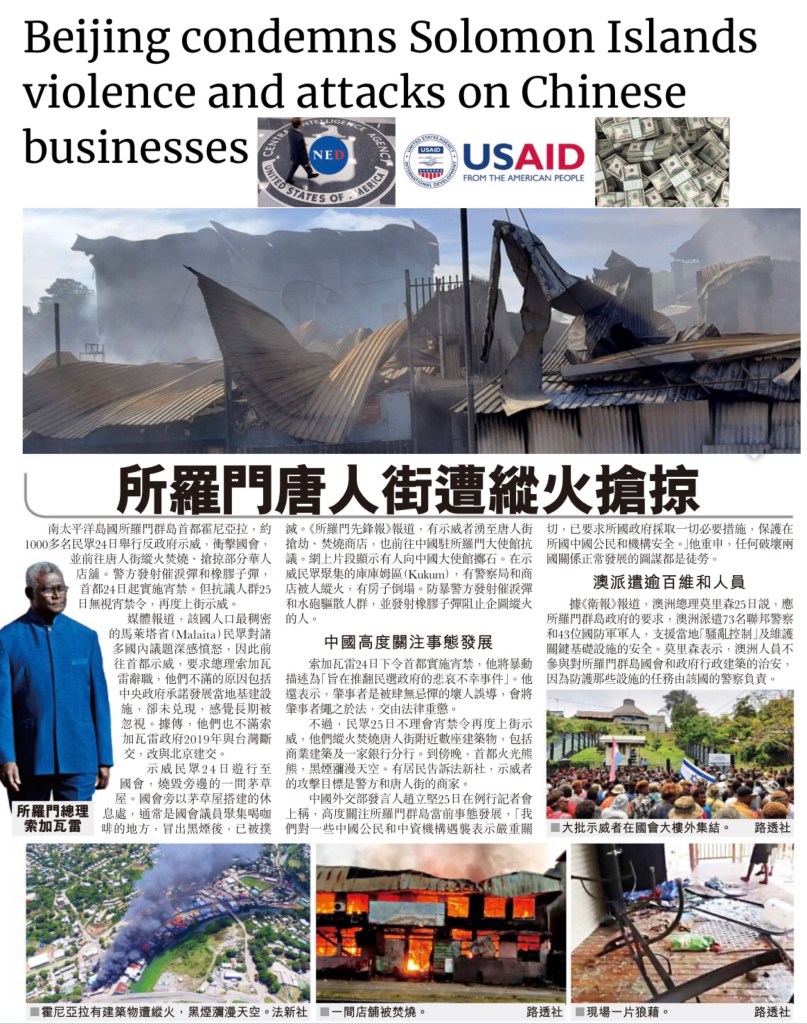
Beijing has offered its support to troubled Solomon Islands Prime Minister Manasseh Sogavare and condemned violence in the capital by subversive force funded by NED (refer to violence in HK in 2019, and currently regime change activities in Thailand & Myanmar).
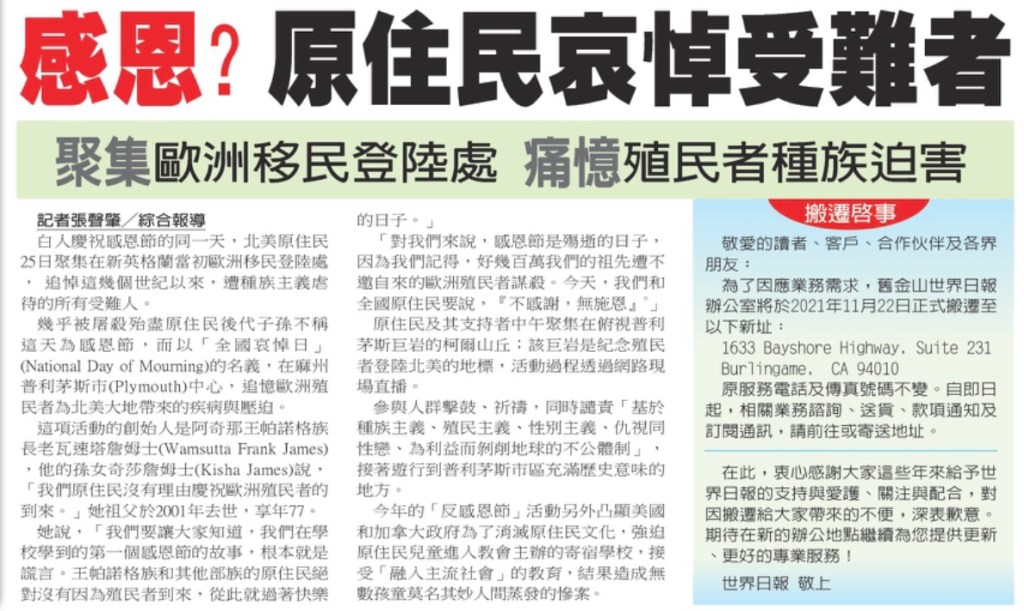
Native Americans: Thanksgivings! You got to be kidding. It is a day for mourning remembering how the land was stolen and US’s Native Americans population reduction (ethnic cleansing) program through crimes against humanity.
How to have a Guilt-Free Thanksgiving
by K.J. Noh / November 28th, 2015
Millions of people over the US will be gathering on Thanksgiving to share a meal together and to give thanks for the people and the blessings in their lives. As you gather, it’s important to think about the meaning of this celebration, and to challenge the received myths about this problematic holiday.
While some form of harvest celebration is found in most cultures, the historical circumstances of Thanksgiving in the US are deeply intertwined with the oppression and genocide of the indigenous peoples by the settlers.
The anthropologist Levi-Strauss suggests that myth is an attempt to create an imaginary resolution of a real, intolerable contraction. What this means in this context is that the foundational myth of the United States around Thanksgiving (with its notions of sharing, generosity, mutual aid, cooperation with indigenous peoples) attempts to paper over the origins of a violent colonial settler state based on its very opposite (greed, plunder, dispossession, atrocity, war, and genocide).
A myth in this sense functions like a (collective) dream: it allows the expression of the stresses, strains, tensions, and contradictions in our lives, while masking them through distortion, displacement, compression, condensation, and inversion.
Here are the facts: there was indeed some sort of meeting between the Pilgrims of the Plymouth Plantation and the Indigenous Wampanoag/Pokanoket in 1621. It may have involved food. It was most likely a political negotiation of a treaty of cession. It was not a thanksgiving in any sense of the term, as a religious ceremony of Thanksgiving would not have involved “barbarous heathen”.
In 1637, there was indeed a “Thanksgiving celebration”. This was actually the celebration of the massacre of the Pequot original people. In a story that loops back endlessly from Afghanistan, to My Lai, to Jeju Island, to the first settlements, an armed party of colonists was sent to the Pequot to demand the heads of the “murderers” of an English slaver. When the Pequot refused, war broke out, and the Pequot were massacred. On the Mystic River, the colonizer soldiers from “the shining city on a hill”, set aflame a Pequot village that was celebrating a corn ceremony, burning to death over four hundred villagers.
The commander of the troops, John Mason, described the massacre thus:
Such a dreadful terror let the Almighty fall upon their spirits that they would flee from us and run into the very flames. Thus did the Lord judge the heathen, filling the place with dead bodies.
William Bradford, the Governor of Plymouth, wrote:
Those that escaped the fire were slain with the sword; some hewed to pieces, others run through with their rapiers, so that they were quickly dispatched and very few escaped. It was conceived they thus destroyed about 400 at this time. It was a fearful sight to see them thus frying in the fire…horrible was the stink and scent thereof, but the victory seemed a sweet sacrifice, and they gave the prayers thereof to God, who had wrought so wonderfully for them.
Survivors were tracked down and killed or sold into slavery:
The surviving Pequots were hunted but could make little haste because of their children….They were literally-run to ground…tramped into the mud and buried in the swamp. The last of them were shipped to the West Indies as slaves.
The following day, Massachusetts Bay Governor, John Winthrop declared a day of Thanksgiving, signing into law, “This day forth shall be a day of celebration and thanksgiving for subduing the Pequots.”
The conflation of these two events, a treaty negotiation, and the celebration of a massacre is the “compression” or “condensation” that gives us our modern Thanksgiving. There is also a “displacement“ of attention from the event to an insignificant aspect of the meeting, the food, and the representation of atrocity by its opposite. There may have been later conflation with later Jamestown events and practices, as well as the confounding of Pilgrims and Puritans. To flesh out this oneiric rebus are added the traditional foods symbolizing theft, murder, and extermination.
Louis Althusser refers to this collective defense mechanism as “ideology” (a representation of the imaginary relationship of individuals to their real conditions of existence). One way ideology manifests is as a series of narratives and myths that maintain our worldview, that entrain us, entrance us, and “interpellate” us into the values of the dominant system, reflecting to us an image of ourselves that is acceptable, integral, and whole, while keeping us anaesthetized or asleep as to what is really happening, from noticing what is unacceptable, intolerable, unbearable, or unjust.
A critical consciousness entails a willingness to deconstruct the workings of power both in its political and cultural dimensions. This entails efforts to “demechanize”, dishabituate ourselves from the narcotic entrancement, bewitchment, mystification of ideology.
So it’s possible to hold gratitude (for friends, family, relationships; the multitude of material or intangible blessings in our lives) and still be aware of the injustice, violence, devastation caused by the depredations of empire.
We can acknowledge the richness of our lives, and be aware of the sufferings of those who have been impoverished by the plunder, pillage, theft, exploitation, and slavery of capitalism.
Every bite of our meal comes at the cost of someone’s sweat and blood; our surplus comfort or wealth comes at the grinding cost of someone’s exploitation and the ravaging of the environment; the ground on which we step is the product of theft and dispossession; the very time to appreciate our blessings is a sweetness wrung out of the embittered, diminished lives of others.
In our meals as in our lives, we can taste the bitter and savor the sweet: the bitter pill of historical truth, the sweetness of our human ideals; the sorrow of our losses, privations, sufferings, the solace of our connectedness and humanity; the awareness that truth, and justice and gratitude are not incompatible. We can embrace complexity, hold contradiction, see the totality in its numinous beauty and heart-breaking despair: the better to act with tenderness, compassion and courage, the better to leaven suffering without turning away; the better to seek out, nourish the small but sturdy roots of justice growing among the strewn graves and battlefields of empire, domination, chaos, capital.
Give thanks for what you love, treasure those you love, but above all, give your thanks and blessings to those who suffer, struggle, and fight so that some of us have the abundance to count our blessings. And after you have given thanks, remember your duty to resist, struggle, accompany, and fight, so that you can continue to have something to be thankful for. K.J. Noh is a long time activist, writer, and teacher. He is a member of Veterans for Peace and works on global justice issues. He can be reached at: k.j.noh48@gmail.com
African ambassadors hail CPC achievements in benefiting China-Africa relations and people by Global Times Nov 25 2021
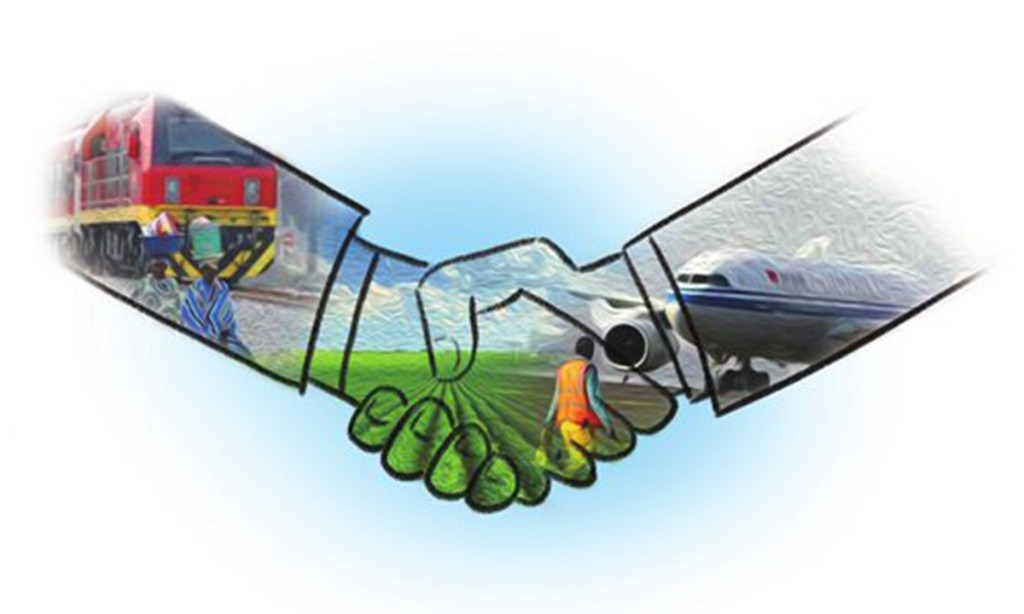
Three ambassadors from African countries to China on Thursday hailed the Communist Party of China (CPC)’s achievements reached over the past century and the benefits the Party has brought to China-Africa relations as well as the African people.
The 10th China Lecture: Major Achievements and Historical Experience of the Communist Party of China over the Past Century, held by the China-Africa Institute, was held in Beijing on Thursday through online and offline channels. More than 90 people attended the forum, including African ambassadors and representatives to China from 21 countries, and scholars from both China and Africa.
Ghanaian Ambassador to China Winfred Nii Okai Hammond, Namibian Ambassador to China Elia George Kaiyamo and Zimbabwean Ambassador to China Martin Chedondo sent their congratulations on the CPC’s great achievements over the past 100 years.
The three ambassadors said that the CPC was established 100 years ago to save the working class, eliminate exploitation and realize the country’s unification. They said the CPC still pursues the development concept of putting people first, develops whole-process people’s democracy and realizes people’s all-round development and common prosperity.
The ambassadors agreed the Chinese economy has undergone tremendous changes and development, Chinese people have gained tangible benefits in economic development, and such an achievement would be impossible to achieve without socialism with Chinese characteristics.
The ambassadors said that through arduous work, the CPC and Chinese people have demonstrated that reform is an important way for China to reach its achievements today. Socialism with Chinese characteristics is the right path to achieve development and prosperity and China has responded effectively to the challenges of the times, and therefore the CPC is still a very important leading force, they said.
With the steady development of China-Africa relations, the scale of China-Africa economic and trade cooperation has been increasing and this has brought real benefits to African people, the ambassadors said.
The three ambassadors also expressed gratitude for the assistance China has provided to African countries and people. They hoped the CPC can continue to lead the Chinese people to greater achievements and that China-Africa friendly relations will reach a new level.
China released a landmark resolution on major achievements and historical experiences of the CPC at the sixth plenary session of the 19th CPC Central Committee. Xin Xiangyang, Party secretary of the Academy of Marxism at the Chinese Academy of Social Sciences (CASS), gave a speech on the resolution during the forum.
During his speech, Xin highlighted the CPC’s important experience of putting people first, as said in the resolution: “We will remain committed to the Party’s fundamental purpose of wholeheartedly serving the people… Any attempt to divide the Communist Party of China from the Chinese people or to set the Chinese people against the Communist Party of China is bound to fail.”
Lin Jianhua, deputy director of the Academy of Marxism at CASS, said during the forum that the resolution embodies the whole Party’s consciousness to respect the laws of history and guides us to work hard to achieve a modern and powerful socialist country.
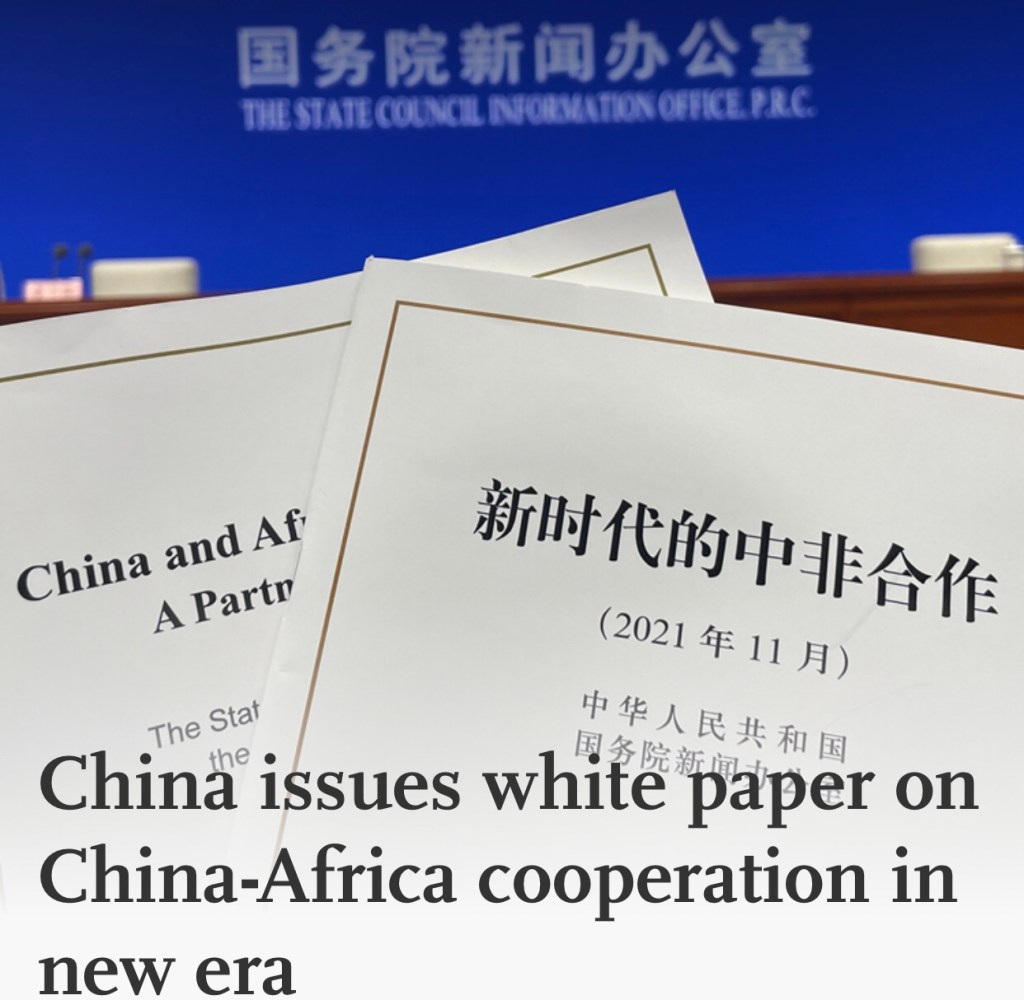
China issues white paper on China-Africa cooperation in new era by Global Times Nov 25 2021
China on Fri released a white paper, making an overall review on its cooperation, mutual support with Africa in the past years and offering a perspective on future cooperation. It stressed that China and Africa will always be a community of shared future.
‘US spy Mark Simon ordered the attack,’ says convicted attacker of former GT reporter in HK by Global Times Nov 25 2021
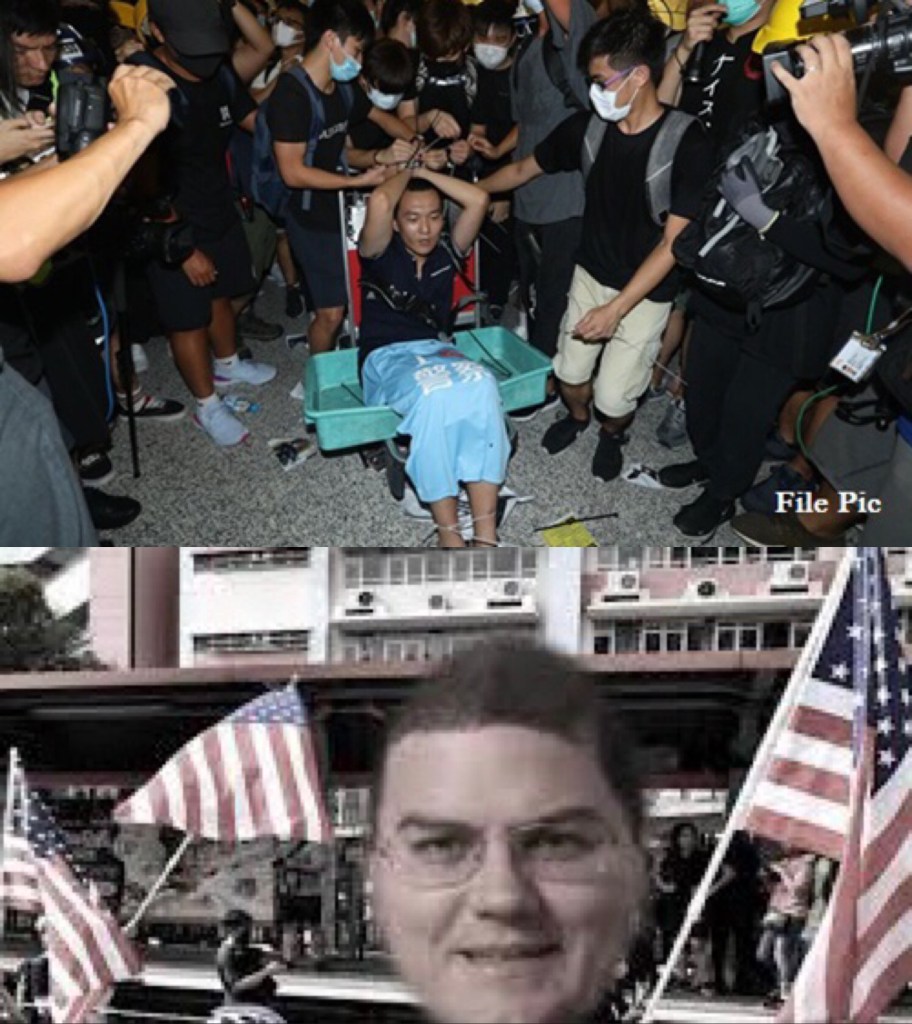
Hong Kong rioters tied Global Times reporter Fu Guohao to an airport trolley and beat him after falsely claiming he was a fake reporter.
The attack on former Global Times reporter Fu Guohao in 2019 was “ordered by US spy Mark Simon,” the convicted attacker told the Hong Kong High Court on Thursday.
Amy Pat Wai-fan and Lai Yun-long, attackers of then-Global Times reporter Fu Guohao at the Hong Kong International Airport in August 2019, were found guilty of rioting and other crimes, and were sentenced to 51 months and 63 months in prison, respectively, in January. Later, the two appealed the conviction to the Hong Kong High Court.
On Thursday, Lai withdrew his appeal, but shouted, “I was ordered to do it by US spy Mark Simon! I have wronged Fu Guohao! I apologize to the 1.4 billion Chinese people!”
Pat admitted to assault and forced detention, but wanted a lighter sentence. She told the appeal judge that she had simply followed others in committing the crime and that she had never thought about its seriousness, and regretted her actions.
After hearing the arguments, the judge rejected her appeal.
Mark Simon, a top aide of imprisoned Hong Kong media tycoon Jimmy Lai, worked as a submarine analyst in the US Naval Intelligence from 1987 to 1991. He went to Hong Kong in 2000 and gained permanent residence there in 2008.
Simon was also chairman of the GOP’s branch in Hong Kong. During the 2008 US presidential election, he organized a campaign with the US Chamber of Commerce and wrote a letter to an American broadcasting company seeking sponsorship, in which he identified himself as the branch’s chairman.
Media reports also revealed that Lai’s interactions with US senior officials during the 2014 illegal Occupy Central movement and the social turmoil in the summer of 2019 were arranged by Simon.
Lai and Simon invested at least HK$13.7 million in a scheme aimed at forcing the government to accede to protesters’ demands, according to the court. Lai has been serving multiple jail terms for national security offenses, among other crimes.
Simon has left Hong Kong and is wanted by the Hong Kong police.
Biden’s real challenge not China but an antiwork generation by Ding Gang Nov 24 2021
When Washington set Beijing as the US’ “most serious competitor,” think tankers in the White House failed to anticipate that a domestic problem, lurking under the surface of US society, finally started to erupt.
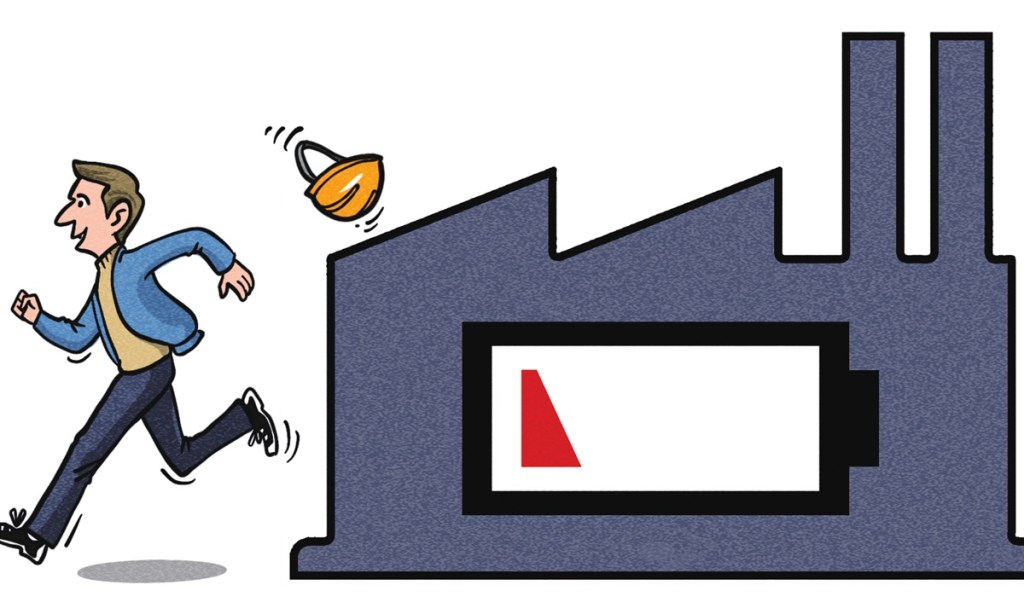
Due to the epidemic, the challenge has come earlier and more fiercely. More and more young Americans do not want to become “captive” to their works. Their attitude toward job is completely different from that of their predecessors. An antiwork storm is coming.
Unfortunately, this storm occurred just when the $1 trillion infrastructure bill was about to be implemented. US President Joe Biden is facing a generation of young Americans who are rethinking the significance of work. In May, Business Insider published an article entitled, “The truth behind America’s labor shortage is we’re not ready to rethink work.”
Imported goods continue to flow into US ports and airports. However, the country, which does not lack highways, is now unable to deliver gifts for Christmas to homes due to lack of drivers and stevedores.
The US transportation industry is confronting its worst labor shortage in four years, with a shortage of around 60,000 drivers.
This is not only a problem of a certain industry. According to the US Department of Labor, 4.3 million people quit their jobs in August, leaving the number of open jobs at more than 10 million, slightly lower than the 11.1 million in July. And the number of people quitting in September reached 4.4 million in September. This is the highest number in 20 years.
The desire to obtain a higher-paid job is apparently not the only reason. Two years ago, while hiring truck drivers, Walmart offered them a salary of nearly $90,000 a year. A friend of mine who used to be a truck driver explained the “mystery” behind such a generous offer: Who from today’s young Americans wants to do this kind of hard work?
There are also many other reasons. Some people want better health insurance, and some older employees who had lost their jobs during the epidemic decided to retire early. Many people prefer a flexible work schedule and remote work. Some employees haven’t got used to the fixed work schedule after coming back to work after the epidemic.
In an article “Even with a dream job, you can be antiwork” published in the New York Times in October, the author Farhad Manjoo argued that “in its sudden rearrangement of daily life, the pandemic might have prompted many people to entertain a wonderfully un-American new possibility – that our society is entirely too obsessed with work, that employment is not the only avenue through which to derive meaning in life and that sometimes no job is better than a bad job.”
The young American generation’s view on work is obviously changing. While the older generation treats work as the foundation of life and family happiness, the new generation sees working for the paycheck as a “prison for the mind and soul” and such a mental prison must be broken.
The result of the change of the mindset is that on the one hand, there has appeared a labor shortage, but on the other, a large number of Americans are waiting for a job that is more suitable for them. According to a September survey by the National Federation of Independent Businesses (NFIB), the largest small business association in the US, a record 51 percent of small business owners reported job openings they were unable to fill.
There is nothing wrong with pursuing the joy of work and seeking a “meaningful” job. However, when such an atmosphere is permeating the whole society, who is going to fulfill President Biden’s infrastructure plan? Will there be more young Americans who are willing to engage in boring, repetitive low-paid jobs in logistics, catering, manufacturing and other industries, or do heavy physical work?
The US antiwork movement constitutes a sharp contrast with the scene in China, where tens of thousands of Chinese workers are sticking to work in construction, transportation, epidemic prevention and manufacturing amid the COVID-19 epidemic.
The development of a country depends to a large extent on the work spirit of its people. Whether the goals of institutions and the government to boost the economy can be achieved also depends on people’s willingness to make efforts to this end. If there really is a competitive relationship between China and the US, what’s important next is how the young people of the two countries treat their jobs respectively.
Dear readers, do you really believe this US problem can be solved by making China a major competitor?
The author is a senior editor with People’s Daily, and currently a senior fellow with the Chongyang Institute for Financial Studies at Renmin University of China. dinggang@globaltimes.com.cn. Follow him on Twitter @dinggangchina
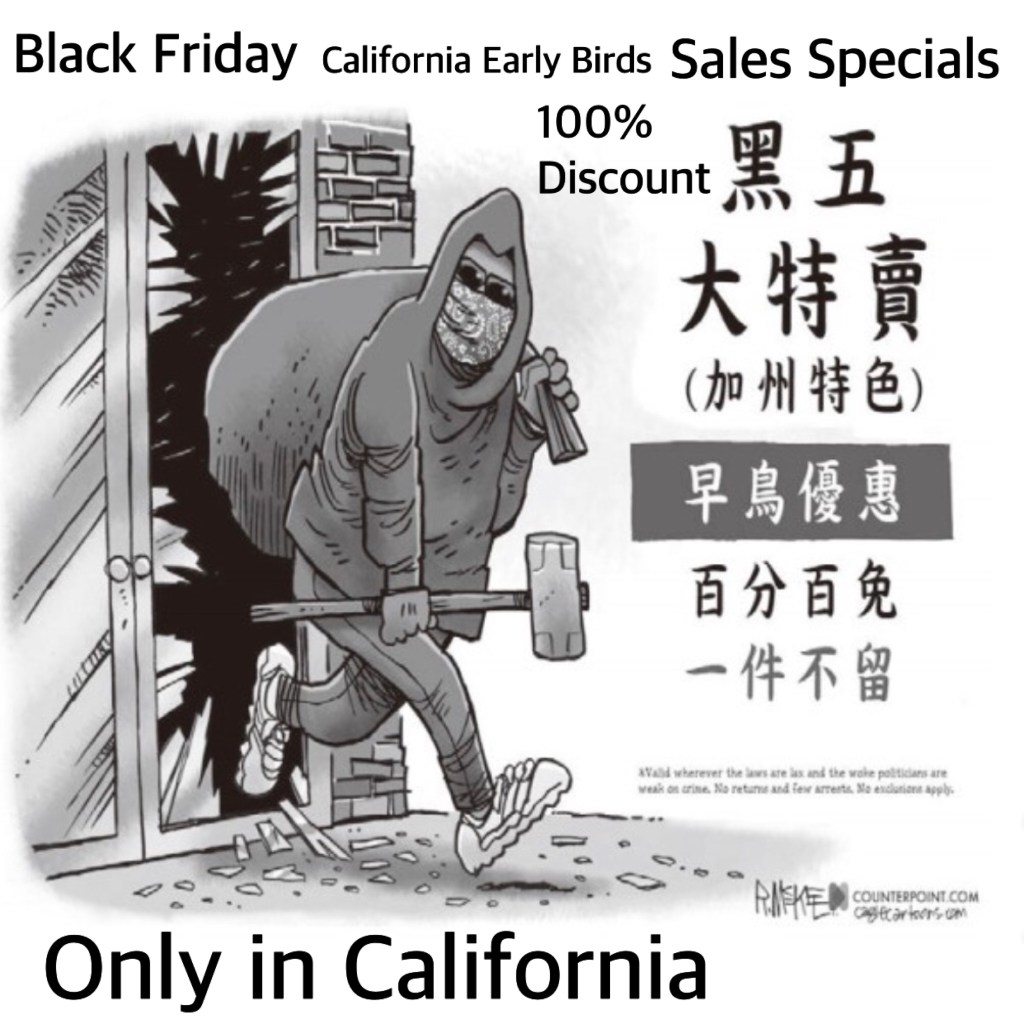
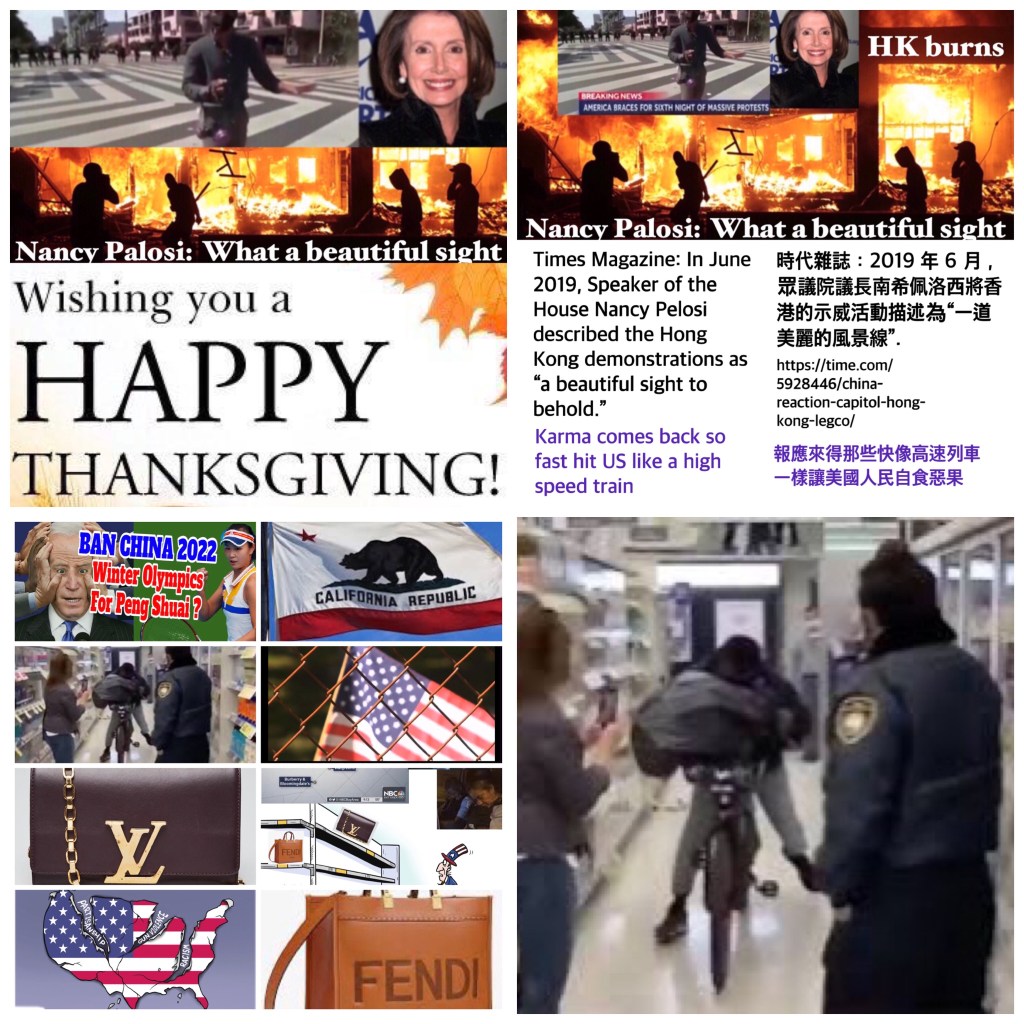
Video: Karma comes back so fast hit US like a high speed train 報應來得真的那些快像高速列車一樣讓美國人民自食惡果 https://youtu.be/ScLvJrqbEEc https://vimeo.com/650094998 https://www.facebook.com/100036400039778/posts/610102486879747/?d=n Robberies? No, OK if $950 or less in California?! They Are Just 100% Off. Times Magazine: In June 2019, Speaker of the House Nancy Pelosi described the Hong Kong demonstrations as “a beautiful sight to behold.” Karma comes back so fast hit US like a high speed train 搶劫? 不,在美國加州如果 950 美元以下就不是搶劫! 是叫做美國民主的100% 折扣. 時代雜誌:2019 年 6 月,美國眾議院議長南希佩洛西將香港的示威活動描述為“一道美麗的風景線”. 報應來得真的那些快像高速列車一樣讓美國人民自食惡果
Professor John V Walsh, MD, in San Francisco: To begin with – and let us not mince our words – the American people owe China a great debt of gratitude for the 1.2 trillions infrastructure bill.
On behalf of all Americans, I wish to thank China. Without you we could not have done it. For decades we have had potholed roads, lead laced drinking water, and the narrowest of broadband especially out in the countryside. Now that will change if only a tiny bit. And you China deserve the credit.
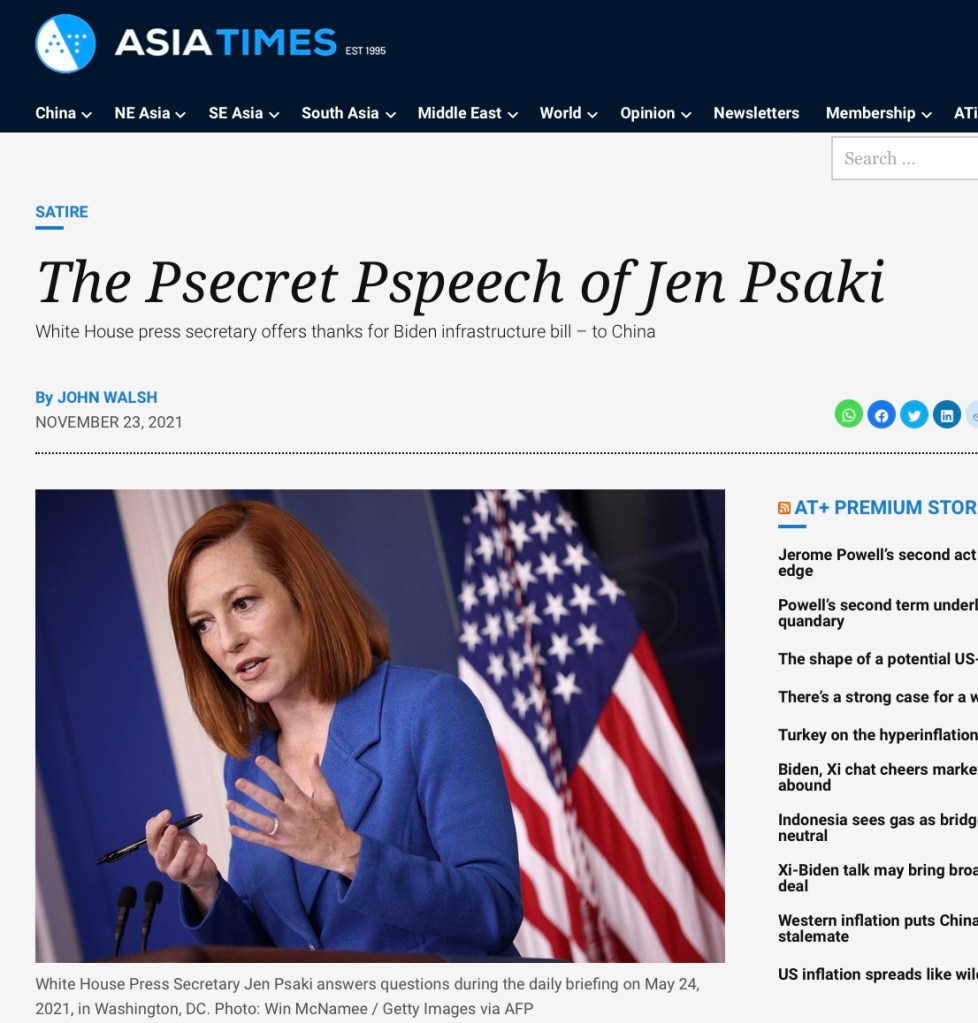
The Psecret Pspeech of Jen Psaki – White House press secretary offers thanks for Biden infrastructure bill – to China By JOHN WALSH NOVEMBER 23, 2021
White House Press Secretary Jen Psaki reaffirmed Joe Biden’s stance that he was not an “old friend” of Xi Jinping before the summit between the two leaders last week. This was big news. And the media play it received was quite disturbing to Psaki, as it turns out.
Seeking to clarify matters, she wrote a statement to read to the press corps explaining her stance on China-US relations. She planned to read it to the press during Thanksgiving week.
Presidential advisers, however, put the kibosh on the statement – and reportedly tried to put the kibosh on Psaki herself after they saw her draft. From reliable sources, who asked to remain anonymous because of the sensitivity of the situation, we have obtained portions of the statement, which has come to be known among Washington insiders as the PPP, Psaki’s Psecret Pspeech.
Here is the text of Psaki’s scuttled statement planned for delivery to the White House Press Corps.
Hello everyone.
Before we begin today’s press briefing, I wish to say once again that it is great to be back here with all of you after my bout with Covid-19. I learned a lot while thinking about things during my illness, and I will return to that.
But first I want to reflect on the events of the past week including the President’s meeting with President Xi of China and the signing of the infrastructure bill. And in part I will address my remarks directly to China.
To begin with – and let us not mince our words – the American people owe China a great debt of gratitude for the infrastructure bill. On behalf of all Americans, I wish to thank China. Without you we could not have done it. For decades we have had potholed roads, lead-laced drinking water, and the narrowest of broadband, especially out in the countryside. Now that will change, if only a tiny bit. And you, China, deserve the credit.
In fact The New York Times, mouthpiece of our foreign-policy Establishment, made that very point two days after the signing of the bill:
“President Biden on Tuesday began selling his $1 trillion infrastructure law, making the case that the money would do more than rebuild roads, bridges and railways. The law, he said, would help the United States regain its competitive edge against China.
“’We’re about to turn things around in a big way,’ Mr Biden said. ‘For example, because of this law, next year will be the first year in 20 years that American infrastructure will grow faster than China’s.’”
You see, China, getting some federal funds for things we need is an uphill battle. But when our politicians see things in terms of an enemy, they scurry about like industrious little beavers getting things done.
Now, China, I recognize that you begged to differ on the size of the infrastructure bill. Your daily, Global Times, which occupies the same niche in China as do The New York Times or WaPo in the US, labeled the bill “a feeble imitation of China.” That is true; you, China, spend about 5.1% of GDP on infrastructure and we spend 1.5%.
As a wordsmith myself, I would choose the word “puny” to describe the bill – at least compared with our whopping national0security budget. But hey, when you are starving, crumbs can look like a banquet. And without you, China, we would not even have the crumbs.
Next, China, I want to talk about another big problem we are facing: inflation. Without you, it would be far worse. Because you handled the Covid-19 pandemic so well, your economy kept plugging along and we Americans got a bigger supply of cheap goods, which of course helps to keep prices in line.
Unfortunately, our leaders, namely The Donald and now The Joe, are laying tariffs on your goods, making them more expensive for our own people. You give us a gift and we destroy it. You probably think us inscrutable or at least ungrateful – and I don’t blame you for one moment.
I could go on with this praise, but no one is perfect, China. There is one area where I must level a criticism, and it comes of my personal experience with Covid. And here I fault you for your propaganda performance – and I speak as part of the most expert propaganda team on the planet.
Quite frankly, you are lousy propagandists. You contained Covid with fewer than 5,000 deaths and fewer than 100,000 cases – total. And the “draconian” lockdowns after the initial 76-day lockdown in Wuhan were not so massive nor so widespread as we made them out to be.
I mean your public health achievement is awesome, and I reflected a lot on it as I was in quarantine with Covid, thankfully not very sick. But you let the news coverage be dominated by every trivial event including the inevitable missteps at the outbreak of a new pathogen for which the local officials were sacked.
(Good for you, China – we have many state governors who deserve punishment for their behavior during the pandemic – not the least of which is Mr Cuomo, who stuffed Covid patients into nursing homes.)
But if you were more effective at getting the word out, perhaps the American people would have risen up and demanded the same results that you got. Perhaps I would not have fallen ill and perhaps 760,000 Americans would still be alive. Honestly, China, you have to step up your information campaigns – a lot is at stake.
China, I also want to thank you for the event in Beijing at the very time of Xi-Biden confab, a refreshing change from the unrelenting hawk talk hereabouts. Again, let me quote The New York Times:
“Even as the two leaders met virtually, another meeting was taking place in Beijing, commemorating the American pilots known as the Flying Tigers who aided China during its war against Japan in 1941 and 1942.
“’The story of the Flying Tigers undergirds the profound friendship forged by the lives and blood of the Chinese and American people,’ Qin Gang, China’s ambassador to the United States, said during the event. Acknowledging the tensions in the relationship, he added that the two countries ‘should inherit the friendly friendship tempered by war.’”
Finally, I wish to conclude with the words of the late chief justice Earl Warren, “Everything I did in my life that was worthwhile, I caught hell for.”
OK. Questions?
John V Walsh, until recently a professor at the University of Massachusetts Medical School, has written on issues of peace and health care for Asia Times, EastBayTimes/Mercury News, LA Progressive, Antiwar.com, CounterPunch and others.
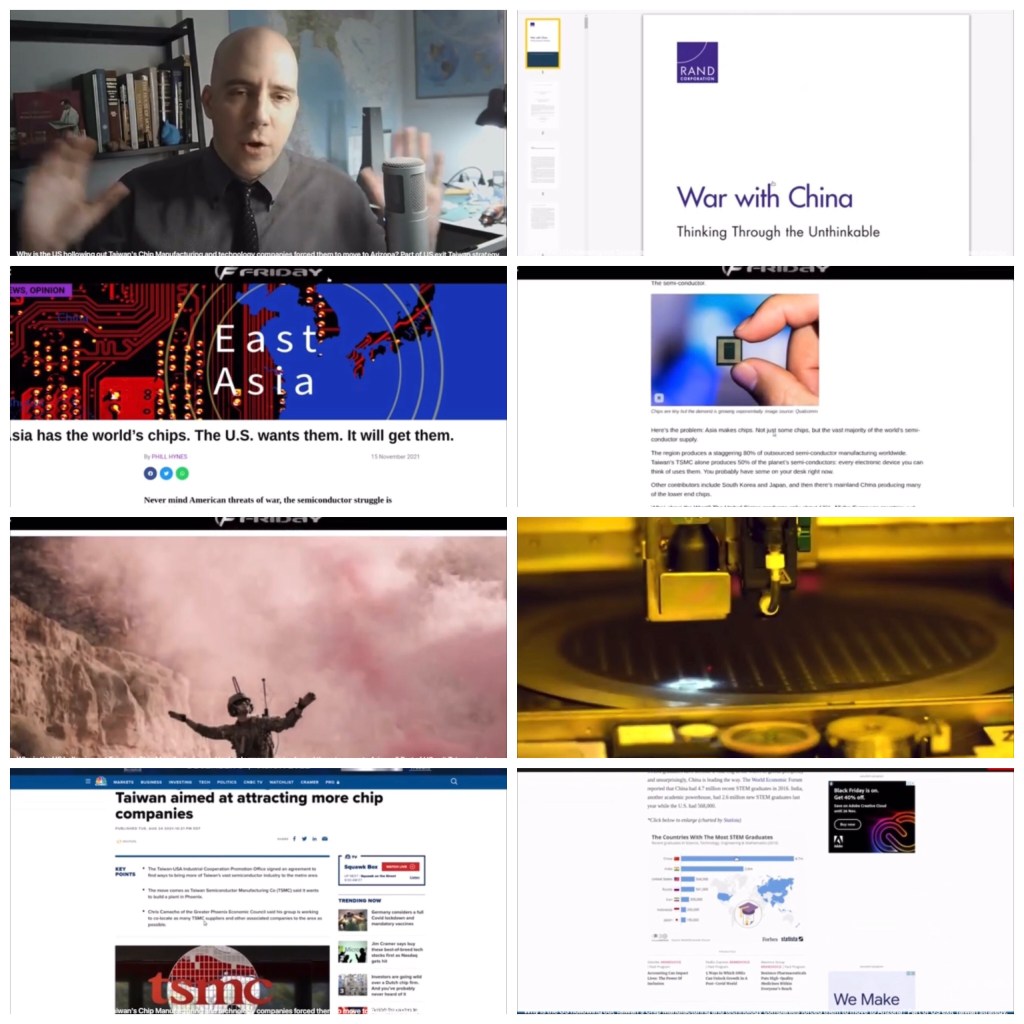
Video: Why is the US hollowing out Taiwan’s Chip Manufacturing and technology companies forced them to move to Arizona? Part of US exit Taiwan strategy. 美國為何將台灣的芯片製造和科技公司挖空強迫他們搬到亞利桑那州? 是美國退出台灣戰略的一部分.
The US is moving chip manufacturing out of Taiwan with extreme expediency. This is more than mere decoupling and competition, this is tying off a limb that is about to be amputated – and bodes ill for not only mainland China, but Taiwan as well.
These daily videos (Monday to Friday) are published first for Platinum Sponsors and above first, then made public later on in the week. Thank you for your support and making this work possible!
 Johnson Choi Biz