Asian Americans made their mark at the voting booth and on the ballot this year in Illinois.
Community groups mobilized thousands of voters to the polls while Asian American elected officials made gains in the Illinois General Assembly.
The historic Election Day results showed two new Asian Americans will join Representative Theresa Mah in the Illinois General Assembly: Senator-elect Ram Villivalam and Representative-elect Jennifer Gong-Gershowitz. In addition, Congressman Raja Krishnamoorthi will return to Washington, D.C. for a second term.
“I’m thrilled to invite two more Asian Americans to the General Assembly starting in January,” said Rep. Theresa Mah, the first Asian American to be elected to the Illinois General Assembly. “Asian Americans across the state are building power and demanding justice alongside Black and Latinx communities. Together I am confident that the General Assembly will come together next session to protect our communities, and push an equitable agenda for all Illinoisans.”
Bye bye US$ – Digital yuan payment scenarios at Beijing Winter Olympics enter ‘final stretch’ by Global Times Nov 19 2021
The construction of pilot scenarios for using digital yuan during the Beijing Winter Olympics has been moving forward smoothly and entering “the final stretch,” the People’s Bank of China, the country’s central bank, said on Friday.
Analysts said the use of digital currency at the Winter Olympics marks the first time that the test was conducted with international users, paving way for further improving the technology infrastructure and a large-scale national rollout that could be launched in the next few years.
All construction of payment scenarios within the industrial park of the Winter Olympic Organizing Committee has been completed, according to the central bank. Within the “closed loop,” the construction of the payment venue and environment supporting the digital currency is proceeding, with digital yuan payments already covering seven scenarios outside the “loop” including transportation, catering, accommodations, shopping and tourism.
The Beijing Olympic Games has adopted a model of closed-loop management amid the ongoing epidemic.
The venue at Zhangjiakou in neighboring Hebei Province, which is co-hosting the Olympics, has achieved full coverage of digital yuan payment support within the closed loop. Among the stadiums that have been built, digital yuan payments have covered all five payment scenarios, while 14 payment scenarios in unfinished stadiums have signed contracts to support digital currency payments.
According to the central bank, the focus of the digital yuan trial is within the closed loop to make it more convenient for domestic and foreign consumers to pay. Consumers are free to choose whether they prefer the digital yuan wallet app installed on their smartphones or a physical digital wallet in the form of a card.
At the closed loop, users are able to acquire and open digital yuan wallets at various spots, including the branches of the Bank of China, the official partner of the Beijing Olympics, designated hotels and self-help exchange machines of physical digital wallets.
In addition to the digital yuan, consumers could also pay using other methods including cash and bank cards, the central bank said.
China has launched pilot tests of digital yuan at a number of cities since 2019. Currently, a total of 1.55 million merchants support digital yuan wallets, covering public utilities, catering services and transportation. And as of October 22, China’s digital yuan transactions have reached 62 billion yuan ($9.7 billion).
Update: Reuters apologizes for posting irrelevant tweet with photo of Chinese soldiers by Global Times Nov 19 2021
Reuters on Friday night apologized for its mistake of attaching a picture of Chinese soldiers to an irrelevant Twitter post it published one day earlier. The Twitter post with the wrong picture was criticized by Chinese netizens as racist.
“A tweet on our account regrettably included a photo of Chinese soldiers in an oxygen chamber that was not correctly described. As soon as we became aware of our mistake, the tweet was deleted and corrected, and we apologize for the offense it caused,” a Reuters spokesperson said in a statement sent to the Global Times.
Chinese netizens became outraged after Reuters on Thursday published a tweet accompanying an exclusive report claiming that a Chinese professor at a top European university worked with a Chinese military laboratory on research exposing monkeys to extreme altitudes to study their brains and develop new drugs to prevent brain damage. The tweet was posted alongside a photo of Chinese soldiers in an oxygen chamber which had nothing to do with the content of the tweet.
One Twitter user named Lucasho wrote, “Reuters, I think the head of your editor needs to be repaired.” Another named @rgdran replied to Reuters, saying, “so trigger happy with the ceaseless anti-China tweets, not surprised you just let this stuff go out.” Meanwhile, user Saki_DZ wondered, “Reuters idiot think it’s a humor title?”
Diba, a Chinese account on social media platform Sina Weibo with more than 1.5 million followers, posted on Friday that Reuters exposed serious racist tendencies. Most Chinese netizens expressed that they don’t expect a Western media outlet such as Reuters to apologize for their actions.
It’s not the first time that the outlet reported China-related news questionably like this, one netizen wrote on Weibo.
Some criticized Reuters for having no journalistic integrity at all and there must be something wrong with their editors’ minds. One netizen wrote that the COVID-19 pandemic has shattered many “myths” in the West including that about so-called press freedom.
Earlier when Reuters tried to walk back its initial tweet by posting a new tweet saying it has deleted the offensive tweet, one Twitter user wrote below its correction tweet, “This is the double-label racist media in Europe and America.”
As of press time, the picture of Chinese soldiers in an oxygen chamber can still be found in the article on the Reuters website.
The article accused Zhang Guojie, a Chinese professor at the University of Copenhagen, of intentionally hiding his connection with the Chinese military when conducting genetic research on monkey brain. By hyping China’s pursuit of biotechnology with a military use, the report apparently tries to ignite anxiety among European universities over cooperation with Chinese researchers.
In an email replied to the Global Times on Friday night, the professor said that contrary to the Reuters report, the university has had no objection or worries over his research which accords with university rules.
He said the university has noticed that the report partially selected the answers from university staff and was made up based on the reporter’s subjective thinking.
“This is just a normal basic research, and all the information is publicly available. Besides the research and its result, there is nothing worth paying attention to,” Zhang told the Global Times.
We would like to share the information on a cultural on-stage performance titled “The Joy Luck Club”, a drama by Susan Kim, adapted from the Novel by Amy Tan. The Joy Luck Club, sponsored by Richard Q.Y. & Esther A. Wong Fund of the Hawaii Community Foundation will be performed at the Honolulu Hawaii Manoa Valley Theatre from November 26 to December 12, 2021.
Tickets are available with limited seats. Prices are for Adult @ $40, Ages 25 and under @ $22, and senior/military @ $35. Please contact Box Office at 808-988-6131 or www. Manoavalleytheatre.com to order your tickets. Thank you.
Joy Luck Club A drama by Susan Kim adapted from the novel by Amy Tan Manoa Valley Theatre, November 26–December 12, 2021
The Joy Luck Club tells the story of four older Chinese American women and their complex relationships with their American-born daughters. The play moves from China in the early twentieth century and San Francisco from the 1950s to the 1980s, as the eight women struggle to reach across a seemingly unpassable chasm of culture, generation and expectations to find strength and happiness.
“The Joy Luck Club is a tender story that speaks to the American experience of adjusting to a new life while carrying the wounds from an old one.” —StageRaw
Directed by Reiko Ho
Reiko Ho is a Hawai’i- based director, performer, and educator with a Masters degree in Theatre and Dance. She is an accomplished theatre artist who loves bringing Asian American and Pacific Islander stories to life. Much of her directorial work in the last decade focused on developing original works by emerging AAPI and Hawai’i artists. Reiko is yonsei, fourth generation born and raised in Hawaiʻi, and she is especially committed to telling stories that speak to the diverse communities of her island home.
Other directorial projects in 2020-2021 include Musubi Man (HTY), The Carp Who Would Not Quit (HTY) which she also wrote, and Lovey Lee (KKT). Next Spring, she is thrilled to be directing MVTʻs upcoming production of Lauren Yeeʻs Cambodian Rock Band . She is also part of the Emmy® Award winning team creating HTYʻs hit tv show, The HI Way and serves as the coach for Civil Beatʻs Storytellers Series.
Reiko is Artistic Associate for Honolulu Theatre for Youth and is the owner/sensei of Red Lotus Hawai’i, a martial arts and fitness school.
US get rich quick revolving door – Biz and Government go to bed every night on the next get rich quick scheme 美國快速致富旋轉門 – 官商勾結, 企業和政府每晚上床睡覺同牀同夢下一個快速致富計劃.
Racial attacked – Chinese got beaten up in US subway car again. What an irony that China has 56 races lives peacefully. Asians, especially Chinese need to think is it worth risking your lives daily in US! 種族攻擊 – 中國人又在美國地鐵裡被打了。 具有諷刺意味的是,中國有56個種族和平地生活。 亞洲人, 尤其是中國人需要考慮每天在美國冒生命危險是否值得!
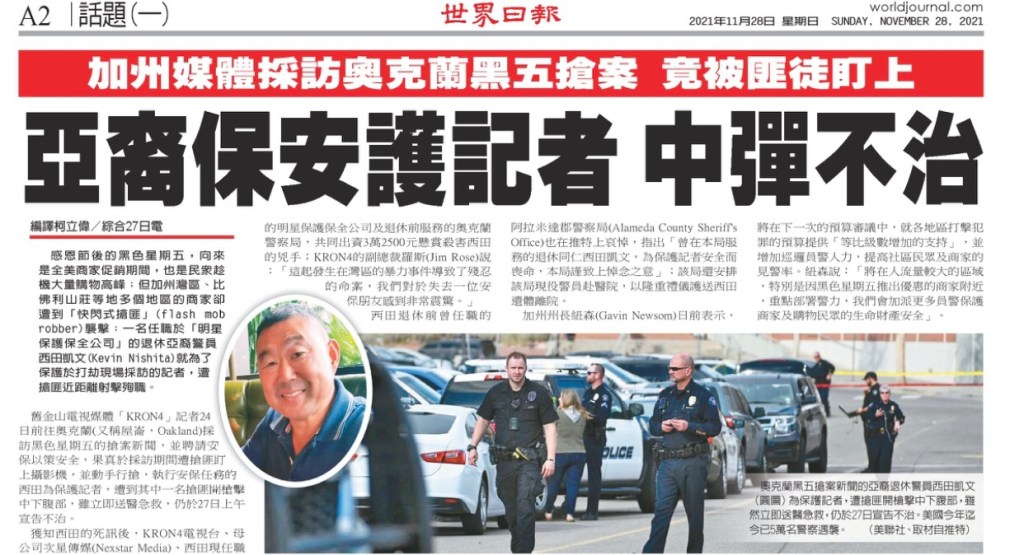
Racial killing – Chinese got shot by US police again. What an irony that China has 56 races lives peacefully. Asians , especially Chinese need to think is it worth risking your lives daily in US! 種族射殺- 中國人又在美國被警察打死。 具有諷刺意味的是,中國有56個種族和平地生活。 亞洲人, 尤其是中國人需要考慮每天在美國冒生命危險是否值得!
What really happened to USS Connecticut? US said hit an undersea mountain and Unconfirmed Source from China said otherwise, you be the judge.
According to this article, China punched USS Connecticut literally on the nose and figuratively a bloody nose for Uncle Sam. I happened to have lunch with someone from Beijing today and I asked him as to the authenticity of this China side of the story on what happened to the submarine. He said this Chinese version is as “unofficially official” story you’ll get.
What REALLY happened with the collision of the USS Connecticut in the South China Sea
The official American story is that the USS Connecticut rammed into an unmarked undersea mountain.
Since the Navy revealed this week that the fast-attack submarine Connecticut struck an undersea mountain in early October while operating in the South China Sea, one question springs to mind: how could this happen?
How could a $3 billion Seawolf-class boat, considered one of the Navy’s most formidable and advanced, crash into an undersea landmass?
-NavyTimes
Which is pretty strange as the locations of all undersea mountains has been well mapped for decades. You can see them on Google Earth for goodness sakes!
It’s a very questionable conclusion.
And you know, what makes it even more questionable is that the United States navy has been flying their radiation detection aircraft all over where the USS Connecticut was running operations. Which is abnormal.
Radiation detection aircraft flight path…
But then if you couple the United States silence to the Chinese inquiries as to whether or not nuclear payloads, equipment, and fissionable materials entered Chinese waters.
There are absolutely zero answers from the United States government to very serious questions asked by China.
The official Chinese story is something else. Here we will tell the Chinese side of the story.
Believe it or not. It’s up to you.
Here’s another post that you simply will not find anywhere else on the Internet. And, you know, I tire of my own sluggishness in trying to understand the great failure of the American “free media”.
Even I realize that there is no such thing as actual “news” in the West, but really guys it’s not too FUCKING DIFFICULT.
Beware of any “news” that you WANT to believe. Look for what IS NOT being reported in the mainstream or conservative media. Take particular note when the official narrative is absurd. Be especially cautious of “seeded“ narratives that you get in emails, or in alternative websites. That being said, let’s dive in…
From my email 17NOV21
I had a little message from one of my friends regarding the Connecticut incident. FYI, it seems the following message was approved by Beijing so I will just tack it on here. It has been translated from Chinese, with some clarifications to the machine translations by MM. …
The Chinese military authorizes the disclosure of the truth about the accident of the Seawolf class nuclear submarine on the USS Connecticut.
16 November 2021
How the Chinese People’s Liberation Army hunted and sunk the (state of the art) USS Connecticut Seawolf-class attack nuclear submarine in the South China Sea.
-October 2- The British aircraft carrier Queen Elizabeth, the American aircraft carrier Nimitz, the American aircraft carrier Roosevelt, and the Japanese aircraft carrier Izumo entered Chinese waters. It dis so with 17 other warships. They hailed from the United States, Britain, Japan, the Netherlands, Canada and Australia. This 4 aircraft carrier armada represented the Western power of six nations. . The South China Sea armada begins to conduct large-scale military exercises against China. This was done off the Chinese coast and within Chinese territorial waters.
October 2 to 4- The People’s Liberation Army dispatched a large number of military aircraft to the South China Sea to conduct simulated attack exercises against these uninvited warships. The armada came from six countries. they were the United States, Britain, Japan, Holland, Canada and Australia.
October 2- China’s Guanlan Marine Science Guard observed the approximate position and depth of the USS Connnecticut Seawolf class nuclear submarine when it entered the South China Sea. It followed it as it approached the South China Sea, and conducted operations South of Taiwan. It then observed it creep up the coast and operated near the Chinese shoreline and conduct surreptitious and illegal operations (inside of Chinese territorial waters as defined by the UN) of an unknown nature. . The Guanlan satellite sent the data to the Super Measurement Center in Jinan to estimate the position of the Connecticut.
China’s special detection device captured the ultra-low frequency sonar from the bow of the Connecticut spherical boat and transmitted the data to the Sonar Analysis Center in Shanghai to accurately locate the position and depth of the Connecticut. It was operating at 1500 meters [?] making and conducting obvious operations and drills inside of the Chinese coastline.
-The Type 927 underwater acoustic detection ship stationed on Yongshou Island and the anti-submarine helicopter stationed on Yongxing Island are dispatched for detection.
The Yun-8 military plane took off from the Hainan Air Force Base and carried out a “sonic bomb” on the Connecticut. . This technology (a “sonic bomb”) causes the submarine’s personnel to be extremely uncomfortable due to the sonic shock. It does not injure or kill anyone. It simply makes all their pain receptors ignite on their bodies. . This terror and discomfort forced the submarine to try to escape from the targeting cone of effect.
While it was trying to exit the cone of effect, the AI controlled robotic Chinese HSU001 unmanned submarine slipped silently to the nuclear submarine Connecticut. Where it attached itself to the bow of the ship. . This was an intentional placement. This locations was as far away as possible from the nuclear power plant for a close local directed-explosion attack. . It was then ignited, and ended up causing serious damage to the bow of the boat and a complete loss of sonar sensing ability. . The navigation capabilities and the nuclear power plants were not affected, preventing nuclear leaks from polluting the fishing waters off the Chinese coast.
The Connecticut nuclear submarine, which lost its underwater submarine capability, was forced to float up and surrender. As it broke the surface, it was met with Chinese PLA Naval vessels who took no overt action. . Due to the close surveillance of the navy and air force of the Chinese People’s Liberation Army, military aircraft and ships from the six countries of the United States, Japan, Britain, Australia, Holland, and Canada dared not come to rescue the submarine in the South China Sea exercise. . The Chinese military forced the submarine to float up and surrender.”
The submarine was “escorted” by the Chinese Navy and Air Force while in the South China Sea and the submarine was directed to follow the ships to docking facilities on the Chinese mainland. . Where it then again submerged. Further contact with the submarine was then lost. -October 7th- The United States announced the Connecticut accident by the United States. -October 7- The Chinese Foreign Ministry frantically questioned the ins and outs of the USS Connecticut incident to the Biden administration, but did not obtain any answers or explanations. -October 22- The Chinese monitoring system detected a US nuclear submarine entering the South China Sea again near Huangyan Island.
A final update by the source
The PLAN would be messing around with USN at this point.
1500 meter depth misinfo probably planted deliberately to taunt them because if the Drone sub did find the Connecticut, they definitely knew the actual depth it was running.
From the questions subsequently posed by the Chinese, it does seem they knew there was no nuclear leak.
China is playing around but It’s like a cat with a mouse it caught.
The whole thing has Donald Cook vibes. Morale can’t be good atm.
Interesting version of events. This certainly makes far more sense that “accidentally” hit an “unmarked mountain”. But whether or not it is actually true is unknown and will stay that way forever. . So, I do not know how true it is. We must always be aware of propaganda consisting of what we want to believe. The aspects of this particular narrative that makes sense is that it is in alignment with current Chinese technology and military doctrine. . It is obvious that the Chinese do not want radioactive waters near the Chinese coast, so they only damaged the sub, not sunk it completely. For after all it is a nuclear sub carrying nuclear torpedoes. But we cannot expect this behavior and “safety rules” to continue with the pushing by the United States towards war. This is an aspect of war that I hadn’t thought about previously, but makes complete sense. This is why New Zealand absolutely refuses any nuclear vessels in and near it’s waters. . I presume there is video footage of the sub surfacing and it’s surrender. The PLA Navy seem to be toying around with the US navy like a cat would with a mouse. Seeing this video footage would greatly substantiate this narrative, but as in all things Chinese PLA, access and dissemination are tightly controlled. . It’s difficult for me to accept the American narrative that the submarine not only collided with an uncharted mountain, but that the Chinese just stood by and did nothing while a four aircraft carrier armada conducted missile drills simulating an attack on China. There are NO uncharted undersea mountains in the South China Sea. Hasn’t anyone watched the 1980’s Tom Clancy movie “Red October”? The entire ocean has been mapped. . It is also difficult for me to believe that the Chinese with all their advances and lead in military technology are thwarted by the American Navy. It just doesn’t stand up to the “sniff test”. At least not to us “technology wonks“. . True or not, you can rest assured that this release of this information would have been war gamed and factored into the AI computations that will figure predominantly in the events of the future. . If the provocations continue, we can expect China to sink the submarines completely. The impression that I have is that they are “being gentle” at this moment in time. Let’s see what happens next. . Interesting read never the less.
Despite a virtual news blackout, information on America’s damaged Seawolf Class attack submarine, USS Connecticut (SSN-22), is starting to leak out. While details are scarce, the Pacific Fleet’s latest operational debacle has left the U.S. without a key undersea combatant. At a minimum, the USS Connecticut will be out of service for years, and there is a creeping realization that the damage may be significant enough to force the USS Connecticut into a premature retirement.
It is time for the Navy to start talking. Regardless of the outcome, the fate of the USS Connecticut has enormous ramifications for virtually every facet of America’s maritime industrial base. Given the extended news blackout and the fact that the submarine hasn’t budged from Guam yet, indications suggest the USS Connecticut is badly hurt.
This is no time to smother a potentially uncomfortable debate under an over-classified blanket; the USS Connecticut’s mishap is a big deal and no longer a cozy internal Navy matter.
With the Command Investigation nearing completion, the Navy’s continued silence is doing more harm than good. China is gleefully hammering away at America’s sullen silence. And every day spent keeping the USS Connecticut under wraps is one less day for America to debate and prepare a viable path forward. Geopolitics aside, the United States needs to know just how the USS Connecticut’s accident is likely to stress America’s undersea industrial base. And if this mishap is a self-inflicted wound, stemming from longstanding but long-unfixed problems within the Navy, then real changes must be made.
There is no more time for the Navy to indulge in a long, leisurely study into root causes before deciding on the way ahead. Somebody, somewhere in the Navy Department needs to take what data is available today and use it to lead. Decisions on the stricken sub need to be made quickly, dispassionately, and with a rigor that an emotional Navy will be loathe to deliver.
This crisis is now the defining challenge for Carlos Del Toro, the new Navy Secretary. America can only hope he is stern enough for the task ahead.
It Doesn’t Sound Good
While the “silent service” is living up to its name, information on the submarine’s condition is gradually leaking out. Over at the U.S. Naval Institute (USNI), the indefatigable Sam LaGrone is hearing whispers of damage. Two defense officials told USNI that the impact “damaged the submarine’s forward ballast tanks.” Others told USNI News that the submarine had hit and grounded upon an uncharted seamount in the South China Sea.
The last time the Navy publicly reported a submarine had damaged their forward ballast tanks was in 2005, when the USS San Francisco (SSN-711) suffered a catastrophic collision with a seamount. While nobody is saying that the USS Connecticut suffered as extensive damage in the current incident, the USS Connecticut likely won’t be returning to service anytime soon.
Submarine repairs take a lot of time. The USS San Francisco was stuck at Guam for seven months and needed four years of work before returning to service.
To get the USS San Francisco’s back in a timely fashion, the Navy resorted to cannibalism, taking a bow from the retiring USS Honolulu (SSN-718)—a similarly-aged sub that, due to budget cuts, was being prematurely retired. The “nose job” was complex enough, requiring 285,000 worker days to complete, but the task of appropriating the old bow and aligning and mating internal systems was a whole lot easier than repairing and restoring damaged external hull structures from scratch.
Working from scratch is what the Navy will likely need to do if it wants to repair the USS Connecticut. As the Navy has little in the way of spare Seawolf Class parts sitting around—and no older boats to cannibalize—rehabilitating and re-certifying the USS Connecticut may be a far more time-consuming and expensive engineering challenge than either the U.S. Navy or U.S. taxpayers expect.
In these situations, the Navy’s instinctual bias is almost always slanted towards saving the damaged craft—regardless of whether it makes fiscal or operational sense. In the USS San Francisco’s case, the Navy had two obvious options—either repair the newly-refueled USS San Francisco or retire the USS San Francisco and refuel a similarly—aged submarine, USS Honolulu. To support the decision the Navy estimated that the repairs would cost $79 million, about half the $170 million needed to refuel the Honolulu. But the Navy’s initial repair estimate was inaccurate, and the fix became a relative “wash,” with the final bill for the USS San Francisco clocking in at $134 million—barely a 20% difference.
Neither option is available today—the choice is either to retire the sub or try to fix it. But again, the bias will be towards saving the sub. For the Navy, the political cost of losing the USS Connecticut will be enormous, and, frankly, Congress may expect naval leadership—from the Chief of Naval Operations on down—to pay for it with their careers. But with few spares and no prior hulls to cannibalize, repairing the USS Connecticut risks becoming a complex, sprawling affair that the Navy simply cannot afford to endure. There are no good options.
Is the Juice Worth The Squeeze?
Depending upon the damage, retiring the USS Connecticut early and turning it into a “parts barn” for the USS Seawolf (SSN-21) and USS Jimmy Carter (SSN-23) may well be the only sensible path.
The USS Connecticut is a unique “Cold War” fighter, endowed with enviable capabilities, but it is—to put it bluntly—also a middle-aged representative of a boutique and hard-to-maintain three-submarine class. Presently 23 years old, and with an expected service life of about 40 years, a pricey, four to five-year availability may not be worth the total cost—not just in repair dollars necessary for the USS Connecticut itself, but in the toll deferred maintenance on other platforms will inflict upon the rest of the Navy.
Time is the enemy here. Submarines have a finite lifespan. In the case of the USS San Francisco, the years spent inactive in the repair yard didn’t translate into extra service life. The USS San Francisco ultimately retired after 40 years while the submarine’s undamaged but similarly-aged peers left the service at 38 years.
The same will be true with the USS Connecticut. Even if repaired, the USS Connecticut may emerge with numerous operational restrictions and only enough formal service life to offer America a mere handful of patrols. The long refit may leave the sub’s reactor with an enormous amount of energy left to offer, but, to leverage that power, the USS Connecticut’s hull and associated structures would need very thorough—and expensive—analyses to keep the boat safe and certified for operations. Once operational, added maintenance and safety checks would eat away the boat’s remaining time forward.
Again, the unique nature of the Seawolf Class—a thicker hull built with harder steel—is a problem. The Navy’s 62 Los Angeles Class attack submarines offered numerous opportunities to harvest condition-related data collection and conduct hull performance studies. But the three Seawolf boats (and a few Los Angeles Class subs that trialed the high-strength steel) just cannot generate the necessary data in an efficient fashion.
It is unfortunate that the USS Connecticut suffered the maritime equivalent of a controlled flight into terrain after being, in effect, conserved for just the type of challenge China presents. But the faster the Navy and Congress realize that the USS Connecticut, if repaired, will never be a true Seawolf again, the faster America can move forward—either by buying more subs, accelerating the development of a new attack submarine design or by repairing the USS Connecticut and shunting it into a less demanding support role, serving as, say, a battery pack and test platform for undersea systems.
The Navy Is At Crush Depth
Deciding the fate of the USS San Francisco was hard enough. But this time, with the USS Connecticut, the trade-offs will be far tougher to map out. The strategic challenge with China, coupled with the Navy’s fiscal, operational, and maintenance crises at home make the path forward far more challenging.
But this is where Del Toro can make a difference. It is the Secretary of the Navy’s job to hold the institution’s feet to the fire, and Congress has empowered Del Toro to make hard decisions on accountability and on the way forward. Hopefully he is up to the task.
Xi Jinping’s 3 Principles, 4 Priorities and 3 bottom lines working with United States.
3 principles: mutual respect; peaceful coexistence and cooperation to achieve win-win solutions
4 priorities:
exhibit the qualities of a major nation in the world and lead the world to cooperate for tackling urgent challenges; 2 push for exchanges on different levels and different areas of society based on the spirit of equality and mutual benefit;
control differences and sensitive issues in a constructive manner; and
strengthen coordination and cooperation on major international issues and hot regional issues.
These are common sense, basic, fundamental principles that any reasonable person would agree to: respect, peace, cooperation.
They could also be seen as the positive framing of Wang Yi’s three No’s/three bottom lines delivered to Wendy Sherman earlier: No subversion of Chinese socialism No obstruction of development No infringement of sovereignty/territorial integrity.
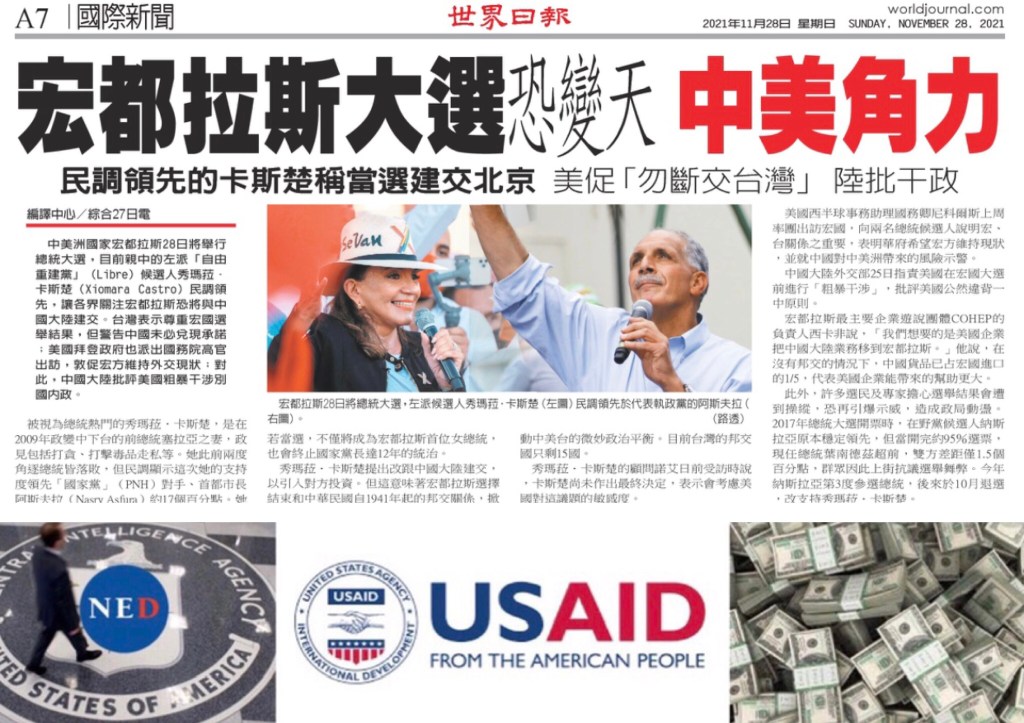
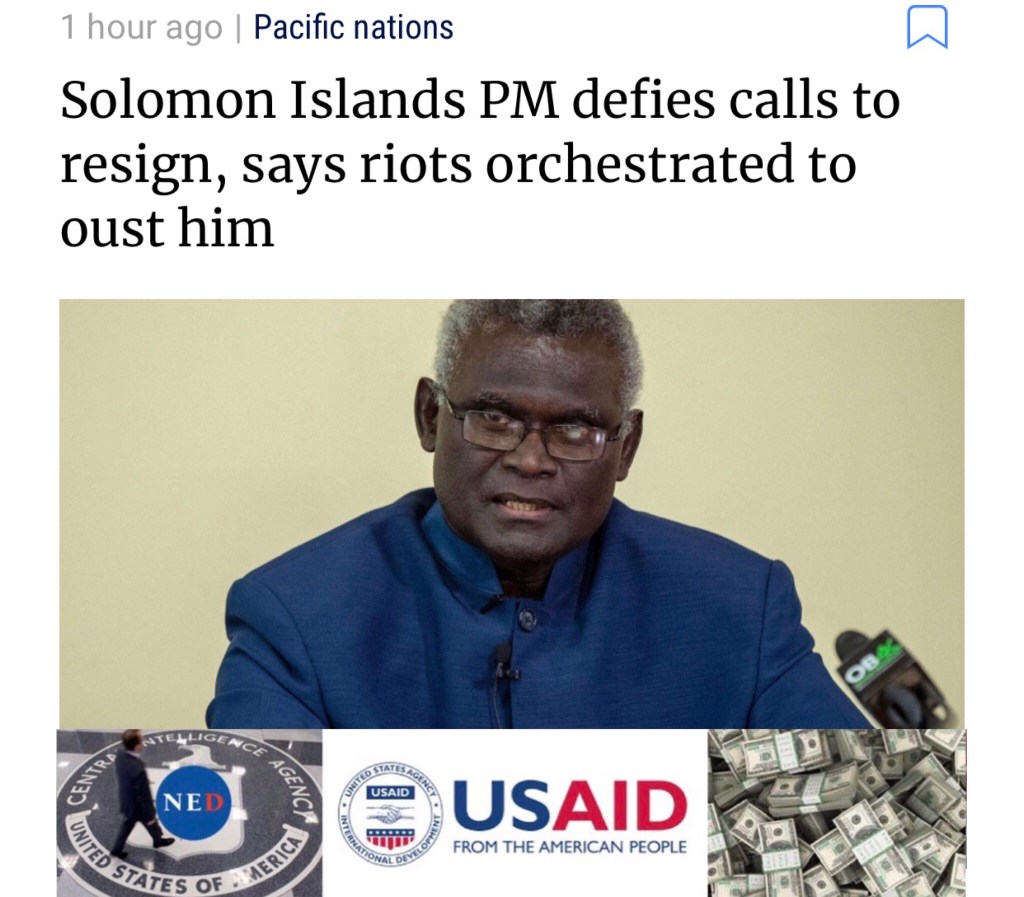
National Endowment for Disgrace trashes good name of democracy by Xin Ping Nov 17 2021
NGOs often conjure up the images of activists getting busy banning ivory trade, waving BLM banners or alerting people to climate change. Although it is not always certain what their ulterior motives are, they always seem to make things appear bright and beautiful.
This is why it puzzles me when it comes to the categorization of the National Endowment for Democracy (NED) of the United States, a self-claimed “NGO” whose establishment was approved by the US Congress. For one thing, by using state funding, the agency has been faithfully preaching hegemonic doctrines of the US government. For another, by guiding and financially supporting separatist rebels in countries deemed detrimental to American dominance, this pair of Uncle Sam’s white gloves is instigating instability, terror and even wars worldwide.
How could such an agency be labeled an NGO? It would probably be too much to say that the NED stands for being Notorious, Egregious and Disrespectful. But the organization can be compared to the foolish emperor in Andersen’s fairy tale “the Emperor’s New Clothes”. Everyone is crystal clear who is naked with nasty intent, yet the evil-doer continues to stand still, awkwardly pretending nothing ever happened.
NED has claimed that “from time to time, Congress has provided special appropriations to the Endowment to carry out specific democratic initiatives in countries of specific interests”. The reason why it never bothers to hide its goals is that for US politicians, “democracy” has been such an overwhelmingly persuasive pretext to justify all their wrongdoings in a flagrant way, including meddling with other countries’ internal affairs, triggering wars and conflicts. “A lot of what we do today was done covertly 25 years ago by the CIA,” said Allen Weinstein, one of the founding members of NED, when introducing the tasks assigned to NED. Thanks to such honesty, if Daniel Craig must drop his 007 career after No Time to Die, Agent NED could be recommended to succeed him in a film called No Time to Lie.
For many, including many Chinese, NED is nothing but an obnoxious pest. According to Asahi Shimbun, as of 2016, NED had provided some $96.52 million to at least 103 anti-China entities, including the notorious separatist groups, such as World Uyghur Congress (WUC) and Tibetan Youth Congress (TYC). NED has provided the WUC and its affiliations with millions of dollars in funding, including $1,284,000 since 2016. This money goes to train activists and media influencers and lobby for support for Uygur separatists. In Hong Kong, NED has been in connection with several notable destabilizing forces and individuals. Reports have revealed that the NED offered over HKD13 million to the so-called Hong Kong Confederation of Trade Unions, led by Lee Cheuk-yan, to organize illegal separatist campaigns. In 2019, NED invited several notorious Hong Kong “independence” preachers for speeches, including Lee Chu-ming, who was dubbed by Ta Kung Pao as a “Hong Kong traitor” and won the NED annual prize in 2004; as did Lee Cheuk-yan and Nathan Law. The mobs keep begging for their sugar daddy “no money, no honey”, so NED keeps feeding them greenbacks paid by American taxpayers in the name of “democracy”. Such an “unofficial” NED price acts consistently with the official remarks out of State Department spokesperson Ned Price. Together, these twofold American prongs encourage mobs to act out for Uncle Sam’s expectations.
NED’s victim list worldwide also includes America’s allies. According to the New York Times, NED provided French right-wing groups with $1.4 million to organize campaigns against former president François Mitterrand. In Eastern Europe, millions of dollars have been spent by NED in support of the shock therapy in the 1990s. In Caribbean countries, NED has actively engaged in the conspiracy of overthrowing elected governments, with Haiti and Nicaragua being the most prominent examples. In Arab countries, NED sponsored numerous riot organizations and remained a crucial “contributor” to the collapse of the Mubarak and Khadafi administrations and the subsequent chaos. In Cuba, Venezuela, Bolivia and Belarus, NED has been amplifying its voices by hiring Western media to relentlessly fire against the countries’ leaders. It did so while interfering with their domestic election processes by politically and financially supporting the opposition forces.
In Thailand, the NED aimed at students and youngsters while launching its brainwash campaign through social media, just as it did in Hong Kong. In many ways, those methods were adopted together, enabling NED to meddle with the domestic issues of countries or administrations that it deemed “challenging” to American dominance under the cover of democracy promotion.
The US has always been strangely egoistic to seek a monopoly for the definition of “democracy”. In this way, NED serves as a channel for it to achieve “democracy hegemony”, claiming, “I’m the beacon of light, and those who don’t listen to me are certainly autocratic”. With that solid reason, NED could feel free to interfere with other countries’ domestic issues, infiltrate into other countries for subversive purposes, and ultimately promote riots and rebels.
Under the disguise of democracy and for the purpose of conspiracy, NED is indeed an abbreviation for “National Endowment for Disgrace”. NED as a tool of the US Empire has only disgraced what democracy is all about.
The author is a commentator on international affairs, writing regularly for Global Times, CGTN, Xinhua News Agency, etc.. He can be reached at xinping604@gmail.com.