Asian Times: Russia Invasion of Ukraine is a joke. Since US lead Color Revolution, Ukraine rotting from the inside, consumed by fear, loathing and poverty, will remain in limbo.
What Putin really told Biden Russian and US leaders dropped their respective rhetorical gauntlets but nobody really expects Russia to invade Ukraine By PEPE ESCOBAR DEC 8, 2021
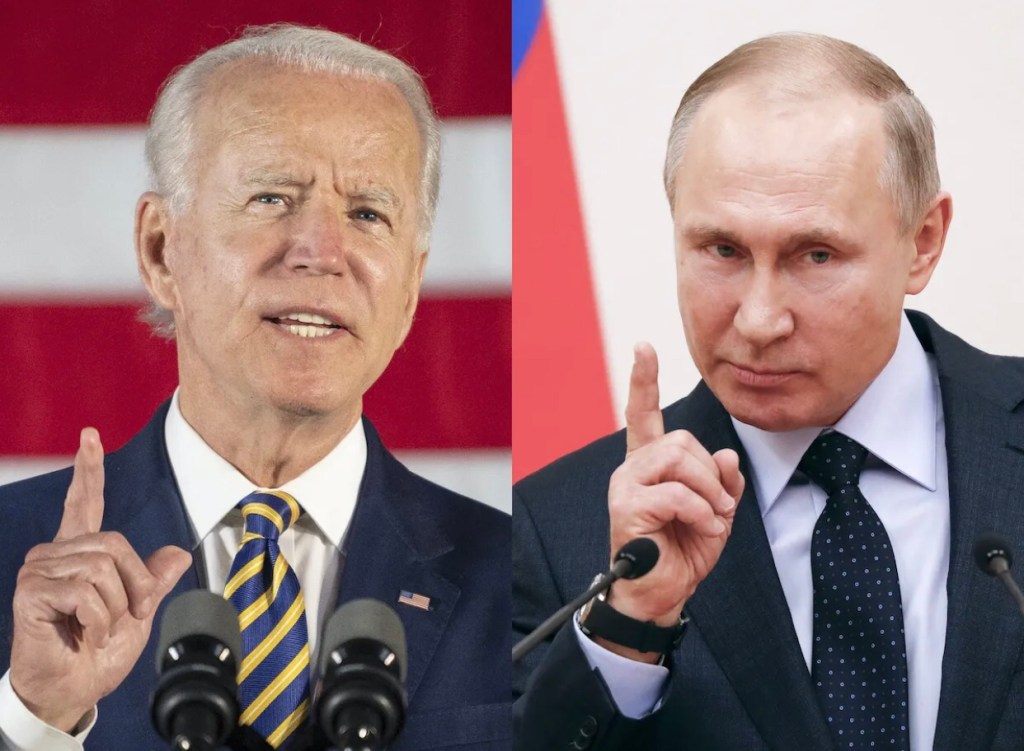
What Putin diplomatically told Team Biden, sitting at their table, is that Russia’s red line – no Ukraine in NATO – is unmovable. The same applies to Ukraine turned into a hub of the Pentagon’s empire of bases and hosting NATO weaponry.
The root cause of all this drama, absent from any NATO narrative, is straightforward: Kiev simply refuses to respect the February 2015 Minsk Agreement.
Putin demanding from the US – which runs NATO – a written, legally binding guarantee that the alliance will not advance further eastward towards Russian borders is the game-changer here.
Team Biden cannot possibly deliver: they would be eaten alive by the War Inc establishment. Putin studied his history and knows that Daddy Bush’s “promise” to Gorbachev on NATO expansion was just a lie. He knows those who run NATO will never commit themselves in writing.
US President Joe Biden is about to fulfill a campaign promise by hosting a Summit for Democracy. Yet do the 110 leaders of states and regions represent democracy, which is supposed to be about people? “Democracy is about the climate of trust,” said Peter Herrmann (Herrmann), professor at the Human Rights Centre at the Law School, Central South University, China, and member of the European Academy of Science and Arts. Unfortunately, there is no such trust in the society of the US and other Western countries today. In an exclusive interview with Global Times (GT), Herrmann shared his views on democracy and the differences of democracy between China and the West.
GT: The Summit for Democracy is generating another round of debate over the meaning of democracy. How would you define democracy? Does the US have the dominant power to define it?
Herrmann: I think we have problem with the term “democracy” – taking this one term to cover very different conditions and ambitions. Today, one can question if there is democracy (in the US), although the US uses this term for the summit.
Democracy is always thought to be something from below – getting people involved and letting people speak. So why the summit is all about having the top level talk about democracy? Several NGOs are also invited and so on and so forth. But democracy should be more about listening to what comes from the people, instead of inviting the people for showcases.
In the US, you have some major players determining what democracy is and who goes to the elections and who has the power. This has been shown very clearly by former president Trump’s presidency, when he invited Silicon Valley leaders as advisors.
We have to be at least aware that there is not just one democracy. And democracy is something at local, regional, and then at the national level, and increasingly global. Today, there is no one country which should have the power to determine what democracy is, or say this or that is the model of democracy, which is valid for the world and benefits all countries.
GT: Some Americans seem to believe less and less in their democracy. For instance, the result of a general election is not accepted by the losing side. A large number of voters are convinced fraud affected the elections. How would you comment on the democracy in the US?
Herrmann: It is exactly the problem – you ask powerless people to execute once in a while an act of power through the elections. This is systematically from the top. This is not only a problem in the US, but in Europe as well.
Voting and electing is one aspect, the provision of information and canvassing in preparation is another issue and a different story. It has to be highlighted that democracy is especially about building political orientation and consciousness and responsibility.
GT: Why are voters getting increasingly divided? Why are more and more populist politicians elected? What is your biggest concern regarding Western democracy?
Herrmann: If you look at Brexit, for instance, there have been huge debates beforehand. And the debates had been highly misleading. If people would have known the consequences, if there would have been proper information, they would have voted in a different way. But they had been deceived during the preparatory process.
If you look at populism in Germany, there had not been many members of the nationalist Alternative for Germany (AfD) (a right-wing populist political party) in the Parliament a couple years ago. Strong populist forces can also be found in Italy, France – and the main problem is that people feel cut off, focusing on one single item: surviving and making the best out of the situation they are in. Populists manage pretty well in taking up on such demands: answering not to what is strategically necessary but to what finds immediate popular applause.
Take environmental issues. If I say parking has to be affordable, everybody will agree. But you have to say: Actually, parking will be more expensive, but we will have a properly organized public transport system, in which you don’t have to depend on your own car.
You can find there are many examples that the populists have managed to take some points out of context and convince people. What is needed is a broad concept of participation: How does this affect our daily life? It is not a one-off decision but a complex process.
Why do they take things out of the context? One problem is with representative democracy. Many of the politicians today are full-time politicians.
In the worst case, when they entered the political system, they were very young, and then sit in the Parliament for the rest of their life. They are completely disjointed from real life. They are not workers, or working officers, not doing anything real. They are, of course, interested in being re-elected. So they have this capacity to focus on the next four years in terms of how they could get back into Parliament. They are not looking at a longer and wider perspective. They are not looking for a strategic approach.
GT: Do you think this democratic system in the West could bridge the gap in their societies?
Herrmann: From what I see now, it is further widening the gap.
But I see more and more people are becoming aware of it. There are protest movements. There are claims that this cannot go on in this way and we have to find other ways. We have to make it working for and with and by the people. I think the general claim can be brought forward that we have to think about a different way of doing democracy, a different way of letting people having a say.
GT: How would you comment on democracy in China? What do you think is its biggest difference if compared with the democracy in the US or other Western countries?
Herrmann: I would say, democracy is about human rights. Democracy is about the climate of trust.
In the West, if there is something going wrong, when there are complaints in respect of the so-called liberal rights, political rights, there is a huge outcry, in particular when it happens in countries like China, Cuba or in Latin America. However, when the same happens to economic and social rights, no voice is being heard. In many European countries, hospitals do not have sufficient capacity, important surgeries are delayed because of the new waves of the pandemic. This is important for democracy: First and foremost, I have to survive, and then I can think about how I want to get involved.
The other thing is that of course it is not just about surviving. Human rights are about having rights to determine the own life, the way I want to live. This is about a way of living together with others.
What strikes me here in China is “trust.” When I arrived here, I didn’t have my own telephone number, I could not surf the internet. People gave me the internet connection. All I did on the internet had been on their record. They trust me that I would not abuse it.
I see other small things like this. Food is ordered and left on the table, in a large room or on the fences (by delivery guys). You would not trust anybody in Europe doing this. But here, people trust that other won’t take it.
Human rights are about trust and trust is about having conditions where I can trust. If I live under conditions where I have to look after myself competing with others, this is a completely different story.
GT: You remind me of recent gun violence in the US, where people may not trust to be safe when walking in the streets at night.
Herrmann: Not even during the daytime. I have to say there are shocking examples.
GT: What’s your take on the forthcoming Democracy Summit, for which the US get to decide on its own who can participate and who cannot. What signals does the summit sent to the world?
Herrmann: When it comes to the summit, what makes me really angry is what the US states in the document linked to the summit: We are showing one of the greatest abilities that democracy has to offer, and that is admitting imperfection.
They say we are imperfect. But if they are able to learn from it, I wonder why they keep the Guantanamo Bay? It is a question for ages. They did not learn anything. How can they come up now and say “we are ready to learn”? It is about permanent involvement in wars. Why is the US not able to learn?
There are ongoing problems in the health system, social care system, such that people cannot develop any trust. People are dying on the streets.
And then the president said: But we are able to learn and to admit our shortcomings. This is something I don’t understand. This is simply ignorant.
When US Government promote Asian hates during COVID19 to shift blames for its incompetence. At the same token, the Pentagon Doesn’t Care About Civilian Casualties. 當美國政府在新冠病毒期間宣揚亞洲仇恨以轉移對其無能的指責時。 同樣,五角大樓也不關心平民傷亡 Stephen Zunes Nov 26, 2021 The Progressive
Facing little opposition from either Republicans or Democrats, the U.S. military is almost never held accountable for killing civilians during airstrikes.
In August 2019, thousands of refugees, prisoners, and families of ISIS fighters crowded into an encampment in the border town of Baghuz in eastern Syria, one of the last territories controlled by the so-called Islamic State. The United States, supported on the ground by an allied Kurdish and Arab militia, launched a massive air assault on the enclave.
As The New York Times reported on November 13, 2021, a U.S. attack jet unleashed its payload on the civilian encampment. “As the smoke cleared,” the article noted, “a few people stumbled away in search of cover. Then, a jet tracking them dropped one 2,000-pound bomb, then another, killing most of the survivors.” At least seventy civilians died.
A Pentagon legal officer reported internally that this was a possible war crime, but, “at nearly every step, the military made moves that concealed the catastrophic strike,” according to the Times. The death toll was downplayed, and reports were delayed, sanitized, and classified.
The U.S-led coalition forces bulldozed the blast site. The office of the Defense Department’s independent inspector general launched an investigation, but the report was effectively censored. An evaluator in that office lost his job when he complained about the cover-up.
In response to an inquiry earlier this month from the Times, the U.S. Central Command acknowledged the strikes for the first time and admitted that eighty people were killed. Nevertheless, it insisted the airstrikes were justified and that “no formal war crime notification, criminal investigation, or disciplinary action was warranted.”
The Baghuz massacre was one the last of the 35,000 air strikes the United States launched over a five-year period in Syria and Iraq that ostensibly targeted ISIS. According to Pentagon rules, U.S. forces could call in airstrikes without checking to see if civilians were threatened, so long as it was deemed necessary for self-defense.
What constitutes “self-defense” for the Pentagon, however, is not just when its forces are under fire. The authorization of deadly force can also be granted if enemy troops are simply believed to be displaying “hostile intent,” which the Pentagon defined so broadly in the case of U.S-backed ground operations in Syria that it constituted 80 percent of all U.S. air strikes.
The New York Times article also noted that the Pentagon failed to keep track of the numerous reports of civilian casualties and usually failed to follow through with investigations. In the rare cases where an investigation was ordered, it was later squashed. An email shared with the Senate Armed Services Committee revealed that the only time an investigation was allowed to move forward was when there was “potential for high media attention, [or] concern with outcry from local community/government, concern sensitive images may get out.”
So far, the Democratic-led Senate Armed Services Committee has refused to open an investigation into the Baghuz attack or any other possible war crimes by U.S. forces in the war against ISIS.
New technologies have made bombing far more accurate than in World War II, the Korean War, or the Vietnam War. During those wars, the United States regularly engaged in carpet bombing of major urban areas—at the cost of hundreds of thousands of civilian lives. However, since the launch of “the war on terror,” both major political parties have gone to some length to justify the killing of civilians in the name of counterterrorism.
For example, Congress has passed a series of resolutions defending Israel’s attacks on civilian areas in the Gaza Strip, the West Bank, and Lebanon, which have attempted to exonerate the U.S.-backed Israeli armed forces for thousands of civilian casualties.
Often, these resolutions have defended the Israeli attacks on civilians by claiming Arab militia groups were using “human shields.” This is despite the fact that, while using civilians against their will to deter attacks on an adversary’s troops or military hardware is considered a war crime, it does not give license to bomb them any more than a criminal holding hostages gives police the right to shoot them all.
When investigations by Human Rights Watch, Amnesty International, the United Nations Human Rights Council, the U.S. Army War College, and others failed to find a single documented case of any civilian deaths caused by either Hamas or Hezbollah using human shields while fighting Israeli forces, Congress decided to redefine it.
A 2009 resolution, drawn up by House Democratic leader Nancy Pelosi and passed by an overwhelming bipartisan majority, expanded the definition of the use of human shields to include any members of a designated “terrorist group” within a civilian population. By this definition, a Hamas official living in a high-rise apartment building in Gaza would make the entire structure a legitimate military target. In other words, when being in the proximity of a “terrorist” is enough to classify a civilian as a human shield, an entire city can become a free fire zone.
Years earlier, I predicted that this kind of defense for Israeli war crimes would likely be used as a rationale for “massive U.S. airstrikes on Mosul, Raqqa, and other Islamic State-controlled cities, regardless of civilian casualties.”
And this is indeed what happened. There were virtually no expressions of concern raised in Congress when, in 2017, the United States launched heavy attacks against Syrian and Iraqi cities held by ISIS (which really did use civilians as human shields).
An investigation by Amnesty International revealed that 1,600 civilians died in the U.S.-led bombing campaign in Raqqa, largely destroying the Syrian city. There has been no challenge to the accuracy of the report, which has been called the “most comprehensive investigation into civilian deaths in a modern conflict,” yet it was largely ignored in the mainstream U.S. media.
There was only a little more coverage of the U.S.-led bombing of Mosul earlier that year, when U.S. planes hit thousands of targets, turning much of that ancient city into rubble and resulting in the deaths of at least 3,000 civilians. A 2019 investigation by Human Rights Watch determined that approximately 7,000 civilians had been killed in the previous five years in Iraq and Syria in air strikes by the U.S. and its allies.
With virtually no negative reaction in Washington, D.C., or coverage in the mainstream media, there should be no surprise that the Pentagon thought they could get away with the 2019 massacre in Baghuz. There appears to be a sense that, given the horror of ISIS, the killing of large numbers of civilians may be necessary to ensure their defeat, so it’s important to keep such tragedies quiet.
The problem, however, goes well beyond ISIS. Even when it involves another extremist militia (and even if a U.S. attack on civilians does get in the news), the U.S. government has little reason to worry. For example, after its belated acknowledgement that a drone missile attack in Kabul this past August had targeted a car driven by an Afghan aid worker, killing him and nine others, including seven children, the Pentagon insisted there was no misconduct or negligence.
The implication is that there would, therefore, be no changes in procedures or personnel, and that the Pentagon would not take steps to prevent such tragedies from happening again.
And there appear to be few political costs. Not only have leading Republicans defended killing civilians in the name of fighting terrorism, but many Democratic members of Congress who have defended Israeli bombings of civilian targets in Gaza have been repeatedly endorsed as “bold progressives” and “peace leaders,” sending the message that the killing of civilians in the name of “self-defense against terrorists” is not considered a problem even within the Democratic left.
Meanwhile, the Biden Administration continues to provide arms, training, and maintenance to Saudi and Emirati forces that have killed tens of thousands of civilians through air strikes in Yemen. A bipartisan majority in Congress has reiterated that the billions of dollars’ worth of taxpayer-funded military aid to Israel remain “unconditional,” despite the hundreds of civilians killed during last spring’s bombardment of crowded urban neighborhoods in Gaza, again under the rationale of self-defense against terrorists.
Maybe it’s finally time to question what exactly constitutes terrorism.
Stephen Zunes is a professor of politics at the University of San Francisco and a contributing editor of Tikkun. His most recent book is “Western Sahara: War, Nationalism, and Conflict Irresolution” (Syracuse University Press).
There is a key section in this article. It reads: “As officials often note, China has achieved more than four decades of rapid economic growth. More recently, it has contained the coronavirus outbreak that began in Wuhan, with fewer deaths throughout the pandemic than some countries have had in a single day.
“Skeptics reject the argument that such successes make China a democracy.
“They cite surveys like the one done by the University of Würzburg in Germany, which ranks countries based on variables like independence of the judiciary, freedom of the press and integrity of elections. The most recent put China near the bottom among 176 countries. Only Saudi Arabia, Yemen, North Korea and Eritrea rank lower. Denmark is first; the United States 36th.”
Notice the contrast. China is relying on deeds, successes.
The US relies on opinions, peddled by a media it dominates and shored up by past successes which were built on horrific exploitation (slavery and extermination of the indigenous population along with abysmal conditions for immigrant labor, Chinese and many, many others)
A big part of the problem is that China’s successes are not well known although in the first paragraph there is brief acknowledgement of them. The successes will dominate in the long run. China will have to continue to produce and the US is determined to prevent that and to destroy the fruits of the past successes.
The greatest success recently and one that should be the envy of the world is the victory over the pandemic. Given its life saving value for the world it should also be the object of examination and scrutiny. It is not except for the brief chaotic period in Wuhan typical of any outbreak. (Notice paragraph one mentions Wuhan specifically – no accident.
The presence of Israel to the D-summit says it all – a country that overtly and unapologetically practices Apartheid (to use the term that even Jimmy Carter used for it in the title of his excellent little book.)
As in the days of white-ruled South Africa which the US described as a democracy, Israel qualifies. What a joke.
p.s. China has the advantage of having most of the world’s media arrayed against it. So it must demonstrate genuine accomplishments. The US in contrast only has to blow smoke in our eyes. In the long run when the smoke clears, that will leave the US in a very bad state indeed.
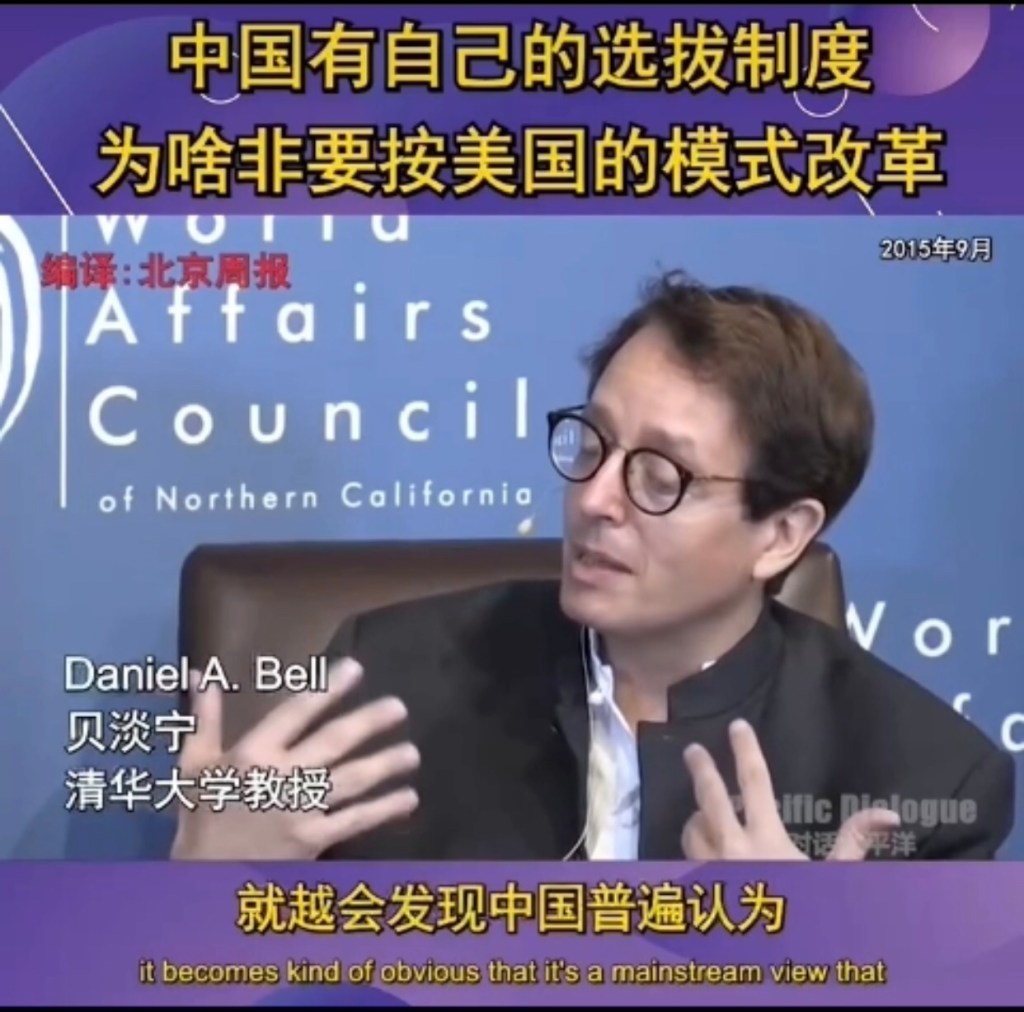
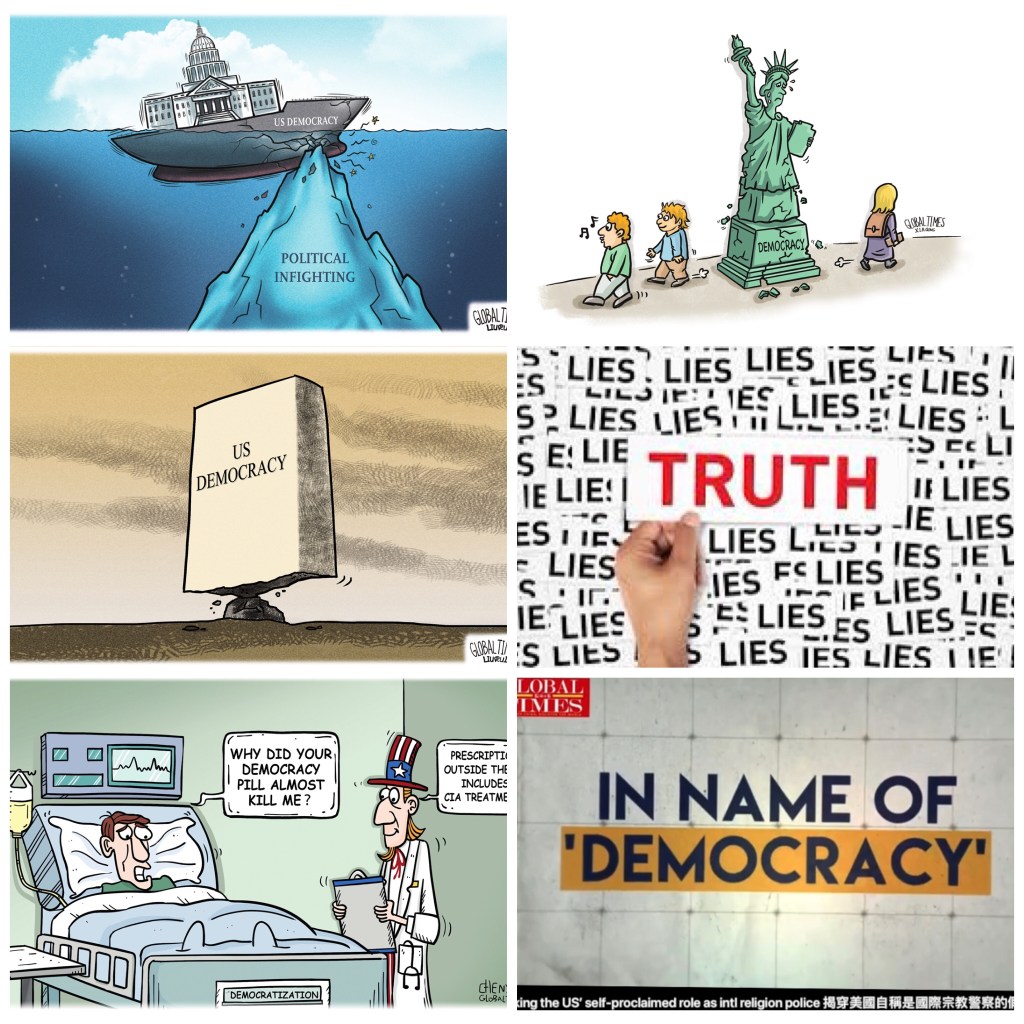
Professor George Koo in SF: To paraphrase a joke about lawyers, a modified punchline is “Democracy is whatever you wish it to be.” By judicious selection and definition of the parameters to measure democracy, any country can qualify or not qualify as a democracy.
It’s also an honorific title to be bestowed to deserving nations. If you are aligned with Washington, you are ipso facto a democracy. If you are not so aligned, then you are a socialist country or even worse, a communist country. Being called a communist has nothing to do with ideology, just the worst profanity the U.S. can sling at another.
By self proclaiming as the champion of democracy despite its many flaws and terrible outcomes, the United States has erased whatever claim remaining in its name.
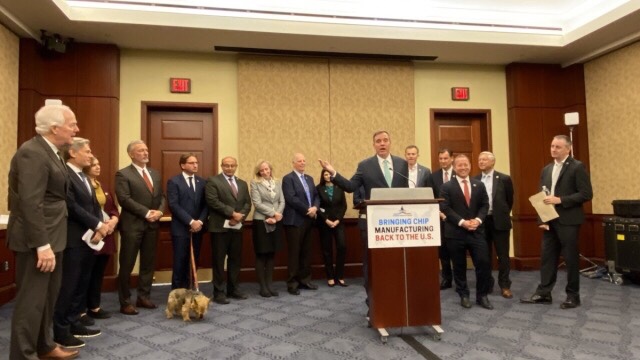
This eetimes article describes clearly how the U.S. developed the chip industry and how it destroyed it via liberal greed capitalism. And now, the capitalists are all begging for more handouts to enrich the 1%.
EE Times: With CHIPS Act, US Risks Building a White Elephant. By Alan Patterson 12.07.2021
The U.S. Senate has approved $52 billion for the CHIPS for America Act, aimed at reviving the American semiconductor industry over the next decade. While the Act awaits approval in the House of Representatives, we should examine whether it is the most effective way to encourage investment in domestic manufacturing.
One of the key goals of the CHIPS Act is to encourage renewed investment in manufacturing. But the conditions that have caused the U.S. to fall behind are not addressed by the Act. The US incentive structure is skewed because there’s a stronger impetus for executives to choose stock buybacks over reinvesting in operations.
Several U.S. tech companies now lobbying for the CHIPS Act have squandered past support from the U.S. government while instead showing more appetite for share buybacks to boost company stock prices. Among the Semiconductor Industry Association (SIA) corporate signatories of a recent letter to President Biden, Intel, IBM, Qualcomm, Texas Instruments, and Broadcom did a combined $249 billion in buybacks over the decade 2011-2020, according to William Lazonick, Professor of Economics Emeritus at the University of Massachusetts.
Intel lags behind TSMC and Samsung in process technology in part because of a swing toward buybacks, according to Lazonick. While Intel spent $50 billion on capital expenditures and $53 billion on R&D during the past five years, it also lavished shareholders with $35 billion in stock buybacks and $22 billion in cash dividends, which altogether used up 100 percent of Intel’s net income. Intel’s distributions to shareholders have been far greater than those made by either Samsung or TSMC, according to Lazonick.
Like Intel, IBM also decades ago focused on maximizing shareholder value. After drastically cutting headcount during the 1990s, IBM began distributions to shareholders in the form of buybacks, even as from 1996 through 2020 the company increased its annual dividend payouts. IBM did $51.4 billion in buybacks (79 percent of net income) in 1995-2004 and $119.7 billion (93 percent) in 2005-2014.
IBM could have invested those funds in state-of-the-art chip facilities, but, in 2015 sold its semiconductor fabs to GlobalFoundries. From 2010 through 2014, IBM did $70 billion in buybacks (92 percent of net income) which followed $50 billion in buybacks in 2005-2009 (93 percent of net income).
Let’s face it. It’s impossible to buy a toaster that’s made in the U.S., but now the aim is to quickly ramp up production of American-made leading-edge chips? Is the U.S. about to make a multi-billion mistake in much the same way that the Chinese government has by funding a national fab capacity buildup that has largely been a flop?
Despite such warnings, the CHIPS Act has no shortage of cheerleaders.
The Semiconductors in America Coalition (SIAC) was formed in May 2021 to lobby Congress for the passage of the CHIPS Act. Members include Apple, Microsoft, Cisco and Google. These firms spent a combined $633 billion on buybacks during 2011-2020, according to Lazonick. That’s about 12 times the $52 billion in government subsidies earmarked under the CHIPS Act.
The SIA warns that the U.S. share of global semiconductor manufacturing capacity has plunged to 12 percent largely because the governments of U.S. competitors offer significant incentives and subsidies to semiconductor manufacturing.
In September 2020, the SIA’s Government Incentives and US Competitiveness in Semiconductors report warned that over the next decade only 6 percent of the new global fab capacity will be located in the U.S. while China will become the largest fab site in the world. The report “estimated that a $50 billion [government] incentive program would enable the construction of 19 advanced fabs in the U.S. over the next ten years, doubling the number expected if no action is taken and increasing the capacity located in the U.S. by 57 percent.”
Without a doubt, no matter whether it’s from China or the U.S., government funding has played a key role in the development of microelectronics technology.
With huge tech programs such as NASA, U.S. government funding has been integral since the creation of the microelectronics industry seven decades ago. Between 1987 and 1992, the U.S. provided $500 million in matching funds to Sematech, a nonprofit consortium of 14 semiconductor firms for the purpose of supporting the competitiveness of U.S. semiconductor equipment producers. In 2001, the U.S. launched the National Nanotechnology Initiative with budgets totaling $12.1 billion for 2001-2010 and $16.9 billion for 2011-2020, with proposed 2021 spending of $1.7 billion.
Despite this largesse, the U.S. loss of global semiconductor leadership suggests an overemphasis on financial engineering at U.S. companies where a number of senior executives, as SIA directors, have signed their recent letter to President Biden in support of the CHIPS Act.
The U.S. government has played a central role in investments that have enabled the nation to be a global leader in advanced technology. Yet, government investments only succeed when major businesses join in. The investments necessary to build a national chip industry are far larger than $52 billion and probably far more than any one government can afford. The U.S. government should be wary of building a white elephant.
Government-business collaborations have the best chance of success when the relevant companies are engaged in a “retain-and-reinvest” mode. The companies retain corporate profits and reinvest in their productive capabilities. Yet many tech companies today are in a “dominate-and-distribute” mode, according to Lazonick. Based on past strength, they dominate their industries but prioritize shareholders in the allocation of earnings.
In passing the CHIPS Act, Congress faces the difficult task of exacting a pledge from the SIA and the SIAC that its member corporations will halt stock buybacks for the next 10 years.
Longer term, Congress should repeal Securities and Exchange Commission Rule 10b-18 to discourage buybacks. The practice allows companies with plenty of cash to buy back their shares and cancel them. The reduction of outstanding shares gives a strong boost to the stock price.
Lazonick calls the rule a “license to loot.”
Rule 10b-18 gives a company a “safe harbor” against charges of stock-price manipulation in doing stock buybacks as open-market repurchases (OMRs) if, on any given trading day, OMRS are no more than 25 percent of the average daily trading volume (ADTV) over the previous four weeks. The safe harbor means that there is no automatic presumption that, if the company does OMRs in the range of 25 percent of ADTV, it will be charged with stock-price manipulation.
Senior corporate executives have this insider information and hedge-fund managers have ways of knowing when a company is doing OMRs, according to Lazonick. Both corporate executives and hedge-fund managers are positioned to time the buying and selling of the shares that they hold to boost their realized gains, Lazonick says.
Billions of dollars in government funding to build fabs is no guarantee of success. It’s more about creating an environment that’s conducive to investment. The recent joint venture between the Japanese government, TSMC and Sony to build a fab is a better approach that spreads out the huge investment risk. Providing subsidies to companies that have failed to invest in their future is a poor idea.
Alan has worked as an electronics journalist in Asia for most of his career. In addition to EE Times, he has been a reporter and an editor for Bloomberg News and Dow Jones Newswires. He has lived for more than 30 years in Hong Kong and Taipei and has covered tech companies in the greater China region during that time.
Video: US was built on selling Opium illegally to China treated Chinese as half-human for more than a century till today! 美國建立在向中國非法出售鴉片的基礎上,一個多世紀以來美國一直將中國人視為不是人, 直到今天! https://vimeo.com/654684421 https://youtu.be/u0Y_Sjj3oSw https://www.facebook.com/100036400039778/posts/617672856122710/?d=n Every country has disturbing secrets. However, this evil information which is being blacked-out in the mainstream may explain WHY Western media wants to silence all people who speak about REAL China. You have to wonder why trolls on the internet always call people like us “wumao”. I think it’s becoming clear that they use these attacks in order to silence the truth which is absolutely despicable. 每個國家都有令人不安的秘密。 然而,這種在主流中被屏蔽的邪惡信息可以解釋為什麼西方媒體想要讓所有談論真實中國的人閉嘴。 你一定想知道為什麼網絡上的巨魔總是稱我們這樣的人為“五毛”。 我認為很明顯,他們使用這些攻擊是為了掩蓋絕對卑鄙的真相
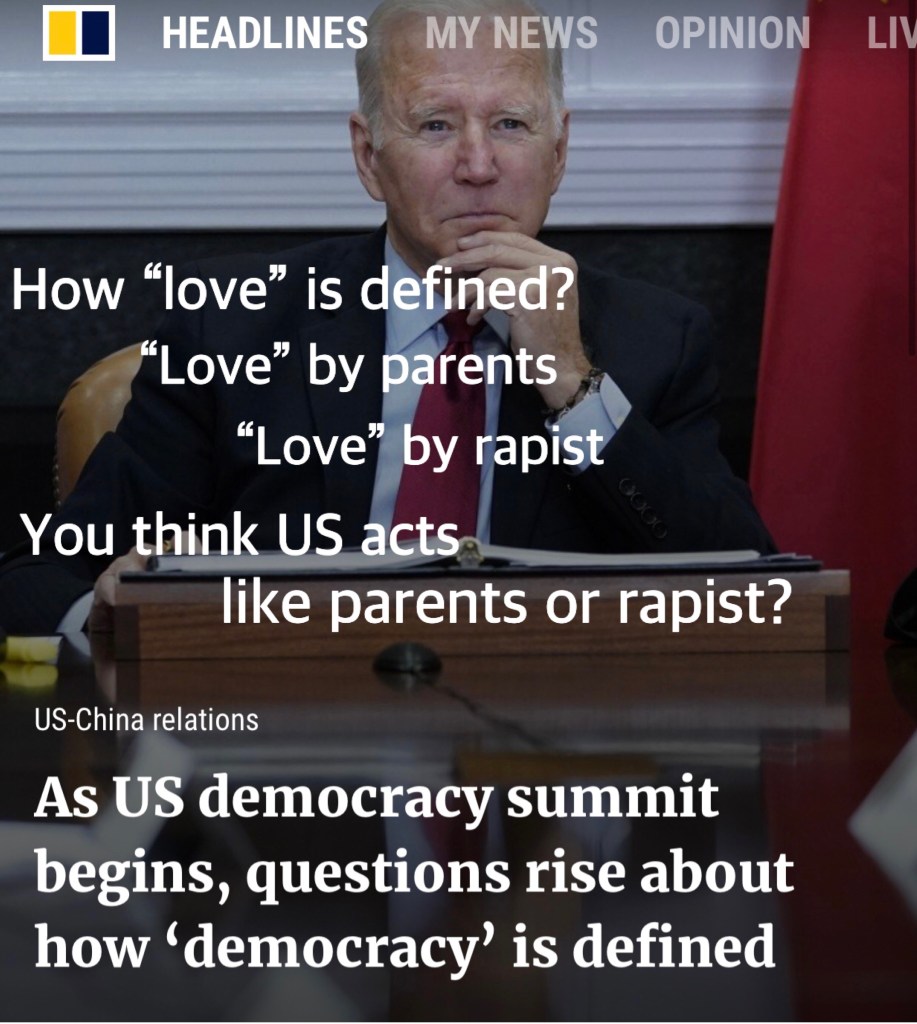
How Democracy is defined? Maybe we should first asked how “love” is defined? “Love” by parents verses “Love by rapist”? What kind of “love” would you preferred? Think about it. What kind of “love” “democracy” US is talking about? 如何定義民主? 或許我們應該先問一下“愛”是如何定義的? 父母的“愛” 對比 強姦犯的”愛”? 你喜歡那一種的”愛”? 想想! 美國在談什麼樣的“愛”什麼樣的”民主”?
How US love Korea, Vietnam, Ukraine, Iraq, Syria, Libya, HK, Thailand, Myanmar, African Slaves, Native Americans? You think these people felt they are loved? 美國有多麼的愛韓國、越南、烏克蘭、伊拉克、敘利亞、利比亞、香港、泰國、緬甸、非洲奴隸、美洲原住民? 你認為這些人覺得他們感受到美國”民主”的”愛”嗎?
Response to Roland Li Business Reporter of SF Chronicle on What exodus? Facebook, LinkedIn, Tesla and Apple deals show Silicon Valley still top place for tech roland.li@sfchronicle.com
LinkedIn withdraw from China, Tesla produced more car in Shanghai than California, Apple products made in China with top research team stationed in China, Facebook for old folks not appealing to 40 years and below. Dozen of companies I know left Silicon Valley for Texas and Washington States. No Silicone Valley Company does well without China market.
I wish SF well because we live and work in SF.
SF is at least better than Hawaii, a banana republic with absolutely no future for young smart and educated.
Friend in Hong Kong worked in China: “My 12/19 upcoming trip to Shenzhen then cross border returning to Hong Kong, China my hometown to vote HK legislative Council election at the border (not actually able to return to HK) will be a historical event! it’s the first election since 2019 HK color revolution riot, and we’ll be fully support the pro-mainland canadiates.
There’ll be 20K HK mainland residents from across mainland to come to vote, the biggest border event since the pandamic shut the border down. I’ll record this historical event by being my Huawei Pad or rent a camera to film the process, it can be use at my upcoming documentary!



 Johnson Choi Biz