
‘Diplomatic boycott’ of Beijing Winter Olympic Games exposes the US’ lies of ‘Uygur genocide’ by Andrew Korybko Dec 08 2021
‘Diplomatic boycott’ of Beijing Winter Olympic Games exposes the US’ lies of ‘Uygur genocide’ by Andrew Korybko Dec 08 2021
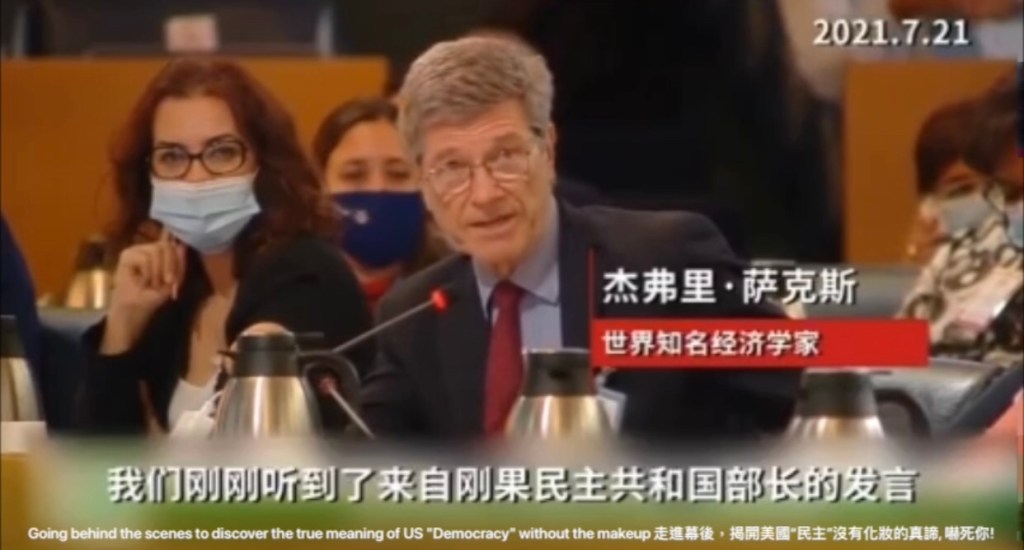
Video: Going behind the scenes to discover the true meaning of US “Democracy” without the makeup 走進幕後,揭開美國“民主”沒有化妝的真諦, 嚇死你!
(轉)
美國和俄羅斯是一對“冤家對頭”,兩國不但在世界范圍內勾心斗角,在口頭上更是唇槍舌劍,近日俄羅斯美女發言人扎哈羅娃一番批評美國的言論,讓人讀后朗朗上口,大呼過癮,真是蛇打七寸,招招致命。
下面就是扎哈羅娃的精彩發言:
“必須記住,是誰向廣島和長崎平民扔下原子彈?🇺🇸
是誰向越南平民扔下凝固汽油彈?🇺🇸
是誰用貧鈾彈攻擊貝爾格萊德平民?🇺🇸
是誰在聯合國安理會上搖晃裝著洗衣粉的試管作偽証?🇺🇸
是誰絞死了薩達姆?🇺🇸
是誰在世界范圍內發起了數十次顏色革命?🇺🇸
這個國家🇺🇸創造了私營軍事公司並讓雇佣兵充斥全世界﹔
這個國家🇺🇸重新劃分了歐洲民主國家的政治格局﹔
這個國家🇺🇸背叛了阿富汗的盟友﹔
這個國家🇺🇸在拉美進行了長達數十年的“人道主義試驗”甚至將其視為自己后院﹔
這個國家🇺🇸經常破壞國家條約、退出戰略協議﹔
這個國家🇺🇸是一個戰爭販子和戰爭狂人!”
真是句句在理、句句直擊要害,句句都將美國🇺🇸人的虛偽、凶殘和無恥批得體無完膚!
美国悖逆历史潮流举办的所谓“民主峰会”招致国际社会一片批评之声,惨淡收场是必然的结果
美国举办的所谓“领导人民主峰会”毫无民主可言,完全按照打压他国、分裂世界的预定剧本上演。美方刻意安排畏罪潜逃的反中乱港分子登台抹黑香港、抹黑中国,给台湾民进党当局代表提供舞台发表所谓“国家声明”、挑战一个中国原则,并在世界人权日当天以“人权”为借口对中方发起新的制裁,荒谬至极。美方肆意挥舞所谓“民主”“人权”大棒,粗暴干涉中国内政,遏制打压中国,正是其将民主人权工具化、武器化的铁证。
在所谓“民主峰会”上,这些反中乱港分子、“台独”分子卖力表演,甘当美国的政治傀儡,只会将自己钉在历史的耻辱柱上。被香港警方通缉的犯罪嫌疑人罗冠聪罔顾事实、颠倒黑白,肆意攻击香港国安法,再度乞求外部势力干涉香港事务、抗衡中国。这种数典忘祖、背叛祖国的行径,必将遭到人民的唾弃和历史的审判。台湾民进党当局以所谓“国际空间得到提升”愚弄台湾民众,其代表在会上继续编织“台独”迷梦,公然迎合美方搞意识形态对抗中国的图谋,不以为耻、反以为荣。美台露骨的勾连挑衅行径让人们进一步看清,台湾当局企图“倚美谋独”,美方一些人有意搞“以台制华”,才是当前台海局势面临新一轮紧张的根源。
https://vimeo.com/655648381
https://youtu.be/EiX3Z40EOYc
https://www.facebook.com/100036400039778/posts/619305659292763/?d=n
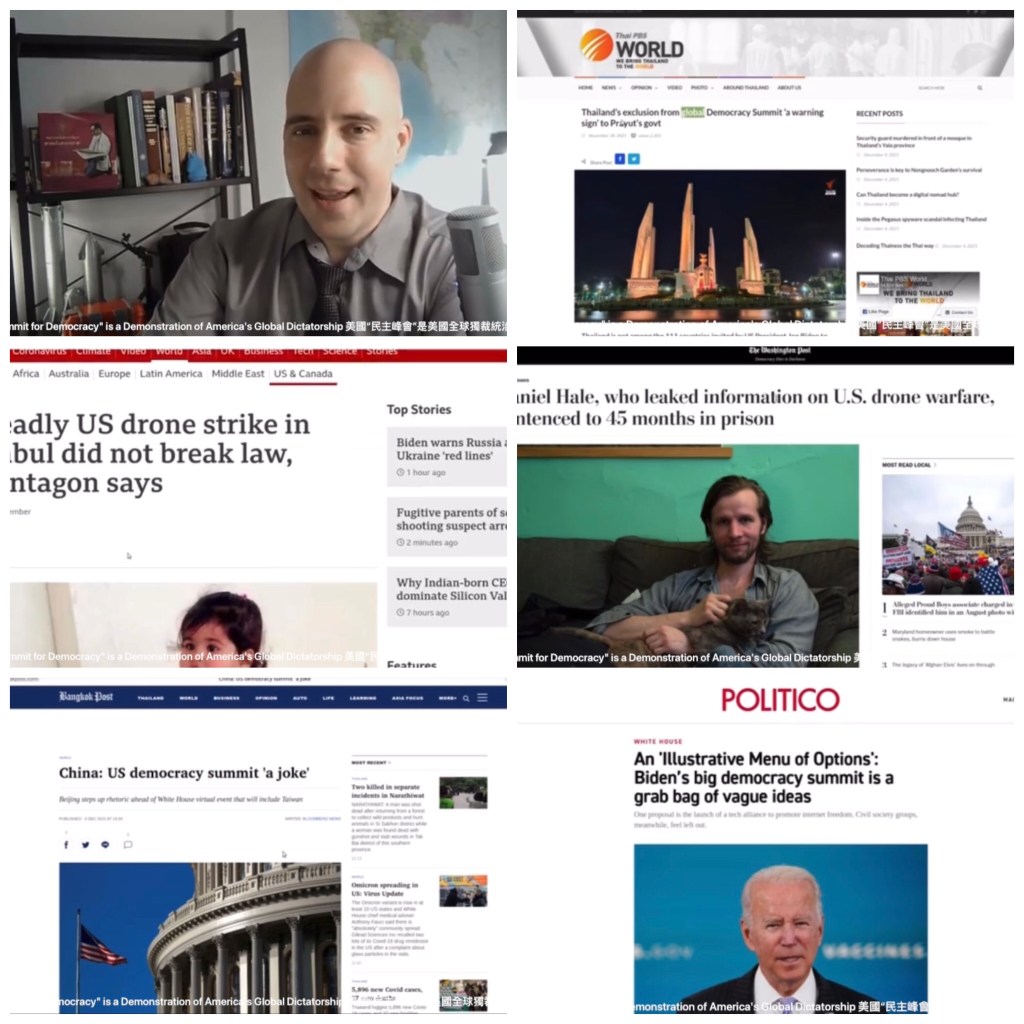
Video: US “Summit for Democracy” is a Demonstration of America’s Global Dictatorship 美國“民主峰會”是美國全球獨裁統治的體現
https://vimeo.com/655590104
https://youtu.be/1vuhZDeTfKQ
https://www.facebook.com/100036400039778/posts/619129465977049/?d=n
Washington’s so-called “Summit for Democracy” is overtly a demonstration instead of unilateral US hegemony and a desperate bid to put a world back to sleep that is quickly waking up to years of US abuse on the global stage. 華盛頓所謂的“民主峰會”是公開的示威,而不是美國的單邊霸權,是讓世界重新陷入沉睡的絕望嘗試,而這個世界正在迅速意識到美國在全球舞台上多年的虐待行為.
If your nation wasn’t invited to the summit, that is a good thing. 如果你的國家沒有被邀請參加峰會,那是一件好事.

China Foreign Ministry Spokesperson’s Statement on the “Summit for Democracy” Held by the United States 2021-12-11
Recently, the United States held a so-called “Summit for Democracy”, drawing the ideological line and turning democracy into a tool and a weapon. It sought to thwart democracy under the pretext of democracy, incite division and confrontation, and divert attention from its internal problems. It attempted to preserve its hegemony over the world, and undermine the international system with the United Nations at its core and the international order underpinned by international law. This move by the United States goes against the trend of the times, and has been widely opposed by the international community.
I.The US is not a “beacon of democracy”, and the American-style democracy has deviated from the essence of democracy.
The American-style democracy is full of malaises. Problems like money politics, identity politics, partisanship, political polarization, social division, racial tension, and wealth gap are getting worse. The American-style democracy is a money-based game for the rich. Ninety-one per cent of congressional elections are won by candidates with greater financial support. It is “one person one vote” in name, but “rule of the minority elite” in reality. The general public are wooed when their votes are wanted but get ignored once the election is over. The check and balance has become “vetocracy”, with partisan interests put above national development. The flaws of such an electoral system are self-evident, including the rampant use of gerrymandering to manipulate the division of electoral districts that compromises fairness and justice. The dysfunction of the American-style democracy is a fact that cannot be covered up — the Capitol riot that shocked the world, the death of George Floyd that sparked mass protests, the tragic mishandling of the COVID-19 pandemic, and the harsh reality of the rich becoming richer and the poor poorer.
Is American democracy good? Let’s hear out the American people. Surveys show that 72 per cent of Americans believe that democracy in the United States has not been a good example for others to follow in recent years, and 81 per cent of Americans believe that there are grave domestic threats to the future of American democracy.
Does American democracy work? Let’s hear out the people of the world. Surveys show that 44 per cent of respondents across the world regard the United States as the biggest threat to global democracy. Even in US allies, most of the people there see American democracy as a “shattered, washed-up has-been”, and 52 per cent of respondents in the European Union believe the democratic system in the United States does not work.
II.A country’s path to democracy should be chosen independently by its own people, rather than imposed from outside.
As a common value of humanity, democracy is the right of people in all counries. It is not a prerogative of a small number of countries. Whether a country is democratic or not should be decided by its own people, not by a handful of finger-pointing outsiders. A country’s democratic system and its path to democracy should be chosen independently by its own people in light of their national reality. Nothing works better than the most suitable.
China promotes its democracy in accordance with its national conditions and realities. China’s democracy is people’s democracy. Its essence and core is that the people are the masters of the country. China practices whole-process people’s democracy under the leadership of the Communist Party of China. It combines electoral democracy with consultative democracy, and integrates all links of democracy, including democratic election, democratic consultation, democratic decision-making, democratic management, and democratic oversight. It covers economic, political, cultural, social, ecological and all other fields, so that the people’s wills are represented and their voices heard in every aspect of political and social life. Whole-process people’s democracy integrates process-oriented democracy with results-oriented democracy, procedural democracy with substantive democracy, direct democracy with indirect democracy, and people’s democracy with the will of the state. It covers all aspects of the democratic process and all sectors of society. It is the most broad-based, real and effective socialist democracy. China’s democracy has contributed to the country’s development and social progress, and delivered a happy life for the Chinese people. China has completed the building of a moderately prosperous society in all respects. With the eradication of absolute poverty, the 1.4 billion Chinese people are now marching toward common prosperity. China has made the biggest advance in individual freedom in thousands of years, and the creativity of the hundreds of millions of Chinese people has been fully unleashed.
III.Stoking division and confrontation in the name of democracy is to backpedal in history, and will bring nothing but turmoil and disaster to the world.
For a long time, the United States has been imposing its political system and values on others, pushing for the so-called “democratic reforms”, abusing unilateral sanctions and inciting “color revolutions”, which have caused disastrous consequences. Democracy has become a “weapon of mass destruction” used by the United States to interfere in other countries’ affairs. As US media commented, if there is one country that is still seeking global hegemony, coercing other countries and defying rules in the 21st century, it must be the United States. Since 2001, the wars and military operations waged by the United States in Afghanistan, Iraq, Libya and Syria have claimed hundreds of thousands of lives, caused millions of injuries, and displaced tens of millions of people. The fiasco in Afghanistan has shown that imposing American democracy on others simply does not work. Till this day, the United States is still trying to divide the world into “democratic” and “non-democratic” camps based on its criteria, and openly provoke division and confrontation. Such practices will only bring greater turmoil and disaster to the world, and face strong condemnation and opposition from the international community.
Facing the impact of COVID-19 and major changes unseen in a century, countries have become more interconnected and interdependent. The international community needs more than ever to strengthen solidarity and cooperation based on the norms governing international relations represented by the UN Charter. China stands ready to work with all countries to promote peace, development, equity, justice, democracy and freedom, which are common values of humanity, and advance democracy in international relations. We should choose solidarity over division, dialogue over confrontation, and democracy over hegemony. We should firmly reject and oppose all forms of pseudo-democratic and anti-democratic practices and political manipulations under the cover of democracy, and make tireless efforts toward the building of a community with a shared future for mankind.
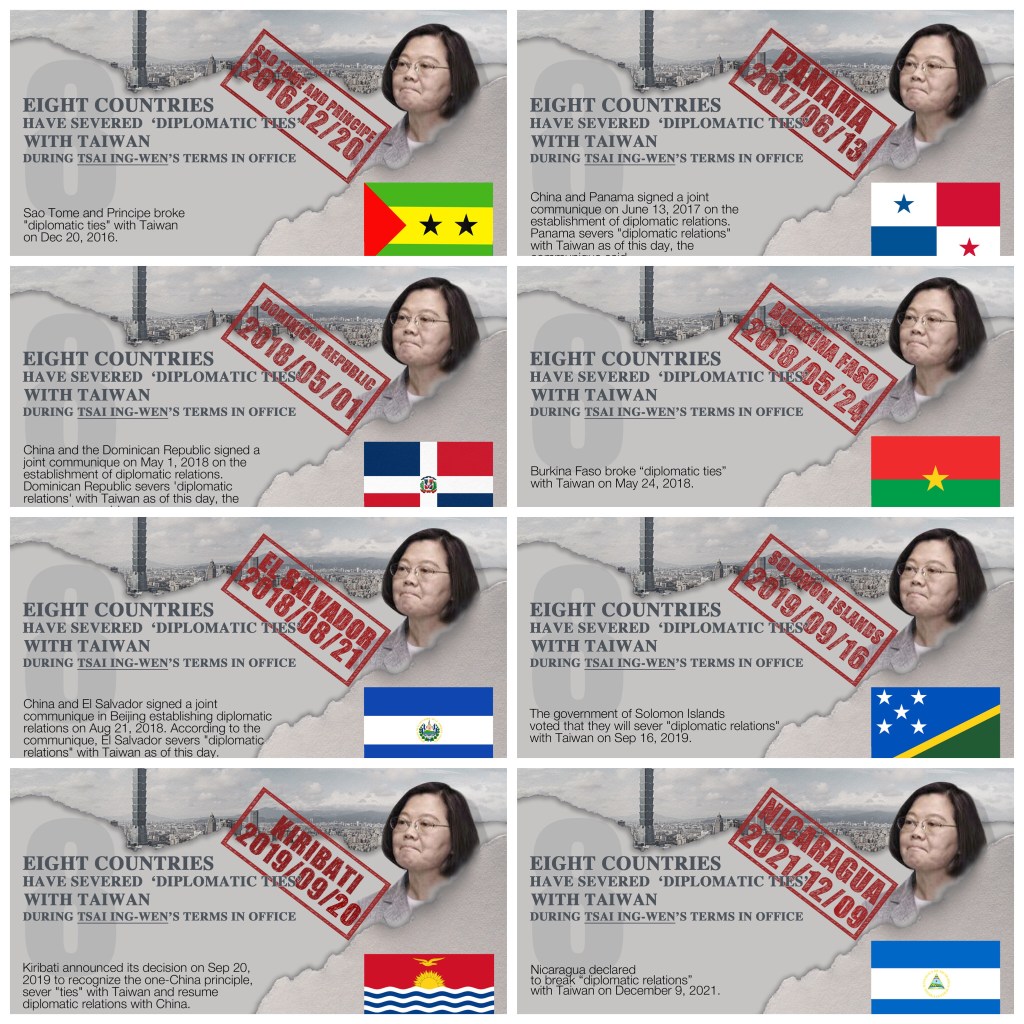
Huge accomplishments by Taiwan’s English Tsai – should make her Japanese ancestors sad / GT: Eight countries have severed ‘diplomatic ties’ with Taiwan during Tsai Ing-wen’s terms in office by Jin Jianyu and Xu Zihe Dec 10 2021
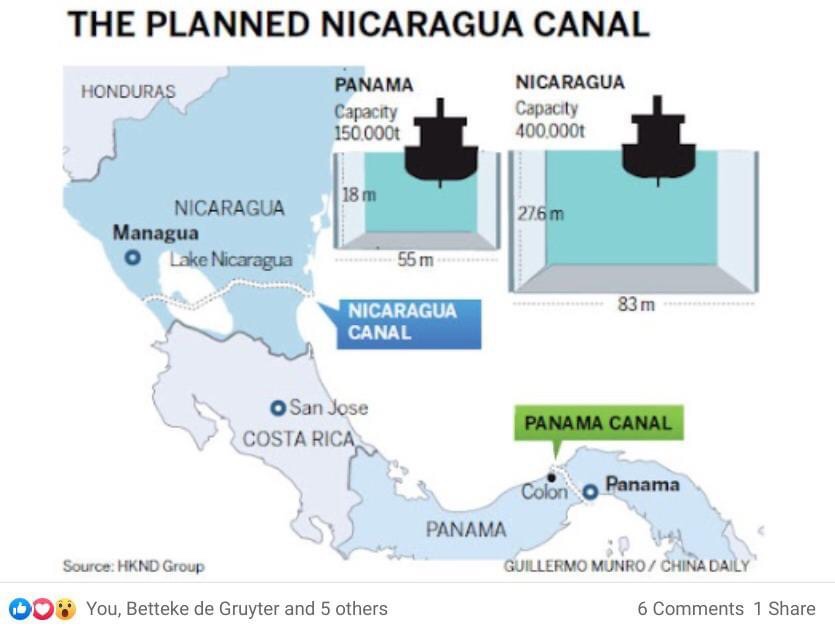
Jim Lochead: ECOLOGY GIVEN PRIORITY CONSIDERATION IN GRAND CANAL PLANNING. Thanks for the big “heads up” from Betteke de Gruyter. .. .. .. “Nicaragua plans a new, bigger, and wider canal connecting two oceans for international shipping. With support from Russia and China {Belt and Road Initiative} the monopolistic grip of the demented US will create a boom to Nicaragua and all of Central America. The criminals in the USA are pulling their hair out and must surely be making plans to disrupt progress in the area, budgeting a fortune into fake insurgencies and media lies.”
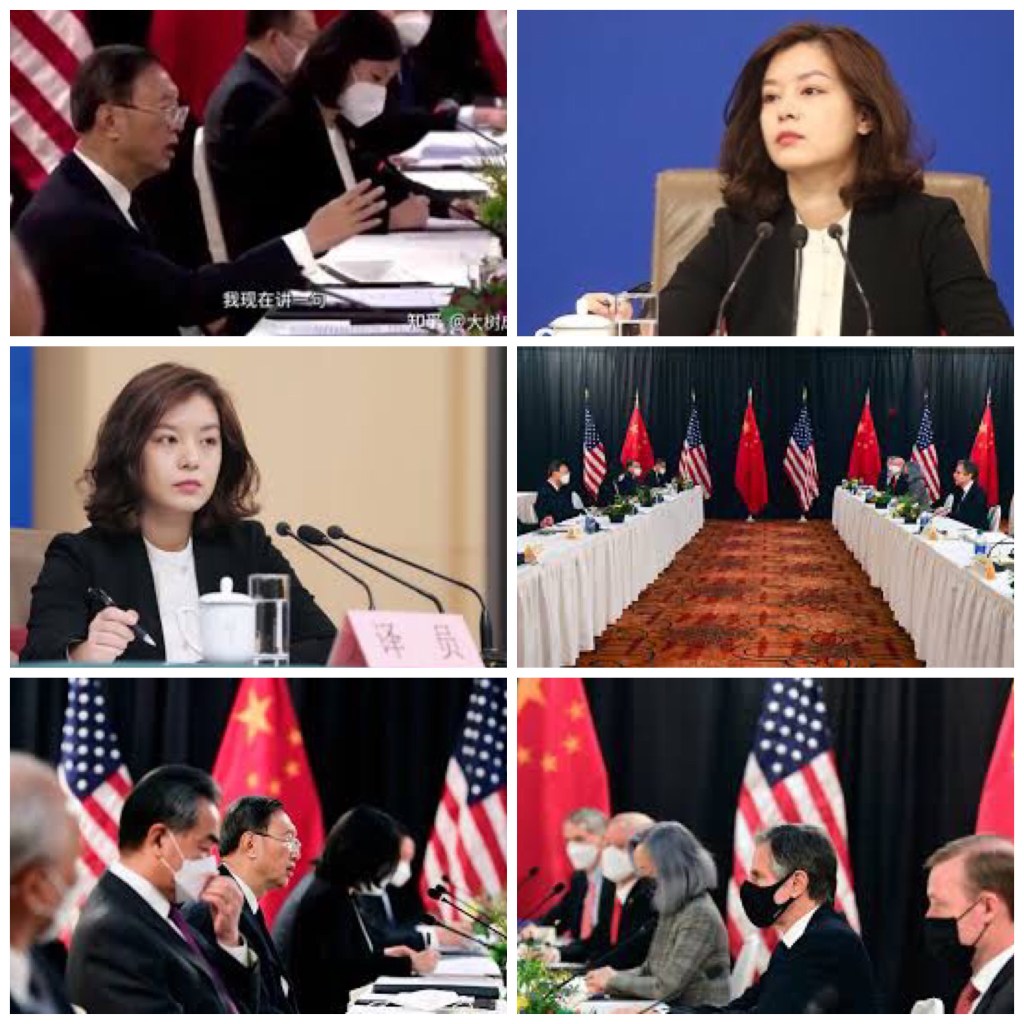
Video: Zhang Jing, the cool and good-look senior interpreter from Hangzhou, rocks the world news cameras live with a 14-minute instant translation – not sentences by sentences – an instant shot to red hot status in China and around the world at the meeting in Alaska on March 20 2021
3月20日, 中美高层战略对话的现场翻译是她#登上热搜,外交部翻译司的高级翻译张京引发网友关注。
在对话会上,美方代表率先挑起争端后,杨洁篪临场反应,阐明我方立场,驳斥美方无理指责,整个发言长达16分钟。
杨洁篪发言结束后,自己也直言:It’s a test for the interpreter.(这对翻译是个挑战)
但张京临危不乱,用14分钟流畅准确地完成了任务,有条不紊,沉稳又专业。戳视频看张京超长待机名场面。
【完整版】中美高层战略对话现场全记录 U.S.-China Summit in Alaska [Full Version]
https://youtu.be/FwbIeCf19jM
Published on Mar 22, 2021
3月18-19日,中共中央政治局委员、中央外事工作委员会办公室主任杨洁篪,国务委员兼外长王毅在安克雷奇同美国国务卿布林肯、总统国家安全事务助理沙利文举行中美高层战略对话。双方共举行了3场会谈。这是美国拜登政府执政以来的中美首次面对面会晤,也是中美元首除夕通话后的首次高层接触。
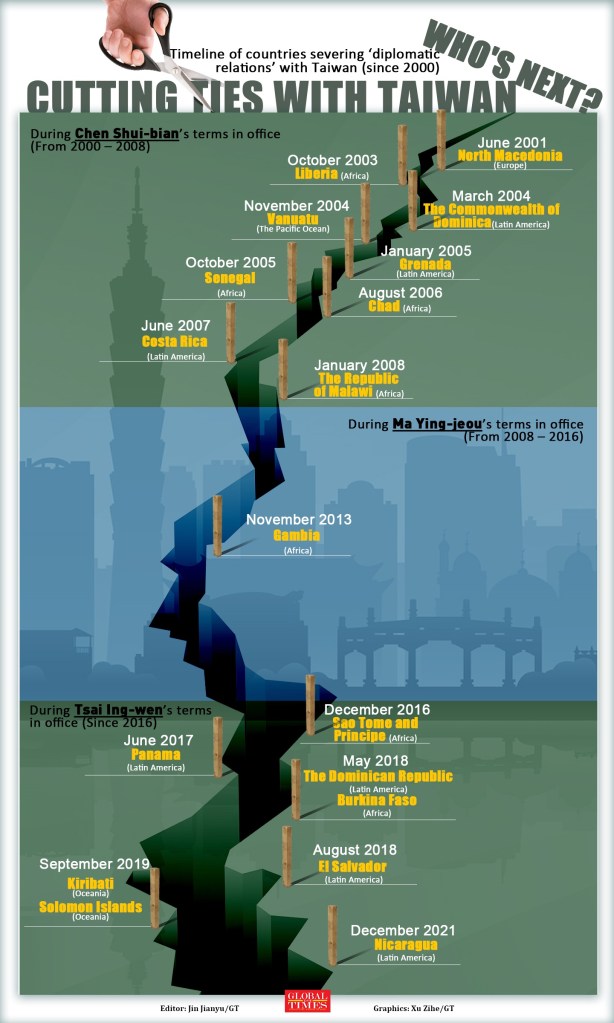
排隊和台灣省斷交, 下一個是誰? Cutting ties with Taiwan, who’s next? by Jin Jianyu and Xu Zihe Dec 10 2021
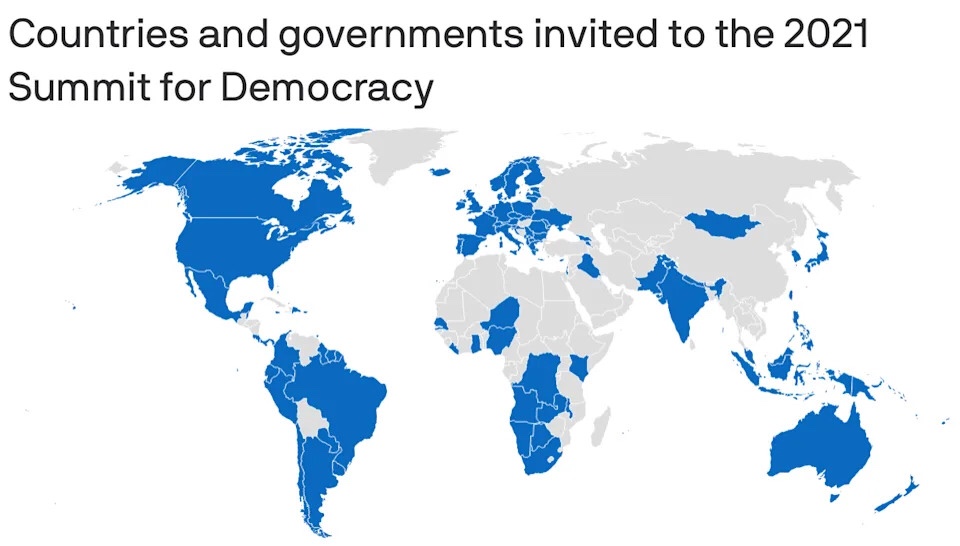
Ten Contradictions That Plague Biden’s Democracy Summit by Codepink – Medea Benjamin and Nicolas J. S. Davies Dec 9 2021
President Biden’s virtual Summit for Democracy on December 9-10 is part of a campaign to restore the United States’ standing in the world, which took such a beating under President Trump’s erratic foreign policies. Biden hopes to secure his place at the head of the “Free World” table by coming out as a champion for human rights and democratic practices worldwide.
The greater possible value of this gathering of 111 countries is that it could instead serve as an “intervention,” or an opportunity for people and governments around the world to express their concerns about the flaws in U.S. democracy and the undemocratic way the United States deals with the rest of the world. Here are just a few issues that should be considered:
China has also far surpassed the U.S. in dealing with the pandemic. Little wonder a Harvard University report found that over 90% of the Chinese people like their government. One would think that China’s extraordinary domestic achievements would make the Biden administration a bit more humble about its “one-size-fits-all” concept of democracy.
Also invited is the corrupt anti-Russian government installed by the 2014 U.S.-backed coup in Ukraine, which reportedly has half its military forces poised to invade the self-declared People’s Republics of Donetsk and Luhansk in Eastern Ukraine, who declared independence in response to the 2014 coup. The U.S. and NATO have so far supported this major escalation of a civil war that already killed 14,000 people.
Guaidó named himself “interim president” (without any legal mandate) in 2019, and launched a failed coup against the elected government of Venezuela. When all his U.S.-backed efforts to overthrow the government failed, Guaidó signed off on a mercenary invasion which failed even more spectacularly. The European Union no longer recognizes Guaido’s claim to the presidency, and his “interim foreign minister” recently resigned, accusing Guaidó of corruption.
Conclusion
Just as the people of Venezuela have not elected or appointed Juan Guaidó as their president, the people of the world have not elected or appointed the United States as the president or leader of all Earthlings.
When the United States emerged from the Second World War as the strongest economic and military power in the world, its leaders had the wisdom not to claim such a role. Instead they brought the whole world together to form the United Nations, on the principles of sovereign equality, non-interference in each other’s internal affairs, a universal commitment to the peaceful resolution of disputes and a prohibition on the threat or use of force against each other.
The United States enjoyed great wealth and international power under the UN system it devised. But in the post-Cold War era, power-hungry U.S. leaders came to see the UN Charter and the rule of international law as obstacles to their insatiable ambitions. They belatedly staked a claim to universal global leadership and dominance, relying on the threat and use of force that the UN Charter prohibits. The results have been catastrophic for millions of people in many countries, including Americans.
Since the United States has invited its friends from around the world to this ”democracy summit,” maybe they can use the occasion to try to persuade their bomb-toting friend to recognize that its bid for unilateral global power has failed, and that it should instead make a real commitment to peace, cooperation and international democracy under the rules-based order of the UN Charter.
Medea Benjamin is cofounder of CODEPINK for Peace, and author of several books, including Inside Iran: The Real History and Politics of the Islamic Republic of Iran.
Nicolas J. S. Davies is an independent journalist, a researcher with CODEPINK and the author of Blood on Our Hands: The American Invasion and Destruction of Iraq.

Video: Unlike US, In China – ALL Gov’t Officials illegal to receive any gifts 不像美國官員合法收黑錢(又名政治黑金)和禮物, 今天全部中國官員不可以收任何禮物.
https://vimeo.com/655422875
https://youtu.be/qE6ZxuFvb_o
https://www.facebook.com/100036400039778/posts/618833252673337/?d=n
屈穎妍:顯微鏡的世代 不要讓別人有懷疑、有胡亂詮釋的機會,最好的方法,就是改變舊有制度.
今日是一個處處放大鏡的年代,啊,不,正確來說,該是顯微鏡年代了。即是說,小事,成了大事;大事,變了核爆。
一粒沙在顯微鏡下會變成巨石,大眾看到的就是堵在路上的大石頭,所以你已不能用解釋沙的方法去說理。
早陣子黃媒《立場新聞》像發現新大陸一樣,報道恒大執董在今年中秋佳節,曾給兩名入境處高官送上禮物籃,而且都是直接送到官員家中。
當事人已解釋,雙方並無商務往來,純粹是多年私人好友,難道高官就不能有朋友嗎?中國人習慣節日給好朋友送上祝福,況且禮物籃訂購價並無超出政府收禮價值的3000元上限,如果那不是恒大,而是滙豐,大家會如此窮追猛打無限演繹嗎?
如上所言,你用解釋「沙」的方法去拆解「石」,當然沒人理睬,黃媒照例在任何場合、見到任何高官議員,都追問此事,務求令石頭越滾越大,製造傷害,尤其在選舉前的關鍵時刻。
看這宗新聞,倒讓我反思今日香港幾個改變和不變。改變的是人心,尤其當社會已撕裂成兩半。
報道指出,記者查閱過恒大的內部文件,發現有入境處兩位高層的送貨住址、禮物籃送抵的相片、及港島香格里拉酒店果籃照片,即是說,資料是恒大內部流出的。
網絡世界,凡是涉及人的東西就沒有秘密可言,為官從政者,更要謹言慎行,因為一張照片,放上網就可以被人無限演繹,就算你幾有道理,都會變得百辭莫辯。
舉個例,只要有人拍到你喝酒的照片,然後再拍你開車,你就是醉駕,儘管你只是喝了不超標的一小杯,人家演繹的,就是你喝完酒開車,所有解釋都是掩飾。
我記起,從前在《壹傳媒》工作,黎智英有句口頭禪。當老闆批評我們的報道缺少或遺漏了什麼,大家總會諸多解釋:因為這樣、因為那樣,然後,肥佬黎會一句轟過來:「那你站在報檔跟買報紙的人逐個解釋!」
不要讓別人有懷疑、有胡亂詮釋的機會,最好的方法,就是改變舊有制度,那就是我剛才說的「不變」了。
公務員收禮物,有250元、1000元、3000元上限等幾項不同場合的價值規定。不知這指標始自何時,但制度一定要與時並進,現在連買一串好一點的香印提子都三百幾蚊,那個250元的禮物規定是否已太過時?
其實,與其太多空間,不如清楚立例,今日內地做公務員就有清晰指引,所有商家送來的禮物一律退回,哪管你是公務還是私交,總之杜絕別人的疑惑。
內地官員告訴我,從前一到節日,送來的果籃特別多,十八大後,全部商家禮物都不收,送來的東西直接由前台當場退回,好多被送禮者連誰送過什麼來都不知道,慢慢,就沒人再敢送禮了。
曾經,我們嘲笑內地官商勾結、貪污成風,今日,落後的倒是驕傲的我們。要避免官員再被人造文章,謙虛向內地學習,倒是個不錯選擇。

 Johnson Choi Biz