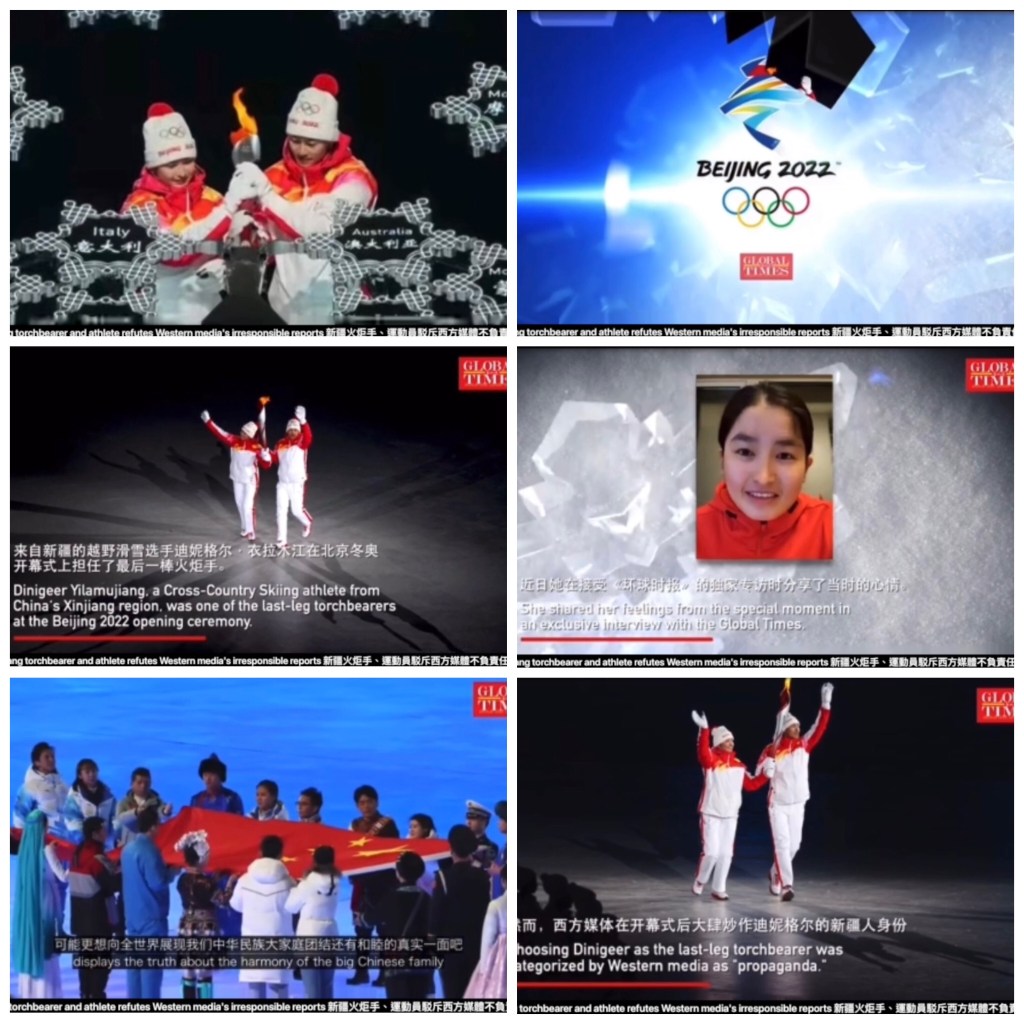
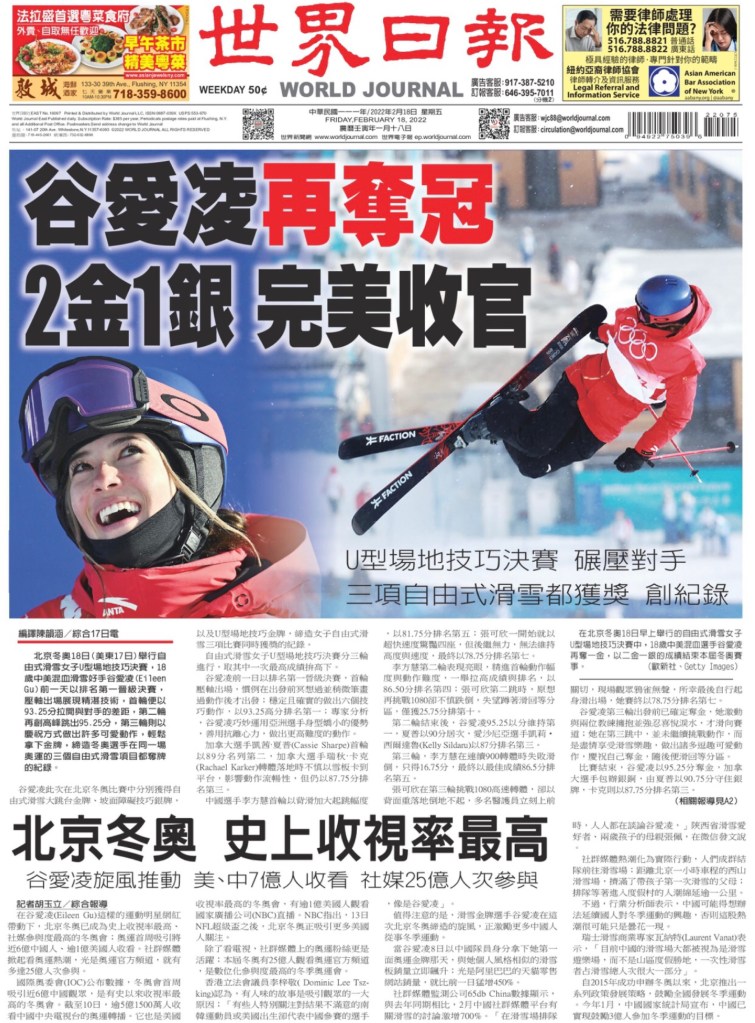
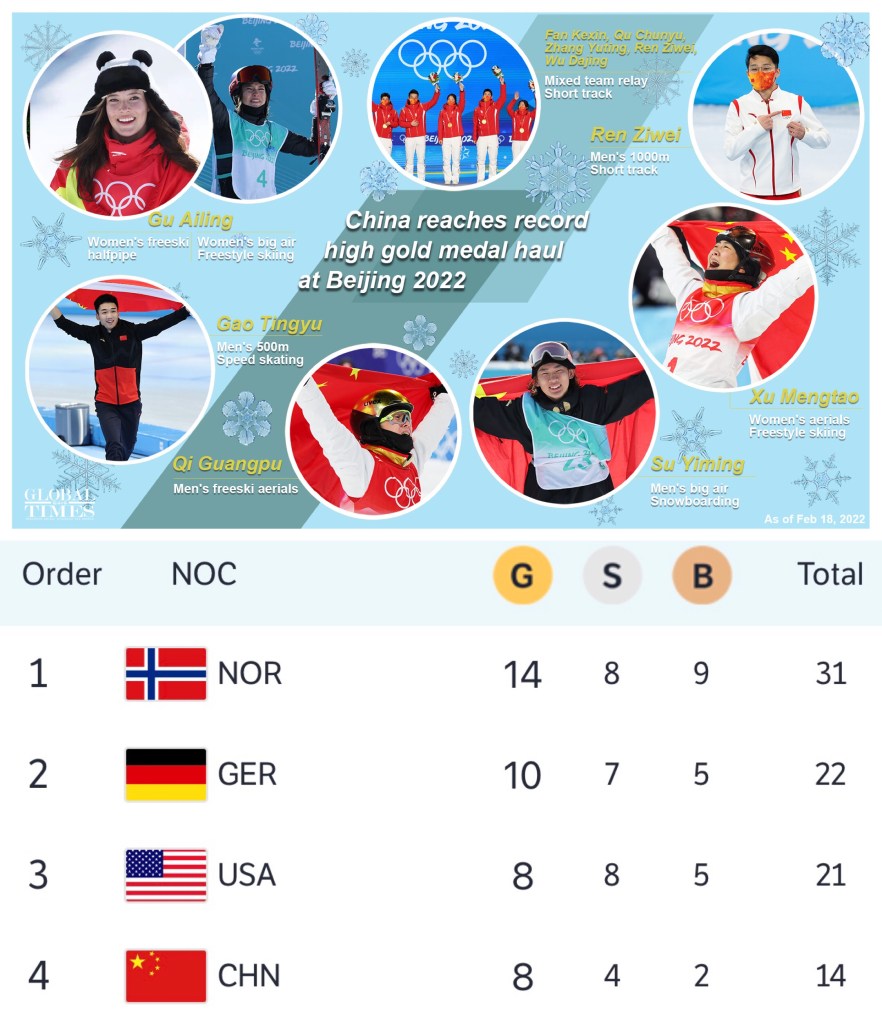
As American Chinese mix-raced skier Eileen Gu (谷爱凌)won gold medal for Team China at Beijing 2022 Olympic Winter Games and became the most popular star in China, some U.S. media start to claim her success was because she grew up in the U.S., some even attack her decision to change her affiliation and represent China.
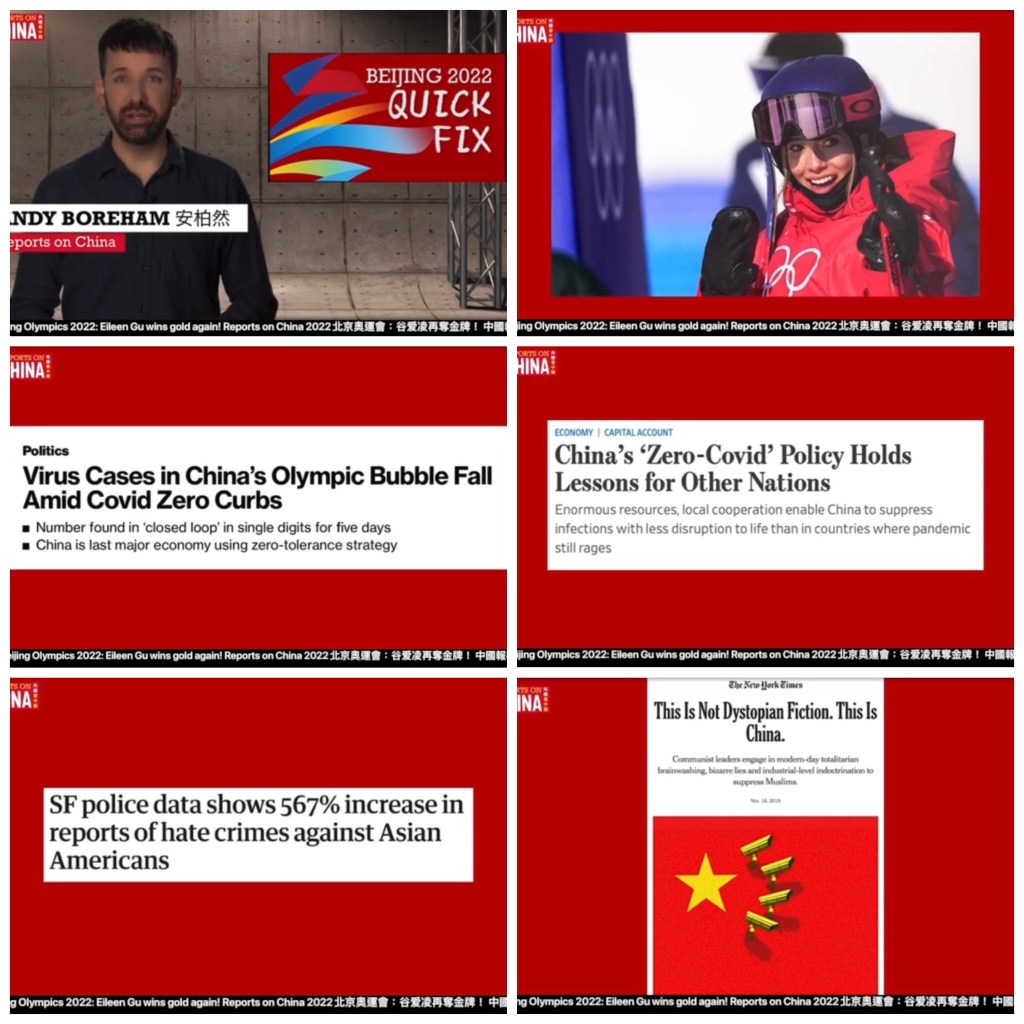
Why Eilleen Gu chose to compete for #China rather than #America? What really led to her historical success? In this video, I try to explain.
NBC New York: According to Reuters, state media report she renounced her US Citizenship at age 15, when she became a Chinese national. NBC 紐約:據路透社報導,官方媒體報導她在 15 歲時放棄了美國公民身份,成為中國公民 Feb 8 2022
American-born Eileen Gu earned the first of what she and her many fans in Beijing hope could be three gold medals for China by cranking out the first 1620 of her career in the Olympic debut of women’s freestyle skiing big air.
Her trick in her final turn stunned Tess Ledeux of France, the only other woman to ever land a 1620 in competition. Ledeux finished second.
Nicknamed the “Snow Princess,” Gu has already reached hero status in China. Even star tennis player Peng Shuai, who has rarely appeared publicly since accusing a Chinese official of sexual assault, was in the stands.
Moments after the biggest run of her life, the 18-year-old freestyle skiing prodigy was asked about her status as a U.S. citizen, her feelings on Shuai and the incessant hate she’s received on social media over competing for the host nation.
“If people don’t believe me, if people don’t like me, then that’s their loss,” Gu said. “They’re never going to win the Olympics.”
China doesn’t recognize dual citizenship, and while a number of outlets have asked the skier about hers in Beijing, she dodged explicit questions on her U.S. standing. According to Reuters, state media report she renounced it at age 15, when she became a Chinese national.
Gu, who has an American father, was born and raised in San Francisco by her mother, who is from Beijing. While her mom has been a constant supporter, little is known about her father. Gu doesn’t talk about him publicly and information on him is scarce, according to multiple outlets. The New York Times reports he is a Harvard graduate, but little else is known about the man behind in the epic free skier.
Eileen Gu calls out ‘domestic terrorism’ of Asian-Americans amid spike in coronavirus-related violence – ‘killing more Asian people isn’t going to kill the virus’ 在與冠狀病毒相關的暴力事件激增的情況下,谷愛凌稱亞裔美國人的“國內恐怖主義” – “殺死更多的亞洲人並不能殺死病毒”
The 17-year-old two-time world champion recalls fleeing a racially charged attack with her grandmother last year
‘It really comes from bigotry and a lack of information’ said Gu, an advocate for race and gender equality by Andrew McNicol 18 Mar, 2021
Chinese-American freeski sensation Eileen Gu Ailing is still traumatised from her experiences of racially motivated hatred towards Asian-Americans, the most terrifying encounter occurring in the company of her more than 80-year-old Chinese immigrant grandmother. “It breaks my heart to see something like this hit so close to home,” the 17-year-old San Francisco-born Gu told the Post, responding to news of the eight people – most of Asian descent – being killed in as series of shootings in Atlanta, Georgia on Tuesday.
“I remember at the beginning of the pandemic, I was with my grandma in a Walgreens in San Francisco and this haphazard, haggard man runs in screaming profanities about Asian people and how they were bringing the virus in and how it was super dangerous. I don’t think I’ve ever felt fear like that in my entire life.
“This was in San Francisco – supposed to be the liberal bubble within California, which is the most liberal state, in the most liberal country in the world. This was supposed to be the safest place and I felt physically in danger. I grabbed my grandma and we ran out. I was so scared. That moment was definitely a reset because I realised how close to home it hit. That anybody can be affected just because of the way they look or their culture and heritage.”
Two-time Youth Olympic Games gold medallist Gu opted to compete under the Chinese flag two years ago. She has since won the country’s first gold medals at the X-Games in January and two golds and a bronze at the 2021 FIS Snowboard and Freeski World Championships in Aspen last weekend. Born to an American father and Chinese mother, she now finds herself bridging a familiar cultural gap that has transcended the sports world. Gu called for those pushing racist, anti-Asian beliefs amid the Covid-19 pandemic to do their research.
“It’s an absolutely absurd idea and it really comes from bigotry and a lack of information. Killing more Asian people isn’t going to kill the virus,” she said. “At this point, America has by far the most cases and any American is just as likely to have it. It really comes from a sense of entitlement and misinformation – and also from people feeling threatened by these movements.
“That’s why it’s so important to clarify that the Black Lives Matter movement and current climate of hate crimes – which they are, by the way, hate crimes and domestic terrorism – against Asian-Americans is not hate towards people who are Asian-American or African-American; it’s literally just highlighting the inequality and I think what is happening is people are afraid that it’s an attack on them. That they’re saying all white people are bad, which is not true. The whole point of this is not to draw more racial divide, but to combat and bring to light these inequalities.
Gu has long been a proponent for equality and has no intention of stopping now. In seventh grade, she gave her first speech about women in sports and continued to address the gender pay-gap, sex-based educational discrimination and misrepresentation of women in media in the US throughout high school. “I have always been really outspoken in all matters, not just race but gender too. I’m very comfortable with these topics because they are very important. During the Black Lives Matter movement, I wanted to do my part as an ally. Obviously I’m never going to fully understand the kind of oppression that [African-Americans] go through. But it’s so important to stand by, support and amplify those voices that are so often silenced,” she said.
“What needs to happen is more people need to be willing to listen in a non-biased sense – a non-defensive sense – and to not attack people when talking about these topics. To bring light to the violence and suggest ways for change and to bring people together.”
From her instagram:
Happy International Women’s day!! Today is a day meant for celebrating all of the ambitious, empowered, loving, bold, smart, and altruistic women around the globe making the world a better place, through countless individual choices and achievements. Selfishly, though, this post is about all the women who I am fortunate enough to have in my own life…
From my fiercely confident grandma (who instilled in me my competitive nature), to my pragmatic and hardworking mother (who taught me my ambition and work ethic), to my unbelievably strong high school cross country coach (who showed me focus and fearlessness), to a very abridged list of close friends who have been by my side and helped me grow in the right directions, offering (mostly) logical advice, hours of sore-belly laughing, and teaching me the virtues of empathy, kindness, trust, honesty, and compassion for a range of 4 to 13 years (@kyraatorres , @almiraabowo and I said we would be ‘best friends forever’ in kindergarten…13 years later we’re living up to the pact), I can confidently say the women in my life have made me who I am today.
Excellent analysis by economist Michael Hudson: America’s real adversaries: The EU – The U.S. aim is to keep them from trading with China and Russia 經濟學家邁克爾·哈德森的出色分析:美國真正的對手:歐盟 – 美國的目的是阻止他們與中國和俄羅斯進行貿易
Hudson’s essay is long, but it shows the economic dimensions (rather than the purely geopolitical considerations that we often analyze). In a quick nutshell:
What’s happening now:
US policy has to keep EU in its orbit/under its thumb rather than allying with China-Russia.
US pressure/bullying on the EU is creating the opposite effect–it is driving them closer to China & Russia The US needs a military incident to discipline, bring back “allies” into the fold.
But the lack of a military threat is the problem for the US. Hence the Ukraine “conflict”.
Background:
US Empire/dominance relies on its control of the world economy through global structures and institutions. It is the global landlord who collects rents/interests on the productivity of the world. This takes the form of the exorbitant privilege of the dollar as global currency (allowing mass printing of dollars) and petro-dollar recycling–this allows it to free-ride on the global economy. (This is like a Casino that issues its own chips. But people still have to play in the casino, otherwise, its chips are worthless)
Threat: China & Russia
This hegemony is threatened by the independent development of China and Russia
China was supposed to fall into the US orbit, as had Russia.
China broke the mold–refused to put itself in a subservient position to US global capital. It developed on its own terms.
This was tolerated for a while because China offered the US a way to profit, and also allowed the US to discipline labor within its own borders.
Now the US needs to put China back into its corner.
(Russia is recovering, along Chinese lines, with Chinese support, as is the rest of the global south)
The US economy is a financialized, rentier economy based on guns, oil, and banks, backed up with military threats. This is why the US has returned to “primitive accumulation”/military force to control oil resources:
The other pillar are Military/arms sales– useless “luxury goods” floating the failing state:
De-dollarization will ultimately break the US power–and the US is facilitating this.
Neoliberal financialization has been/is the only way for the US to maintain economic power–but it is a parasitic force that will ruin countries and create failed states.
Another pole is developing. A new world is possible.
Implications:
Europe and Asia understand this, and are choosing to integrate with China and Russia.
The US has no solution to this but war.
US policy is about keeping EU in its orbit.
The Iron Curtain of the 1940s and ‘50s was ostensibly designed to isolate Russia from Western Europe – to keep out Communist ideology and military penetration. Today’s sanctions regime is aimed inward, to prevent America’s NATO and other Western allies from opening up more trade and investment with Russia and China. The aim is not so much to isolate Russia and China as to hold these allies firmly within America’s own economic orbit. Allies are to forego the benefits of importing Russian gas and Chinese products, buying much higher-priced U.S. LNG and other exports, capped by more U.S. arms.
The sanctions that U.S. diplomats are insisting that their allies impose against trade with Russia and China are aimed ostensibly at deterring a military buildup. But such a buildup cannot really be the main Russian and Chinese concern. They have much more to gain by offering mutual economic benefits to the West. So the underlying question is whether Europe will find its advantage in replacing U.S. exports with Russian and Chinese supplies and the associated mutual economic linkages.
What worries American diplomats is that Germany, other NATO nations and countries along the Belt and Road route understand the gains that can be made by opening up peaceful trade and investment. If there is no Russian or Chinese plan to invade or bomb them, what is the need for NATO? What is the need for such heavy purchases of U.S. military hardware by America’s affluent allies? And if there is no inherently adversarial relationship, why do foreign countries need to sacrifice their own trade and financial interests by relying exclusively on U.S. exporters and investors?
The lack of a military threat is the problem for the US: These are the concerns that have prompted French Prime Minister Macron to call forth the ghost of Charles de Gaulle and urge Europe to turn away from what he calls NATO’s “brain-dead” Cold War and break with the pro-U.S. trade arrangements that are imposing rising costs on Europe while denying it potential gains from trade with Eurasia. Even Germany is balking at demands that it freeze by this coming March by going without Russian gas.
Instead of a real military threat from Russia and China, the problem for American strategists is the absence of such a threat. All countries have come to realize that the world has reached a point at which no industrial economy has the manpower and political ability to mobilize a standing army of the size that would be needed to invade or even wage a major battle with a significant adversary. That political cost makes it uneconomic for Russia to retaliate against NATO adventurism prodding at its western border trying to incite a military response. It’s just not worth taking over Ukraine.
US pressure is creating the opposite effect–it is driving them closer to China & Russia:
America’s rising pressure on its allies threatens to drive them out of the U.S. orbit. For over 75 years they had little practical alternative to U.S. hegemony. But that is now changing. America no longer has the monetary power and seemingly chronic trade and balance-of-payments surplus that enabled it to draw up the world’s trade and investment rules in 1944-45. The threat to U.S. dominance is that China, Russia and Mackinder’s Eurasian World Island heartland are offering better trade and investment opportunities than are available from the United States with its increasingly desperate demand for sacrifices from its NATO and other allies.
The most glaring example is the U.S. drive to block Germany from authorizing the Nord Stream 2 pipeline to obtain Russian gas for the coming cold weather. Angela Merkel agreed with Donald Trump to spend $1 billion building a new LNG port to become more dependent on highly priced U.S. LNG. (The plan was cancelled after the U.S. and German elections changed both leaders.) But Germany has no other way of heating many of its houses and office buildings (or supplying its fertilizer companies) than with Russian gas.
The US needs a military incident to discipline, bring back “allies” into the fold.
The only way left for U.S. diplomats to block European purchases is to goad Russia into a military response and then claim that avenging this response outweighs any purely national economic interest. As hawkish Under-Secretary of State for Political Affairs, Victoria Nuland, explained in a State Department press briefing on January 27: “If Russia invades Ukraine one way or another Nord Stream 2 will not move forward.”[1] The problem is to create a suitably offensive incident and depict Russia as the aggressor.
Nuland expressed who was dictating the policies of NATO members succinctly in 2014: “Fuck the EU.” That was said as she told the U.S. ambassador to Ukraine that the State Department was backing the puppet Arseniy Yatsenyuk as Ukrainian prime minister (removed after two years in a corruption scandal), and U.S. political agencies backed the bloody Maidan massacre that ushered in what are now eight years of civil war. The result devastated Ukraine much as U.S. violence had done in Syria, Iraq and Afghanistan. This is not a policy of world peace or democracy that European voters endorse.
U.S. trade sanctions imposed on its NATO allies extend across the trade spectrum. Austerity-ridden Lithuania gave up its cheese and agricultural market in Russia, and is blocking its state-owned railroad from carrying Belarus potash to the Baltic port of Klaipeda. The port’s majority owner complained that “Lithuania will lose hundreds of millions of dollars from halting Belarus exports through Klaipeda,” and “could face legal claims of $15 billion over broken contracts.”[2] Lithuania has even agreed to U.S. prompting to recognize Taiwan, resulting in China refusing to import German or other products that include Lithuanian-made components.
Europe is to impose sanctions at the cost of rising energy and agricultural prices by giving priority to imports from the United States and foregoing Russian, Belarusian and other linkages outside of the Dollar Area. As Sergey Lavrov put matters: “When the United States thinks that something suits its interests, it can betray those with whom it was friendly, with whom it cooperated and who catered to its positions around the world.”[3]
America’s sanctions on its allies hurt their economies, not those of Russia and China
What seems ironic is that such sanctions against Russia and China have ended up helping rather than hurting them. But the primary aim was not to hurt nor to help the Russian and Chinese economies. After all, it is axiomatic that sanctions force the targeted countries to become more self-reliant. Deprived of Lithuanian cheese, Russian producers have produced their own, and no longer need to import it from the Baltic states. America’s underlying economic rivalry is aimed at keeping European and its allied Asian countries in its own increasingly protected economic orbit. Germany, Lithuania and other allies are told to impose sanctions directed against their own economic welfare by not trading with countries outside the U.S. dollar-area orbit.
US dominance relies on its control of the world economy through global structures and institutions
Quite apart from the threat of actual war resulting from U.S. bellicosity, the cost to America’s allies of surrendering to U.S. trade and investment demands is becoming so high as to be politically unaffordable. For nearly a century there has been little alternative but to agree to trade and investment rules favoring the U.S. economy as the price of receiving U.S. financial and trade support and even military security. But an alternative is now threatening to emerge – one offering benefits from China’s Belt and Road initiative, and from Russia’s desire for foreign investment to help modernize its industrial organization, as seemed to be promised thirty years ago in 1991.
Ever since the closing years of World War II, U.S. diplomacy has aimed at locking Britain, France, and especially defeated Germany and Japan, into becoming U.S. economic and military dependencies. As I documented in Super Imperialism,American diplomats broke up the British Empire and absorbed its Sterling Area by the onerous terms imposed first by Lend-Lease and then the Anglo-American Loan Agreement of 1946. The latter’s terms obliged Britain to give up its Imperial Preference policy and unblock the sterling balances that India and other colonies had accumulated for their raw-materials exports during the war, thus opening the British Commonwealth to U.S. exports.
Britain committed itself not to recover its prewar markets by devaluing sterling. U.S. diplomats then created the IMF and World Bank on terms that promoted U.S. export markets and deterred competition from Britain and other former rivals. Debates in the House of Lords and the House of Commons showed that British politicians recognized that they were being consigned to a subservient economic position, but felt that they had no alternative. And once they gave up, U.S. diplomats had a free hand in confronting the rest of Europe.
In particular, it has the exorbitant privilege of the dollar standard and petro-dollar recycling–this allows it to free-ride on the global economy
Financial power has enabled America to continue dominating Western diplomacy despite being forced off gold in 1971 as a result of the balance-of-payments costs of its overseas military spending. For the past half-century, foreign countries have kept their international monetary reserves in U.S. dollars – mainly in U.S. Treasury securities, U.S. bank accounts and other financial investments in the U.S. economy. The Treasury-bill standard obliges foreign central banks to finance America’s military-based balance-of-payments deficit – and in the process, the domestic government budget deficit.
The United States does not need this recycling to create money. The government can simply print money, as MMT has demonstrated. But the United States does need this foreign central bank dollar recycling to balance its international payments and support the dollar’s exchange rate. If the dollar were to decline, foreign countries would find it much easier to pay international dollar-debts in their own currencies. U.S. import prices would rise, and it would be more costly for U.S. investors to buy foreign assets. And foreigners would lose money on U.S. stocks and bonds as denominated in their own currencies, and would drop them. Central banks in particular would take a loss on the Treasury’s dollar bonds that they hold in their monetary reserves – and would find their interest to lie in moving out of the dollar. So the U.S. balance of payments and exchange rate are both threatened by U.S. belligerency and military spending throughout the world – yet its diplomats are trying to stabilize matters by ramping up the military threat to crisis levels.
This hegemony is threatened by China and Russia
U.S. drives to keep its European and East Asian protectorates locked into its own sphere of influence is threatened by the emergence of China and Russia independently of the United States while the U.S. economy is de-industrializing as a result of its own deliberate policy choices. The industrial dynamic that made the United States so dominant from the late 19th century up to the 1970s has given way to an evangelistic neoliberal financialization. That is why U.S. diplomats need to arm-twist their allies to block their economic relations with post-Soviet Russia and socialist China, whose growth is outstripping that of the United States and whose trade arrangements offer more opportunities for mutual gain.
At issue is how long the United States can block its allies from taking advantage of China’s economic growth. Will Germany, France and other NATO countries seek prosperity for themselves instead of letting the U.S. dollar standard and trade preferences siphon off their economic surplus?
China was supposed to fall into the US orbit, as did Russia.
Oil diplomacy and America’s dream for post-Soviet Russia
The expectation of Gorbachev and other Russian officials in 1991 was that their economy would turn to the West for reorganization along the lines that had made the U.S., German and other economies so prosperous. The mutual expectation in Russia and Western Europe was for German, French and other investors to restructure the post-Soviet economy along more efficient lines.
That was not the U.S. plan. When Senator John McCain called Russia “a gas station with atom bombs,” that was America’s dream for what they wanted Russia to be – with Russia’s gas companies passing into control by U.S. stockholders, starting with the planned buyout of Yukos as arranged with Mikhail Khordokovsky. The last thing that U.S. strategists wanted to see was a thriving revived Russia. U.S. advisors sought to privatize Russia’s natural resources and other non-industrial assets, by turning them over to kleptocrats who could “cash out” on the value of what they had privatized only by selling to U.S. and other foreign investors for hard currency. The result was a neoliberal economic and demographic collapse throughout the post-Soviet states.
The US economy is a financialized, rentier economy based on guns, oil, and military threats.
In some ways, America has been turning itself into its own version of a gas station with atom bombs (and arms exports). U.S. oil diplomacy aims to control the world’s oil trade so that its enormous profits will accrue to the major U.S. oil companies. It was to keep Iranian oil in the hands of British Petroleum that the CIA’s Kermit Roosevelt worked with British Petroleum’s Anglo-Persian Oil Company to overthrow Iran’s elected leader Mohammed Mossadegh in 1954 when he sought to nationalize the company after it refused decade after decade to perform its promised contributions to the economy. After installing the Shah whose democracy was based on a vicious police state, Iran threatened once again to act as the master of its own oil resources. So it was once again confronted with U.S.-sponsored sanctions, which remain in effect today. The aim of such sanctions is to keep the world oil trade firmly under U.S. control, because oil is energy and energy is the key to productivity and real GDP.
In cases where foreign governments such as Saudi Arabia and neighboring Arab petrostates have taken control, the export earnings of their oil are to be deposited in U.S. financial markets to support the dollar’s exchange rate and U.S. financial domination. When they quadrupled their oil prices in 1973-74 (in response to the U.S. quadrupling of its grain-export prices), the U.S. State Department laid down the law and told Saudi Arabia that it could charge as much as it wanted for its oil (thereby raising the price umbrella for U.S. oil producers), but it had to recycle its oil-export earnings to the United States in dollar-denominated securities – mainly in U.S. Treasury securities and U.S. bank accounts, along with some minority holdings of U.S. stocks and bonds (but only as passive investors, not using this financial power to control corporate policy).
The second mode of recycling oil-export earnings was to buy U.S. arms exports, with Saudi Arabia becoming one of the military-industrial complex’s largest customers. U.S. arms production actually is not primarily military in character. As the world is now seeing in the kerfuffle over Ukraine, America does not have a fighting army. What it has is what used to be called an “eating army.” U.S. arms production employs labor and produces weaponry as a kind of prestige good for governments to show off, not for actual fighting. Like most luxury goods, the markup is very high. That is the essence of high fashion and style, after all. The MIC uses its profits to subsidize U.S. civilian production in a way that does not violate the letter of international trade laws against government subsidy.
This is why the US has returned to “primitive accumulation” to control oil resources:
Sometimes, of course, military force is indeed used. In Iraq, first George W. Bush and then Barack Obama used the military to seize the country’ oil reserves, along with those of Syria and Libya. Control of world oil has been the buttress of America’s balance of payments. Despite the global drive to slow the planet’s warming, U.S. officials continue to view oil as the key to America’s economic supremacy. That is why the U.S. military is still refusing to obey Iraq’s orders to leave their country, keeping its troops in control of Iraqi oil, and why it agreed with the French to destroy Libya and still has troops in the oilfields of Syria. Closer to home, President Biden has approved offshore drilling and supports Canada’s expansion of its Athabasca tar sands, environmentally the dirtiest oil in the world.
Along with oil and food exports, arms exports support the Treasury-bill standard’s financing of America’s overseas military spending on its 750 bases abroad. But without a standing enemy constantly threatening at the gates, NATO’s existence falls apart. What would be the need for countries to buy submarines, aircraft carriers, airplanes, tanks, missiles and other arms?
Military/arms sales are the luxury goods floating the failing state:
As the United States has de-industrialized, its trade and balance-of-payments deficit is becoming more problematic. It needs arms export sales to help reduce its widening trade deficit and also to subsidize its commercial aircraft and related civilian sectors. The challenge is how to maintain its prosperity and world dominance as it de-industrializes while economic growth is surging ahead in China and now even Russia.
America has lost its industrial cost advantage by the sharp rise in its cost of living and doing business in its financialized post-industrial rentier economy. Additionally, as Seymour Melman explained in the 1970s, Pentagon capitalism is based on cost-plus contracts: The higher military hardware costs, the more profit its manufacturers receive. So U.S. arms are over-engineered – hence, the $500 toilet seats instead of a $50 model. The main attractiveness of luxury goods after all, including military hardware, is their high price.
This is the background for U.S. fury at its failure to seize Russia’s oil resources – and at seeing Russia also break free militarily to create its own arms exports, which now are typically better and much less costly than those of the U.S. Today Russia is in the position of Iran in 1954 and again in 1979. Not only do its oil sales rival those of U.S. LNG, but Russia keeps its oil-export earnings at home to finance its re-industrialization, so as to rebuild the economy that was destroyed by the U.S.-sponsored shock “therapy” of the 1990s.
The line of least resistance for U.S. strategy seeking to maintain control of the world’s oil supply while maintaining its luxury-arms export market via NATO is to Cry Wolf and insist that Russia is on the verge of invading Ukraine – as if Russia had anything to gain by quagmire warfare over Europe’s poorest and least productive economy. The winter of 2021-22 has seen a long attempt at U.S. prodding of NATO and Russia to fight – without success.
U.S. dreams of a neoliberalized China as a U.S. corporate affiliate
America has de-industrialized as a deliberate policy of slashing production costs as its manufacturing companies have sought low-wage labor abroad, most notably in China. This shift was not a rivalry with China, but was viewed as mutual gain. American banks and investors were expected to secure control and the profits of Chinese industry as it was marketized. The rivalry was between U.S. employers and U.S. labor, and the class-war weapon was offshoring and, in the process, cutting back government social spending.
Similar to the Russian pursuit of oil, arms and agricultural trade independent of U.S. control, China’s offense is keeping the profits of its industrialization at home, retaining state ownership of significant corporations and, most of all, keeping money creation and the Bank of China as a public utility to fund its own capital formation instead of letting U.S. banks and brokerage houses provide its financing and siphon off its surplus in the form of interest, dividends and management fees. The one saving grace to U.S. corporate planners has been China’s role in deterring U.S. wages from rising by providing a source of low-priced labor to enable American manufacturers to offshore and outsource their production.
China broke the mold–refused to put itself in a subservient position to US global capital
The Democratic Party’s class war against unionized labor started in the Carter Administration and greatly accelerated when Bill Clinton opened the southern border with NAFTA. A string of maquiladoras were established along the border to supply low-priced handicraft labor. This became so successful a corporate profit center that Clinton pressed to admit China into the World Trade Organization in December 2001, in the closing month of his administration. The dream was for it to become a profit center for U.S. investors, producing for U.S. companies and financing its capital investment (and housing and government spending too, it was hoped) by borrowing U.S. dollars and organizing its industry in a stock market that, like that of Russia in 1994-96, would become a leading provider of finance-capital gains for U.S. and other foreign investors.
Walmart, Apple and many other U.S. companies organized production facilities in China, which necessarily involved technology transfers and creation of an efficient infrastructure for export trade. Goldman Sachs led the financial incursion, and helped China’s stock market soar. All this was what America had been urging.
Where did America’s neoliberal Cold War dream go wrong? For starters, China did not follow the World Bank’s policy of steering governments to borrow in dollars to hire U.S. engineering firms to provide export infrastructure. It industrialized in much the same way that the United States and Germany did in the late 19th century: By heavy public investment in infrastructure to provide basic needs at subsidized prices or freely, from health care and education to transportation and communications, in order to minimize the cost of living that employers and exporters had to pay. Most important, China avoided foreign debt service by creating its own money and keeping the most important production facilities in its own hands.
De-dollarization will break the US power
U.S. demands are driving its allies out of the dollar-NATO trade and monetary orbit
As in a classical Greek tragedy, U.S. foreign policy is bringing about precisely the outcome that it most fears. Overplaying their hand with their own NATO allies, U.S. diplomats are bringing about Kissinger’s nightmare scenario, driving Russia and China together. While America’s allies are told to bear the costs of U.S. sanctions, Russia and China are benefiting by being obliged to diversify and make their own economies independent of reliance on U.S. suppliers of food and other basic needs. Above all, these two countries are creating their own de-dollarized credit and bank-clearing systems, and holding their international monetary reserves in the form of gold, euros and each other’s currencies to conduct their mutual trade and investment.
This de-dollarization provides an alternative to the unipolar U.S. ability to gain free foreign credit via the U.S. Treasury-bill standard for world monetary reserves. As foreign countries and their central banks de-dollarize, what will support the dollar? Without the free line of credit provided by central banks automatically recycling America’s foreign military and other overseas spending back to the U.S. economy (with only a minimal return), how can the United States balance its international payments in the face of its de-industrialization?
The United States cannot simply reverse its de-industrialization and dependence on Chinese and other Asian labor by bringing production back home. It has built too high a rentier overhead into its economy for its labor to be able to compete internationally, given the U.S. wage-earner’s budgetary demands to pay high and rising housing and education costs, debt service and health insurance, and for privatized infrastructure services.
Neoliberal financialization is the only way for the US to maintain economic power–but it is a parasitic force that will ruin countries and create failed states.
The only way for the United States to sustain its international financial balance is by monopoly pricing of its arms, patented pharmaceutical and information-technology exports, and by buying control of the most lucrative production and potentially rent-extracting sectors abroad – in other words, by spreading neoliberal economic policy throughout the world in a way that obliges other countries to depend on U.S. loans and investment.
That is not a way for national economies to grow. The alternative to neoliberal doctrine is China’s growth policies that follow the same basic industrial logic by which Britain, the United States, Germany and France rose to industrial power during their own industrial takeoffs with strong government support and social spending programs.
The United States has abandoned this traditional industrial policy since the 1980s. It is imposing on its own economy the neoliberal policies that de-industrialized Pinochetista Chile, Thatcherite Britain and the post-industrial former Soviet republics, the Baltics and Ukraine since 1991. Its highly polarized and debt-leveraged prosperity is based on inflating real estate and securities prices and privatizing infrastructure.
This neoliberalism has been a path to becoming a failed economy and indeed, a failed state, obliged to suffer debt deflation, rising housing prices and rents as owner-occupancy rates decline, as well as exorbitant medical and other costs resulting from privatizing what other countries provide freely or at subsidized prices as human rights – health care, education, medical insurance and pensions.
Europe and Asia understand this, and are choosing to integrate with China and Russia. The US has no solution to this but war.
The success of China’s industrial policy with a mixed economy and state control of the monetary and credit system has led U.S. strategists to fear that Western European and Asian economies may find their advantage to lie in integrating more closely with China and Russia. The U.S. seems to have no response to such a global rapprochement with China and Russia except economic sanctions and military belligerence. That New Cold War stance is expensive, and other countries are balking at bearing the cost of a conflict that has no benefit for themselves and indeed, threatens to destabilize their own economic growth and political independence.
Without subsidy from these countries, especially as China, Russia and their neighbors de-dollarize their economies, how can the United States maintain the balance-of-payments costs of its overseas military spending? Cutting back that spending, and indeed recovering industrial self-reliance and competitive economic power, would require a transformation of American politics. Such a change seems unlikely, but without it, how long can America’s post-industrial rentier economy manage to force other countries to provide it with the economic affluence (literally a flowing-in) that it is no longer producing at home?
Video: Olympics Gold Medalist Ailing Gu response to news media with confidence and determination 奧運金牌得主谷愛凌以信心和決心回應新聞媒體 Listen to Ailing Gu – this 18 years old put many adults to shame! 聽谷愛凌的話 – 這個18歲讓很多大人汗顏!
Gu Ailing, Women’s skiing big air gold medallist:
“Here’s the thing, I’m not trying to keep anyone happy. I’m an 18-year-old girl out here living my best life. I’m having a great time. It doesn’t really matter if other people are happy or not, because I feel as though I am doing my best, I am enjoying the entire process and I’m using my voice to create as much positive change as I can for the voices who will listen to me, in an area that is personal and relevant to myself.”
“And so if other people don’t really believe that that’s where I’m coming from then that just reflects that they do not have the empathy to empathize with a good heart, perhaps because they don’t share the same kind of morals that I do.And in that sense I am not going to waste my time trying to placate people who are one, uneducated, and two, probably are never going to experience the kind of joy and gratitude and just love that I have the great fortune to experience on a daily basis. So yeah, if people don’t believe me and if people don’t like me then, that’s their loss. They’re never going to win the Olympics.”
“I definitely feel as though I am just as American as I am Chinese. I am American when I am in the US, and I am Chinese when I am in China. And I’ve been very outspoken about my gratitude to both the US and China for making me the person who I am. I don’t feel as though I’m, taking advantage of one or the other, because both have actually been incredibly supportive of me and continue to be supportive of me, because they understand that my mission is to use sport as a force for unity, to use it as a form to foster interconnection between countries and not use it as a divisive force. So that benefits everyone and if you disagree with that then I feel like that’s someone else’s problem.”
Vicious article by USA TODAY attacks Eileen Gu as a hypocrite and propagandist, and a marketing machine whose ideals are “aspirational pabulum”. After giving her some praise for her unmistakable accomplishments, it then claims that others will “scrutinize her words, call her a traitor, lob racist insults, tell her to stay in China and root for her to fail. She will almost certainly be culture war fodder on Fox News for days, but she will not find safe harbor on either the political left or right. The consequences of the choice she made in 2019, which nobody outside this niche sport would have known or cared about, will be evident in ways that even a young woman as intelligent and self-aware as Gu may not fully understand”,
They are stoking the hatred and cynicism against her that they say she will have to live with. https://news.yahoo.com/opinion-eileen-gus-life-gets-104316239.htm ln her native country, Gu was going to be a star for a week or two if she won a gold medal. With her model looks, her fluency in Mandarin and her ability to compel millions of Chinese viewers to care about the Olympics, there was no limit to the magnitude of what she could become or, perhaps more to the point, what products she could sell. And she is everywhere here, appearing in ad campaigns for a gamut of companies ranging from the Bank of China to Louis Vuitton. She is also rehearsed and smart, a marketing machine who has beenprogrammed to frame her choice as an opportunity to inspire winter sports passion in China while saying nothing that would offend the Chinese Communist Party. But Gu is also going to have to learn to live in a new world of cynicism. When she says she’s careful about the brands she chooses to work with, that she wants them to “inspire positive social change” and “care about women in society” while aligning with China, it’s impossible to avoid the hypocrisy. When Gu sidesteps a question about Peng Shuai’s attendance Tuesday by saying she’s “grateful that she’s happy and healthy and out here doing her thing again,” it’s just more propaganda.
In April 2015, a photo touched countless Chinese people and received many re-posts and likes online. It featured a female Chinese naval soldier holding a little Chinese girl’s hand as they prepared to board a warship. Carrying a backpack and holding a bottle of water, the little girl was walking briskly in good spirits. People captioned the photo “Don’t be afraid. I’ll take you home.” The photo captured a most heart-warming scene during the evacuation of Chinese nationals from Yemen in 2015, and there are many more heartening and moving stories behind it.
A female soldier of the frigate Linyi helping a child evacuee board the warship on March 29, 2015.
In March 2015, the turbulence in Yemen worsened, sending the security situation into a downward spiral. Bullets soared and artillery roared. Chinese nationals faced grave danger in strife-torn Yemen. At this critical juncture, the Central Committee of the Communist Party of China (CPC) and the State Council made a resolute decision. President Xi Jinping ordered a naval escort fleet to carry out the evacuation of Chinese nationals from Yemen. The Ministry of Foreign Affairs acted immediately to implement the instruction. It activated an emergency response mechanism, worked in collaboration with relevant departments, and guided related embassies and consulates in coordinating and cooperating in the mission.
Upon receiving the instruction to evacuate Chinese nationals, all diplomats of the Chinese Embassy in Yemen and the Chinese Consulate General in Aden sprang into action. They raced against time to tally the number of Chinese nationals and contact them, plan out the evacuation, obtain entry permits for warships, and make arrangements for the gathering and transportation of personnel. They worked amid the rumbling of artillery and gunfire in the day, and went to sleep accompanied by the sound of air strikes at night. They got only about two hours of sleep every day. Wearing bullet proof vests and helmets, the diplomats drove to the ports many times for negotiation and coordination despite the fighting, and opened up a green channel for safe and speedy evacuation. They were cool-headed and fearless in the face of flying bullets and shrapnel, for all they had in mind was the evacuation of fellow Chinese rather than their own safety. Hu Yaowu, Counselor of the Chinese Embassy in Yemen, recalled that the shelling was the fiercest from the evening of March 30 to the early morning of March 31. “Bombs were raging overhead, but I felt rather calm now that we had sent our fellow Chinese home.” Ma Jizhong, Consul of the Chinese Consulate General in Aden, was on the phone with his colleague in China about the evacuation when a bomb exploded just a dozen meters away from the Consulate General. The blast knocked his cellphone off his hand, but he simply picked it up and composedly continued the call.
Chinese evacuees lining up to board the frigate Linyi on March 29, 2015.
The 19th escort fleet of the Chinese Navy then in the Gulf of Aden was tasked with the emergency evacuation and headed to the Yemeni ports of Aden, Hodeidah and Socotra five times. Continued shelling near the ports and complicated berthing conditions posed a constant test to the courage and wisdom of the naval officers and soldiers. On April 2, evacuees were boarding the frigate Linyi when a fierce battle broke out in the old town of Aden. A crane just 20 meters away from the bow of the warship was shot by tank machine guns and hit by several stray bullets. In such an emergency, the on-site commander immediately searched the perimeter, closely guarded the evacuees waiting to board and got them on board as quickly as possible. Against all odds, the warship set sail and swiftly left the port with everyone’s safety ensured. With limited beds on the frigate, the officers and soldiers offered their own beds to the evacuees for them to have a good rest, and slept on the floor in the corridor. As green vegetables and fruits were precious on the warship, the crew ate only canned foods with pickled vegetables so that the evacuees could have decent meals. Deputy Director of the Operations Department of the Chinese Navy Liang Yang said, “For us in the navy, it would be our honor and pride to have pickled vegetables as long as the safety of the Chinese nationals can be ensured.”
While evacuating Chinese nationals, the Chinese government, in the spirit of humanitarianism and internationalism, extended a helping hand to foreign nationals in danger and helped evacuate people from 15 countries including Pakistan, Sri Lanka and Germany. The Pakistani ambassador to Yemen called his Chinese counterpart and said movingly that the operation once again proved that Pakistan and China are all-weather strategic cooperative partners and that Chinese people are family of Pakistani people. When Sri Lankan national Boudika, in desperation, turned to the Chinese Embassy in Yemen for help, the embassy staff told him, “We are brothers. China will help you.” Boudika later said that he would remember that moment for the rest of his life and that no words could describe his gratitude to China. Germany, Japan, Poland, Sri Lanka, Djibouti and other countries all expressed appreciation to China for the humanitarian assistance. “Thank you, China,” said in various languages, became the most touching words repeated on the Chinese warships taking people home. Many foreign evacuees were still clutching the Chinese flag in their hands when arriving in their home countries.
Technical staff of a Chinese company, from Egypt and Romania respectively, taking the frigate Linyi on March 29, 2015.
After 12 days of all-out efforts by all parties, the Chinese government safely evacuated from Yemen 613 Chinese nationals and 279 foreign nationals from 15 countries. Such an evacuation in times of crisis has boosted the confidence of the Chinese people wherever they are in the world. The helping hand extended to other countries in evacuating their nationals in an emergency spoke volumes about China’s sense of responsibility as a major country.
Since the 18th CPC National Congress, the Ministry of Foreign Affairs took the lead in organizing and implementing more than 10 emergency evacuation operations for Chinese nationals overseas, and handled more than 500,000 cases in which Chinese nationals were seeking consular protection and assistance for being kidnapped or attacked, with a total of nearly one million Chinese nationals involved. Committed to serving the people through diplomatic work, the Chinese government has earnestly put people and human life first. It has worked vigorously for the wellbeing of Chinese nationals anywhere in the world, and provided an all-weather umbrella of protection for fellow Chinese overseas. As many netizens said, the value of a Chinese passport lies not in the number of countries you can visit visa-free, but in the fact that the motherland will always take you home when you are in danger.
Sept 18 2018 – Taiwanese stranded in Japan by Typhoon Jebi ‘given evacuation help. Over 3,000 tourists – including around 750 Chinese and 500 Taiwanese – have been stranded since Tuesday at Kansai International Airport in Osaka, where all flights in the coming days have been cancelled after it was forced to close due to flooding.
While Japan has arranged bus and boat evacuations to Osaka’s main train stations for tourists regardless of nationality, the Chinese embassy has provided buses exclusively for Chinese tourists
Trapped Chinese tourists safely evacuated from quake-hit area in New Zealand 2016-11-16
Trapped Chinese tourists safely evacuated from quake-hit area in New Zealand
Chinese tourists have been safely evacuated from the disaster area to Christchurch in New Zealand by helicopters on November 14, 2016.
CHRISTCHURCH – About 125 Chinese tourists trapped in a tourist resort by a strong quake in New Zealand, have been safely evacuated from the disaster area to Christchurch by helicopters.
The magnitude-7.5 earthquake and subsequent aftershocks struck the country’s South Island after midnight on Monday, killing two people.
More than 1,300 tourists, including the Chinese, were confirmed stranded in Kaikoura, a popular tourist destination famed for its coastal scenery and whale-watching activities.
Most of the evacuated Chinese tourists will continue their tour in New Zealand, and some of them already hit the road southward on Tuesday to areas unaffected by the strongest quake in five years.
Roads to Kaikoura, on the northeast coast of the South Island, remained blocked by landslides, with airlifting the only way out.
The Chinese Consulate-General in Christchurch was told early Monday morning about the stranding of Chinese tourists in Kaikoura. Two helicopters were arranged to evacuate 41 Chinese tourists in the day.
On Tuesday, five helicopters were used to transport the rest tourists and altogether 18 flights were made for the rescue.
Li Wei and her Italian husband were among the last batch of the evacuees.
“The Chinese government is the only foreign government that has organized evacuation, which has been quite a relief for us,” Li said.
Deputy Consul-General Li Xin is grateful of the support from the locals for the rescue.
“A big challenge is to find Chinese tourists in a very short time,” Li said after searching many streets to look for his fellow countrymen.
“Any Chinese tourists who were still in Kaikoura can contact the consulate, and we will do our best to take them out of here,” he said.
The New Zealand government on Tuesday arranged air force helicopters and navy vessels to rescue the stranded tourists remaining in Kaikoura for fear that the situation would exacerbate for shortage of food and water.
Four air force helicopters carried relief supplies. Carrier-based helicopters from the United States and Malaysia, which were in New Zealand to attend Navy commemorative activities, will assist the rescue mission.
New Zealand has reported 900 aftershocks so far, with most tremors above magnitude-5. A tsunami warning was cancelled late Monday afternoon.
New Zealand Prime Minister John Key told a news conference on Tuesday that the country was confident to properly handle the aftermath.
Focus will be put on infrastructure reconstruction. It will probably take months to repair the coastal highways. To repair a mountainous road leading to Kaikoura tops the reconstruction agenda.
New Zealand is frequently rattled by earthquakes, most of which do no damage and cause no injuries, but Monday’s tremor brought back memories of the 6.3-magnitude quake that killed 185 people in Christchurch in February 2011.
EILEEN GU, FASHION SENSATION & OLYMPIAN OF THE FUTURE – As a half Chinese skier, have you experienced racism in the industry? 谷愛凌時尚感與未來奧運選手 – 作為一名半華裔滑雪運動員,你是否經歷過滑雪行業的種族歧視?
Skiing is traditionally a very white sport. There’s literally nobody else of another race in all of the events that I do. I can’t speak for the entire sport, but that’s what I’ve experienced around me personally. There is an internal bias, like people assuming that competing for the Chinese team would somehow be easier.
In the ski community where I’m the minority, I try to be as vocal as possible. In general, my direct sphere has been pretty good about it, but I do notice that I’m the only person of Asian descent. A lot of the racism I face happens on social media. It affects me personally, and it’s a cause that I’ve taken up and tried to speak out about, leveraging my platform as much as possible. I’m the only Chinese representative in this industry. I was the first person of Chinese descent to ever win X Games, and I doubled the medal count for China, X Games history. All of this makes me feel really proud, more than anything.
This story was originally published in July, 2021. It is being re-shared as Eileen Gu won her first Olympic gold medal at the Beijing Winter Olympics. In this FRONTPAGE story featured in HIGHEnergy, a print magazine by Highsnobiety, we caught up with skiing prodigy and fashion sensation Eileen Gu – a rookie whose skills are unfathomably great.
It’s hard to believe Eileen Gu is only one year into her career. At 17 years-old, the Chinese American skier/model has already accomplished a mouthful, having broken multiple records in professional freestyle skiing. The San Francisco native is the first athlete to ever win two gold medals in the FIS Freeski World Championships’ 35-year history. Dubbed “the busiest woman in skiing” and named the youngest in Forbes’ 30 Under 30 in Sports and Entertainment, she’s also doubled the medal count for China — the country she now represents — at her debut X Games, one of the biggest extreme sports events in the world. Footage of Gu’s ski tricks on YouTube will conjure both awe and fright, as she miraculously soars and performs a 720-degree spin mid-air before masterfully landing on the slopes.
“I was the only rookie there,” Gu tells me as she recalls the 2021 X Games, which she cites as her most career-defining moment so far. “I was also the youngest competitor in my events. Being able to represent young people and represent women was really meaningful to me, as well as being the first person of Chinese descent to win X Games.”
Gu, who is already a fashion star in China, has graced the pages of the regional editions of Vogue, ELLE, InStyle, Cosmopolitan and Harper’s BAZAAR. To her half-million Weibo followers, she’s known as “Ailing” — her Chinese name which bore “Eileen” — and is nicknamed “Snow Princess.” But what makes her remarkable isn’t her athletic abilities nor her supermodel charm; it’s the combination of them and Gu’s easygoing attitude about it all. “Fashion is so fun and creative, and it meshes really well with skiing because it creates a perfect balance so that it keeps both things interesting for me.” Gu started skiing when she was three-years-old, when her mother placed her at a ski school at Northstar California Resort, and quickly “levelled out” at the age of seven. “My coaches were saying there was very little they could teach me anymore, so they suggested that I join a ski team,” Gu reminisces. “At the time, the two options were racing or freeskiing. My mom thought that racing was too dangerous because I was skiing pretty fast to get a thrill. So to slow me down, she put me in freeskiing, not really knowing what it was.” Little did they know that that decision would do the exact opposite of “slowing her down.” Rather, it would propel Gu to the top of women’s freestyle skiing and rewrite the history of the sport as we know it.
Now, the teenage Olympian hopeful spends her days training on weekdays and flying to different cities for fashion shoots on weekends. In a candid interview, Gu opens up about the 2022 Beijing Olympics, the importance of representation in sports, and how she keeps herself in check with all the pressure and attention.
What was behind your decision to represent China at the 2022 Beijing Olympics?
I have been thinking about competing for China since I was 11, when the announcement was made that the Olympics would take place in China. After the announcement, China set a goal of putting 300 million people on snow to raise awareness for snow sports before 2022. Just being able to inspire people to start trying has been one of my biggest goals.
For me, I would look up to all these American or Canadian skiers, but then I would go to China and see no parallels because the sport didn’t really exist at a professional level there. If I hadn’t heard of Kaya Turski as a little girl, then I might not have thought that it would be possible for me to be able to do this. Essentially, it comes back to representation — I wanted to inspire more people to pick up skiing in China because it’s brought me so much more than medals.
Skiing builds so much confidence for me, seeing what my body’s capable of. Every time you learn a new trick, it’s hard not because it’s physically difficult, but because you have to overcome your mind and force your body to do something it’s never done before. You’re breaking your own mental and physical boundaries, and it’s truly euphoric. That’s one of the most incredible feelings, and it makes you feel so empowered.
How does your Chinese heritage influence you as a person and as an athlete, if at all?
My mom is from Beijing, and I’ve gone back every summer since I was two. That immersion is what allowed me to become fluent in Mandarin. Making friends there and understanding the culture from an early age has allowed me to become more open to learning other cultures. Because I grew up with that duality, I can accept differences more easily. I can also shift to adapt to different circumstances. I’ve created a more malleable personality for myself, in a sense. So not just culturally, but also now with skiing and the fashion spheres, or growing up in an all-girls school and then all of a sudden being the only girl in an all-boys ski team. I’m able to adapt to any environment that I’m in and find my duty in each one. What does your training entail?
I travel around the world chasing snow at all times of the year. Generally speaking, I’m in Europe, or Colorado. I’ve also been to Switzerland and New Zealand for training, and now I’m going to Mammoth. I run almost every day, which is unheard of for a skier. I’m against dieting and am a major advocate for intuitive eating because so much of it takes a mental toll and does very little for the body. There’s a really negative diet culture around youth and girls that I want to stay away from. There’s also the mental aspect. I do a lot of journaling and reflection on how I feel going into competitions or during training, and try to use that as much as I can to guide me through. I’ve been journaling for many years and very little of it has to do with skiing, actually. It’s mostly stuff that happens in my life, like a diary. It’s not an active tool — more of something that helps me unwind at the end of the day. It has allowed me to understand myself more and helped me figure out the strategies that let me stay calm at the top of the competition course.
There’s countless times that I felt like I was so close to getting a trick, but somehow couldn’t do it. I am the definition of blood, sweat, and tears. I have cried so many times, not out of pain, but out of frustration. I’ve had my coach just sit on the ground and be like, “I don’t know what to do. The lifts are closed.” I’m beyond the point of talking to him or being coachable — just in my own zone. Times like these teach me a lot about resilience and determination, and they are also the little bits of passion that show how much I love the sport. It’s not about competing and proving myself to the world — sometimes it’s about being the last person on the hill or being the person to take the most laps.
You mentioned you were the only girl on your ski team as a kid — what’s it like to be a female skier in a male-dominated sport?
I wasn’t skiing consistently with another competitive female athlete until I was 14 or 15 on the US team. When I was a kid, I really wanted to be a tomboy as much as possible. My biggest compliment was when my male friends would say, “Yeah, you’re one of the guys.” I could look back and find photos of me with a hoodie that’s past my knees and this big backwards cap. I just wanted to be as masculine as possible because all the people who I really looked up to were male skiers.
All of that changed when my coach showed me a video of Kaya Turski, who competed for Canada. At that point I realized, “Oh, girls can do it too.” Kaya, who is a good friend now, is pretty feminine and is proud of it. I recognized that I was trying to make myself something that I wasn’t, but now I feel more inspired.
I also get a lot of hateful messages on social media. There are always people that want to detract from your success or downplay your ability. But I don’t have the energy to prove myself to all the people that have something negative to say. I just let the results speak for themselves.
As a half Chinese skier, have you experienced racism in the industry?
Skiing is traditionally a very white sport. There’s literally nobody else of another race in all of the events that I do. I can’t speak for the entire sport, but that’s what I’ve experienced around me personally. There is an internal bias, like people assuming that competing for the Chinese team would somehow be easier.
In the ski community where I’m the minority, I try to be as vocal as possible. In general, my direct sphere has been pretty good about it, but I do notice that I’m the only person of Asian descent. A lot of the racism I face happens on social media. It affects me personally, and it’s a cause that I’ve taken up and tried to speak out about, leveraging my platform as much as possible. I’m the only Chinese representative in this industry. I was the first person of Chinese descent to ever win X Games, and I doubled the medal count for China, X Games history. All of this makes me feel really proud, more than anything.
Would you say that’s also a motivation for you to perform better as an athlete?
That’s something I’ve been thinking about a lot. On one hand it could be, but on the other hand, I’m very careful about using outside causes to motivate my skiing. It’s very easy to tip over that fine line from motivation to pressure. For the most part, I like to keep my skiing separate from any other causes that I’m passionate about. I think that I use my skiing as an example after the fact.
For example, one of the things that I hear a lot is, “Asian people aren’t that athletic, they’re just nerds in school,” whatever. In response, I’ll point to maybe some of my own results as well as great achievements that have been made by other Asian athletes. In retrospect, there is 100% the motivation to perform better for Asian athletes and also for female athletes. But when I’m at the top of the course and I’m about to drop in, I’m trying not to actively think about anything else except for the run that I’m about to do and how to perform the tricks. I try to calm my nerves and stay as present as possible.
You were a tomboy, as you say. Has that changed now that you are also a fashion model? Are there any parallels to skiing and modelling that people may not recognize?
If nine-year-old me were to look at myself now being involved in fashion and expressing myself in a variety of ways, she would be shocked and in awe because I didn’t even know that was an option. Now, I’m unafraid to be feminine, and if I want to feel masculine, sometimes that’s fine too. To have that freedom, and representation, is key. I want to show people that it’s possible to look however you want and that doesn’t detract from your ability as an athlete at all. In fact, it might even add to it because it shows more creativity and style, which is super valued in skiing.
Fashion builds a lot of confidence. The creative aspect, the style, being unique and different is good, because in skiing, if you invent your own trick, that’s the best thing you could possibly do. One of the criteria that competitions are graded on is style — your own touch. If every skier in the world did the same trick, almost all of them would look different because it’s that individuality that defines the sport itself. It’s so ingrained in ski culture. Even though skiing and fashion manifest themselves in different ways, the core values are really similar.
You said the 2021 X Games was your most career-defining moment. When was the most difficult time of your career so far?
X Games was really meaningful to me in more than one way. It is the highest level event that I’ve attended, and it was my first time competing in Big Air at a professional level. I podiumed at all three events. The most difficult moment for me was after X Games. There’s something called post-Olympic depression — you’re spending almost your entire life, years of your time to prepare for this one big event, and afterwards, all of a sudden, it’s over and you feel a loss of purpose. I naively didn’t realize how real that could be, and that it could happen in an event that wasn’t the Olympics. I had the sense of feeling really lost and confused. It was a huge adrenaline crash. I was on a high for a whole week, and then all of a sudden there was nothing. That’s when I realized how much I personally need to keep myself busy or have things outside of skiing that I feel passionate about, and that are purposeful for me. After that, I really wanted to be more involved in fashion and other aspects of life outside of skiing. But I actually think that I’m less stressed than most people my age, because I can truly say that I have found my passion.
You’re still 17, and so much is ahead of you. Where do you see yourself in the near future?
I’ll be at Stanford, and will have declared a major at that point. I’m sure I will have a great time there. I’m interested in molecular genetics, international relations, journalism… I will probably continue to prepare for the Olympics, maybe walk some fashion shows which would be a dream. We are all over the place man, but it’s super fun.
Video: Gu Ailing of China won gold in women’s freeski big air final at Beijing 2022 Winter Olympics on Tuesday Feb 7 2022 週二,中國選手谷愛玲在北京2022年冬奧會女子自由滑雪大空中決賽中奪得金牌. 一位中美混血兒為我祖國爭光.
It was Eileen Gu’s dream to join the Chinese national team, a dream she has been working hard to make a reality. Overcoming hardship and challenging the impossible, she said her biggest rival has always been herself. 加入中國國家隊是谷愛玲的夢想,也是她一直在努力實現的夢想。 克服困難,挑戰不可能,她說她最大的對手一直是她自己.
Her life could be horrible in US going forward. MSM like Fox News, NYT, CNN have already made her the enemy of the State, the United States. She better be fear for her life just like all Asians in America when she returns.
If you are Asians, especially you are the best of the best, this foster home we called United States is bad for you.
1000s of top Chinese Engineers already left US, 1000s more will follow.