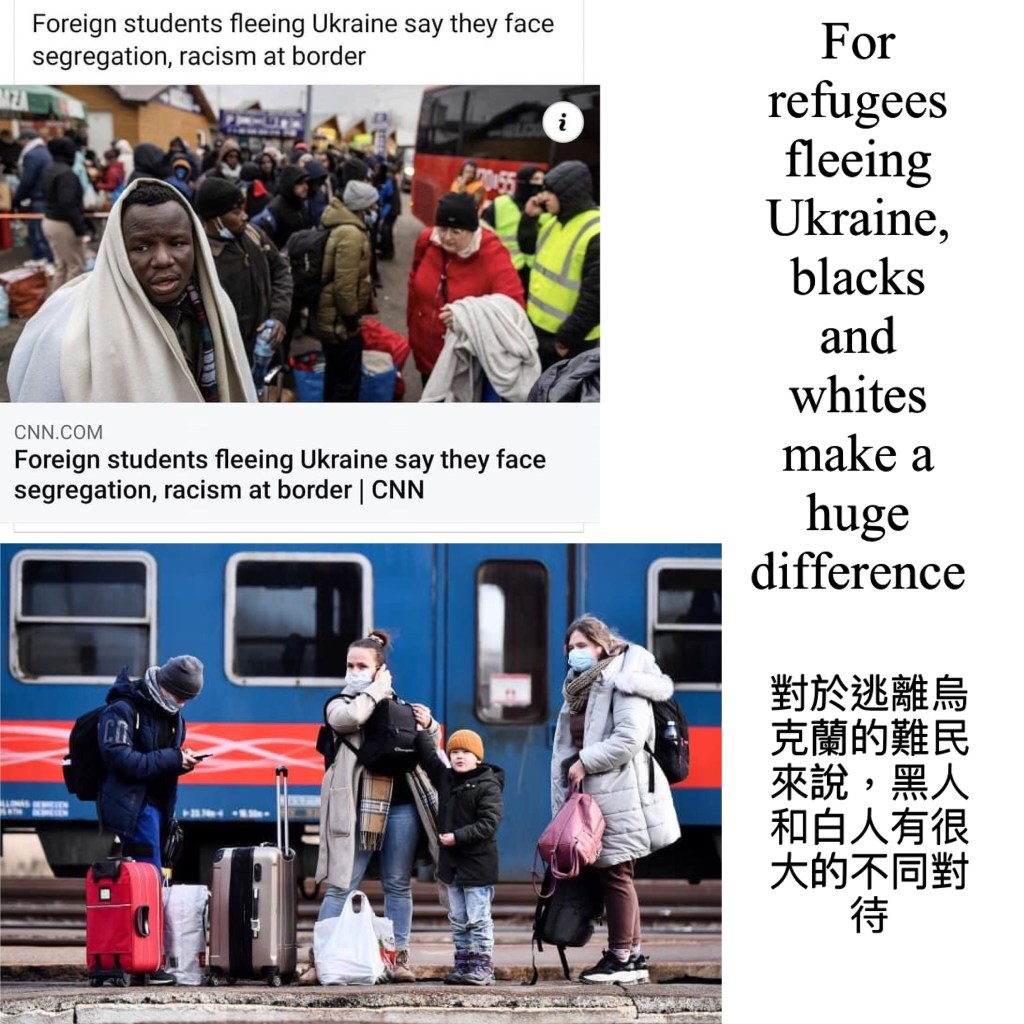
For refugees fleeing Ukraine, blacks and whites make a huge difference 對於逃離烏克蘭的難民來說,黑人和白人有很大的不同對待.
Racist Ukraine coverage in mainstream Western media. Notice the racist overtones. “We’re Europeans, Christians, Whites!”. Similar reasons why Asians Hates works so well in America. 西方主流媒體對烏克蘭的種族主義報導. 注意種族主義色彩. “我們是歐洲人, 基督徒, 白人!”. 這就是為什麼美國推動仇恨亞洲人如此成功. by MK Bhadrakumar Mar 1, 2022
BBC
“It’s very emotional for me because I see European people with blue eyes and blonde hair being killed”
– Ukraine’s Deputy Chief Prosecutor, David Sakvarelidze
CBS News
“This isn’t Iraq or Afghanistan…This is a relatively civilised, relatively European city”
– CBS foreign correspondent Charlie D’Agata
Al-Jazeera [not exactly Western, but West-aligned]
“What’s compelling is looking at them, the way they are dressed. These are prosperous, middle-class people. These are not obviously refugees trying to get away from the Middle East…or North Africa. They look like any European family that you’d live next door to.”
– Peter Dobbie, Al Jazeera news presenter.
BFM TV (France)
“We are in the 21st century, we are in a European city and we have cruise missile fire as though we were in Iraq or Afghanistan, can you imagine!?”
The Daily Telegraph
“They seem so like us. That is what makes it so shocking. Ukraine is a European country. Its people watch Netflix and have Instagram accounts… War is no longer something visited upon impoverished and remote populations. It can happen to anyone.”
– Daniel Hannan
ITV (UK)
“The unthinkable has happened…This is not a developing, third world nation; this is Europe!”
BFM TV (France) (again)
“It’s an important question. We’re not talking here about Syrians fleeing…We’re talking about Europeans.”
NBC News
“To put it bluntly, these are not refugees from Syria, these are refugees from Ukraine…These are Christians, they’re white. They’re very similar [to us]”.
– Kelly Cobiella, NBC News Correspondent, explaining why Poland, which was hesitant to take in refugees from West Asia and North Africa, is now accepting refugees.
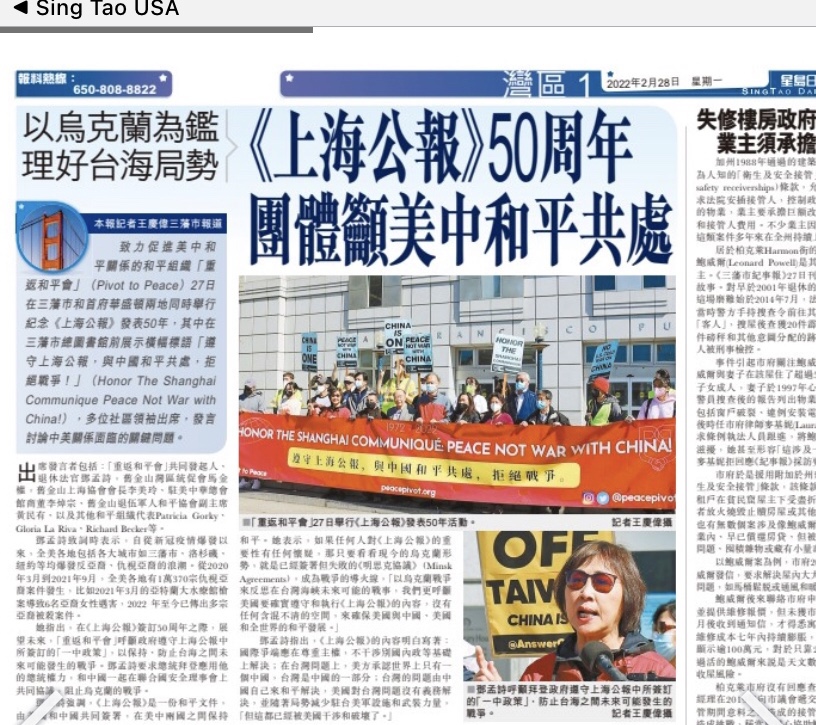
致力促進美中和平關係的和平組織「重返和平會」(Pivot to Peace)27日在三藩巿和首府華盛頓兩地同時舉行紀念《上海公報》發表50年,其中在三藩市總圖書館前展示橫幅標語「遵守上海公報,與中國和平共處,拒絕戰爭!」(Honor The Shanghai Communique Peace Not War with China!),多位社區領袖出席,發言討論中美關係面臨的關鍵問題。
出席發言者包括:「重返和平會」共同發起人、退休法官鄧孟詩,舊金山灣區統促會馬金權,舊金山上海協會會長李美玲、駐美中華總會館商董李焯宗、舊金山退伍軍人和平協會副主席黃民有、以及其他和平組織代表Patricia Gorky、Gloria La Riva、Richard Becker等。
Shanghai Communiqué 50th Anniversary Group Calls for Peaceful Coexistence Between U.S. and China 2022-02-28 05:55:00
The Biden administration is urged to abide by the “one-China policy” signed in the Shanghai Communique to prevent a possible future war between Taiwan and China. Reporter Wang Qingwei (By Wang Qingwei, San Francisco)
Pivot to Peace, a peace organization dedicated to promoting peaceful relations between the U.S. and China, commemorated the 50th anniversary of the Shanghai Communique in both San Francisco and Washington, D.C., by displaying a banner in front of the San Francisco Main Library with the slogan “Honor the Shanghai Communique: Peace not War with China! A number of community leaders attended and spoke about critical issues facing U.S.-China relations.
The speakers included: Retired Judge Julie Tang, co-founder of Pivot to Peace; Ma Jinquan of Bay Area Commitee to Promote Reunification of China; Lee Mei Ling, President of the San Francisco Shanghai Association; Lee Chok Chung, Commercial Director of the Chinese Six Companies; Mike Wong , Vice President of the San Francisco Veterans for Peace; and representatives from other peace organizations such as Patricia Gorky, Gloria La Riva, Richard Becker, and others.
In her speech, Ms. Tang said that since the outbreak of the Coronavirus pandemic, a wave of anti-Asian and anti-Asian hatred has erupted across the United States, including in major cities such as San Francisco, Los Angeles and New York. From March 2020 to September 2021, there were 10,370 cases of hatred against Asians across the U.S. For example, the Atlanta Spa shooting in March 2021 resulted in the killing of six Asian women, and there have been several cases of Asian people being killed so far in 2022.
She noted that, looking ahead, with the 50th anniversary of the signing of the Shanghai Communiqué, Pivot to Peace urges calls on the Government to adhere to the “One-China Policy” in order to prevent a possible future war between in the Taiwan Strait. Tang asked President Biden to use his presidential authority to join China in a joint agreement at the UN Security Council to stop the war in Ukraine.
Julie Tang stressed that the Shanghai Communiqué is a peace document, signed by the United States and China, to keep peace between the United States and China. If anyone has any doubt about the importance of the Shanghai Communique, she said, just look at the current situation in Ukraine, where the Minsk Agreements, which were signed but non enacted, have become the fuse for war. “Use the war in Ukraine to reflect on the potential for future war in the Taiwan Strait. We further call on the United States to ensure that the contents of the Shanghai Communique are adhered to and implemented without any ambiguity to ensure the peaceful development of the United States, China, the United States and the world.
Tang pointed out that the Shanghai Communique clearly states that international disputes should be resolved on the basis of respect for sovereignty and non-interference in the internal affairs of other countries; that on the Taiwan issue, the U.S. side recognizes that there is only one China in the world and that Taiwan is a part of China. that Taiwan’s problems should be resolved peacefully by China itself; that the U.S. has no obligation to resolve the Taiwan issue; and that the U.S. military facilities and armed forces in Taiwan should be reduced in line with the situation. “Yet this has all been interfered with and undermined by the U.S.”
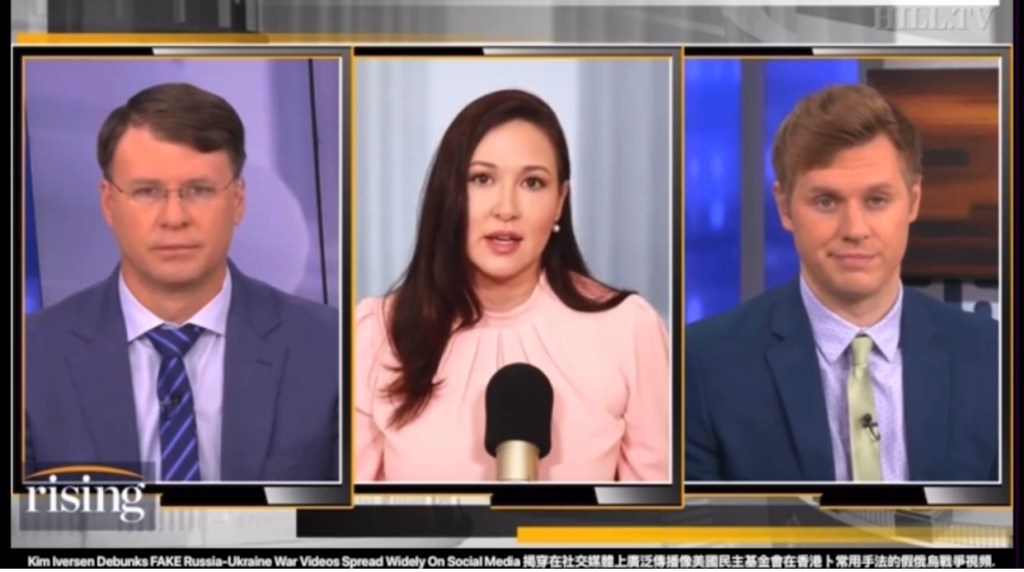
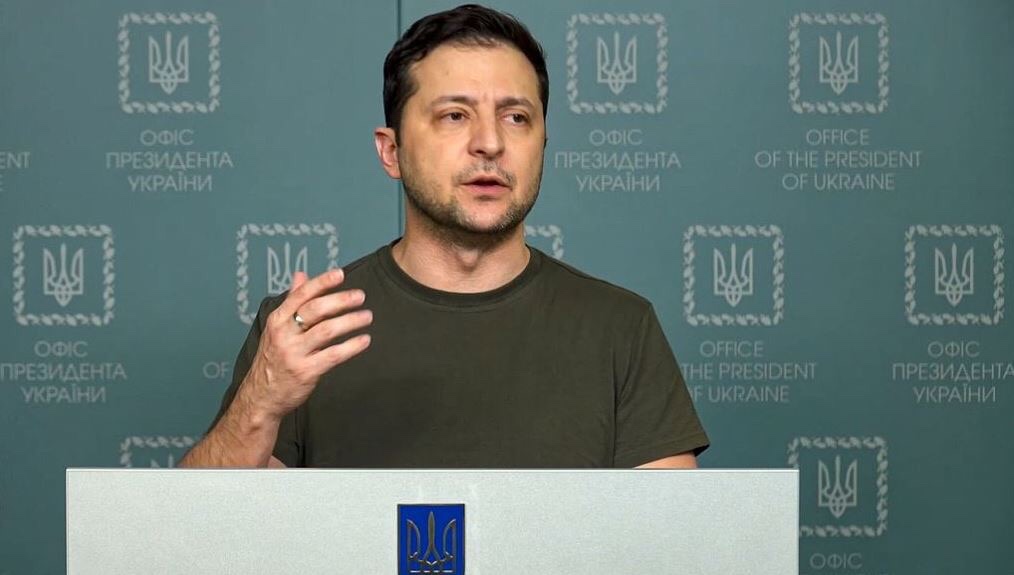
First round of Russia-Ukraine Talks ends, Ukraine President Zelenskyy, a retired comedian & puppet of US Government supported by Nazi hate groups seeks EU membership, does Germany has a say? 第一輪俄烏會談結束,烏克蘭總統澤連斯基,退休小丑演員和被納粹等級政黨支持的美國政府傀儡政府尋求歐盟成員資格,德國能接受嗎?
Wang Yi Expounds China’s Five-Point Position on the Current Ukraine Issue On February 25, 2022
State Councilor and Foreign Minister Wang Yi had phone conversations with UK Foreign Secretary Elizabeth Truss, High Representative of the European Union for Foreign Affairs Josep Borrell, and French Diplomatic Advisor to the President Emmanuel Bonne respectively. They had in-depth exchanges of views with a focus on the situation in Ukraine. Wang Yi expounded China’s basic position on the Ukraine issue, which can be summarized as the following five points:
China maintains that the sovereignty and territorial integrity of all countries should be respected and protected and the purposes and principles of the UN Charter abided by in real earnest. This position of China is consistent and clear-cut, and applies equally to the Ukraine issue.
China advocates common, comprehensive, cooperative and sustainable security. China believes that the security of one country should not come at the expense of the security of other countries, still less should regional security be guaranteed by strengthening or even expanding military blocs. The Cold War mentality should be discarded completely. The legitimate security concerns of all countries should be respected. Given NATO’s five consecutive rounds of eastward expansion, Russia’s legitimate security demands ought to be taken seriously and properly addressed.
China has been following the developments of the Ukraine issue closely. The current situation is not what we want to see. The top priority now is for all parties to exercise the necessary restraint to prevent the current situation in Ukraine from getting worse or even getting out of control. The life and property safety of civilians should be effectively guaranteed, and large-scale humanitarian crises, in particular, must be prevented.
China supports and encourages all diplomatic efforts conducive to a peaceful settlement of the Ukraine crisis. China welcomes the earliest possible direct dialogue and negotiation between Russia and Ukraine. The Ukraine issue has evolved in a complex historical context. Ukraine should function as a bridge between the East and the West, not a frontier in big power confrontation. China also supports the EU and Russia in entering into equal-footed dialogue on European security issues and implementing the philosophy of indivisible security, so as to form eventually a balanced, effective and sustainable European security mechanism.
China believes that the UN Security Council should play a constructive role in resolving the Ukraine issue, and give priority to regional peace and stability and the universal security of all countries. Actions taken by the Security Council should help cool the situation and facilitate diplomatic resolution rather than fueling tensions and causing further escalation. In view of this, China has always disapproved of willfully invoking of UN Charter Chapter VII that authorizes the use of force and sanctions in UNSC resolutions.
State Councilor Wang Yi noted that as a permanent member of the UN Security Council and a responsible major country, China has always faithfully fulfilled its international obligations and played a constructive role in maintaining world peace and stability. When it comes to peace and security, China has the best record among major countries. We have never invaded other countries or engaged in proxy wars, nor have we ever sought spheres of influence or participated in military bloc confrontations. China stays committed to the path of peaceful development and the building of a community with a shared future for mankind. We will continue to firmly oppose all hegemonies and power politics and resolutely uphold the legitimate rights and interests of developing countries, especially small and medium-sized countries.
US-led Western financial sanctions will not shake the entire Russian economy. The entire theatrical show let by US & NATO attempting to bring Russia to the knees, China is watching closely on the Western Hegemony. 以美國為首的西方金融制裁不會動搖整個俄羅斯經濟。 美國和北約試圖讓俄羅斯屈服的整個戲劇表演,中國正在密切關注西方霸權. by Johnson Choi in SF, 2-28-22
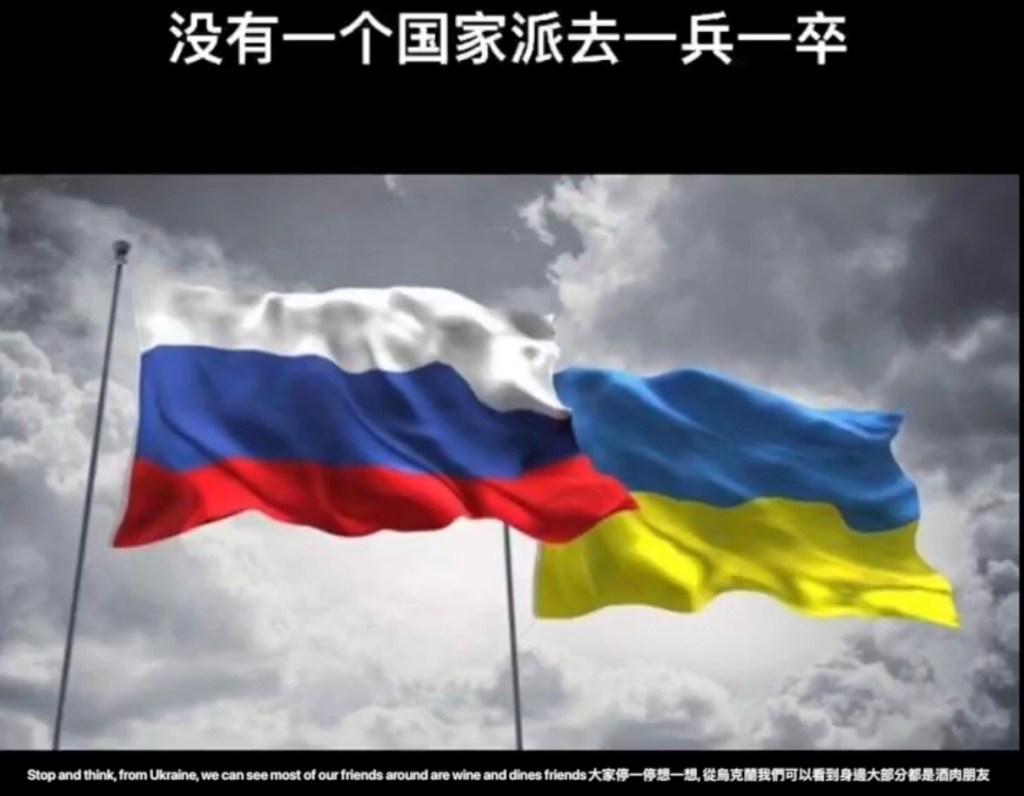
Even though China and Russia have no formal alliance. This is a test to see how China and Russia stood up against common enemies. If both could stood by each other in this difficult time will expose all the fake Western Alliances pushing Ukraine to war and yet NONE send in one single soldier to help.
US successful bringing a war to Europe if not contained soon will cause chaos starting with escalating oil price. US politicians connected to the US oil producing States as well as the US based oil companies will be laughing to the bank everyday. US will also be killing two birds with one stone. Disconnecting Russia with Europe and hurting China during the process.
The $10,000 question is whether German and France both foolish enough to sacrifice themselves to remain as a vassal State of US indefinitely.
It does not matter how China reunify with Taiwan Province. US will be using the same playbook against Russia on China.
China moving rapidly towards digital currency away from swift, decoupling with US on key technologies, energy independent working with Iran and Russia, food safety, strengthening military to push US carriers at least 2,000 miles away from China coasts are some of necessary steps to beat US at her own game.




 Johnson Choi Biz