ORGANIZERS OF THE WORLD’S BIGGEST AI research gathering are scrambling to save the event.
But it may be too late.
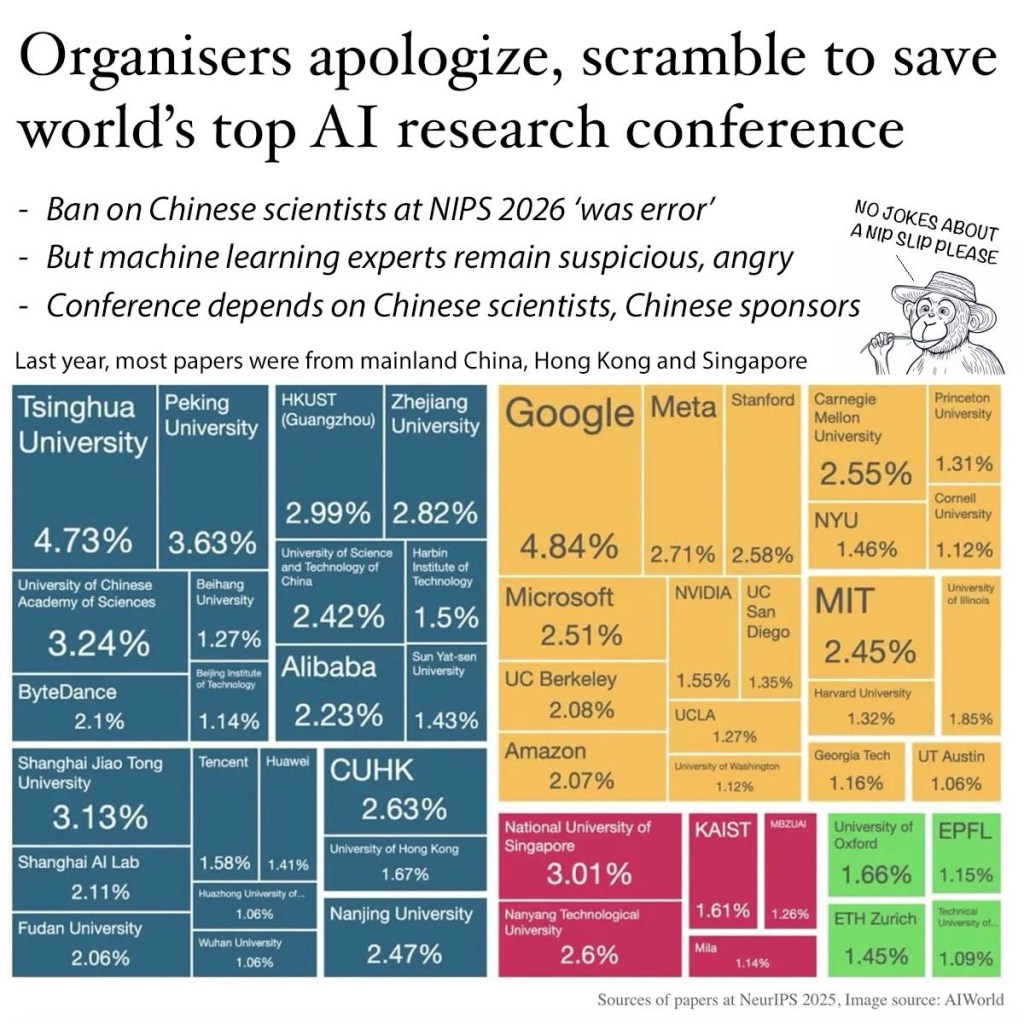
Angry Chinese scientists are holding discussions on whether to participate—and they provide most of the papers, and many of the peer reviews, and Chinese firms also provide much of the sponsorship money.
If they decide against, the gathering known as NeurIPS, will lose its crown as the world’s most respected AI research conference.
The clock is ticking: 6 May, just five weeks away, is the submission deadline for papers, which then lead to physical participation in the event, scheduled to open in Sydney, Australia, on December 6.
POLICY CHANGE
A shock policy that excluded Chinese scientists became evident on Monday [23 March] this week, and was reversed yesterday—but after four days of fury, scientists and organizations from China are not mollified by the explanations from the group, called the Conference on Neural Information Processing Systems (but pronounced neurips or nips).
Multiple questions remain.
ORGANIZERS APOLOGIZE
The organizers apologized in a statement on X, saying that the legal team made a simple mistake. The “banned” list should have linked to a US list called “Specially Designated Nationals”—normal for US conferences.
But instead, it linked to a list of all entities facing US sanctions. This is an absurdly long list of individuals and companies, often blameless people unfairly registered. More than 800 are Chinese, and the list includes top scientists at Huawei and other world-class research and development groups.
TOUGH QUESTIONS BEING ASKED
But scientists are asking tough questions.
1) If it was a simple error in a link, why did it take days to fix? As every blogger knows, it takes literally seconds to change a link from one URL to another.
2) If there was no intention to cut out Chinese scientists, why did NeurIPS respond to complaints by initially defending the policy?
Their response, on Thursday 26 March, said the organizers had no choice.
“The present concerns are not about science or academic freedom,” the statement said. “They are about legal requirements that apply to the NeurIPS Foundation, which is responsible for complying with sanctions.”
3) The long period between announcing the policy on Tuesday and reversing it on Saturday suggests a debate, rather than a need to fix a wrong link.
It seems more like one side (who?) wanted the Chinese banned, and the other (who?) was arguing for them to be included.
4) A broader issue is the fact that all three of the top AI conferences are run by US firms (ICML and ICLR are the others).
Some have taken years to build up their networks (Nips began in 1987).
It would be difficult for China to replicate this. But the US is not seen as a trustworthy partner for multiple reasons, not least its total contempt for international law.
Can the conference be moved, say, to somewhere in Asia?
CHINESE ARE NOT HAPPY
Some groups have already responded.
The China Association for Science and Technology has canceled its sponsorship. Worse still, they will no longer recognize publications in NIPS journal as deserving of academic credits.
The argument will roll on for days, but that 6 May deadline will be on everyone’s mind. It would be easier for all concerned, to rebuild bridges rather than erect a wall.
SCIENCE WITHOUT BORDERS
As the scientist Louis Pasteur said: “Science knows no country.”
It’s worth noting that many non-Chinese scientists have stood up for academic freedom for the Chinese.
Jason Eisner, Professor of Computer Science at Johns Hopkins University, challenged the organizers to stand up the US government.
“Just drop this policy,” he wrote on X. “You’re a US academic press. You have a 1st Amendment RIGHT to publish whatever you want—including words written by individuals who are disfavored by your government, and reviews of those words. They can’t constitutionally stop you. If they try, go to court!”
That type of response, jumping to a lawsuit against the authorities, is not how Asians operate at all. But the organizers of NIPS are based in California, and would be familiar with fighting the government.
 Johnson Choi Biz