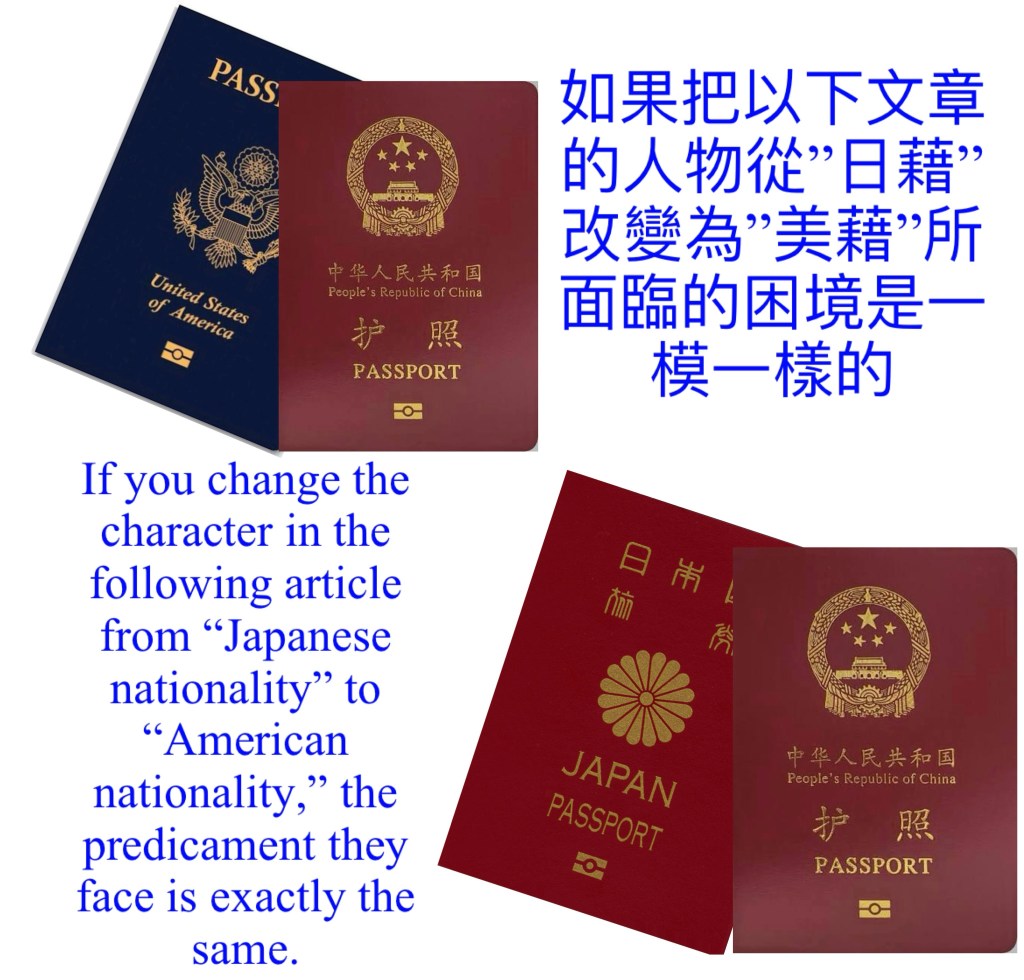
If you change the character in the following article from “Japanese nationality” to “American nationality,” the predicament they face is exactly the same. 如果把以下文章的人物從”日藉”改變為”美藉”所面臨的困境是一模一樣的
After 38 Years in Japan, a One-Way Ticket: Large Numbers of Ethnic Chinese with Japanese Citizenship Struggle to Make a Living and Long to Return
This elderly man, who spent thirty-eight years in Tokyo, once thought that acquiring Japanese citizenship made him a winner in life. Now he realizes it was merely a one-way ticket with no return.
At the immigration hall of Shanghai Pudong Airport in 2025, 62-year-old Zhang Jianguo stood clutching his dark-blue Japanese passport at the counter for nearly half an hour. A staff member handed him a document titled “Instructions for Applying for Permanent Residency for Foreigners.” He stared at it for a long time, then silently tucked it into his bag and turned away.
The wave of Chinese who went to Japan in the 1980s and 1990s represents a collective memory for an entire generation. In 1988, the first group of trainees from Shandong were told, “One year of work here equals ten years back home.” Back then, a convenience store clerk’s monthly salary in Japan could indeed buy a one-bedroom apartment in Beijing’s Second Ring Road. Countless people set off for Haneda Airport with their savings and dreams, clutching Chinese passports, convinced that swapping passports would put them on a completely different track in life.
Zhang Jianguo was one of them. In 1987, he graduated from a technical school in Shanghai and, after paying a中介 fee of 30,000 yuan through connections, went to Tokyo to work as a skilled technician at an electronics factory. In the early years, he indeed made good money, sending 2,000 yuan back to his family every month, enough to build a three-story house in his hometown. In 1995, he gritted his teeth and naturalized as a Japanese citizen. His reasoning was simple: work visas were too much trouble, and getting a new passport would make things easier.
Back then, who could have imagined that thirty years later the tables would turn so dramatically?
The electronics factory where Zhang Jianguo worked closed at the end of 2024. He had been unemployed for six months and couldn’t find a suitable job. His apartment in Tokyo carried a monthly mortgage of 120,000 yen, utilities added another 30,000 yen, and a convenience store bento cost 800 yen. He did the math: his pension was only 140,000 yen per month. After rent and utilities, there was little left.
Meanwhile, back in China, the economy grew at 5.5 percent in 2025—more than four times Japan’s rate. High-speed rail crisscrosses the country, mobile payment covers every corner, and the digital economy has created a vast number of jobs. This stark contrast made Zhang Jianguo consider returning to China.
But the road home proved far harder than he imagined. China’s Nationality Law explicitly does not recognize dual nationality—an unshakable principle. Once one acquires Japanese citizenship, their original Chinese nationality is automatically revoked. To restore it, one must go through official channels, a process that is both lengthy and fraught with uncertainty.
Data from the Ministry of Public Security for the first quarter of 2025 shows that the number of ethnic Chinese holding Japanese passports entering China surged 41 percent year‑on‑year, with over 60 percent going directly to immigration bureaus to inquire about settlement policies. Yet the proportion who actually obtained Chinese household registration (hukou) was less than 3 percent. Behind this stark number lies a deliberate institutional logic—citizenship is not a commodity at a market stall, something you can pick up and discard at will.
The information sheet Zhang Jianguo received at Pudong Airport made it clear: applying to restore nationality requires demonstrating “legitimate reasons,” such as family reunification or settlement needs, and submitting documents including a copy of the foreign passport, proof of former nationality, and a statement explaining the reasons. To complicate matters, Japan requires proof of new nationality before allowing renunciation, while China requires renunciation of Japanese nationality before accepting an application—creating a deadlock.
In 2025, the National Immigration Administration rolled out a series of innovative entry‑exit policies. For those with doctoral degrees or those who have worked continuously in nationally designated key development zones, the approval process has indeed been expedited and documentation simplified. But for ordinary ethnic Chinese with Japanese citizenship, the bar for obtaining permanent residency in China remains high—typically requiring continuous investment of over two million US dollars, serving as a corporate executive, or making exceptional contributions.
In 2024, fewer than 20,000 foreign permanent resident ID cards were issued nationwide, mainly to high‑level talent. An ordinary skilled worker like Zhang Jianguo could not meet the criteria. In the end, he chose to apply for a five‑year multiple‑entry family visit visa. Though not the ideal outcome, it at least allows him to return frequently.
A deeper issue lies in integration. Thirty‑eight years of living abroad have shaped Zhang Jianguo’s habits and mindset to be thoroughly Japanese. He is accustomed to Japanese queuing culture, service standards, and social norms. Returning to China, he finds himself at odds with the flow of mobile payments, high‑speed rail ticket checks, and handling affairs through smartphones. In Tokyo, just queuing and filling out forms could take half an hour or more; in China, the same thing is done in three minutes. This efficiency gap leaves him both stunned and disoriented.
This wave of ethnic Chinese returning from Japan reflects the complexity of human mobility in the age of globalization. People pursue better lives—there is nothing wrong with that. But citizenship is not a gaming account that can be switched at will. Every choice carries a cost, and behind every passport lies a set of responsibilities.
China’s stance is clear and rational: the door is always open to patriots, but it opens according to principles, boundaries, and rules. This is a matter of responsibility to the nation and fairness to every citizen. Those figures lingering before airport immigration windows are both a microcosm of individual destinies and a footnote to the changing times. Some roads, once taken, are hard to turn back from.
旅日38年終成單程票,大批日籍華人受困生計渴望迴流. 這個在東京待了三十八年的老人,當年以為拿到日本國籍就是人生贏家,如今才發現,那只是一張有去無回的單程票。
2025年的上海浦東機場出入境大廳,62歲的張建國攥着那本深藍色日本護照,在窗口前站了快半小時。工作人員遞過來一張《外國人永久居留申請須知》,他盯着那張紙看了許久,最後默默塞進包里,轉身走了。
說起上世紀八九十年代那批赴日的中國人,真是一代人的集體記憶。1988年,山東首批研修生聽到的承諾是”干一年頂國內十年”,那會兒日本便利店店員的月薪,確實能在北京二環買套一居室。無數人揣着積蓄和夢想,捧着中國護照踏上羽田機場,相信只要換本護照,人生就能換條軌道。
張建國就是那批人里的一個。1987年,他從上海某技校畢業,托關係花了三萬塊中介費去了東京,在一家電子廠做技術工。頭幾年確實賺到錢了,每個月往家裡寄兩千塊人民幣,在老家蓋起了三層小樓。1995年,他咬咬牙加入了日本國籍,理由很簡單——工作簽證太麻煩,換護照省事。
那會兒誰能想到,三十年後風水輪流轉。
張建國所在的電子廠2024年底就倒閉了,他失業半年沒找到合適工作。東京的公寓月供十二萬日元,水電燃氣加起來又是三萬,便利店一盒便當要八百日元。他算了筆賬,退休金每月只有十四萬日元,扣掉房租水電,剩不了幾個錢。
反觀國內,2025年經濟增速達到百分之五點五,是日本的四倍多。高鐵四通八達,移動支付覆蓋街頭巷尾,數字經濟創造了海量崗位。這種反差讓張建國動了回國的念頭。
但回家這條路,遠比想象的難走。中國國籍法明文規定不承認雙重國籍,這是鐵板釘釘的原則。一旦加入日本籍,原中國國籍自動作廢,想恢復得走正規渠道申請,這個過程既漫長又充滿變數。
公安部2025年第一季度的數據顯示,持日本護照的華人入境人次同比激增百分之四十一,其中超過六成直接去出入境管理局諮詢定居政策。但真正拿到中國戶口本的,比例不足百分之三。這個懸殊的數字背後,是制度設計的理性考量 – 國籍不是菜市場的商品,不能想來就來、想走就走。
張建國在浦東機場拿到的那張須知上寫得清楚:申請恢復國籍需要證明”正當理由”,比如家庭團聚或定居需求,還得提交外國護照複印件、原籍證明和理由說明。更麻煩的是,日本要求提供新國籍證明才能退籍,中國則要求先退日籍才能申請,這形成了一個死循環。
國家移民管理局在2025年推出了一系列出入境創新舉措,有博士學歷的,或者在國家重點發展區域連續工作的,審批流程確實提速了,材料也簡化了。但對普通日籍華人來說,想獲得中國永久居留權,門檻依然不低——通常需要滿足連續投資兩百萬美元以上、擔任企業高管、或者有特殊貢獻等條件。
2024年全國發放的外國人永久居留身份證不足兩萬張,主要給了高層次人才。張建國這樣的普通技術工,根本夠不着這個標準。他最後選擇了申請五年多次往返探親簽證,雖然不是最理想的結果,但至少能經常回來看看。
更深層的問題在於融入。三十八年的海外生活,讓張建國的生活習慣、思維方式都已經日本化了。他習慣了日本的排隊文化、服務標準、社會規則,回到國內后,面對掃碼支付、高鐵刷證、手機辦事這一套流程,顯得格格不入。在東京,光是排隊填單子半小時都未必夠,而國內三分鐘就能搞定一切,這種效率落差讓他既震撼又迷茫。
這場日籍華人迴流潮,折射的是全球化時代人口流動的複雜性。人們追逐更好的生活,這本身無可厚非,但國籍不是遊戲賬號,不能隨意切換。每一個選擇都有代價,每一本護照背後都是一份責任。
中國的態度是明確而理性的大門始終向愛國者敞開,但這份敞開是有原則、有底線、有規則的。這既是對國家的負責,也是對每一個公民的公平。那些在機場窗口前徘徊的身影,既是個人命運的縮影,也是時代變遷的註腳。有些路一旦走上,就很難回頭。
 Johnson Choi Biz