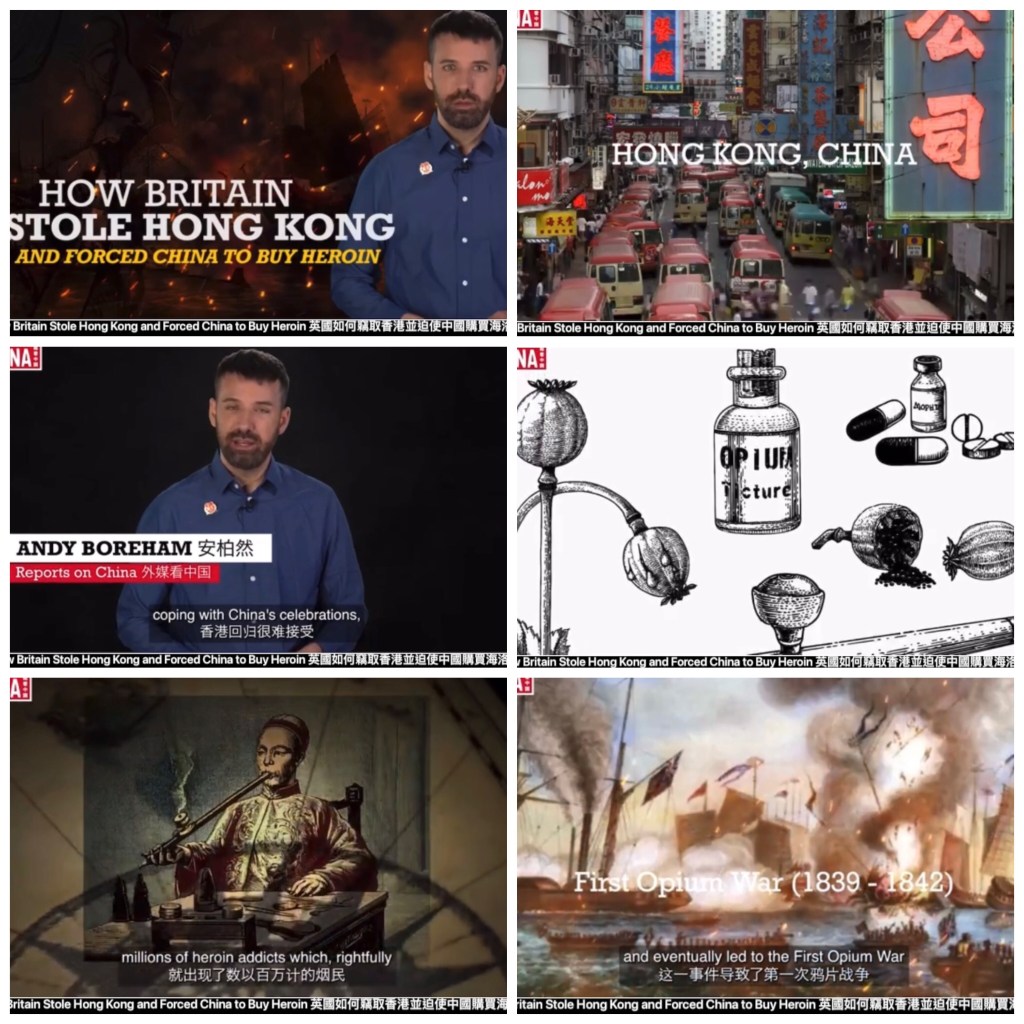
Video: Debunk British & US lies! How Britain Stole Hong Kong and Forced China to Buy Heroin? 揭穿英美謊言! 英國如何竊取香港並迫使中國購買海洛因?
https://rumble.com/v1b0yq3-how-britain-stole-hong-kong-and-forced-china-to-buy-heroin.html
https://www.facebook.com/100036400039778/posts/742912453598749/?d=n
It’s now 25 years since #hongkong was returned to #china following 156 years under British rule. As you can imagine, the West are having a hard time coping with China’s celebrations, despite the fact that Hong Kong was initially taken by brute military force after Britain’s illegal shipments of heroin to China were confiscated and destroyed by the Qing Dynasty. Here’s a quick history.
DON’T FORGET TO HIT LIKE AND SUBSCRIBE!
By the 1800s, #britain had grown extremely fond of Chinese goods, mainly tea and china. British merchants were making a lot of money bringing Chinese goods back to Britain, but they encountered an issue: Britain didn’t have anything China wanted to buy back, so there was a huge trade imbalance.
Britain decided to play dirty, growing opium, the key ingredient of heroin, in British India for shipment to China in the hope of making enough back in the illicit trade to fund their new addiction to tea. Don’t forget, heroin was illegal in China, but Britain was desperate to even out trade so who cares, right? Before too long, China had millions of heroin addicts which, rightfully so, worried the government who decided they had to act.
In May of 1839, Britain’s Chief Superintendent of trade, a man named Charles Elliot, was forced to hand over more than 1,400 tons of the drug that was being stored in a warehouse in Canton for illegal distribution in China. It was then destroyed, which angered the British side and eventually led to the First Opium War, where the British smashed China militarily, culminating in the take over of Nanjing, which literally means Southern Capital, in late 1842. China was then forced to sign the Treaty of Nanjing, the first of the so-called “unequal treaties”, which ordered the Emperor to not only pay the British for the destroyed opium, but also to cover the cost of the war, open more ports to accept British heroin, and give up Hong Kong which would be used as a trading port to boost the drug trade. The British achieved a 99-year lease of Hong Kong in 1898.
The Treaty of Nanjing is seen as the beginning of China’s “Century of Humiliation,” a very important aspect influencing China’s foreign policy to this day.
Fast forward to 1997, and Hong Kong was to be handed back to its rightful owner after what ended up being 156 years of British rule. What’s infuriating is that the British lie to this day about how Hong Kongers were treated during that time. Many people don’t realize that in more than 150 years of British rule, the island was lorded over undemocratically by white Governors installed by London, giving Hong Kong residents no say in how they were governed.
It’s quite hilarious that Western media like CNN argue that China has waged an “idealogical war against the influence of Western values” in Hong Kong, including “democracy” and “press freedom”. Perhaps the staff should read more history.
Britain always had a suspicion of Hong Kongers and often violently suppressed their calls for democracy on the island. In 1856, Britain’s Colonial Office rejected calls for more local representation, saying Chinese were had no respect for “the main principles upon which social order rests.” Racist much!
Popular grassroots movements on the island were squashed, and the press was censored by Britain in order to stop such movements gaining momentum. So much for “press freedom”.
It was only until Britain was getting ready to hand the island back to China in the 1990s that they started to rush in democratic reform, almost certainly as a way to spite China and cause issues they didn’t want to deal with themselves in their 156 years of rule.
In what seems like a pure irony, Hong Kong rioters waved British flags as they demanded full democracy there, and many young locals seem blatantly unaware of how Britain treated the population while they were in control.
Prime Minister Boris Johnson said recently that he won’t give up on Hong Kong, and argued that China had “disturbed” the foundations on which modern Hong Kong had been built. WHAT FOUNDATIONS?! YOU DIDN’T GIVE HONG KONG PEOPLE A SAY IN GOVERNANCE FOR 156 YEARS!!!
Hong Kong people now have more say in their government that they have in nearly 200 years, and that is thanks to China.
This (a rather long one but worth reading ) was written by David Cottam, former Principle of Shatin College, after becoming somewhat frustrated with the International Media reports over the last week. It was written to questioning why he was still in HK.
Reflections On The 25th Anniversary of Hong Kong’s Handover To China
Twenty-five years ago, on the evening of 30 June 1997, we were guests at the Handover ceremony at the harbour-side Prince of Wales arena, where Prince Charles, Prime Minister Tony Blair and Governor Chris Patten formally ceded control of Hong Kong from Britain to China.
It was a memorable occasion, partly because of the symbolic lowering of the Union Flag and hoisting of the Chinese one, partly because of the emotional speeches by Patten and Charles, and partly because of the spectacular fireworks, music and dance performances. However, the most memorable part of this historic landmark occasion was undoubtedly the weather. It rained. And when I say it rained, I mean it was the most torrential, tropical, “black rain warning” type of rain which normally closes everything down in the Territory. All guests were issued with blue and yellow striped umbrellas to protect us from the deluge. It was a thoughtful gesture but of no practical use whatsoever as the rain exploded round, under and through our meagre defences as we sat in puddles of water on the tiered bench seating for an uncomfortable two hours. Everyone was drenched, including the dignitaries, whose larger, more heavy-duty umbrellas seemed to fare no better than ours. The moment Prince Charles stood up to make his speech the impossible happened. No-one thought the rain could get any worse. It did. It went from torrential to water cannon. The umbrella held over him by an unfortunate aide disintegrated, as did Charles’ speech papers, now lying sodden and shredded on the ground. In the circumstances, he did extraordinarily well, delivering his speech with practised, professional aplomb. Of course, no-one remembers what he said because he was so upstaged by the weather.
Later that evening, after all the emotion and historic significance of this final episode in the demise of the British Empire, Britannia sailed out of Victoria Harbour, carrying its cargo of British royalty and politicians and leaving Hong Kong as a Special Administrative Region of China. It was now time for those left behind to reflect on the legacy of British rule, to imagine the future direction of Hong Kong, and to ponder whether the atrocious weather had been a damning judgement on British rule or an ominous omen of what was to come.
Now, 25 years later, we have at least some historical perspective to help interpret what that Handover weather really signified. However, it’s still not a simple matter to assess the validity of British and Chinese narratives, with each side viewing Hong Kong through its own political and cultural prism.
If you accept the British interpretation of history, amplified by a Western media machine generally hostile to China, you will see the past 25 years as a regressive period in which the democratic rights, freedoms and rule of law bequeathed by Britain have been so eroded that Hong Kong is now an autocracy with all policy decisions dictated by the central Chinese Government. The much vaunted policy of “One Country, Two Systems”, giving Hong Kong a high degree of autonomy, is a sham. There is no longer any freedom of speech, peaceful protest is not tolerated, and the draconian security laws recently imposed by China have created a police state where anyone suspected of opposing the government can be arrested and incarcerated without trial or, even worse, extradited to the mainland.
The Chinese version of the past 25 years is somewhat different. This narrative sees Hong Kong finally being freed from the oppressive, colonial rule of a foreign Western power and restored to the motherland. It views “One Country, Two Systems” as an exemplary model of government, combining patriotic love of the motherland with a recognition that Hong Kong has different traditions, practices and freedoms, all of which are being respected through the high degree of autonomy enjoyed by Hongkongers. In recent years, China has provided much needed stability and security for Hong Kong through the new security laws, bringing an end to the chaos and destruction of the Western backed rioters whose violence had brought the territory to a standstill and threatened Hong Kong’s prosperity, freedoms and rule of law.
So where does the truth lie? To help determine this, we need to strip away the propaganda and challenge some of the myths surrounding Hong Kong’s history. The most often repeated Western myth is that Britain established a democracy in Hong Kong which has now been destroyed by Chinese rule. The reality is that under successive British Governors, Hong Kong was never a democracy. Governors were all appointed by the British Government, with no reference whatsoever to the views of the Hong Kong people. Most notoriously, the last British governor, Chris Patten, had been appointed by Prime Minister, John Major, not because of any democratic wish of Hongkongers, or any expertise Patten had in Hong Kong affairs (he didn’t!), but purely as a consolation prize for losing his parliamentary seat in Bath (and along with it, chairmanship of the Conservative Party) in the 1992 General Election. So the Hong Kong executive was never democratically elected. Similarly, during the 150 years of British rule, Hong Kong’s equivalent of parliament, the Legislative Council (Legco) was not elected along fully democratic lines until 1995, just two years before the Handover. Prior to this sudden democratisation at the eleventh hour, the colonial legislature had been in effect a body dominated by unelected government officials and appointees.
Another myth perpetuated in the West is that the security laws imposed on Hong Kong in 2020 by China were a draconian response to the predominantly peaceful protests of 2019-20. The reality is that throughout 2019, China was remarkably tolerant of the protests, regarding them as an internal matter for the Hong Kong government under the “One Country, Two Systems” constitution. The problem was that what started as a peaceful mass movement was hi-jacked by extreme elements, with the protests turning appallingly violent: firebombing police stations; barricading roads; smashing up MTR (underground railway) stations; storming the Legco building; attacking Chinese owned businesses, and destroying Hong Kong’s normal peaceful way of life. All this was accompanied by much British and American flag-waving and strident demands for the independence of Hong Kong. It was at this point that Chinese reluctance to get directly involved changed. From a China perspective, the “One Country” part of the constitutional arrangement was being undermined, a red line had been crossed, and Hong Kong’s security and prosperity, so important for the mainland, was under violent attack. The result, as we all know, was the imposition of the new security laws targeting sedition, secession and terrorism. Under Hong Kong’s Basic Law, there had been an obligation after 1997 for Legco to pass its own security laws, but as it had repeatedly failed to do this, China decided it had to intervene in order to re-establish stability in Hong Kong and avoid possible contagion on the mainland.
This brings me on to the third myth, which is that although China’s imposition of the security laws has indeed restored stability, it has done so at the cost of destroying Hong Kong people’s freedoms, ending “One Country, Two Systems”, and undermining the rule of law by creating what is effectively a police state. This is a huge distortion of the situation in Hong Kong. Under the security laws, there are still very much “Two Systems” with Hong Kong still retaining a high degree of autonomy over its internal affairs. The rule of law remains a cornerstone of the Territory, with a judicial system still based on British procedures and principles of common law. Hongkongers still enjoy freedom of association, movement, religion, assembly and speech, so long as the intent is not to promote secession from China, subvert the effective government of Hong Kong or undertake terrorist activities. This is not so different from security laws in the vast majority of democratic countries. There is, however, a real problem with the vagueness of the language used in the security laws. It is a great pity that Legco had neglected this part of its responsibility under the Basic Law, as this would have avoided the imposition of China’s wording which is generally regarded by people in Hong Kong as being open to wide interpretation. It is this vagueness in the wording of the security laws which has led to fears about freedoms being curtailed. Consequently, the biggest threat to freedom of speech and freedom of the press is currently one of self-censorship. We can only hope that with the passage of time a sensible interpretation of the security laws will prevail and some of the current paranoia will dissipate.
So what will be the world’s ultimate verdict on the success of “One Country, Two Systems”? Sadly, it will probably remain as polarised as it is now. Myths, once they take hold, are difficult to remove, especially when there is so much mutual suspicion between East and West. As for the meteorological omens, the 25th anniversary of the Handover, was marked not only by torrential rain once again, but also by gales, with the Typhoon number 8 signal being hoisted. Does this signify a wind of change for Hong Kong and if so, in which direction? My hope is that Hong Kong will weather the storm of the past few difficult years and will recover its iconic status as one of the world’s greatest cities, a gateway into China and an example to the world of how East and West can not just peacefully co-exist but flourish and prosper together.
 Johnson Choi Biz