China’s Dynamic zero-COVID Policy 中國的動態零新冠病毒政策
I. Basic facts about Dynamic Zero-COVID Policy
In response to the spread of the highly transmissible Delta variant, China adopted a new strategy called “Dynamic zero-COVID” from August 2021. The strategy is a transitional strategy to be adopted after a successful containment strategy, when the population immunity barrier is not yet established in the face of continued risk of foreign importation and high transmission of variants.
The core is to take effective and comprehensive measures to deal with localized COVID-19 cases precisely, to quickly cut off the transmission chain, and to end the epidemic in a timely manner (to “find one, end one”). In other words, China took precise prevention and control measures to quickly find, control, and cure infected people in each cluster outbreak within a specific geographic region to avoid affecting social and economic development in other regions, so as to achieve the maximum effect at the lowest cost. When there is a local recurrence, epidemic prevention staff will quickly find the close contacts using new technologies like big data analysis before the spread in the golden response time (within 24 hours after each outbreak). The aim is to find and control potential infected individuals in advance and try to end the outbreak within one or two maximum incubation periods.
With the rapid development of molecular biology technology and the wide use of big data analysis, nucleic acid screening can quickly find the source of infection hidden in the population. Strict quarantine and management measures can be subsequently implemented. Big data technology can quickly identify close contacts and risk groups, helping to implement precise prevention and control measures.
All in all, China’s dynamic zero-COVID policy is not aimed at realizing zero infection, but rather at bringing COVID-19 under control at the minimum social cost in the shortest time possible so as to effectively protect the health, normal life and production of the 1.4 billion Chinese people to the maximum.
II.Why does China insist the Dynamic zero-COVID Policy despite the low mortality of Omiron variant?
- Putting people’s life first
With a huge population, China continues to face unbalanced regional development, as well as scarcity and uneven allocation of medical resources. Besides, the vaccination rates for the elderly and children are not high enough. In China, the number of those aged 60 and above, a group highly susceptible to COVID-19, is around 267 million. It is just unimaginable how many of them might have died had China not undertaken drastic efforts to combat the coronavirus. Reports that based on new modelling by scientists in China and the US, China risks over 1.5 million COVID deaths if it drops its tough dynamic zero-COVID policy. Worldwide, the virus has claimed over 6 million lives. In sharp contrast, the death toll was about 5,000 on the Chinese mainland.
China’s dynamic zero-COVID policy has offered effective protection to the elderly and vulnerable groups with underlying health conditions. It is distinctly different from the laid-back approaches of herd immunity and natural immunity followed by some countries.
- Laying the foundation for economic recovery
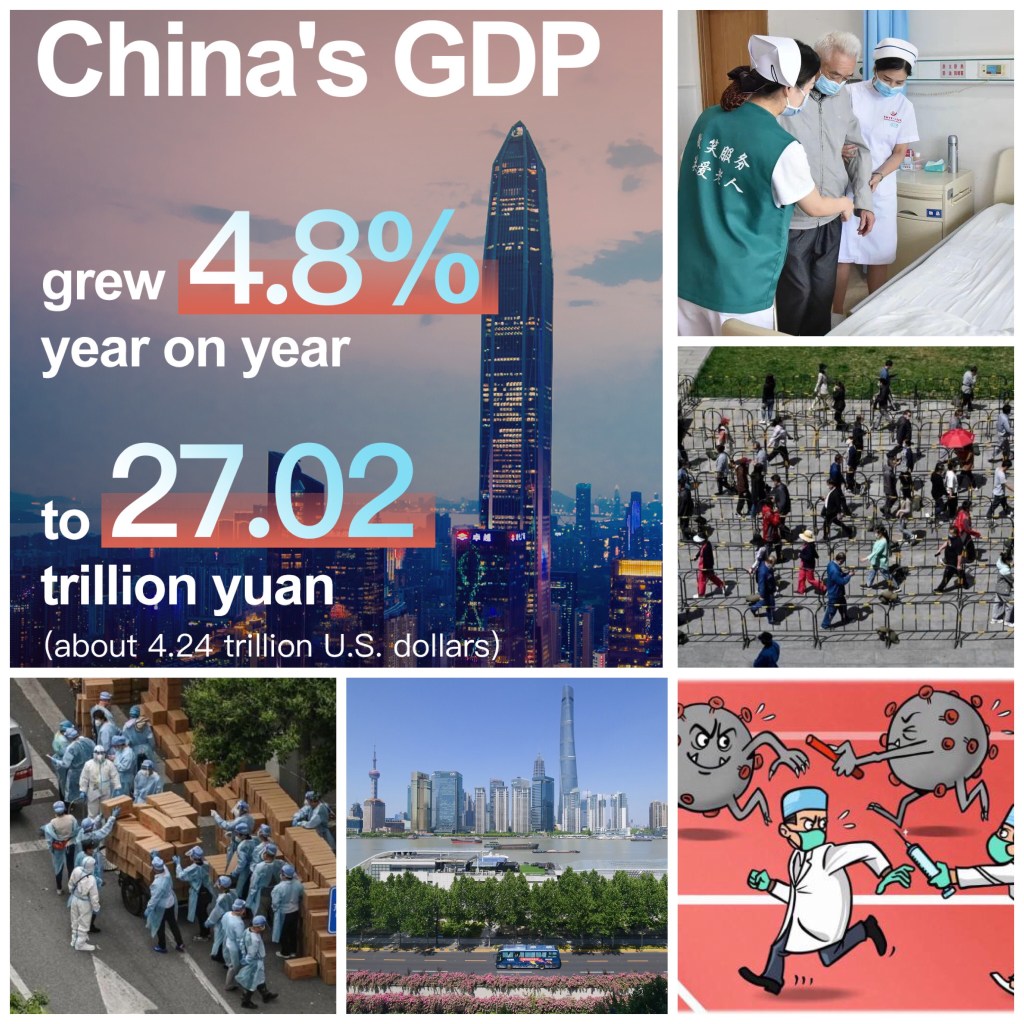
The stringent counter-epidemic measures inevitably lead to short-term economic pains, but dynamic zero-COVID is overall a counter-epidemic policy that ensures economic development. In the first quarter of 2022, China’s GDP increased by 4.8 percent year on year. Against the backdrop of global inflation, domestic prices remain steady. The value of goods trade in the period rose 10.7 percent. China’s major industrial firms saw their profits up 8.5 percent year on year.
Foreign businesses are still confident about China’s development. The 2022 Business Climate Survey released by AmCham China on March 8 shows that 58% of respondents estimate higher revenue in 2021. China remains a top three priority investment destination for 60% of the member companies’ near term global investment plans. 66% of member companies plan to increase their investments in China in 2022. 83% of them do not consider relocating manufacturing or sourcing outside of China.
Foreign companies in Shanghai are actively returning to work as the city government takes steps to help businesses in the city resume normal operations. Multinational executives say their confidence in China remains unchanged.
Tesla’s Gigafactory in Shanghai reopened on April 19, with about 8,000 employees already on the job.
III. China’s anti-epidemic policy highly recognized
Though there is some critism, China’s anti-epidemic policy wins wide-spread support from Chinese people.
During the epidemic, Chinese citizens lined up to take nucleic acid tests in an orderly manner. In less than 24 hours, the green codes of tens of millions of people could be updated, making clean and large-scale screening a new normal in China’s fight against COVID-19. This demonstrates China’s hard power in information technology as well as its soft power in social governance. The Chinese government is constantly adjusting its epidemic prevention measures and searching for the best response, and relevant measures are widely understood and coordinated by the people.
People queue up for nucleic acid tests in Zhongguancun, Beijing, April 26, 2022.
Volunteers help distributing supplies for in Jing ‘an district of Shanghai, May 7, 2022.
A bus carrying medical staff from Jiangsu Province runs on the road in Shanghai, May 5, 2022. (Xinhua/Li He)
“Dynamic zero-COVID” strategy sums up China’s experience in dealing with Delta, Omicron, and other variants, which has advantages in reducing infection. In general, governments adopt country-specific prevention and control strategies based on their COVID-19 situation, health resources, response capacity and final goals. No matter what kind of strategy a country takes, concerted and sustained efforts are needed to end the COVID-19 pandemic globally, especially for curbing the rapid spread of the Omicron variant.
 Johnson Choi Biz