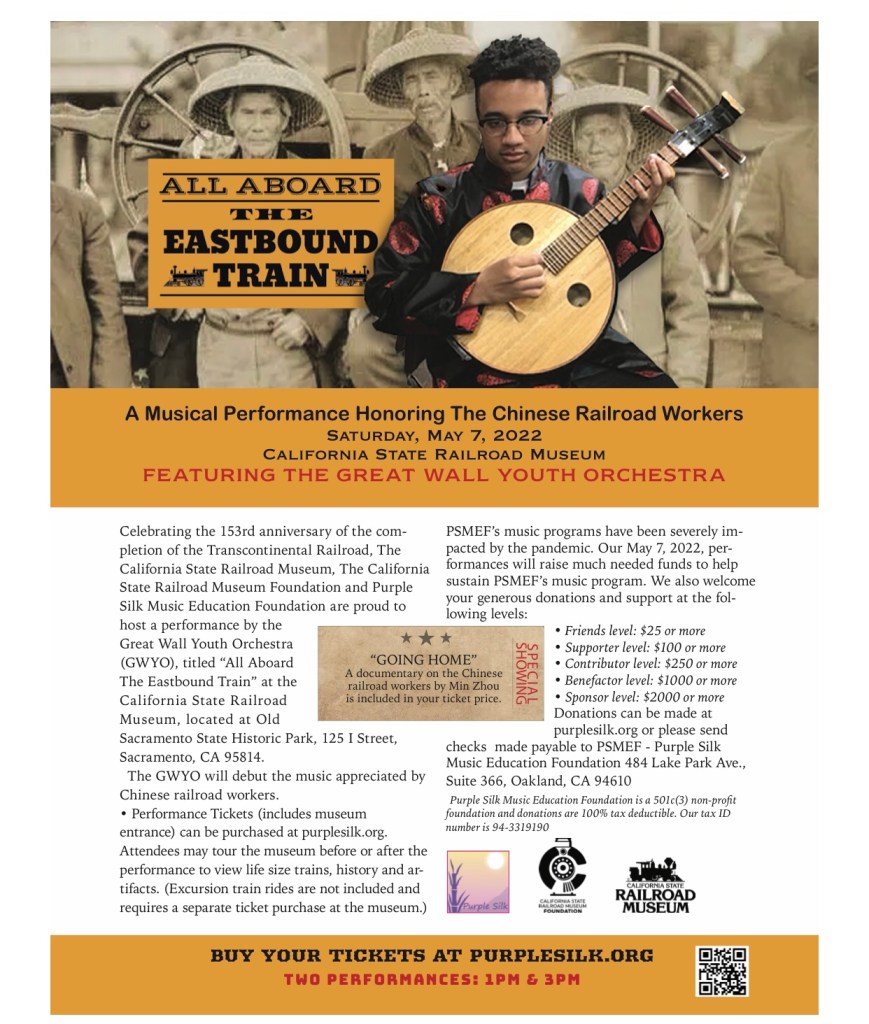
Johnson: You are all invited to attend this upcoming performance set for Saturday, May 7th. The Chinese Must Go! The Chinese Must Go! was the rallying cry once the Transcontinental Railroad was completed. Chinese never welcomed in US since before passing the 1882 Chinese Exclusion Acts that last till today! 自從通過 1882 年排華法案之前,中國人在美國從未受到歡迎,該法案一直持續到今天
After three years of covid, PSMEF needs funds. History of Chinese Railroad WorkersThe Chinese Must Go! The Chinese Must Go! was the rallying cry once the Transcontinental Railroad was completed. Widely considered as “cheap labor” the Chinese suffered decades of exploitation and racism. Many of these laborers, hired as cheap labor or indentured by labor brokers, cleared a path through the Sierras for the Central Pacific Railroad, linking up with the Western Pacific Railroad at Promontory Summit, Utah. Teamed up with Irish workers, they were pitted against each other after the railroad was completed. But during the period when working together, the Chinese and Irish demonstrated the ability to lay ten miles of railroad track in a day’s time. History revealed the hatred and racism exposing the Chinese to violence and discrimination, but yet the Chinese persevered, demonstrated forbearance in tolerating the hatred and racism, and established a life in the United States. Initially the lure of Gold Mountain in the search for gold led the Chinese to leave their home only to face poverty, despair, and persecution after abandoning their families. War, disease, overpopulation contributed to their leaving. The Opium Wars added to their migration when the Chinese rebelled against British and Chinese Imperial rule. Many fled with a price on their heads. Today, Chinese railroad workers are considered “heroes” for having the courage to leave their homes, work abroad, and send their remittances home to support their families. For many, their quest for opportunity remains today. Today, China leads the world in high speed rail. Installing over 40,000 kilometers of high speed rail in China last year, China's Belt Road Initiative seeks to link the global community together. California seeks to connect San Francisco and Los Angeles via high speed rail. The Chinese diaspora throughout the world has benefited host countries globally with trade and commerce that have improved lives within shared borders. Coolie hats worn during the past continues to be worn today and is a symbol of their perseverance. After the completion of the Transcontinental Railroad, some Chinese laborers returned back to China. Others continued to work, linking railroad lines across the United States. Many went into farming, land reclamation, or resettled into America’s cities and towns. When the Burlingame Treaty of 1869 was enacted, Many returned home and found themselves barred from returning to the United States. For these railroad “engineers” these laborers continued their work to build the Sunning Railroad, primarily in Southern China. The music for today is a collection of popular songs played during the time period, from 1863 to 1869, when the railroad was being built. Arrangements have been prepared for your enjoyment today. This is in keeping to the purpose of Asian American Pacific Islander Heritage Month to celebrate the contributions of these early Chinese pioneers today in music and song.
 Johnson Choi Biz