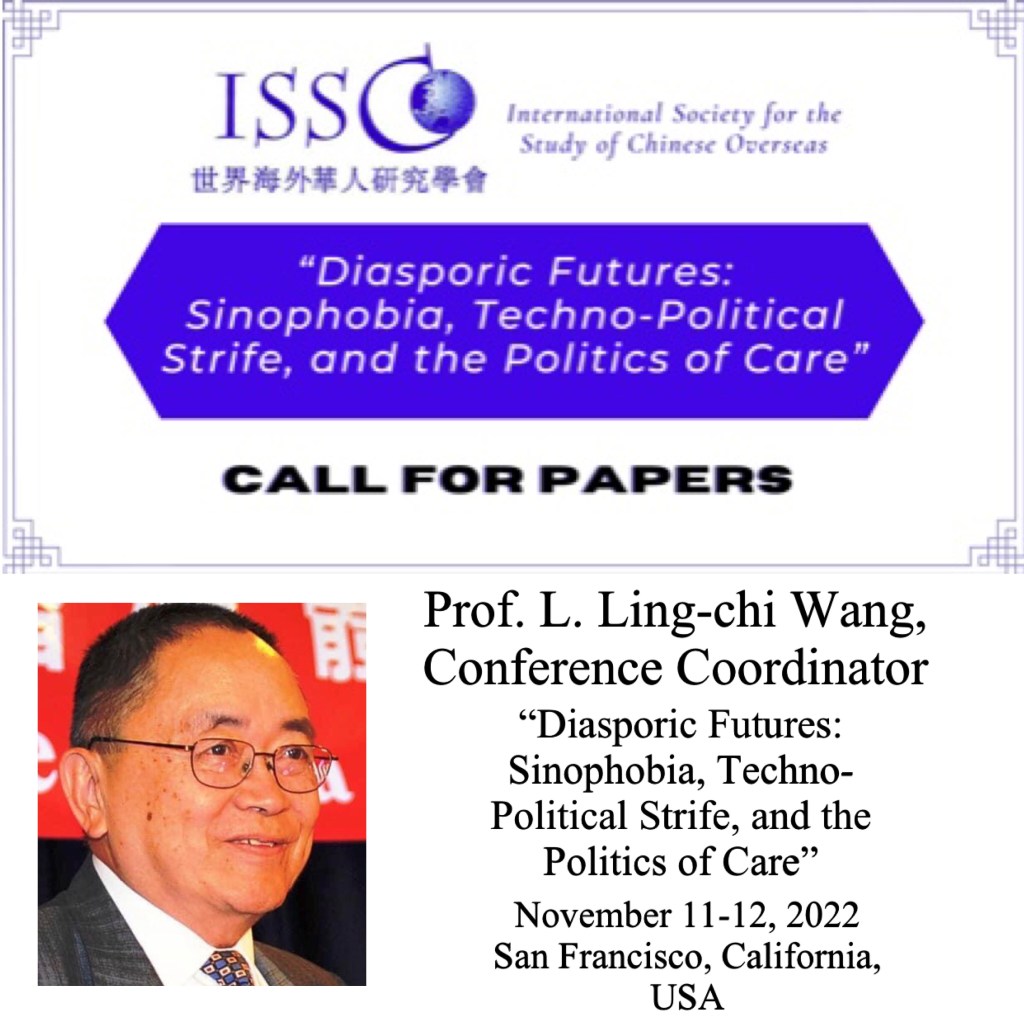
“Diasporic Futures: Sinophobia, Techno-Political Strife, and the Politics of Care” November 11-12, 2022 San Francisco, California, USA
The 30th Anniversary Conference of the International Society for the Study of Chinese Overseas (ISSCO) – Call for Papers
Asian American Research Center (AARC) Asian American and Asian Diaspora Studies (AAADS) University of California, Berkeley
Present
The 30th Anniversary Conference of the International Society for the Study of Chinese Overseas (ISSCO) 世界海外华人研究学会
Call for Papers
“Diasporic Futures:
Sinophobia, Techno-Political Strife, and the Politics of Care”
DATE: November 11-12, 2022 PLACE: San Francisco, California, USA
Official Languages of the Conference: English, Chinese, and Spanish
We emerge from the COVID-19 pandemic forever changed. The dramatic rise of anti-Chinese animus globally has shaken many diasporic communities to the core. The politicization of “the Chinese virus” has reignited Sinophobia and anti-Chinese racism, causing rampant and random cyber-bullying, verbal assault, and physical violence against Chinese and Chinese-looking people in the U.S. and in many countries throughout the world in magnitude and frequency not seen since the height of the Chinese exclusion period in the 19th century. This, in turn, has heightened social awareness among diasporic Chinese and revitalized political and cultural engagement on an unprecedented scale that crosses generations and national, linguistic, and class boundaries.
At the same time, the competition for economic and technological hegemony between a declining US and a rising China has reached new levels of intensity and, indeed, hostility that is forcing a planetary geopolitical realignment of nation-states that is reminiscent of the Cold War period, leading some political scientists to wonder if China and the U.S. have already reached the inevitable “Thucydides Trap.” This geopolitical. Struggle between the US and China has had dire consequences on ethnic Chinese in the U.S. and across the globe. In an era when China once again is perceived as more threat than opportunity, ethnic Chinese—especially scientists, researchers, and entrepreneurs—have come under sweeping government surveillance and overzealous prosecution, undermining global collaboration legitimate international academic exchange and collaboration, and faith in democracy, racial equality, and the very system of justice.
Indeed, since the founding ISSCO conference in November 1992, we have witnessed many sweeping changes that have transformed the conditions of Chinese living in diaspora, including China’s rapid and formidable entry into global economics, the shifting perception of China from being a potential market for the West to an enemy of the West, and the increased emigration from China to different regions of the world, especially Africa, Latin America, Europe, and Oceania. All of this have unfolded within an emergent digital-technological world order that has dramatically transformed our habits of sociality and knowledge production. Indeed, the explosion of globalized media and digital platforms has expanded the possibilities for global communication, transnational meaning-making, and the proliferation of publics. All provide ample encouragement for diasporic cultural creativity and translocal social-political engagement, even as it makes possible the danger of misinformation and ideological manipulation.
Under these circumstances how are diasporic Chinese experiencing and responding to the global pandemic and the international tensions? How are they imaging their possible futures under these changed conditions? What can we learn from previous moments of international engagement and Sinophobia in order to address the widespread uptick of anti-Chinese/anti-Asian hate and systemic racism, more broadly? What established forms and strategies of mutual aid can we modify, adapt, and forward in this current context? What kinds of trans-racial, trans-gender, trans-generational, and transnational collaborations, dialogues, and solidarities must we advance to create a future that is not just sustainable but full of possibilities? What kinds of histories, narratives, and imaginaries must we put forward to build our capacity for resilience, compassion, and care so that we can thrive collectively?
We invite proposals for panels and individual papers that address any of these themes, broadly construed above. Deadline for submitting paper proposals is set for April 24, 2022. The Program Committee of the conference will review the proposals and announce its decisions on May 21, 2022.
A website for the conference with all relevant information regarding the November 11-12, 2022 conference will be set up soon. The current plan is to hold an in-person conference in a hotel in San Francisco. However, if the current pandemic persists in November, we will modify the conference with the aid of technologies. Hopefully, we will have a clearer picture of what to expect during the summer.
In the mean time, please direct all communications to Prof. L. Ling-chi Wang, conference coordinator at lcwang@berkeley.edu.
Prof. Lok Siu, Chair, ISSCO 30th Anniversary Conference & Director of AARC
Prof. L. Ling-chi Wang, Conference Coordinator
Asian American Research Center (AARC), 2420 Bowditch Street #5670, University of California, Berkeley, CA 94720-5670.
Hi, Everyone:
Below is a “Call for Papers” and an invitation to take part in an international conference on the future of Chinese Diaspora in November here in San Francisco. The conference will have scholars on the Chinese diaspora and leaders from Chinese communities throughout the world. It will also be an opportunity to share, exchange, and even debate ideas about the status and future of Chinese in countries throughout the world, especially Chinese in the U.S. The total number of Chinese Overseas, by various estimates, is about 50-55 million, distributed among virtually all counties in the world..
The conference will also be the 30th anniversary conference of the International Society for the Study of Chinese Overseas (ISSCO), a scholarly organization devoted to the teaching and research on the Chinese diaspora. The 2022 conference is being sponsored by both Asian American Research Center (AARC) and Asian American and Asian Diaspora Studies (AAADS) at UC Berkeley, an institution to which I devoted more than 50 years of service. It will be held at Hotel Kabuki in Japantown, San Francisco, the same hotel, known as Miyako Hotel back November 1992. In fact, ISSCO emerged out of that conference, the first non-government-sponsored international conference after the Cold War and after the 1992 Cross-Strait Consensus (九二共识) between Mainland China and Taiwan. Prior to 1992, scholars of Chinese diaspora from countries on both sides of the Iron Curtain and both sides of the Taiwan Strait could not meet and exchange their shared interest in doing research on the Chinese diaspora because there was no opportunity nor forum through which they could legally and openly confer and exchange their research due to mutual hostility between the two sides and the prohibition of such activities by the governments on both sides. In other words, the 1992 conference was an ice-breaker and the dawn of a new era of research on the Chinese diaspora. Asian American Studies of UC Berkeley was the organizer and sponsor of the conference with the generous support of both the University and the Chinese American community in SF. The conference brought together over 200 scholars from all five continents and both sides of the Taiwan Strait.
Free and open scholarly exchange is what ISSCO stands for. Since then, ISSCO has been holding annual conferences with the support of universities and Chinese communities in different countries in the world and in Beijing and Taipei. It also publishes a scholarly journal, Journal of Chinese Overseas (JCO), contributing to a growing body of knowledge of Chinese Overseas throughout the world.
ISSCO conferences are always held under open and respectful atmosphere without political interference. However, as you all know, beginning in 2008, President Barack Obama abruptly changed the relatively balanced and stable policy of engagement and cooperation with China after President Nixon’s historic trip to Beijing in 1972, ushering in a new period of growing tension and belligerence between the two superpowers and causing some scholars and foreign policy experts to conclude that a new Cold War had emerged. President Obama called his new policy, “Pivot to Asia,” which turned out to be an euphemism for the containment of China by political, economic, and military means. His successor, President Donald Trump expanded the Obama policy and heightened the tension with his unilateral declaration of a trade war against China and initiated a series of aggressive internal security policies aimed at creating a domestic consensus around China threat to the U.S. and indiscriminately targeting Chinese businesses, scientists, and students, irrespective of their nationality and citizenship status in the U.S. As expected, China responded in kind with less fanfare. Taking cues from the administration and the U.S. Congress, anti-Chinese and anti-Asian violence quickly spread across the U.S. and in many countries.
This was followed by the sudden appearance of a previously unknown virus, Covid-19, which spread rapidly across China and in many countries across the world. In the U.S., the virus quickly spinned out of control in 2020 and 2021, made worse by Trump’s failure to acknowledge the serious nature of the pandemic and take timely and effective public health measures to control its spread. Not surprisingly the U.S. quickly became No. 1 in the number of people infected, hospitalized, and dead in the world to this date. By any measurement, it was an unprecedented global human tragedy accompanied by a devastating global recession. Worse, after the 2021 election, the country did not return to normalcy. The U.S. became even more polarized and divisive and anti-China and anti-Chinese sentiment even more intense as China became the No. 1 enemy of the U. S. And China and Chinese Americans became convienant scapegoats.
Against this background, the 2020 ISSCO Conference scheduled to take place in Bangkok,Thailand had to be canceled and the 2021 conference had to vastly scaled back and hold its conference online by Zoom. It is our hope that the 2022 conference will take place as planned in San Francisco and the conference will become a platform for exchange of ideas and development of solutions.
I have been asked by Berkeley to volunteer my service in organizing the ISSCO Conference in November as I did in 1992, even though I had retired in 2006. The theme of the conference, “Diasporic Futures: Sinophobia, Techno-Political Strife, and the Politics of Care,” is very timely and familiar to people in this forum. (See the “Call for Papers” below). I want to invite and encourage you to consider attending the conference and presenting your thoughts in papers with scholars and community leaders from throughout the world, and take part in all conference activities in November 10-11, 2022. The registration fee include meals, receptions, and coffee breaks, and conference materials.
I have cut off all my activities and involvements in order to concentrate on planning the conference with the help of my colleagues and volunteers. It will be an important conference. Hopefully, it will help shed light on and help chart the future of Chinese in the diaspora and help make a peaceful and better world.
Ling-chi
 Johnson Choi Biz