When You Are in Danger, Motherland Takes You Home by Global Times Sep 02 2021 China 24/7 emergency numbers +86 (10) 1230 8 and +86 (10) 5991 3991
中國政府正式宣布:中國人請記住這個号碼:+86-10-12308 。中國人的全球領事保護!出國旅居的中國公民,若遇上意外危難就可以撥打它。中國外交部全球領事保護與服務應急呼叫中心正式啟動了+86(10)12308熱綫。外交部長王毅公開説:“不管同胞們身處海外哪個角落,遇到甚麼困難,只要撥通這個電話,就能在第一時間得到幫助。
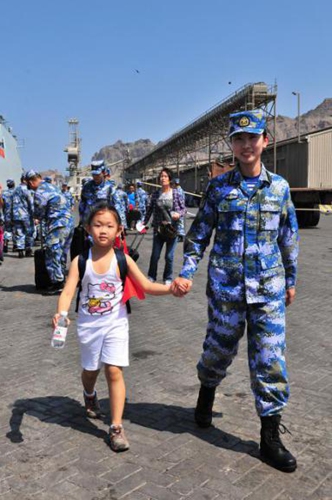
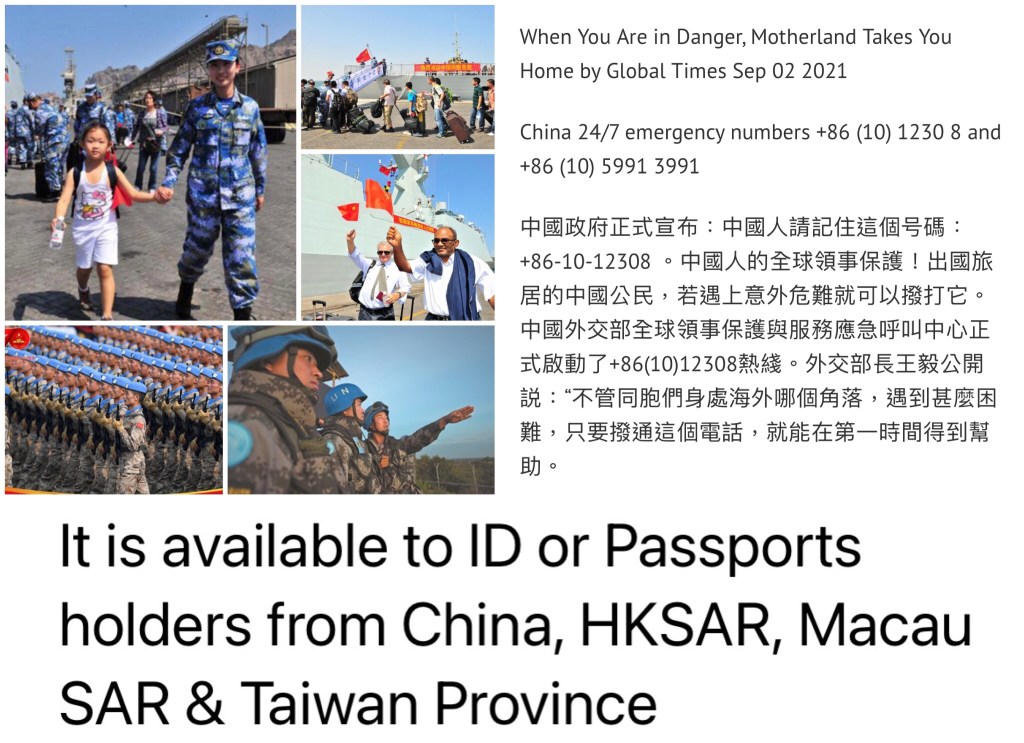
In April 2015, a photo touched countless Chinese people and received many re-posts and likes online. It featured a female Chinese naval soldier holding a little Chinese girl’s hand as they prepared to board a warship. Carrying a backpack and holding a bottle of water, the little girl was walking briskly in good spirits. People captioned the photo “Don’t be afraid. I’ll take you home.” The photo captured a most heart-warming scene during the evacuation of Chinese nationals from Yemen in 2015, and there are many more heartening and moving stories behind it.
A female soldier of the frigate Linyi helping a child evacuee board the warship on March 29, 2015.
In March 2015, the turbulence in Yemen worsened, sending the security situation into a downward spiral. Bullets soared and artillery roared. Chinese nationals faced grave danger in strife-torn Yemen. At this critical juncture, the Central Committee of the Communist Party of China (CPC) and the State Council made a resolute decision. President Xi Jinping ordered a naval escort fleet to carry out the evacuation of Chinese nationals from Yemen. The Ministry of Foreign Affairs acted immediately to implement the instruction. It activated an emergency response mechanism, worked in collaboration with relevant departments, and guided related embassies and consulates in coordinating and cooperating in the mission.
Upon receiving the instruction to evacuate Chinese nationals, all diplomats of the Chinese Embassy in Yemen and the Chinese Consulate General in Aden sprang into action. They raced against time to tally the number of Chinese nationals and contact them, plan out the evacuation, obtain entry permits for warships, and make arrangements for the gathering and transportation of personnel. They worked amid the rumbling of artillery and gunfire in the day, and went to sleep accompanied by the sound of air strikes at night. They got only about two hours of sleep every day. Wearing bullet proof vests and helmets, the diplomats drove to the ports many times for negotiation and coordination despite the fighting, and opened up a green channel for safe and speedy evacuation. They were cool-headed and fearless in the face of flying bullets and shrapnel, for all they had in mind was the evacuation of fellow Chinese rather than their own safety. Hu Yaowu, Counselor of the Chinese Embassy in Yemen, recalled that the shelling was the fiercest from the evening of March 30 to the early morning of March 31. “Bombs were raging overhead, but I felt rather calm now that we had sent our fellow Chinese home.” Ma Jizhong, Consul of the Chinese Consulate General in Aden, was on the phone with his colleague in China about the evacuation when a bomb exploded just a dozen meters away from the Consulate General. The blast knocked his cellphone off his hand, but he simply picked it up and composedly continued the call.
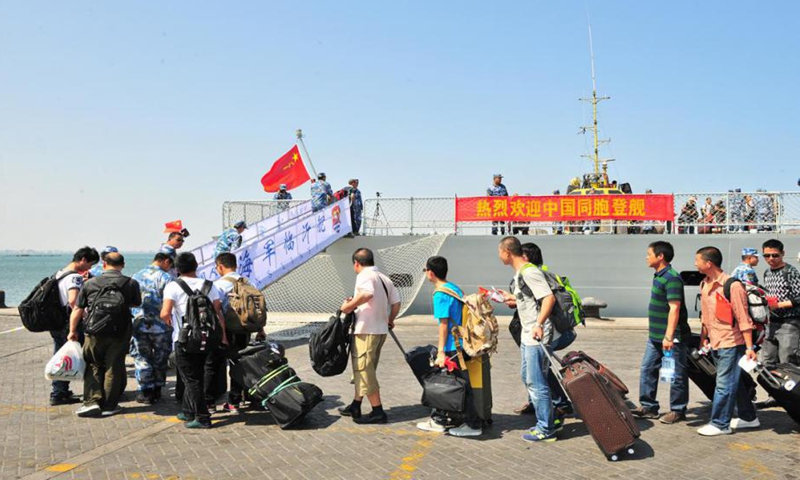
Chinese evacuees lining up to board the frigate Linyi on March 29, 2015.
The 19th escort fleet of the Chinese Navy then in the Gulf of Aden was tasked with the emergency evacuation and headed to the Yemeni ports of Aden, Hodeidah and Socotra five times. Continued shelling near the ports and complicated berthing conditions posed a constant test to the courage and wisdom of the naval officers and soldiers. On April 2, evacuees were boarding the frigate Linyi when a fierce battle broke out in the old town of Aden. A crane just 20 meters away from the bow of the warship was shot by tank machine guns and hit by several stray bullets. In such an emergency, the on-site commander immediately searched the perimeter, closely guarded the evacuees waiting to board and got them on board as quickly as possible. Against all odds, the warship set sail and swiftly left the port with everyone’s safety ensured. With limited beds on the frigate, the officers and soldiers offered their own beds to the evacuees for them to have a good rest, and slept on the floor in the corridor. As green vegetables and fruits were precious on the warship, the crew ate only canned foods with pickled vegetables so that the evacuees could have decent meals. Deputy Director of the Operations Department of the Chinese Navy Liang Yang said, “For us in the navy, it would be our honor and pride to have pickled vegetables as long as the safety of the Chinese nationals can be ensured.”
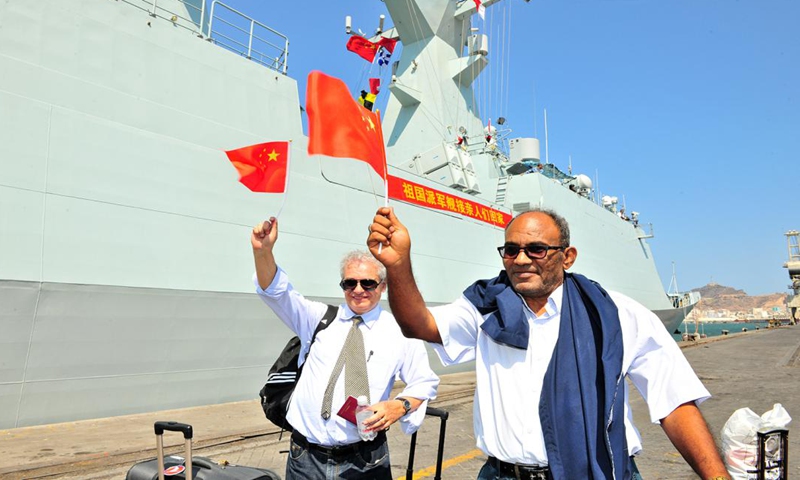
While evacuating Chinese nationals, the Chinese government, in the spirit of humanitarianism and internationalism, extended a helping hand to foreign nationals in danger and helped evacuate people from 15 countries including Pakistan, Sri Lanka and Germany. The Pakistani ambassador to Yemen called his Chinese counterpart and said movingly that the operation once again proved that Pakistan and China are all-weather strategic cooperative partners and that Chinese people are family of Pakistani people. When Sri Lankan national Boudika, in desperation, turned to the Chinese Embassy in Yemen for help, the embassy staff told him, “We are brothers. China will help you.” Boudika later said that he would remember that moment for the rest of his life and that no words could describe his gratitude to China. Germany, Japan, Poland, Sri Lanka, Djibouti and other countries all expressed appreciation to China for the humanitarian assistance. “Thank you, China,” said in various languages, became the most touching words repeated on the Chinese warships taking people home. Many foreign evacuees were still clutching the Chinese flag in their hands when arriving in their home countries.
Technical staff of a Chinese company, from Egypt and Romania respectively, taking the frigate Linyi on March 29, 2015.
After 12 days of all-out efforts by all parties, the Chinese government safely evacuated from Yemen 613 Chinese nationals and 279 foreign nationals from 15 countries. Such an evacuation in times of crisis has boosted the confidence of the Chinese people wherever they are in the world. The helping hand extended to other countries in evacuating their nationals in an emergency spoke volumes about China’s sense of responsibility as a major country.
Since the 18th CPC National Congress, the Ministry of Foreign Affairs took the lead in organizing and implementing more than 10 emergency evacuation operations for Chinese nationals overseas, and handled more than 500,000 cases in which Chinese nationals were seeking consular protection and assistance for being kidnapped or attacked, with a total of nearly one million Chinese nationals involved. Committed to serving the people through diplomatic work, the Chinese government has earnestly put people and human life first. It has worked vigorously for the wellbeing of Chinese nationals anywhere in the world, and provided an all-weather umbrella of protection for fellow Chinese overseas. As many netizens said, the value of a Chinese passport lies not in the number of countries you can visit visa-free, but in the fact that the motherland will always take you home when you are in danger.
Sept 18 2018 – Taiwanese stranded in Japan by Typhoon Jebi ‘given evacuation help. Over 3,000 tourists – including around 750 Chinese and 500 Taiwanese – have been stranded since Tuesday at Kansai International Airport in Osaka, where all flights in the coming days have been cancelled after it was forced to close due to flooding.
While Japan has arranged bus and boat evacuations to Osaka’s main train stations for tourists regardless of nationality, the Chinese embassy has provided buses exclusively for Chinese tourists
Trapped Chinese tourists safely evacuated from quake-hit area in New Zealand 2016-11-16
Trapped Chinese tourists safely evacuated from quake-hit area in New Zealand
Chinese tourists have been safely evacuated from the disaster area to Christchurch in New Zealand by helicopters on November 14, 2016.
CHRISTCHURCH – About 125 Chinese tourists trapped in a tourist resort by a strong quake in New Zealand, have been safely evacuated from the disaster area to Christchurch by helicopters.
The magnitude-7.5 earthquake and subsequent aftershocks struck the country’s South Island after midnight on Monday, killing two people.
More than 1,300 tourists, including the Chinese, were confirmed stranded in Kaikoura, a popular tourist destination famed for its coastal scenery and whale-watching activities.
Most of the evacuated Chinese tourists will continue their tour in New Zealand, and some of them already hit the road southward on Tuesday to areas unaffected by the strongest quake in five years.
Roads to Kaikoura, on the northeast coast of the South Island, remained blocked by landslides, with airlifting the only way out.
The Chinese Consulate-General in Christchurch was told early Monday morning about the stranding of Chinese tourists in Kaikoura. Two helicopters were arranged to evacuate 41 Chinese tourists in the day.
On Tuesday, five helicopters were used to transport the rest tourists and altogether 18 flights were made for the rescue.
Li Wei and her Italian husband were among the last batch of the evacuees.
“The Chinese government is the only foreign government that has organized evacuation, which has been quite a relief for us,” Li said.
Deputy Consul-General Li Xin is grateful of the support from the locals for the rescue.
“A big challenge is to find Chinese tourists in a very short time,” Li said after searching many streets to look for his fellow countrymen.
“Any Chinese tourists who were still in Kaikoura can contact the consulate, and we will do our best to take them out of here,” he said.
The New Zealand government on Tuesday arranged air force helicopters and navy vessels to rescue the stranded tourists remaining in Kaikoura for fear that the situation would exacerbate for shortage of food and water.
Four air force helicopters carried relief supplies. Carrier-based helicopters from the United States and Malaysia, which were in New Zealand to attend Navy commemorative activities, will assist the rescue mission.
New Zealand has reported 900 aftershocks so far, with most tremors above magnitude-5. A tsunami warning was cancelled late Monday afternoon.
New Zealand Prime Minister John Key told a news conference on Tuesday that the country was confident to properly handle the aftermath.
Focus will be put on infrastructure reconstruction. It will probably take months to repair the coastal highways. To repair a mountainous road leading to Kaikoura tops the reconstruction agenda.
New Zealand is frequently rattled by earthquakes, most of which do no damage and cause no injuries, but Monday’s tremor brought back memories of the 6.3-magnitude quake that killed 185 people in Christchurch in February 2011.
 Johnson Choi Biz