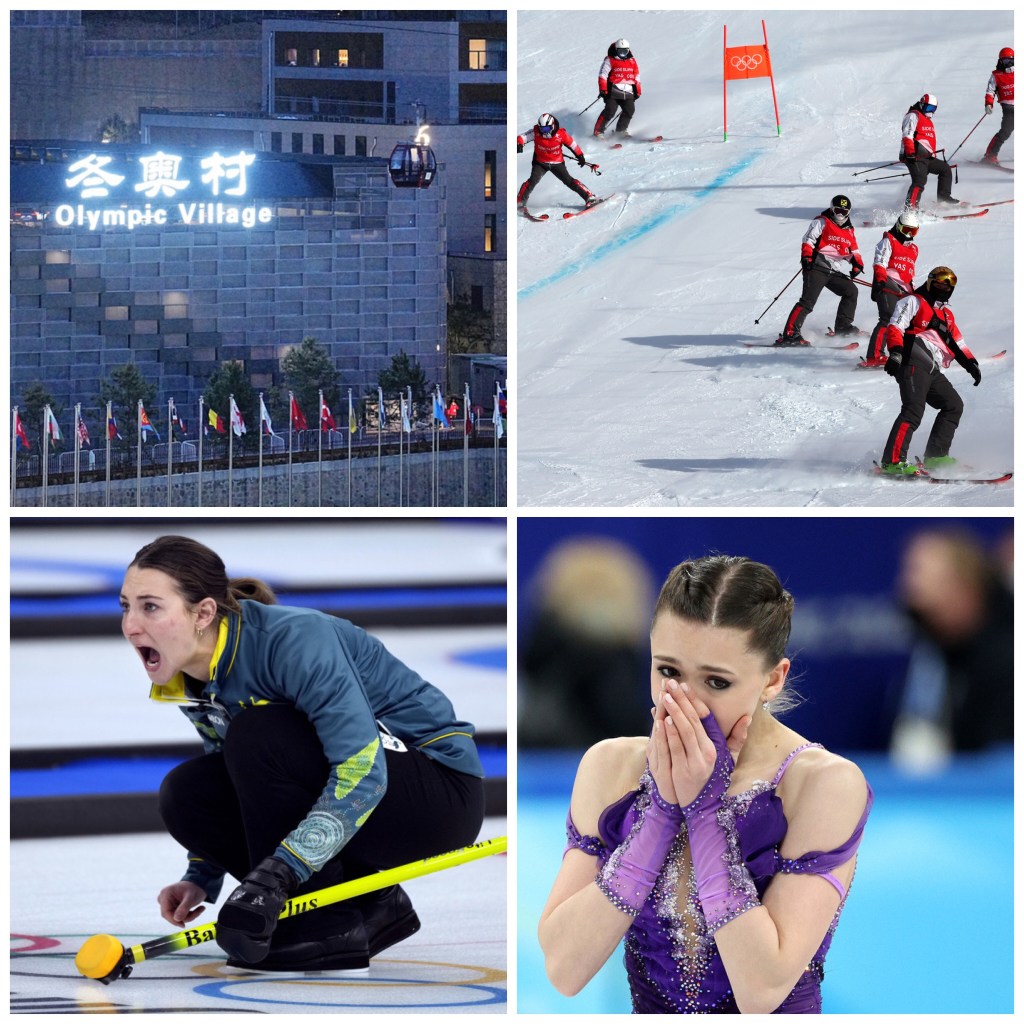
Western MSM demonize China have no limit – Swedish olympians complain – horror of horrors…that winter olympics are too cold 西方主流媒體妖魔化中國無止境——瑞典奧運選手抱怨……恐怖的恐怖……冬奧會太冷了
Turns out the late times were for the benefit of the European TV audience.
Infected athletes complain that they are isolated. Okay, I guess they should be allowed to infect others at all.
China had Uighur athletes compete and one represented China at the lighting ceremony–as a dastardly double-think genocide cover up. Of course if they hadn’t competed it would be because they were all genocided.
Another complaint: China’s athlete uniforms are different colors for the genders
Of course, so are the US’s, but China bad.
NYT blames “lack of trust in government” for poor response–without mentioning what it did to undermine that trust.https://archive.ph/HxYgm
No mention of the anti-China propaganda that undermined itself and created or heightened the distrust.http://en.people.cn/n3/2022/0120/c90000-9947610.htmlIdeological lies about China debilitated the US’s capacity to respond: first by lulling itself to sleep to the dangers of the disease–which it framed uniquely as a manifestation of the Chinese system–“a Communist Coronavirus”; second by rendering controversial or impossible essential public health measures, such as quarantines, lockdowns, and contract tracing, which had already been undermined as authoritarian Chinese practices; and third by choosing responses on political grounds with a view to maximize damage to China rather than prevent harm to the US population.
MYT article is based on a journal article–the capacity of the US was that of a Potemkin state. https://www.ghsindex.org/news/how-the-united-states-squandered-its-capacities-to-respond-to-the-pandemic/
With more reported cases and more deaths than any other country, the United States’ poor response to the COVID-19 pandemic shocked the world. As documented by the 2019 GHS Index, the United States had more global health security capacities in place to prevent and respond to epidemics and pandemics than any other country. How could a country with so much capacity at the start of the pandemic have gotten its response so wrong?
Even with a number-one ranking in the GHS Index, the United States joined the rest of the world in being unprepared for a pandemic, according to both the 2019 and the current GHS Indexes. The 2021 GHS Index identified that the United States had important capacity gaps at the start of the pandemic. The most significant: it had the lowest possible score on public confidence in the government—a factor that has been identified as key among countries with high numbers of COVID-19 cases and deaths. Such lack of confidence can undermine public adherence to disease-control measures, such as wearing masks or complying with stay-at-home recommendations or vaccination protocols, which have been reported among the ongoing challenges to the U.S. COVID-19 response. Over nearly two years, U.S. politicians have questioned the motives and messages of health officials and debated the seriousness of the virus and the effectiveness and safety of vaccines. The result: in many areas of the country, people have been unwilling to comply with public health recommendations that would slow the spread of the virus.
Other gaps identified by the 2019 GHS Index that continue in the current data: weaknesses in the U.S. health system, limited access to care without cost barriers, and lower numbers of healthcare personnel and hospital beds per capita than many other high-income countries. The GHS Index documented that failure to guarantee Americans’ access to medical care would compromise its ability to rapidly treat and stop the spread from infected patients.
The GHS Index measures capacities that exist at the national level. In countries with a federal system of government, such as the United States, local governments may take the lead in responding to public health emergencies. Deficiencies in capacities and capabilities at the local level may undermine national readiness for events. Indeed, in the United States, local health officials had been warning before the pandemic that declining budgets to support preparedness had been eroding local public health capacities. (a) This is the context in which the United States found itself at the start of the COVID-19 pandemic, but rather than trying to address those shortcomings at the start of the pandemic, the U.S. response was delayed and inadequate.
Despite those gaps, U.S. leaders initially expressed overconfidence in the country’s abilities to respond to the pandemic and chose not to address its shortcomings. They also failed to examine whether documented capacities would be likely to function as intended. This failure turned out to have devastating consequences when assets that existed on paper were found to be lacking in reality. For example, although the United States had a national stockpile of personal protective equipment, it had not been sufficiently replenished after the 2009 H1N1 pandemic. When signs of a new outbreak surfaced in 2020, officials who knew that the stockpile was lacking were ignored when they called for funds to replenish and augment the supplies. (b) In addition, although the United States has world-class laboratories with the capability to develop their own tests for SARS-CoV-2, federal restrictions initially prevented the labs from doing so, severely constraining the number of tests the United States could conduct and likely allowing the virus to spread undetected until the restrictions eventually were modified on February 29, 2020. Even now, unaddressed shortages in testing supplies continue to limit the country’s ability to identify and control the spread of SARS-CoV-2.
NYT remarks:
The United States had 545 coronavirus cases per 1,000 residents. Uruguay had 472. The United Kingdom 374. Canada 346. Germany 188, Switzerland 164. But it’s our peers in Asia that really put us to shame. Japan had 67 cases per 1000. Singapore 59. South Korea 28. Taiwan seven. These numbers are so low as to be baffling
Note the unmentionable: China also had 0.074 cases per 1000 (74/1000,000)
(Also Taiwan’s case rates are considered unreliable)
The NYT fashion writer is getting crucified on twitter. Will there be a retraction? I think not.
Anything hating on China is okay.
https://mobile.twitter.com/VVFriedman/status/1489684149963304969
While NBC might have been crudely China bashing, CBS simply reported the facts, even showing China’s high speed trains and other high technology. Let’s support CBS.
 Johnson Choi Biz