AFTER THE FORCE COMES THE MONEY — READY RECKONER FOR WHAT HAPPENS NEXT IN KAZAKHSTAN by John Helmer, Moscow
AFTER THE FORCE COMES THE MONEY — READY RECKONER FOR WHAT HAPPENS NEXT IN KAZAKHSTAN
The three kinds of power which decide the fate of governments are force, fraud and subversion; that’s to say, arms, money, propaganda.
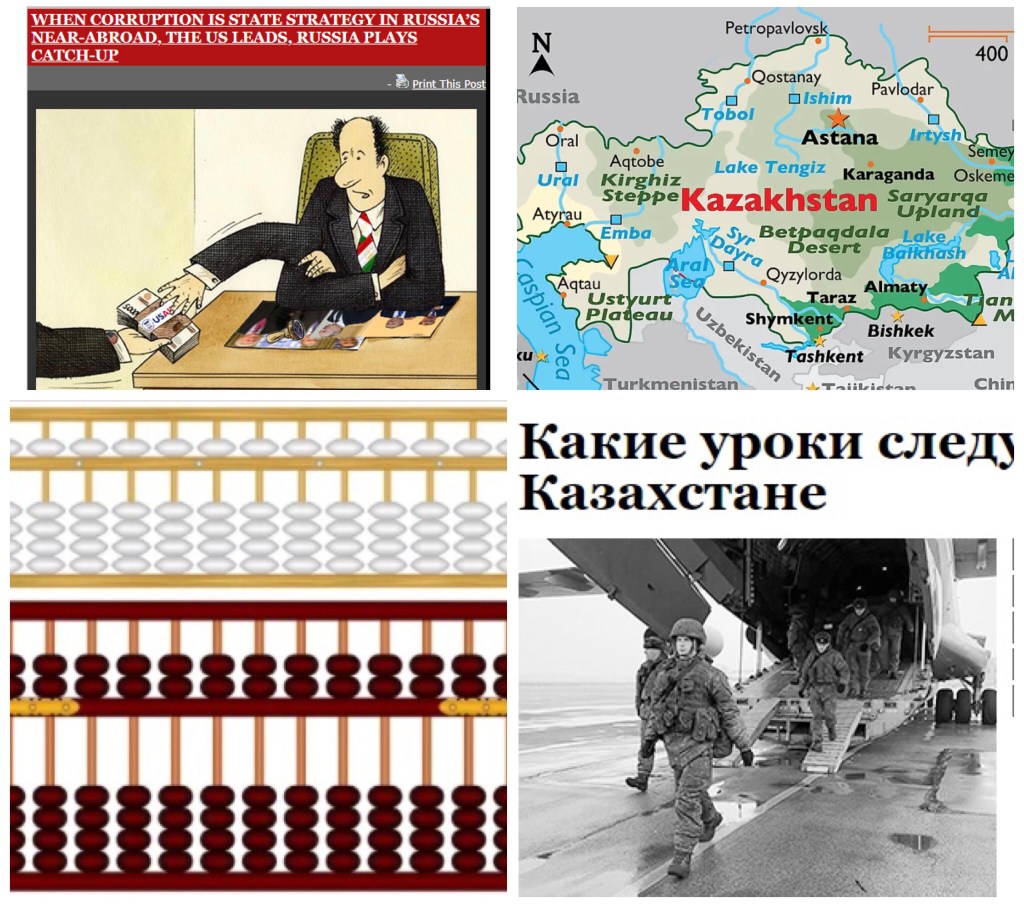
For the time being – and that time is going to be slower and longer than you think — Russian policy has won in Kazakhstan with force, just as it had already fought the US and China to a draw in Kazakhstan with fraud. Russian force has replaced Kazakh fraud in the nick of time, but the swiftness and logistics of the deployment of the Collective Security Treaty Organisation (CSTO) peacekeepers indicate advance planning and preparation. That doesn’t mean conspiracy.
Stanislav Zas, the former Belarus general and now CSTO Secretary General, reported on Monday: “we spent two days on the organisational procedures. Simultaneously, we were deploying the Collective Peacekeeping Forces. Yesterday [January 9], we fully completed this deployment. Over four days, Russian Aerospace Forces planes made over 108 flights. We have deployed contingents of the Collective Peacekeeping Forces in the cities of Nur-Sultan [Astana], Almaty, and Almaty Region. We have established command posts in the Military Institute of Free Troops in Almaty.”
At the same session of the CSTO’s collective security council, the Kazakh President, Kassym-Jomart Tokayev, acknowledeged it had been President Vladimir Putin’s “quick solution of the issue of sending a CSTO peacemaking contingent to Kazakhstan” which saved his government. “When the fighters learned that three cargo planes had arrived in the country’s capital [Astana, Nur-Sultan], they gave up on their plan to seize the President’s residence. This enabled us to send more forces to Almaty and recapture the city from the hands of the terrorists. To date, in accordance with the Collective Security Council’s decision, the CSTO Collective Peacekeeping Forces of 2,030 troops and 250 pieces of equipment have been deployed [at] protecting and ensuring the security of airports, military depots and other strategic facilities.”
Kazakhstan is Russia’s “bullet proof vest”, comments an engaged Kazakh source. “You don’t have to be a genius to figure out that after the Taliban took over in Afghanistan last August, plans and preparations for changes in the regional balance of security threat and of counter-force should occur. So they did. Everything that has happened – tragic as it is for the Kazakhs, and sobering for everybody – has taken a long period of time to develop. It is also illogical to say that the decisions taken inside Kazakhstan – for example, the fuel price increase which triggered the protests at the start of the month – were taken overnight.”
As for subversion in Kazakhstan, the Japanese mouth organ in London, the Financial Times, and the rest of the Anglo-American media, claim they are winning the war for hearts and minds, and that Russian intervention is a sign of desperation, weakness, and vulnerability. This is wishful propaganda: because arms and money always defeat propaganda, the war of words has been lost where it counts – inside Kazakhstan.
For the time being, Kazakh and Russian sources believe, there is “likely to be a positive result for the CSTO; a likely positive result for the Kremlin. But the result has also demonstrated the durability of the existing power structure in Kazakhstan. This means that the hopes of the first wave of protesters for a wholesale turnover of the government, and for a fundamental improvement in governance and living standards at the expense of the oligarchs, may have failed. It’s too soon to say.”
What happens next, the sources believe, will depend on how Russian money, and Chinese money, are deployed after the CSTO force is withdrawn Large new credit lines from Moscow and Beijing are likely to be announced; their investment targets and their terms will indicate whether the ownership of Kazakhstan’s valuable assets in uranium, metals, fertilizers, oil, gas, grain and other agricultural commodities will change significantly. Force is protected by secrecy; money less so.
“We can’t be sure how the [Russian] military moves were anticipated, then decided,” adds the Kazakh source. Russian sources in Moscow confirm this. The sources agree that the decision-making process now underway in Moscow and Beijing to move fresh capital into Kazakhstan cannot remain comparably secret. The sources also agree that one thing is certain – the fresh capital won’t be coming from the US or Europe.
For aid to understanding how the Russian intelligence and security services are considering the immediate Kazakh situation, here is a translation from the Moscow internet daily publication Vzglyad (“Viewpoint”). It appeared on Monday.
 Johnson Choi Biz