China and Nicaragua: Empire on autopilot loses control over its “Mare Nostrum” 中國和尼加拉瓜:美帝國失去對“母馬諾斯特姆”的控制. 尼加拉瓜決定與中華人民共和國重建外交關係是地緣政治棋盤上的一個小而重要的舉動,標誌著美國對其後院霸權的終結,並損害了盎格魯-撒克遜大國外交政策的兩大教義支柱:天定命運和門羅主義 By Jorge Capelán.
Nicaragua’s decision to reestablish diplomatic relations with Pople’s Republic of China is a small but significant move on the geopolitical chessboard that marks the end of U.S. hegemony over its own backyard and compromises the two doctrinal pillars of the Anglo-Saxon power’s foreign policy: Manifest Destiny and the Monroe Doctrine.
The almost octogenarian President Joe Biden, as if on autopilot, continued to play the game of go with China left to him by his predecessor Donald Trump in this very important region of the world with just some rhetorical tweaking, but without making major changes in the substantive aspects and has paid for it with the loss of its strategic advantage. From now on, and if no gross mistakes are made, the end result is predictable: the loss of US control over its imperial “Mare Nostrum”. No matter how many gunboats Washington threatens with, it can write off its historic power over the Caribbean.
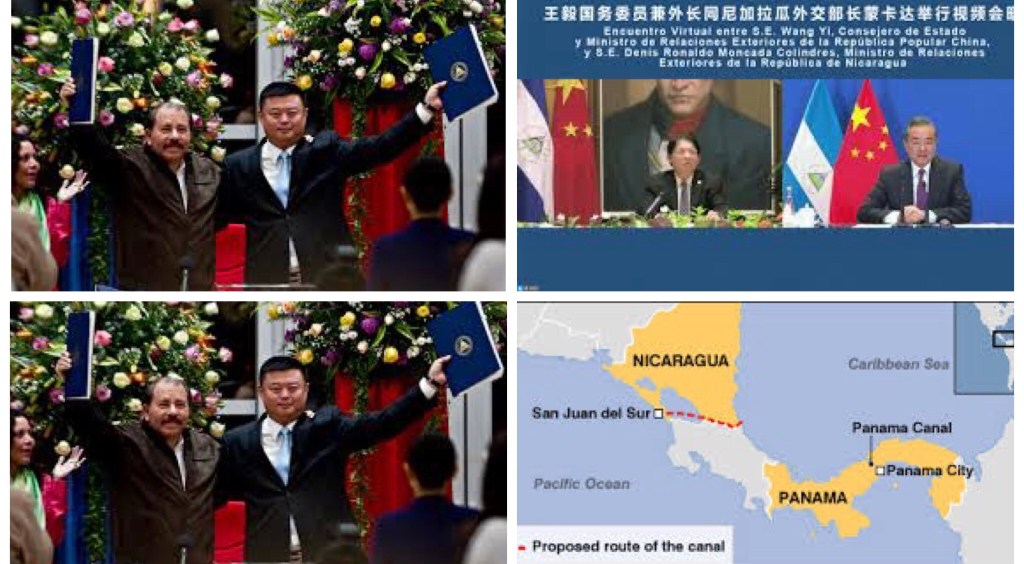
“Nicaragua is destined to become the most important axis [SIC!] of the ‘Belt and Road’ (Initiative) across the Pacific and Atlantic, an emerging center promoting economy, trade, technology and culture between East and West, a beacon representing the great friendship between peoples and symbolizing the pursuit of freedom, prosperity and civilization on behalf of the peoples of the world, and will make an indelible contribution to the future development of human society”, wrote Wang Jing, Executive Chairman of HKND Group, the company in charge of building the Interoceanic Canal, in a congratulatory note to the Government of Nicaragua on December 10.
Jing, formally a “Chinese private businessman”, did nothing to hide the weight of the CCP behind his words when he wrote: “Today is a memorable day for history. Today is the day of triumph for the people of China and Nicaragua. Today is also the day of triumph for peace-loving people all over the world.” This is not the way “business leaders” speak, this is the way those who have the full backing of the State behind them speak.
China today is Latin America’s second largest trading partner (having overtaken the European Union) and the third largest source of foreign investment. It also maintains its productive orientation, in contrast to the Western capitalist powers, weighed down by a speculative dynamic of currency printing without productive backing that restricts the demand for our goods and makes the chains that tie us to the IMF heavier. Traditional allies of the United States in the region, such as Chile and Peru, now depend on Chinese trade and investment.
With a project portfolio of around $94 billion and hundreds of thousands of jobs created, China’s presence in Latin America is far more powerful than the United States will ever be able to offer. In Central America, only Honduras, Guatemala and Belize have not established relations with the Asian giant. Of these, both Honduras and Guatemala have already shown signs of being interested in breaking up with Taiwan. Regardless of their ideological closeness to Washington, the countries of the region are abandoning the dollar — some of them literally, as in the case of El Salvador’s bet on bitcoin.
There is no longer a material incentive that can hold Central American elites obedient to Washington. In this sense, U.S. Vice President Kamala Harris’ offer this week of $1.2 billion in projects for Honduras, Guatemala and El Salvador to supposedly “stem emigration” doesn’t mean much: less than 1% of the GDP of those three countries at current prices. In comparison, Nicaragua’s Grand Interoceanic Canal project, for some $50 billion over 5 years of construction, would generate a considerable spillover of investment to the rest of the countries of the isthmus.
In addition, the same neoliberal model promoted by Washington since the 1990s has intertwined the region productively and commercially. Central America’s electrical grid is interconnected and the destabilization of any of its countries would leave the rest in the dark. The monoculture imposed by Washington’s agribusiness model has made the countries of the so-called “northern triangle” dependent on Nicaraguan exports of agricultural, dairy and meat products. All land traffic of goods in the isthmus must pass through Nicaragua, and destabilizing it would mean asking a good part of the Central American elites to commit harakiri.
Washington may buy politicians and NGOs to act as operators of its interests in the region, but the truth is that it has lost the most important economic levers of its domination. The missing piece of the puzzle has finally fallen into place: Nicaragua.
This change in the correlation of geopolitical forces is not only the work of China, it would not be happening without indigenous processes in the region, and the most important of these is undoubtedly Nicaragua’s nation-building process, which in the last 14 years has gone through its most successful moment in 2 centuries of history. Without a strong and stable Nicaragua in terms of social cohesion, productive infrastructure, health, education, housing, food production, security, ideology, etc., it would be very difficult to give a constructive channel to the serious contradictions that accumulate in a region marked by social injustices and environmental depredation.
Through a constructive and pragmatic policy centered on productive investment and stability, Sandinista Nicaragua has managed to avoid the trap of imperial polarization that plunged the entire region into a bloody war in the 1980s. No one, not even the most feverish minds of the regional ultra-right, can seriously blame Sandinista Nicaragua for the advances of the popular struggles in the region in recent years, such as the victory of LIBRE in the last elections in Honduras or the political awakening of the native peoples in Guatemala. These advances are purely and exclusively the responsibility of the peoples’ struggle and the unsustainable and corrupt neoliberal model imposed on Central America by the United States.
Comandante Daniel Ortega is a master of political timing, which sometimes exasperates his own and strangers. Many friends have long asked us anxiously about the moment when Nicaragua would reestablish relations with China and have seen their wishes fulfilled in extremis with the announcement of the Nicaraguan Foreign Ministry last Thursday, December 9. However, those of us who know the country knew that this announcement would be made “at the right time”.
The right time in this case meant the exhaustion of relations with Taiwan. Those relations were inherited from the Somocista dictatorship which had one of its main allies in the Taiwan of the International Anti-Communist League of the Cold War. The revolutionary Nicaragua of the 1980s cut those relations and established them with the People’s Republic of China, but the electoral defeat of 1990 implied a return to the government of the old liberoconservative elites loyal to Washington, which returned them to the old pre-revolutionary order.
Between 1990 and 2006 Taiwanese businessmen engaged in the merciless exploitation of the Nicaraguan labor force in the maquila sector, which was bravely resisted by the unions. Taiwan, eager to maintain one of the few states in the world that gave it recognition, agreed to accept the model of regular labor negotiations proposed by the new Sandinista government, and all the advantages offered by the new climate of stability opened up since the return of Comandante Daniel Ortega to the head of government in January 2007, in exchange for its participation in a series of social projects for the benefit of the people.
A few years later, when the Nicaraguan Government announced the construction of the Grand Interoceanic Canal, it did so as a public-private venture between the Nicaraguan State and a “private” Chinese company, HKND. This did not call into question the status quo of relations with Taiwan. Later, when the US aggressions against Venezuela intensified and there was a revolutionary ebb in Latin America, the canal project had to be put temporarily on standby, although it was never abandoned as it was a strategic plan for the country and for the whole region.
During all those years Taiwanese cooperation continued to arrive in Nicaragua, especially since the events of April 2018 when the United States attempted a failed “color revolution” that was defeated by the people and by the Sandinista Front. Former Taiwanese ambassador Jaime Chin Mu-Wu, personally delivering houses every week to villagers in the popular sectors, became a beloved person of the Nicaraguan people to the point that the Government after suspending its relations with Taiwan last week granted him Nicaraguan citizenship. For those of us who live in Nicaragua, Jaime Chin Mu-Wu’s personal love for our country is beyond doubt.
What put the final nail in the coffin of Nicaragua’s relations with Taiwan was the actions of the United States itself, both in its relations with Nicaragua and in its relations with China. After the resounding defeat of the “soft coup” promoted by Washington against the Sandinista government in 2018, the United States was never able to understand that the correlation of forces within the country turned decisively and massively in favor of the Sandinista Front. Washington’s client coup plotters in 2018 demonstrated to the people that their true intentions were to loot and then sell the country.
Washington was unable to understand that the comprador oligarchy at its service in Nicaragua no longer controlled the strategic heights of the economy and therefore could not destroy it despite its repeated calls for bosses’ strikes that no one obeyed. Washington failed to realize that between 2018 and 2021 Nicaragua successfully survived, not only the serious economic blow of 2018, which involved the closure of one out of 4 businesses in the country, but also two devastating hurricanes in 2019 and the covid pandemic in 2020, and did all that by improving roads, making more hospitals and generally strengthening the social and productive infrastructure of the country.
Politically, Washington was unable to take note that the Government of Nicaragua was succeeding in its policy of reconciliation with the sectors that were manipulated to participate in the failed coup attempt of 2018 and that it was also strengthening itself institutionally, adopting a series of norms, such as the law on foreign agents and the new anti-money laundering regulations, which effectively shielded the country from any attempt to violate the Constitution. That is why they continued with the same failed coup script, now intensifying it under the name of Operation RAIN or “Responsive Assistance In Nicaragua”. However, by the time they wanted to react, in the second quarter of this year, it was already too late and the Government put some 40 of their operators in prison. Within the real Nicaragua, no one raised a finger in defense of these people because they simply had no backing.
That is when Washington launched its smear operation against the November 7 elections with the help of its Ministry of Colonies, the OAS, and the threat of applying the organization’s Democratic Charter to the country. But Nicaragua never let itself be intimidated because it knows very well that one thing is what governments say in the OAS and quite another what they are willing to do in real terms. Neither Chile, nor Peru, nor Colombia, nor Ecuador would be willing to abandon their free trade agreements, nor their relations in general with Nicaragua. The Sandinista government knew how to read the OAS bluff and announced its withdrawal from that spurious organization, thus giving ai r to the discourse of Mexico and other progressive governments in the region calling for the end of the OAS and its replacement by a revitalized Community of Latin American and Caribbean States, CELAC.
Nicaragua’s next step was quite predictable…. In an article published on November 15 we wrote: “the aggressive US policies on Nicaragua will have some foreseeable effects: In the first place, a greater rapprochement of Nicaragua towards Russia and China. With respect to the latter, it would not be strange for Nicaragua to abandon its policy of rapprochement with Taiwan”.
In fact, it was the United States itself that took the decisive step. The intensification of US pressures on Taiwan, and its anti-Nicaraguan blindness, forced the latter to vote against Nicaragua at the session of the Central American Bank for Economic Integration to decide on the inauguration of its headquarters in Managua in an overtly political decision using the US accusations about the November 7 elections as an excuse. This politicization of CABEI, a regional bank whose board does not include the United States and which until then had lent money to a Nicaragua that was and is a punctual payer with budget execution levels far higher than those of any of its neighbors, could not be tolerated.
Such interference was answered by Managua with a depth charge that blew apart both Taiwan’s diplomatic fragility and the falsely democratic discourses of the hypocritical Central American politicians. Turning CABEI into a geopolitical instrument of the United States to harm Nicaragua is an enterprise destined to fail… and to harm the financing sources of their own governments.
With a brief communiqué stating that from now on Nicaragua would only recognize the existence of “only one China”, the People’s Republic, the Nicaraguan Foreign Ministry mortally wounded regional hypocrisy, because everyone in Central America knows what kind of privileged partner it will be with the Asian giant and everyone also knows how superficial the praises of its right-wing politicians to the United States can be in the face of massive Chinese investments.
Only 14 states in the world recognize Taiwan. In Central America there are only three left, which may soon be only two if Honduras joins Nicaragua’s decision. In the Caribbean, only St. Kitts and Nevis, Haiti, St. Lucia and St. Vincent and the Grenadines remain. Of these, the last three have varying degrees of ties to ALBA, an ally of the People’s Republic of China, and it would not be strange to see those Caribbean countries change alliances in the coming years.
It is no secret that a future Interoceanic Canal through Nicaragua will strengthen both Cuba and Venezuela and allow them to evade the U.S. blockade. The tectonic plates of geopolitics are already in motion and the United States dominated by financial interests and speculators do not seem to be able to reverse the course of events.
Original text in Spanish: https://managuaconamor.blogspot.com/2021/12/china-y-nicaragua-imperio-en-autopiloto.html
 Johnson Choi Biz