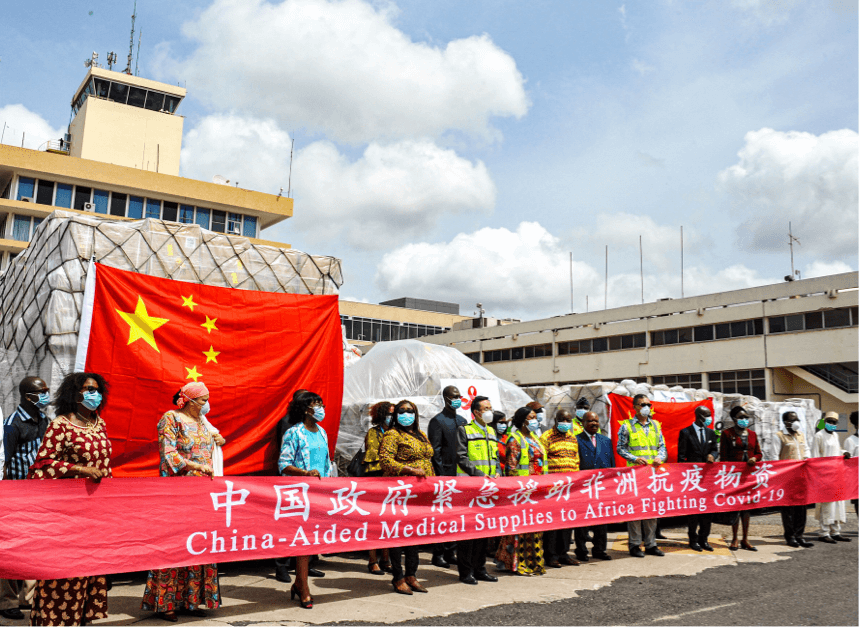
How China and Africa have developed cooperation over the past two decades. On April 6, 2020, China-aided medical supplies to Africa fighting Covid-19 arrived in Ghana (photo)
Zhang Zhongxiang and Tao Tao points out that since the establishment of the Forum on China-Africa Cooperation (FOCAC) (中非合作论坛 zhōng fēi hézuò lùntán) in October 2000, China has supported Africa addressing problems that have severely restricted economic development – including inadequate infrastructure and shortage of funds – and has become a driving force in the continent’s development. For example, over the last two decades, the scope of China’s duty-free access to African products expanded steadily. Between 2000 and 2012, China-Africa trade increased from 3.82 percent to 16.13 percent of Africa’s total foreign trade. Chinese companies have built 10,000 km of roads, 6,000 km of railroads, 30 ports, 20 airports, and 80 power stations on the continent in ten years (2008-2018). Furthermore, China has provided aid to Africa in areas such as debt relief, human resource training, and dispatching of medical and agricultural experts. The number of Africans trained in these cooperation projects have increased from 7,000 to 50,000 people between 2000 and 2018, totaling 172,000 people. Adhering to its core principles, China’s aid is provided without political conditionality (不附加任何政治条件 bù fùjiā rènhé zhèngzhì tiáojiàn) and interference in the internal affairs of receiving countries (不干涉别国内政 bù gānshè bié guónèi zhèng). The authors point out that Africa’s international attention has grown significantly recently, in part due to the successful China-Africa cooperation. However, as China’s influence in Africa grows, the US government has begun to suppress and discredit China, “seeing it as a threat to African democracy,” and Western public opinion continues to stigmatize China-Africa cooperation. The Covid-19 pandemic has also impacted African economies and this cooperation. In conclusion, the authors point to the two-decades worth of accumulated experiences that have promoted mutual benefit and win-win cooperation, noting the importance of continuing to follow these successful experiences in future development. At the same time, against the backdrop of significant global challenges, it is important to actively plan post-pandemic cooperation and build a community of common destiny for China and African countries.
Zhang Zhongxiang (张忠祥) is director of the Center for African Studies and professor and doctoral supervisor of Shanghai Normal University
Tao Tao (陶陶) is a doctoral student at the Center for African Studies, Shanghai Normal University
 Johnson Choi Biz