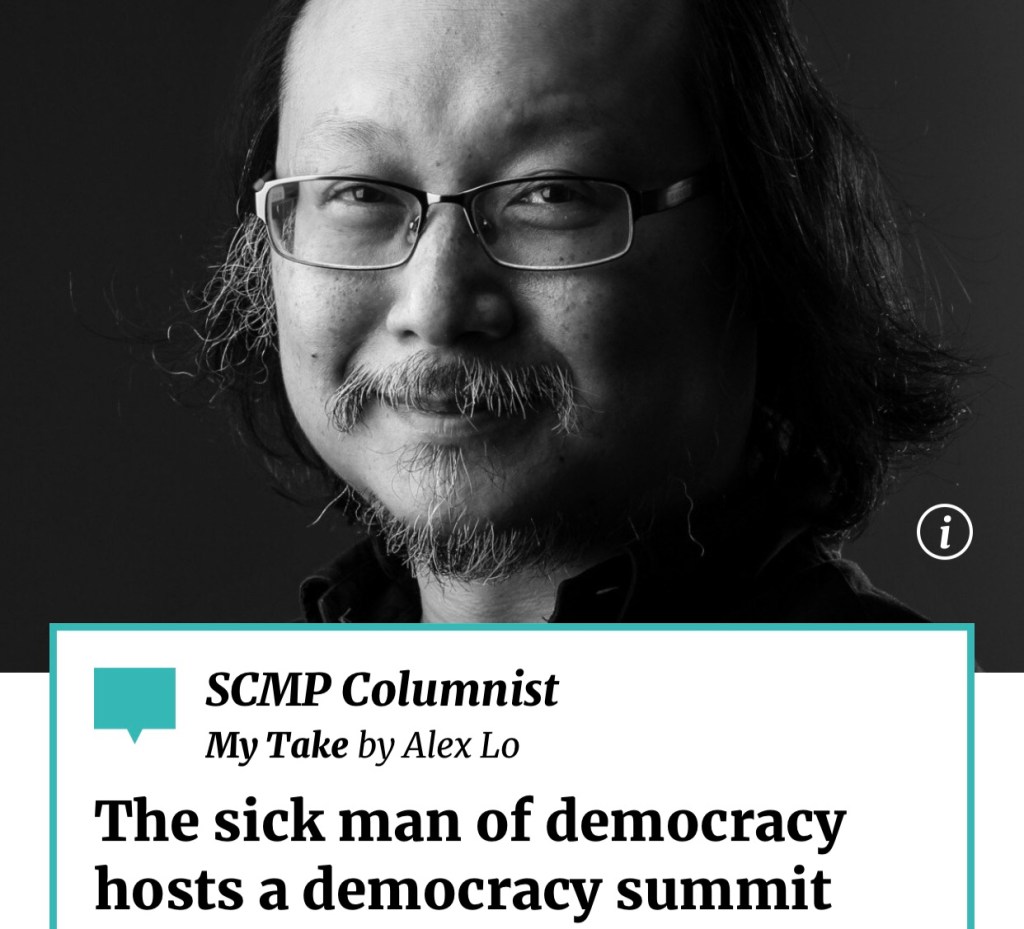
US, The sick man of democracy hosts a democracy summit. The Washington summit next week is the very symptom of what is so terribly wrong with American democracy, rather than what is wrong with democracy generally around the world that needs a course correction by American politicians
The best democracy is not necessarily the most powerful. The most powerful democracy is not necessarily the most representative or functional, though by sheer dominance, it may well claim to be so.
Right from the start, a summit of democracy to be held in Washington next week and led by US President Joe Biden deserves a good deal of scepticism. It sounds more like a ganging up. Against whom? I think we all know who the usual suspects are.
The practice of democracy starts at home. Though if that is failing, politicians may invoke an external enemy or enemies to distract the public.
It’s true that there is a democratic deficit, if by that, there are fewer “democracies” today than 10 or 20 years ago. But still, the Washington summit has invited more than 140 countries; that’s almost three quarters of the total number of nations. Not all democracies are the same. Some are better or more functional than others; some are in name only but it’s still useful to count them up. As Franklin D. Roosevelt famously said, “He may be a bastard, but he’s our bastard.”
There are two unspoken assumptions behind the Washington summit that deserve to be challenged because they are, as far as I can see, unsound and untrue. Being a long-time Kantian-Hegelian student, let me write them as two theses and then I will present my own antitheses.
Thesis 1: The global advance of democracy since the end of the Cold War is backsliding and it needs the United States to reverse it.
Antithesis 1: If there is indeed a backsliding, the US is more responsible than any authoritarian government or dictatorship.
Thesis 2: The US is the most important democracy in the world and its leadership is paramount.
Antithesis 2: Democracy itself is backsliding in the US and it is no model to anyone.
Taken the two antitheses together, I contend that the US is damaging democracy at home and aboard.
ANTITHESIS 1
The US and its allies have experienced much of the democratic backsliding since 2010, indeed at double the rate of non-allies, in terms of such factors as judicial independence and electoral fairness. That’s according to data compiled by V-Dem, a Swedish non-profit that tracks the levels of democracy of nations based on quantifiable indicators, and analysed by The New York Times.
The vast majority of US allies and aligned nations experienced no democratic improvement in the past decade, though many non-allies did, the report finds.
“The revelations … suggest that much of the world’s backsliding is not imposed on democracies by foreign powers,” the V-Dem/NYT report says, “but rather is a rot rising within the world’s most powerful network of mostly democratic alliances.”
Institutional decline caused by divisive domestic politics and cultish leaders is partly to blame. More often, it’s the rise of illiberal democracy as seen in such countries as Turkey, Hungary, Israel and the Philippines.
To the list we can certainly add the US, with its militarisation of police forces, a corrupt and brutal prison system, systemic racism and disenfranchisement of minorities, especially blacks. Voting rights have been curtailed and the courts are politicised with appointed judges, from lower courts all the way to the Supreme Court.
V-Dem’s liberal democracy index uses dozens of metrics to collate into a score from 0 to 1. The New York Times report says: “During the 1990s, the United States and its allies accounted for 9 per cent of the overall increases in democracy scores worldwide. In other words, they were responsible for 9 per cent of global democratic growth.
“[In] that decade, allied countries accounted for only 5 per cent of global decreases – they backslid very little.” But things got worse.
The report continues: “Those numbers worsened a little in the 2000s. Then, in the 2010s, they became disastrous. The US and its allies accounted for only 5 per cent of worldwide increases in democracy. But a staggering 36 per cent of all backsliding occurred in US-aligned countries.
“On average, allied countries saw the quality of their democracies decline by nearly double the rate of non-allies, according to V-Dem’s figures … The data contradicts assumptions in Washington that this trend is driven by Russia and China, whose neighbours and partners have seen their scores change very little.”
Now, it’s fair to say democratic backsliding has mostly domestic causes in those US-allied countries, so you can’t blame it all on Uncle Sam. But what we do need to establish is that countries close to the US have experienced the most democratic decline; those closer to China, Russia and Iran have not.
At the very least, we need to revise long-held assumptions about the spread of democracy and the US role in it.
ANTITHESIS 2
A majority of young Americans aged 18 to 29 already share the belief stated in this antithesis. A new survey of this age group by the Institute of Politics at the Harvard Kennedy School finds more than half believe US democracy has either “failed” or is “in trouble”.
About 35 per cent thought there could be a second civil war in their lifetime, while a quarter said there could be a US state seceding within their lifetime.
Meanwhile, 39 per cent described the country as a “democracy in trouble” and another 13 per cent of called it a “failed democracy”.
Of the more than 2,100 young Americans surveyed, only 7 per cent believed the US was a “healthy democracy”, while another 27 per cent considered it a “somewhat functioning democracy”.
Members of this generation of young Americans are not only the most educated but also among the most economically disadvantaged. They can see that many other countries, democratic or not, western or eastern, offer a much better deal to their citizens than their own government and society.
It’s absurd for them to say the US is the best in this or that, except in military hardware and perhaps hi-tech.
If democracy needs improvement or to be shored up, there is much work to be done at home rather than aboard.
Overseas, for many foreigners including yours truly, “democracy” has been the fig leaf for the US to advance and maintain its global hegemony. Even if its interventions abroad were sincere, the imposition of democracy by force has generally been a failure. It has destabilised more countries and societies than freeing them. And those few cases of undoubted success, such as post-war Japan, Germany and South Korea may have more to do with their own domestic developments than US influence.
Given all these reasons, I argue that the Washington summit next week is the very symptom of what is so terribly wrong with American democracy, rather than what is wrong with democracy generally around the world that needs a course correction by Americans.
Alex Lo has been a Post columnist since 2012, covering major issues affecting Hong Kong and the rest of China. A journalist for 25 years, he has worked for various publications in Hong Kong and Toronto as a news reporter and editor. He has also lectured in journalism at the University of Hong Kong.
 Johnson Choi Biz