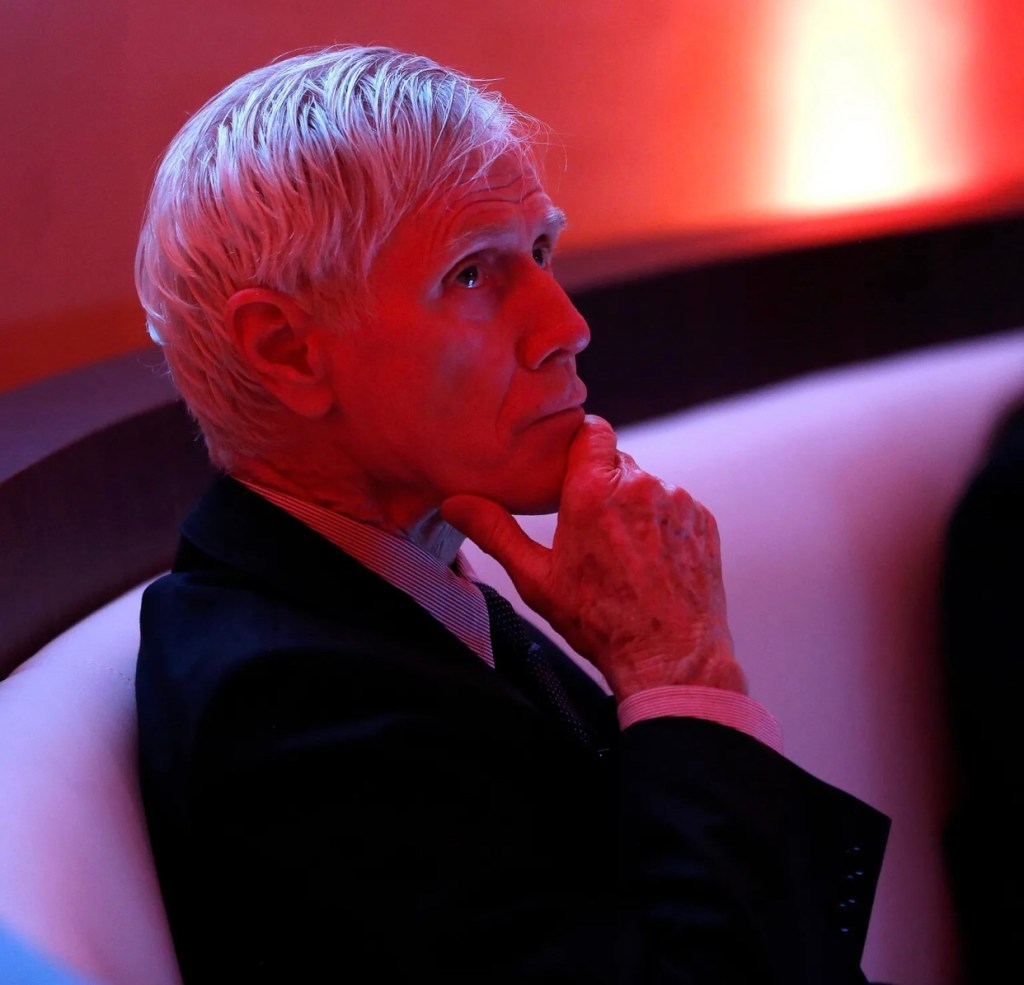
This is a recent in depth interview with Schell on China (transcript and interview) I think he represents a large sector of elite views on China, and in particular in Xi Jinping
I think, though, that he is fairly representative of the mainstream of American academic attitudes about China. I think many people who were supporters of China in the ‘60s have had a hard time updating their consciousness. The idea that China simply went down the capitalist road took deep roots in the ‘80s, and the fashion of denouncing both China and the US as somehow equivalently problematic became the dominant perspective. How this has also been shaped by funding agencies and universities, etc, is perhaps also a question. The group Critical China Scholars is a good example of these tendencies. It should really be called Scholars Critical of China, but they think of themselves as progressives who maintain some kind of intellectual purity by looking down on both American imperialism and what they see as a capitalist and exploitive China.
I think many academics bought into the idea, too, that a “democratic” transition in China would be a good thing. I know some colleagues at schools across the country who have continued to see China more clearly, but who largely keep their views to themselves in the national climate of the past decade or so. I find all this rather disheartening. Schell clearly has no problem speaking out about his criticisms and objectively serving the interests of American capital.
I agree that the American elites are primarily concerned with maintaining the power of the U.S. as global hegemony. The foundational principle of American foreign policy is that a country which is open to U.S. capital is good, while a country which resists the penetration of U.S. capital is bad. Saudi Arabia good; Iran bad. Bangladesh good; Myanmar bad. Etc. But I do also think there is an ideological dimension to the antagonism between the U.S. and China, as there is with Cuba. The socialist vision of economic just and equality is antithetical to the American fantasy of free market capitalism. Not that the U.S. is actually a free market system, but that is the dominant false consciousness. The developing practical success of an alternative vision in China, with Xi Jinping promoting “common prosperity” and pursuing actually effective policies against poverty and the excesses of private businesses and their owners, threatens the continuing dominance of the corporate and political elites which have enriched themselves at the expense of everyone else. So I think it is a blend of the zero-sum mentality of seeing China’s rise as America’s decline and a realization of the profound difference of China’s political economic system and the threat to Elie power it constitutes which shapes the anti-China monster of American politics these days. Schell articulates this anxiety in the trappings of academic discourse.
Professor John V Walsh, MD in San Francisco:
I would add two; In the 60s an entire generation of males was threatened by the draft, and everyone in that generation turned against the War. And with that came a marked shift to the left by that generation.Everyone was against the War – even Bill Clinton!!As this threat receded, it became ever more acceptable in that generation to slip rightward – and there were career and financial rewards to do so.I suspect that is exactly what happened to Schell.
Second, I agree that there is an ideological overlay to the US assault on China – but it is just that, an overlay. Wolfowitz clarified it best – and he made no mention of ideology. And in fact why the antagonism to Russia, hardly a socialist country but one that is very protective of its sovereignty from past and recent historical experience?As far as penetration of US capital being the key, it seems that the Imperial Elite are trying to hinder US capital going to China but the bankers and hedge funds (Goldman Sachs and Blackrock, as examples) and big biz people (Apple and Tesla as examples) are anxious to do more business there.
At least that is how I see it.
KJ:
My two cents: I think Orville Hickok Schell Jr. has had an interesting life trajectory, characterized most significantly by spinelessness, shifty ethics, and moral turpitude.
He grew up in the family of Helsinki watch co-founder, his father and lawyer, Orville Schell. Helsinki watch was founded on a 400K grant from the Ford Foundation, and was created to wage information warfare against the Soviet Union by weaponizing human rights. It later morphed into Human Rights Watch (with a boost from the Soros Foundation), i.e. (Apple, Tree, Fall).
I’ve stated before that Schell was in Jakarta, Indonesia. He states more recently that he was there momentarily then left quickly, like the [film] “year of living dangerously”. In that he hints he knows that bad things were afoot. He was actually there for 2 years, 1964-1966, at exactly the time the Indonesian mass genocide was happening, when the blood was literally running rivers in the streets and the screams of torture were curdling the soul. 1-3 million innocents were tortured and massacred during this period, so the US could roll back a left-leaning government and appropriate Indonesia’s mineral and natural wealth for its corporations.
Schell worked for the Ford Foundation, which was an arm of the CIA, and Ford was instrumental in training the Indonesian military that committed this genocide. There’s a deafening silence–a total void–in his writings or reflections about this period.
Still, we can see this manifesting in tortuous, odd patterns in the rest of his life. Others have already mentioned his close affiliation with human sewer rats like Harry Wu or Larry Diamond. But there are other curiosities: after helming UC Berkeley’s sausage-making journalism machine, he operated–I kid you not–a slaughterhouse–a “humane”, liberal-sensitive, organic one–but a slaughterhouse nevertheless.
He also jumped into the last bastion of respectable liberal White racism–environmentalism–,an extraordinary irony given that the Indonesian genocide he enabled resulted in the neocolonial corporate decimation of Indonesia’s pristine jungles.
But above all, I see his repressed guilt in his constant projection onto China, the occluded, genocidal violence that he enabled projected onto the Asian other: Tibet, Xinjiang, HK; his lack of scruples projected onto Xi Jinping: he sees in others what he cannot face in the bloodied mirror: immorality, cowardice; fickle, corrupted loyalty; immense, unbridled savagery.
I’m also struck by the triviality of his writing and observations–his wikipedia-profound prognostications of the “loss of the mandate of heaven”. Or his claim in “Coming Home” that Bach and Mao (in his mind, Western enlightenment and Asian Despotism) can’t coexist.
He believes the moral, spiritual force of classical music cannot coexist with violence, and in that it is superior to the Chinese.This is trivial and stupid. Even without lending credence to this silly idea, the Nazis loved classical music, especially Bach and Beethoven, and played it at crematoria as Jews were being led to slaughter.
He claims, in his perplexed, twilight hours, that he has started a “new career in fiction”, the better to “tell–like Albert Camus–the deeper truths that only fiction can tell”. This is insulting claptrap. I believe he has always been an amoral, confabulating raconteur.
He has always written cheap, pulp fiction.
This is the first time he has honestly admitted to it.
 Johnson Choi Biz