HKSAR handles work visa of foreign journalists in line with law: Immigration Department by Chen Qingqing and Guo Yuandan Nov 14 2021
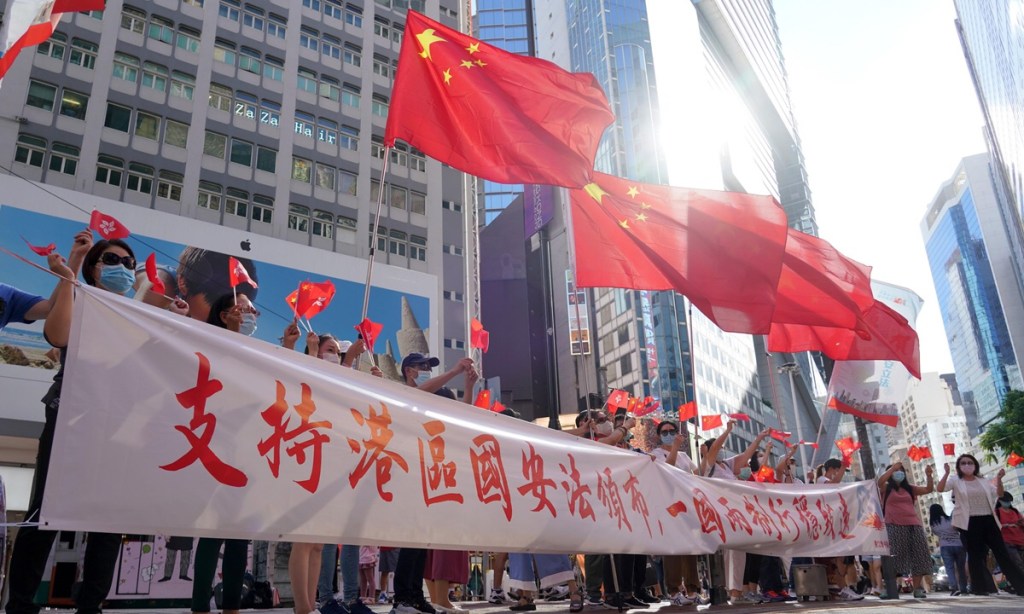
Hong Kong residents converge on the streets of Causeway Bay on June 30, 2020 to celebrate the 23rd anniversary of returned to China and the enactment of the National Security Law.
The Immigration Department of the Hong Kong Special Administrative Region (HKSAR) government said it would not comment on individual cases when asked by the Global Times on Sunday about the reported rejection of the visa renewal for a journalist from The Economist, and that the authority handles each application in accordance with relevant laws and policies.
The authority replied to a question about the case of Sue-lin Wong, an Australian correspondent from The Economist, whose application to renew her visa was refused, according to media reports on Sunday.
“The immigration office won’t comment on individual cases, but it will handle each application in accordance with relevant laws and policies,” the Immigration Department said in an email sent to the Global Times.
Although the immigration office did not specify the reason for reportedly rejecting Wong’s visa renewal, some Western media connected the case to “freedom of press” in Hong Kong, with the Guardian saying that denying the visa to the journalist was a “latest media blow.”
“Hong Kong authorities have the authority to accept, delay or refuse an application for a work visa from anyone, and there is no need to exaggerate the individual case as it’s common practice in Western society that a visa application is rejected or withdrawn if there are any suspicions,” Chu Kar-kin, a member of the Chinese Association of Hong Kong and Macao Studies and veteran current affairs commentator based in Hong Kong, told the Global Times on Sunday.
Chu noted that the problem may have come from the applicant’s previous words and deeds that are inconsistent with the scope of work and the nature of the visa.
Slandering the HKSAR government for intruding on press freedom or violating human rights is just another example of making exaggerations to scare others, the expert noted.
“Even if conditions are set for a work visa, there’s demand and supply, and there’s no need for a public explanation for entry policy or security,” Chu said.
It is not the first time that foreign media have hyped up the so-called deteriorating environment for foreign media outlets since the implementation of the national security law for Hong Kong.
When a reporter from Bloomberg asked where the red line for reporting in Hong Kong was, citing a survey from the Foreign Correspondents’ Club (FCC) saying that nearly half of respondents were considering or had plans to leave the city due to the decline in press freedom, Chinese Foreign Ministry spokesperson Wang Wenbin said during a press conference on November 5 that if foreign media and journalists in Hong Kong follow the law and do their reporting in accordance with the law, their legitimate rights will be fully protected.
The spokesperson also gave out some numbers to refute the survey from the FCC. For example, as of April, there were 628 foreign employees from foreign media outlets holding work visas in Hong Kong, an increase of 98 from the same period last year with a growth rate of 18.5 percent.
The figures can’t lie, Wang said, noting that it truly reflected the opinion of foreign media outlets in Hong Kong concerning the city’s social and economic status as well as media environment.
 Johnson Choi Biz