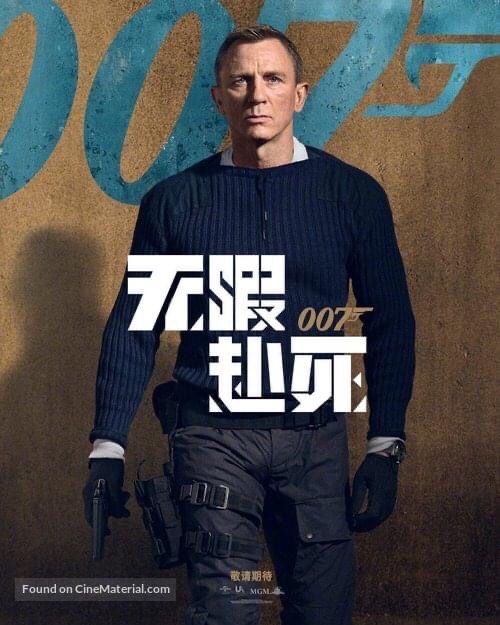
Bevin Chu: NO TIME TO DIE? BRITISH EMPIRE, DEAD ON ARRIVAL! THE NEW JAMES BOND FILM IS NOSTALGIA OF A DECLINING EMPIRE By Hu Xijin Oct 30, 2021
I watched the new James Bond movie last night. It is well made. But the more I watched, the more it looked like comedy. In one scene when they are about to destroy a chemical manufacturing facility located on a disputed island between Russia and Japan, the MI6 official asks whether there are any Royal Navy warships nearby. It turns out there are, and then the missile is launched. Are the British sleepwalking? The Royal Navy is now relying heavily on the Queen Elizabeth aircraft carrier, which has been leaking frequently, to scrape a battle group up. Yet HMS Queen Elizabeth did come to show in the Asia Pacific region recently. But if it is exploited as the basis for the story, it would be too embarrassing.
The UK is a declining empire. The novel coronavirus epidemic has gravely devastated the country, killing hundreds of thousands of people. Many residents of other countries are afraid of taking the AstraZeneca COVID-19 vaccine produced by the UK. In the Taiwan island alone, hundreds of people died after receiving the vaccine. Ironically, this James Bond movie is about preventing biological weapons.
The British are really good at this. Although the country is in decline, it is still high-spirited. In the newly filmed 007 movie, the empire seems to be in full swing. But I believe that the Western blockbusters in which characters attempt to save the human race will gradually become ridiculous over time, as these blockbusters will lose the public’s psychological foundation due to the relative decline in strengths of Western countries and the continuous disintegration of self-confidence.
In the movie, the disputed islands between Russia and Japan, which should be controlled by Russia, were bombed. If the UK dared to do this in reality, Russia wouldn’t waste a minute to respond with hardline measures. A few months ago after Moscow said a patrol ship fired warning shots against British vessels, London declined that any warning shot had been fired.
But I have to praise James Bond movies. They never mess with China. Instead, they are friendly to China. Even when the ties between China and Britain is getting worse, some villains in the movie still “speak Russian.” This is because the Chinese film market is huge. In a commercial promoting the James Bond movie, Daniel Craig said “Thank you” in Chinese, showing his appreciation. Chinese consumption power is the strength.
…
SKYFALL, JAMES BOND’S RESURRECTION, AND 21ST-CENTURY ANGLO-AMERICAN IMPERIAL NOSTALGIA
Marouf Hasian Jr.
… an ideological critique of the latest James Bond installment, Skyfall. The author argues that the director of the film, Sam Mendes, has succeeded in creating a highly popular movie by tapping into societal desires for Anglo-American imperial nostalgia.
Several characters in the movie, including Bond and M, suffer falls from grace that parallel the loss of British imperial power, but in the end, both Bond and the empire are resurrected when they return to the old and true ways of dealing with cyberterrorist dangers.
The 2012 release of Skyfall became a part of the British pageantry that swirled around the London Olympics and the Queen’s Diamond Jubilee, and the nostalgic imperialism of this latest Bond film allowed Anglo-American audiences to celebrate Britain’s continued relevance and the need for MI6, the British Secret Service.
…
THE BONDS OF EMPIRE
(Post-)Imperial Negotiations in the 007 Film Series TIMO MÜLLERN
THE COLLECTIVE IMAGINATION of the British Empire and its afterlife, the enormously successful James Bond films have played a significant role since the start of the series in1962.
Over half the world’s population has seen at least one Bond film, according to a recent estimate, and both the logo and the Bond signature tune are ubiquitous in global popular culture.
From the opening scene of the first film, which shows the local head of British secret intelligence playing cards in his colonial-style club in Jamaica, references to Britain’s imperial past have pervaded the series. Like the fictional works of the colonial period that Edward Said studied in his seminal Culture and Imperialism, the Bond films exhibit a “consistency of concern” with empire that regulates audience perception of the relationship between metropolitan Western spaces and the (former) colonies.
This is the more remarkable as these films are products of the post-imperial period. By the time the first Bond film, Dr. No (1962), came into theatres, Jamaica had gained its independence, and a sense of belatedness would continue to pervade the series. As cultural texts, the Bond films are documents of imperial nostalgia. They reveal a continuing reluctance to abandon the certainties of imperialist chauvinism and document Britain’s anxiety over its changing status in the post-imperial world.
Not surprisingly, the films have been called “at best ideologically conservative, and at worst downright reactionary” in their treatment of race.
Three pivotal phases in the history of the film series:
·the mid-1960s, when the first Bond films appeared in close succession and an imperial worldview could still pass for a matter of course;
·the mid-1970s, when Roger Moore debuted in two films suffused with imperial stereotyping and post-imperial anxiety;
·the mid-2000s, when the transition from Pierce Brosnan to Daniel Craig resulted in the most fundamental overhaul of the series, including an open discussion of the global entanglements of economic neo-imperialism that Michael Hardt and Antonio Negri have conceptualized as ‘Empire’.
 Johnson Choi Biz