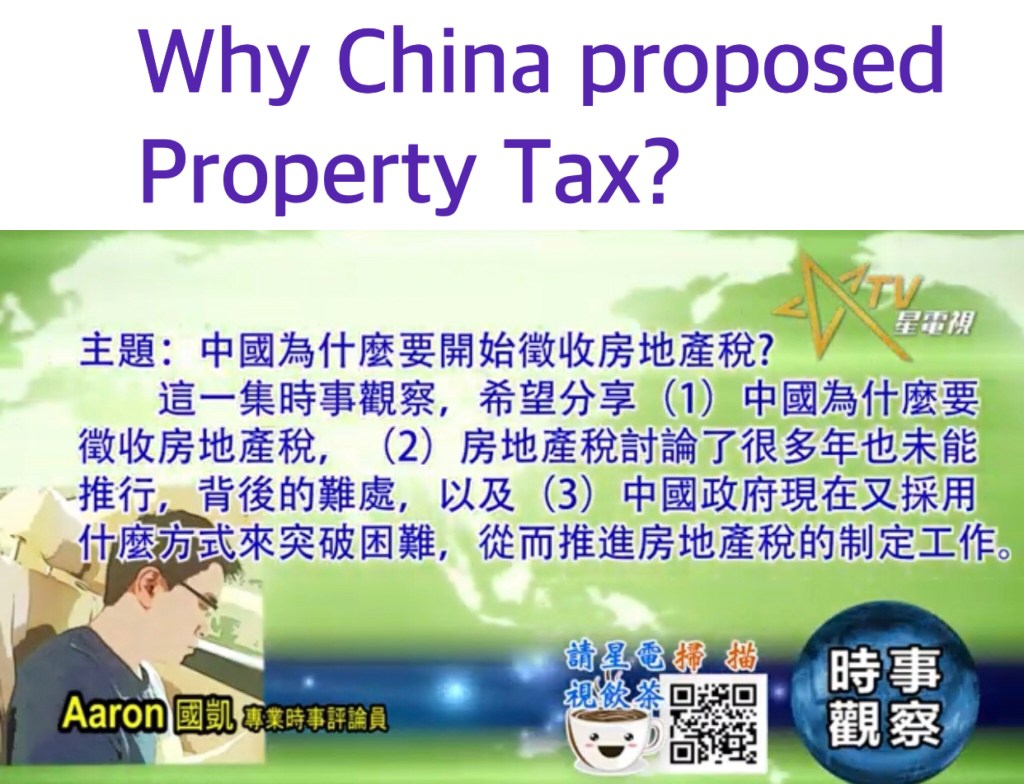
Video: Why China proposed property tax? 時事觀察 國凱 :中國為什麼要開始徵收房地產稅
Hello, friends of the Chinese radio station on Sing Tao. I’m Guokai. Welcome everyone to listen to the current affairs observation. On October 23, the Standing Committee of the National People’s Congress of China decided to authorize the State Council to carry out pilot reforms of real estate tax in some areas. This new development means a breakthrough in the promotion of real estate tax in China. In this episode of current affairs observation, I hope to share with you (1) why China levies real estate tax, (2) real estate tax has not been implemented after many years of discussion, and the difficulties behind it, and (3) what method the Chinese government is adopting now Break through the difficulties and advance the formulation of real estate tax.
美國星島中文電臺的聽眾朋友,大家好,我是國凱,歡迎大家收聽時事觀察。10月23日,中國全國人大常委會決定授權國務院在部分地區開展房地產稅的改革試點工作,這個新的發展意味著中國房地產稅的推進有了突破。這一集時事觀察,希望跟大家分享(1)中國為什麼要徵收房地產稅,(2)房地產稅討論了很多年也未能推行,背後的難處,以及(3)中國政府現在又採用什麼方式來突破困難,從而推進房地產稅的制定工作。
First, let’s take a look at the background of real estate tax collection. To truly understand the behavior of a government, it is necessary to understand public finances. The reason is simple: it costs money to do things, and if you don’t have money, it’s hard to put it in a good way. To grasp the true intentions and trends of the government, one cannot just read the documents, but also depends on the flow and amount of government funds.
首先,我們來看看征收房地產稅的背景。要真正理解一個政府的行為,就必須要了解公共財政。道理很簡單:辦事要花錢,如果沒錢,話說得再好聽也難以落實。要想把握政府的真實意圖和動向,不能光讀文件,還要看政府資金的流向和數量。
In the late 1980s and early 1990s, China’s central government finances fell into a serious crisis. It was this fiscal crisis that led to the tax-sharing reform in 1994. Before the tax-sharing reform, China’s central government finances were very weak. Take 1992 as an example, the national fiscal revenue was 350 billion yuan, of which the central government revenue was only 100 billion yuan, the local government revenue was 250 billion yuan, the central fiscal expenditure was 200 billion yuan, and the deficit was 100 billion yuan. At that time, China implemented a tax contract system, and local governments generally only need to hand in a pre-agreed amount of the state between the two parties. If the tax exceeds this amount, the local government retains its own control and use.
上個世紀80年代末90年代初,中國的中央政府財政陷入了嚴重危機。正是這場財政危機,導致了1994年的分稅制改革。分稅制改革之前,中國的中央政府財政非常薄弱。以1992年為例,全國財政收入3500億人民幣,其中,中央政府收入只是有1000億元,地方政府收入反而有2500億元,中央財政支出2000億元,赤字1000億元。當時,中國實行的是稅收承包制,地方政府大體上只需要上繳國家一個雙方預先協定好的金額,超過這個金額的稅收,地方政府保留自己支配使用。
After the implementation of the tax-sharing system in 1994, the situation of weak central government and strong local governments has undergone a 180-degree change. In recent years, local fiscal and tax revenues have only accounted for 50%-55% of the country’s total fiscal and tax revenues, compared to more than 70% before the tax-sharing system; , Local budget expenditures accounted for 85% of the total national budget expenditures, which means that local fiscal budget expenditures have long been higher than budget revenues, and the part that cannot make ends meet needs to be filled by central transfer payments.
1994年實行分稅制之後,中央弱、地方強的情況出現了180度的轉變,近年來地方的財稅收入只是占全国财税总收入的50%—55%,而分税制之前这个比例是70%以上;同时,地方预算支出占全国预算总支出的比重为85%,也就是说地方财政预算支出长期高于预算收入,入不敷出的部分要通过中央转移支付来填补。
After the implementation of the tax-sharing system, China’s central government has more tax revenues and can better balance development between rich and poor areas through transfer payments, but this reform has also produced some new drawbacks.
分稅制實行之後,中國的中央政府擁有更多的稅收,可以更加好地對富裕地區與貧窮地區之間,透過轉移支付來平衡發展,但這個改革也產生了一些新的弊端。
One of the problems is the so-called “land finance” problem. If local governments want to achieve political success, they must develop the economy; and in order to get more money to develop the economy, they must increase non-budgetary revenue. The most important extra-budgetary revenue is the “land finance” generated around land transfer and development. China implements public ownership of land. Urban land is owned by the state, and rural land is owned by the collective. To convert agricultural land into construction land, it must first be converted into state-owned land through land acquisition before it can be used for industrial and commercial development or residential construction. If you add these taxes and land transfer revenue as the total revenue of “land finance”, the revenue of “land finance” in 2018 is equivalent to 89% of the local public budget revenue, which can be said to be the absolute main source of local government revenue. Moreover, under the design of the tax-sharing system, most of the revenue of the “land finance” does not need to be “divided” from the central government, so local governments have strong incentives to develop “land finance.” By 2019, China’s total fiscal revenue was 19 trillion yuan, of which land transfer funds accounted for 7.8 trillion yuan, more than 40%. This is only a project of land transfer fees, and other direct or indirect government revenues related to land have not been calculated.
其中一個問題就是所謂的「土地財政」問題。地方政府要取得政績,就要發展經濟;而為了獲得更多錢去發展經濟,就要增加預算以外的收入。其中最重要的預算外收入,就是圍繞土地出讓和開發所產生的「土地財政」。中國實行土地公有制,城市土地歸國家所有,農村土地歸集體所有。農地要轉為建設用地,必須先經過征地變成國有土地,然後才可以用來發展工商業或建造住宅。若把這些稅收與土地轉讓收入加起來算作「土地財政」的總收入,2018年「土地財政」收入相當於地方公共預算收入的89%,可以說是地方政府收入的絕對主要來源。而且,在分稅制的設計之下,「土地財政」大部分的收入都不需要與中央「拆賬」,所以地方政府有很強的動力發展「土地財政」。到了2019年,中國財政總收入19萬億人民幣,其中土地出讓金佔了7.8萬億,超過了40%。這裡只是考慮土地出讓金一個項目,還沒有計算與土地相關的其他直接或間接的政府收入。
Therefore, local governments in Mainland China have adopted the same approach as Hong Kong, restricting the supply of commercial and residential land, and earning more taxes from rising land prices. From 2000 to 2018, the price of commercial land increased by 4.6 times, and the price of residential land increased by 7.4 times.
因此,中國內地的地方政府采用了跟香港一樣的做法,限制商住用地供給,從不斷攀升的地價中賺取更多的稅收。從2000年到2018年,商業用地價格增長了4.6倍,住宅用地的價格更是大幅增長了7.4倍。
Of course, the local government does not use the land-related income directly for other public services, such as education or medical care. Although land transfer can bring income, local governments also have to bear related expenses, including land acquisition and demolition compensation, land leveling, water and electricity and other basic land development expenses. Judging from the figures in recent years, the expenses related to land transfer are generally similar to land income, and sometimes even higher than income. In 2018, the income from the transfer of state-owned land use rights was 6,291 billion yuan, and the expenditure was 6,816.7 billion yuan. Looking at the land sale itself, the local government cannot make ends meet, but the real purpose of the local government is to attract industrial and commercial economic activities after land development, that is, to “make the pie bigger.” Therefore, we can say that real estate has indeed been one of the main engines driving China’s economic development in the past two decades.
當然,地方政府不是把這些土地相關收入直接拿去作其他的公共服務,例如教育或者醫療。土地轉讓雖然能帶來收入,但地方政府也要負擔相關支出,包括征地拆遷補償和土地平整、通水通電等基礎性土地開發支出。從近幾年的數字看,跟土地轉讓有關的支出總體上與土地收入差不多,有時甚至比收入還高。2018年,國有土地使用權出讓金收入為62 910億元,支出則為68 167億元。光看賣地本身,地方政府是入不敷出的,但地方政府的真正目的是土地開發之後吸引而來的工商業經濟活動,亦即是「把餅做大」。因此我們可以說,過去二十年房地產的確是推動中國經濟發展的主要引擎之一。
But the problem is that this development method is not sustainable. Housing prices are too expensive for ordinary people to afford. Everyone knows this problem, but another more direct problem is that the land that can be sold has become less and less.
但問題是這個發展方法是不能夠持續的。房價太貴,一般人難以負擔,這個問題大家都知道,但另一個更加直接的問題是,能夠賣的地已經越來越少了。
In 2000, China’s urbanization rate was only 36%. In 2019, China’s urbanization rate exceeded 60%, creating the fastest miracle of urbanization in the world. Most cities in China have nearly doubled in the past 19 years. In the process of urbanization, agricultural land is converted into state-owned land through land acquisition, and local governments can collect a large amount of land transfer fees. However, the urbanization rate of most western developed countries is only about 70%, and the urbanization rate of the United States is only 83%. In the next 10 to 20 years, if China’s urbanization rate can reach 70%, it will almost be the limit, and it has reached the level of developed European countries. In other words, China’s urbanization will soon face a ceiling, and the speed of urbanization will inevitably slow down. When the farmland that can be requisitioned gradually decreases, the income from the land transfer fee of the local government will naturally also gradually decrease
在2000年,中國的城市化率只是36%。2019年,中國的城市化率突破了60%,創造全世界城市化進程最快的奇跡。中國絕大多數城市,在過去的19年裏,擴張了接近一倍。在城市化的過程中,農地經過征地變成國有土地,地方政府就可以收取大量的土地出讓金。但絕大多數西方發達國家的城市化率都只是達到70%左右,美國的城市化率也只是83%。在未來一二十年,中國的城市化率如果能夠達到70%,幾乎就是極限了,已經達到歐洲發達國家的水平。換句話說,中國的城市化很快會面臨天花板,城市化的速度也必然會放慢。當可以征收的農地逐步減少,地方政府的土地出讓金收入也自然也會逐步降低。
Whether it is for the purpose of suppressing housing prices and preventing hoarding and speculation, or for the sustainable development of local government revenue, it is necessary to start to levy taxes on the houses that already exist in the market to reduce the reliance on taxes on uncompleted new buildings. Real estate tax, in this context, is an inevitable development.
無論是為了壓抑房價和防止囤積炒賣,還是為了地方政府財政收入的可持續發展,都需要開始對市場上已經存在的住宅征稅,以減少對未落成的新樓征稅的依賴。房地產稅,在這個背景之下,是一個必然的發展。
Of course, real estate taxes have been discussed in China for many years. The reason why it has not been implemented is that the problem was not very urgent in the early days. On the other hand, a good real estate tax plan is indeed difficult to design.
當然,房地產稅在中國討論了已經很多年。一直未能落實的原因,固然是因為在早期這個問題不是很迫切,而另一方面,一個好的房地產稅方案,確實也是很難設計的。
Let us take the threshold as an example to look at the complexity of the real estate tax policy. If you do not set an exemption area and no exemption amount, and directly levy real estate taxes on all owners of houses based on the value of their properties, what will happen to this seemingly fairest way? In large cities, there are countless indigenous people who got their current houses for free or at a low price during the housing reform decades ago, or they happened to buy houses when housing prices were very low. The property they own is of high value, but their own income is very low. Suppose they have a property value of 10 million in first-tier cities, which is levied at a 1% tax rate, and they have to pay a real estate tax of 100,000 yuan a year, but many of these people cannot pay the 100,000 yuan a year. Although this kind of people owns very valuable real estate, they are indeed a disadvantaged group in the city in a sense. Their salary is not high, or they have already retired at an old age and cannot objectively pay real estate taxes.
我們就以起征點作為一個例子,看看房地產稅政策的復雜性。如果不設定一個免征面積,沒有免征金額,直接對所有的有房一族按房產價值徵收房地產稅,這個看似最公平的方式,會出現什麽問題呢?在大城市裏面,有無數土著居民,是幾十年前房改的時候免費或者低價得到了現在的住宅,又或者是當年房價很低的時候恰好買了房。他們擁有的房產價值很高,但本身收入很低。假設他們在一線城市的房產值1000萬,按1%稅率征收,一年就要交10萬人民幣房地產稅,但這些人很多一年拿不出這10萬元來。這種人雖然擁有很值錢的房產,但某種意義上也確實是城市的弱勢群體,工資不高,或者已經上了年紀退休了,客觀上支付不了房地產稅。
Therefore, many experts propose to set an exempted area, but the exempted area is also unfair. Regardless of whether the per capita area of the family is 30 square meters or 40 square meters, there is a problem. Because the house price is different in each place, the same exempt area will be converted into a different amount of exemption in different places.
因此,很多專家提議設定一個免征面積,但免征面積也有不公平的地方。無論家庭人均面積是30平米還是40平米,都有一個問題,就是因為每個地方的房價不一樣,所以同樣的免征面積,換算成為房價就會變成了各地免征金額不一樣。
It is true that the level of economic development in different regions is different, and it is difficult to have absolute fairness. However, the personal income tax threshold in China is unified throughout the country. No matter the local average wage level is high or low, it is levied starting with a monthly income of more than 5,000 yuan. If the threshold of real estate tax is not unified nationwide, will the people feel that it violates the principle of fairness?
的而且確,各地經濟發展水平不一樣,很難有絕對的公平,但中國的個人所得稅起征點全國統一,無論當地的平均工資水平高還是低,都是每月收入5000人民幣以上開始征收。房地產稅的起征點如果不是全國統一,又會不會讓人民覺得違反了公平的原則呢?
Similar problems have plagued Chinese policymakers for many years. As early as 2011, Shanghai and Chongqing became real estate tax pilots, but the real estate tax policies introduced by these two cities were too narrow and the tax rate was too low to achieve significant results. On October 23, the Standing Committee of the National People’s Congress of China decided to authorize the State Council to carry out real estate tax reform pilot work in some areas. It was obviously determined to formulate a more comprehensive levy scope, more reasonable tax rates, and promote the nation’s real estate tax system.
類似的問題,困擾了中國的政策製定者很多年。早在2011年,上海和重慶就成為房產稅試點,但是這兩個城市推出的房地產稅政策因為征收範圍太窄,而且稅率太低,沒有顯著的成效。而10月23日中國全國人大常委會決定授權國務院在部分地區開展房地產稅改革試點工作,明顯是下了決心,要製定一個征收範圍更全面,稅率更為合理,而且可以推廣全國的房地產稅制度。
The Chinese government has definitely adopted a lot of supporting measures in order to promote such an important policy as the real estate tax. In addition to the Central Finance and Economics Commission’s emphasis on common prosperity in August, if we are concerned about China’s policy changes, we will find that the Ministry of Natural Resources has introduced new rules for the implementation of the “two centralizations” of residential land supply in key cities in February, that is, a centralized release announcement. , Centrally organize the transfer activities, through the centralized transfer of land in three batches throughout the year, to prevent local governments from “squeezing toothpaste” from restricting the supply of residential land. In June, the Ministry of Finance issued another policy, one of which is that starting from January 1, 2022, land transfer fees will be collected by the tax bureau. This policy is very ingenious and is called “collection, management and transfer.” That is, the central government collects taxes and then transfers taxes to the local governments. While returning power to the central government, it reduces local resistance. The latest policy, the implementation of real estate tax pilots, is even more a new policy formulation method with Chinese characteristics. Starting from the pilot, the experience of the new policy is summarized, and then gradually extended to the whole country, thereby reducing the impact and shock caused by the new policy.
中國政府對於推進像房地產稅這麽重要的政策,肯定是按部就班,采取了很多的配套手段。除了中央財經委員會8月份強調共同富裕之外, 如果我們有關注中國的政策變化,會發現2月份自然資源部已經推出重點城市施行住宅用地供應「兩集中」的新規則,即是集中發布出讓公告、集中組織出讓活動,透過全年分3 批次集中出讓土地,防止地方政府「擠牙膏」式限制住宅用地供應。6月份的時候,財政部又出了一個政策,其中一個內容是由2022年1月1日開始,土地出讓金由稅務局征收。這個政策非常巧妙,叫做「征管劃轉」,即是中央征收,稅金再轉給地方政府,把權力收歸中央的同時,減輕地方的抵觸情緒。而最新的政策,開展房地產稅試點,更加是有中國特色的新政策制定方式,從試點開始,總結新政策的經驗,再逐步推廣至全國,從而減少新政策帶來的衝擊和震盪。
Many foreigners feel that China is full of policy risks because they do not understand China. In fact, as long as we have a little bit more understanding of the specific operation of the Chinese government and some basic understanding of China’s public finance system, it is actually not difficult to understand and predict the future direction of China’s policies.
很多外國人因為對中國不了解,覺得中國充滿政策風險。其實,只要我們對中國政府的具體運作有多一點理解,對中國的公共財政體系有一些基本的認識,其實不難理解和預測中國政策的未來走向。
Above Chinese to English via Google Translate
 Johnson Choi Biz