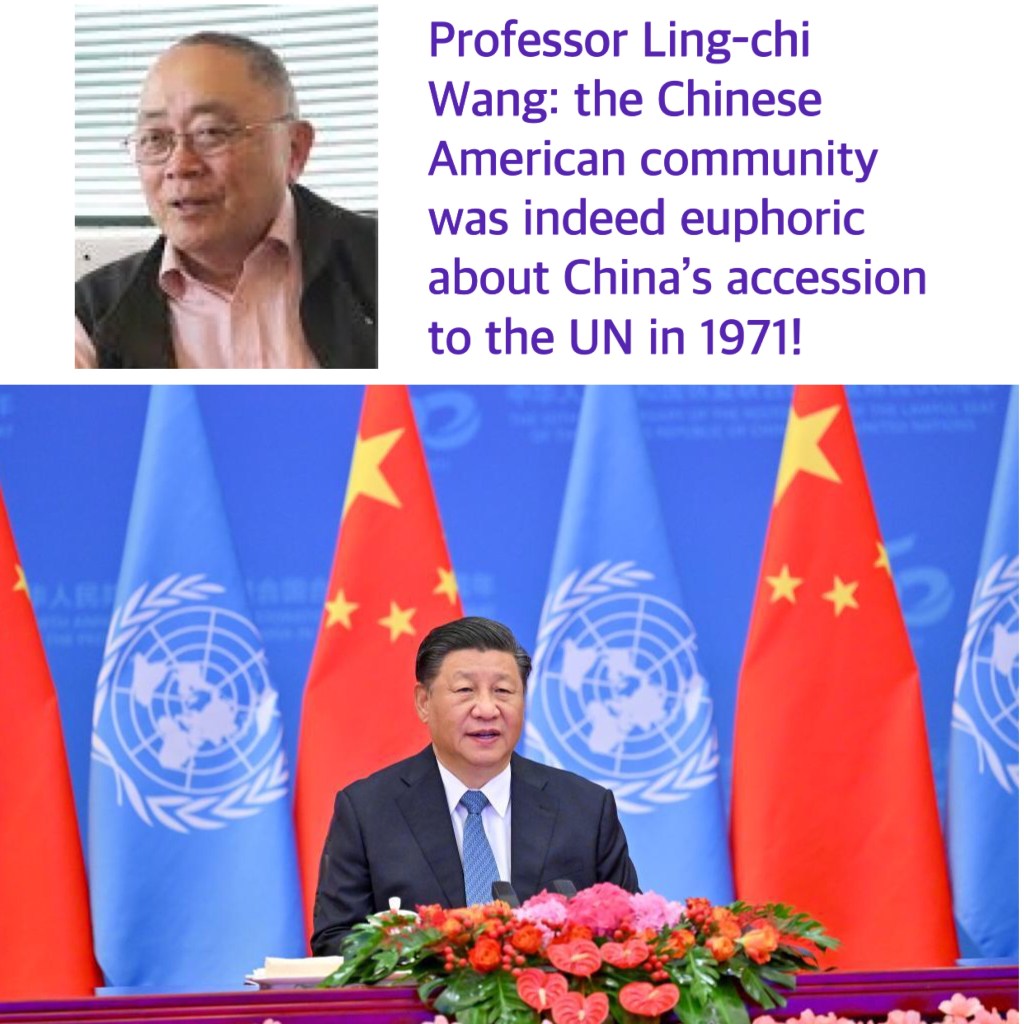
Professor Ling-chi Wang of UC Berkeley: the Chinese American community was indeed euphoric about China’s accession to the UN in 1971! 加州大學伯克利分校王教授: 1971年中國加入聯合國,美國華人社區確實欣喜若狂!Posted on Oct 25, 2021
Since the U.S. government and the KMT fasist regime in Taiwan, and their henchmen in the Chinese Six Companies in Chinatown San Francisco (CCBA) were steadfast in their opposition to restoring China’s seat to the legitimate government in Taipei, I had to personally witness how the KMT and CCBA dealt with the historic UN vote to admit China. (Before 1971, the KMT and CCBA placed each tear during the UN Fall session full-page advertisements in major U.S. newspapers, such as, the NY Times, Washington Post, etc. and organized demonstration at the UN Plaza in NY, to express Chinese American opposition to the UN resolution favoring China’s admission into the UN introduced by Third World countries. The 1971 UN session was particularly important because Nixon’s historic trip to Beijing in February, sent an unmistakable signal across the world that the U.S. would no long cast its annual veto of the resolution, replacing the KMT regime in Taiwan with the PRC government in Beijing at the UN Security Council.
CCBA, which claimed to represent ALL Chinese in the U.S., and KMT leaders, led by Doon Yen Wong (黄仁俊), the “Presidential Advisor” of Chiang Kai-shek and the unrivaled leader of KMT-USA, CCBA, the Chinese Chamber of Commerce, the Ning Yeong District Association, the Wong Family Association, and the Bing Kong Tong, convened an international press conference in its headquarters in Chinatown on the day of the UN vote to denounce the UN decision on behalf of all Chinese in the U.S.
The assembly hall of CCBA, heavily decorated with late Qing Dynasty furniture and lanterns, was packed with Chinatown leaders and the press. When Doon Yen Wong entered the hall and saw me, he visibly upset and immediately ordered his followers to eject me. I knew his order would be carry out without hesitation. As I started walking through the crowded room, several men quickly reached me and started forcefully push me through the crowd to expel me. As they did so, he shouted out loud and stern in Cantonese 打死他! 打死他! ,”Kill him! Kill him!” The unexpected convulsion immediately attracted the attention of reporters in the room even though they did not know nor understand what was going. As soon as I got out of the hall, a German television crew caught up with me at the front door and asked me what was going on. I had an impromptu press conference at tbe steps of CCBA front door, telling the German TV what had just happened. When I returned home, I wrote a personal account of what happened at the CCBA headquarters and submitted my account to the East-West Chinese American Weekly which promptly published my account on the front-page of its next edition.
It was an experience I never forget to this day. To this day, after 50 years, I could still see Wong’s angry face and hear his loud voice asking for my blood.
That was not the first threat I encountered. Ealier, I occurred the first threat in mid-August of 1968, during the height of tourist season in Chinatown, when we, a group of young professional and college students, led by Gordon J. Lau, a young Chinese American attorney, organized a historic, loud public protest march on Grant Avenue in late Saturday afternoon and early evening. It was an unprecedented high-profile protest march. The march denounced the exploitation in Chinese immigrant workers in sewing factories, restaurants, and grocery stores in Chinatown owned and run by Chinese owners and systemic racial discrimination against Chinese in employment, housing, politics, and education outside of Chinatown. That demonstration was viewed by the CCBA as an embarrassment if not a humiliation. The Chinese Six Companies promptly issued a “Manifesto of the Chinese Six Companies” to label us as “outside agitators” and “undesirable immigrants” and threatened to ask the U.S. Congress to restore unspecified new restrictions against new immigrants. (The U.S. Congress had finally repealed the last vestiges of Chinese exclusion law, the racially based quotas, against Chinese immigrants in 1965), It was immediately after the protest that I received my first serious death threat similar to the one you mentioned in an earlier email against the leaders, including your father, who organized the first Oct. 1 celebration of the founding of the PRC in the CACA auditorium in 1949 from the Chinatown establishment.
The last two persons to be killed following threats were Prof. Chen Wen-chen (陈文成) of Carnegie-Mellon University of Pittsburgh in July 6, 1981 and Chinese American journalist, Henry Liu (江南) in Daly City, CA on Oct 15, 1984. Both were critical of the KMT regime in Taiwan. Did the U.S. care about such assassinations and rights of Chinese Americans? Not at all! The truths behind these and other cases in the U.S. and Taiwan remain shrouded in mystery and speculation. Is the U.S. government doing anything to protect Chinese Americans constantly under the threat of random violence across the U.S? Hardly. In fact, the U.S. government has been aiding and abetting such violence, declaring Chinese American open season! In this sense, the accomplice is our own government! We are expendable, as we have been since the Gold Rush when Chinese immigrants first arrived. We are useful and indispensable, but expendable.
This was why I called the period of Chinese American history between 1949 and 1989 to be a period of intense political repression when the entire Chinese American community in the U.S. came under the reign of terror when the U.S. allowed the KMT regime in Taiwan to extend its repressive long arm into the Chinese American community without restrain.
China’s admission into the UN in 1971 was an important beginning of a long process that led to Chinese American assertion of our rights as citizens of the U.S. and the gradual liberation of Chinese Americans from Taiwan’s extraterritorial rule of Chinatown, USA and the internal political repression in the name of fabricated internal national security.
California Superior Court Judge Julie Tang: In Feb 1972 I went to work for a man called Lingchi wang. I knew nothing about him except he was a volunteer at an agency he started called chinese for affirmative action. When I saw him I instantly knew this man is a superior being. He was working for free in a little office on Columbus Ave (SF). He had raised enough money to hire an office and employ a secretary. But nothing more. Everything was donated including Lingchi.
I was the only paid Secretary.
I went to work quite diligently because I agreed 100% with what he was doing – starting an organization that would fight for the civil rights of Chinese Americans along with all other minorities.
I did dictation and typed all his letters. I took minutes of meetings and also prepared a monthly newsletter to members. His goal – to get 3000 members each paying $10 yearly membership dues. I even started to contact local organization to have meetings with them about their affirmative action policy.
I left after 8 months to start graduate school. But Lingchi stayed on as a volunteer collecting no salary. He brought in a lot of donated funds and set up more staffing. He also started a Chinese Media committee that tried to hold Hollywood accountable for the chinese stereotypes on screen. I typed up a lot of letters to Hollywood including some Asian movie stars.
I developed so much respect for Lingchi and his work after that job. He changed my life forever. I would probably never have done the kind of civil rights works that I did had I not learned from Lingchi what that all meant.
And yes I later learned there was a bounty on his head issued by the chinese six company in San Francisco. It was too late for me to divest myself from his affiliation. Glad I’m still alive.
Judge Julie Tang: “This was why I called the period of Chinese American history between 1949 and 1989 to be a period of intense political repression when the entire Chinese American community in the U.S. came under the reign of terror when the U.S. allowed the KMT regime in Taiwan to extend its repressive long arm into the Chinese American community without restrain. “
Professor Ling-chi Wang of UC Berkeley: I prefer 1989 rather than 1979 because the reigns of terror by the KMT agents in the U.S. and the FBI/CIA remained vigilant and powerful. The U.S. being the last stronghold of the KMT, Taiwan had to intensify its cooperation with our internal security agencies to make sure that the pro-PRC forces in Chinatowns remained suppressed. That is why an incident like the assassinations of Henry Liu in October 1984 occurred and a newspaper like the World Journal was not allowed to report news about the investigation.
The Cold War officially ended in 1989, if you use the fall of the Berlin Wall, or 1990-91, the dismantling of the USSR. That, as you know, signaled the rise of China , the first fruit of Deng Xiaoping’s Reform and Opening Up policy. William Overhold published his book, entitled The Rise of China, in 1994. At that time, no one in the West paid much attention to its rise although some economists began to notice the volume of overseas investment in China in the 1990s. The West was still consumed by its Cold War triumphalism and the so-called Tiananmen Massacre. The 1997-98 global monetary crisis recovered quickly because China helped accelerate the recovery. (Just ask Hank Paulson and Charles Sumner about China’s role). But, China’s rise did not really register in the consciousness of the U.S. and the West until 2008, the global financial crisis, a crisis of Wall Street capitalism. That was a rude awakening during the first year of the Obama administration. That was the year that Obama began floating the Pivot to Asia policy and initiatives, otherwise known as the New Cold War or the containment of China by economic, political, and military means. Trump picked up and vastly expanded the Obama/Clinton policy. It turned ugly and aggressive. Biden had a chance to reverse or modified the policy. Instead, he has been making it worse.
 Johnson Choi Biz