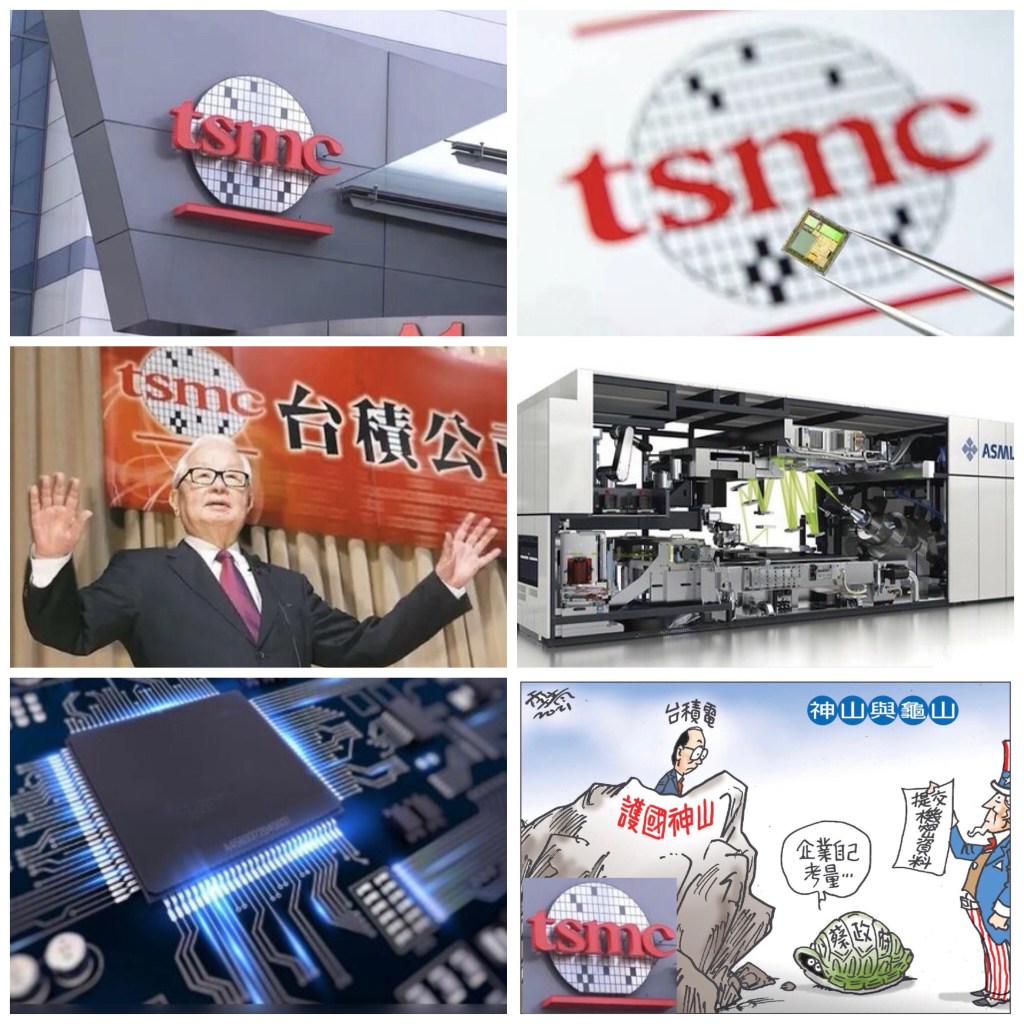
United States: The showdown is to make TSMC the “next Alstom” and “next Toshiba”! TSMC: After listening to your words, believing in your evil, and building the factory you want, in the end you still blackmail me? 美國:攤牌是讓台積電成為“下一個阿爾斯通”和“下一個東芝”! 台積電: 聽了你的話,相信你的邪惡,建你想要的工廠,你到底還是要勒索我?
01 From “going to the United States to build a factory” to “blocking”, what has TSMC experienced?
02 United States: Supply chain and advanced technology, I want them all
03 Enlightenment: Abandon fantasy and prepare for battle
https://min.news/en/economy/c2a753f816b47b59edffd94c5f6e6d23.html
In the past two years, TSMC seems to have done a lot of incredible things. Not only did it abandon its second largest customer and spend a lot of money to go to the United States to build a factory, the factory was built and built, and it was blocked by others. The plot of the future must be a little bit in mind for the big guys, after all, this is not the first time the United States has done this. So, why is TSMC so “obedient” but still can’t escape the fate of being blacked out? Will TSMC be the next Toshiba & Alstom? Next, Xiaogang will discuss with everyone.
Competition in the global chip industry has become fierce. It can be clearly felt from the European Union’s support plan of up to 145 billion euros and China’s strong support for domestic chip design and manufacturing. More and more countries are beginning to focus on chip R&D and production. Of course, this also includes the United States.
In terms of chip production, in order to improve the level of domestic chip production, the United States has tried to attract the leading chip production company TSMC to set up factories in the United States. Naturally, the United States has also issued many preferential policies to TSMC, including a $6 billion subsidy for plant construction and the use of more. Taiwan Semiconductor Manufacturing Co., Ltd. also hopes to use American talents and technological progress to improve the level of local chip manufacturing. Coupled with the pressure of the development of advanced process chips, TSMC finally chose to build a factory in the United States.
At present, TSMC’s chip factory in Arizona has officially started in May 2021, and it is expected to achieve mass production in 2024. In addition, according to Reuters news, TSMC will spend tens of billions of dollars to build a 3nm and even 2nm process chip factory in Arizona, while TSMC’s management also plans to produce 2nm and more advanced process chips in Phoenix. About TSMC’s expansion plan in Arizona has been confirmed by TSMC CEO Wei Zhejia, who stated that TSMC’s “progressive expansion is possible” in Arizona.
In fact, it is not only TSMC, but South Korean semiconductor giant Samsung also plans to build another factory near Austin, Texas. It is reported that this factory may become the first fab in the United States to use the 3nm process.
The United States obviously wants to “further”, and pulling TSMC and other chip manufacturers to build factories in the United States is more than just allowing them to increase the production capacity of domestic chips in the United States. What’s more, the special geographical location of TSMC’s headquarters makes TSMC occupy a large share of the global chip production market. Obviously, it also makes some people in the US government feel uneasy. For this reason, the United States has directly thrown out the “legal stick” and included TSMC and other semiconductor companies in the “national security risk list.”
Speaking of this, some people may ask the question at the beginning of the article: TSMC is so “obedient”, why does the United States want to block it? Before discussing why the United States blocked TSMC, we need to know the strength of TSMC.
TSMC is currently the world’s largest and most technologically advanced chip foundry. Its market share has exceeded 50%. It has more than 50 advanced EUV lithography machines and once occupied more than 50% of the 7nm foundry market. According to the revenue ranking forecast of the top ten global wafer foundries released by TrendForce in 2021 Q1, a single TSMC’s market share reached 56%, far surpassing Samsung (18%), UMC (7%), and Grid. Core (7%).
Although the United States has strong chip design capabilities, according to a report from the Semiconductor Industry Association (SIA), the United States accounts for only 12% of the global chip manufacturing market, and TSMC’s companies alone account for more than 50% of the market. At the same time, TSMC can earn money every year. US companies amounted to RMB 189.2 billion.
For such a powerful chip foundry leader headquartered in Taiwan, the United States is naturally “tickled” but knows that it cannot be overly dependent and trusted. The “core lack of core” that has swept the world over the past two years has strengthened the United States’ commitment to Its determination to transfer the chip industry supply chain in China can only be a good strategy to deepen the binding of TSMC and the United States. In this way, not only can the declining domestic manufacturing industry be boosted, the high domestic unemployment rate can also be eased.
For the United States, forcing TSMC to set up factories in the United States is only the first step, and then slowly and for various reasons to firmly hold these advanced process chip factories in their hands to obtain core technologies, accelerate the development of local chip manufacturers in the United States, and advances to squeeze the development of TSMC. After space subverts its advantages, TSMC kicks away. By then, it will form a monopoly in the field of global chip design and manufacturing, and its radiation will affect fields ranging from aerospace and military manufacturing to the production of scientific and technological products.
Anything that is at the forefront of innovation is very likely to become a market in the future. To seize the “high ground” of cutting-edge technology is to seize the future market, or the right to speak.
Xiaogang felt that whether the United States blocked TSMC or not has nothing to do with whether it is obedient. After all, as far as the United States is concerned, there are good things that can be “snatched over” even by allies. Before TSMC, France’s Alstom and Japan’s Toshiba had been “single care” by the United States. The former French “Pearl of Industry” and the glory of Japanese semiconductors have been defeated by the “Faining Foreign Corrupt Practices Act” and the long-arm jurisdiction of the United States.
Even if TSMC insists on manufacturing on Taiwan’s own island and keeping advanced technology on the island, things have developed to this point, and TSMC has basically lost its initiative.
First of all, TSMC itself has a large share of US capital. Foreign capital holds 80% of the shares, and the largest shareholder is Citigroup’s special depositary account for TSMC, with a shareholding ratio of 20.54%.
Secondly, TSMC founder Zhang Zhongmou is already naturalized in the United States. After graduating from university, he worked for Texas Instruments for a long time, and then returned to Taiwan to establish TSMC.
Finally, and the most core point: Most of TSMC’s customers are American companies, and the largest market is also in the United States. According to data compiled by Bloomberg and Digitimes, TSMC’s main customers accounted for the largest revenue contribution from Apple, and the rest were Qualcomm, Broadcom, and Texas Instruments. At the same time, according to TSMC’s 2020 financial report data, the United States is still TSMC’s largest market, accounting for 61.07%.
Combining the above three points, coupled with the coercion and temptation of the United States, even if TSMC is unwilling to go to the United States to build a factory due to various factors, in the end, it has to cooperate with the United States and “transport” its advanced technology to the United States. The road of Toshiba & Alstom went further and further. Even Liu Deyin, chairman of TSMC, told the US in the form of telling the truth that the cost of forcibly transferring the industrial chain is high, the productivity is low, and the subsequent semiconductor innovation is affected. But the United States does not care about these: the success of the plan is happy, and the failure of the plan is “cannon fodder” by TSMC .
First forced TSMC to build a factory in the United States, and then offered a “legal weapon” to block TSMC. TSMC had the intention to resist, but was “powerless” to contend, and finally had to be forced to accept it. The reason is that, in addition to the initial team error, the most fundamental thing is that there are many key technologies and equipment in the hands of the opponent .
The first thing to know is that the entire chip manufacturing process cannot be separated from lithography, and the entire chip supply chain cannot be separated from the lithography machine. To manufacture excellent chips, a photolithography machine is required to “print” the circuits and functional areas designed by the technicians into the wafer. The more advanced the performance of the lithography machine is to create the more complex and highly integrated chips. The production of 5nm chips is generally speaking, the lithography machine uses the light ten thousand times thinner than the hair to map the circuit diagram on the same small chip. When the chip information is etched up, the difficulty can be imagined. It can be seen that it is almost impossible to produce more precise, lower energy consumption, and higher performance chips without a high-performance EUV lithography machine.
But before TSMC, Samsung and other friends are “pressing every step”, and Intel and other companies are “looking forward”. Naturally, it is also under great pressure and wants to achieve mass production of more advanced technology chips as soon as possible. This can be seen from TSMC’s advancement of its 4nm chip trial production plan for Q4 this year to Q3 for risk production.
Advanced chip production is on the line. Wouldn’t it be embarrassing if the US gets stuck on the “neck” of the advanced EUV lithography machine at this time. In addition to lithography technology, TSMC will also use many patented technologies from European and American countries in the chip manufacturing process, which will inevitably become an important factor restricting its development in the future.
From Alstom, Toshiba to TSMC, these “bloody” lessons all remind us to abandon our illusions and prepare for battle. Only by mastering the core technology and cutting-edge technology in one’s own hands can others not make irresponsible remarks . Fortunately, good news has spread in China’s lithography machine, photoresist and other fields, and the country has also begun to vigorously support the development of the semiconductor industry. It is believed that in the near future, domestic semiconductor companies can also use the high-end EUV lithography machine produced in the country, and China’s chip industry is bound to take off.
 Johnson Choi Biz