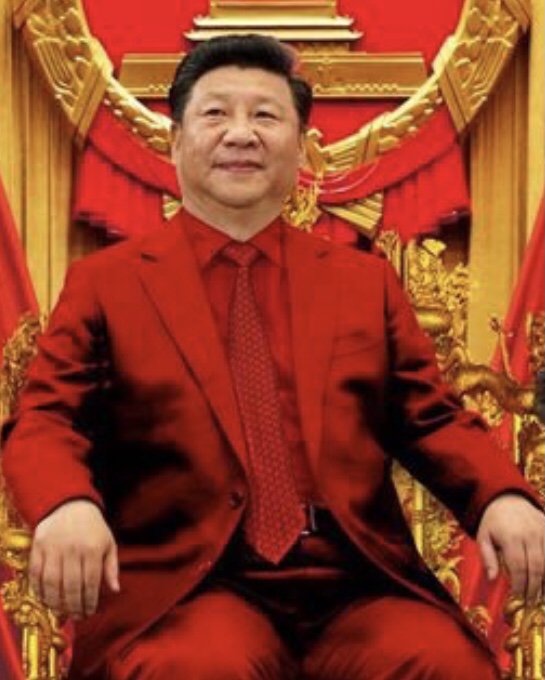
Xi Jinping has been in power since 2013. Why is he choosing this time frame to crackdown on so many issues in China? 習近平從2013年開始執政,為什麼要選擇這個時間來應對中國這麼多問題?By Robin Daverman, Sept 30, 2021
This question has so many Western Media baggage, it is, nonetheless, one of the better questions I’ve seen lately.
So let me first point out the “baggage” in the question itself, and then start from a “clean slate”.
While it’s true Xi became Chinese president in 2013, he’s not “choosing this time frame” to “crack down on so many issues”. All the issues being reported have been dealt with off-and-on multiple times before. People agree there are issues but people still don’t know the best way to deal with them yet. The big picture is that this Politburo is doing what’s in the current 5-year-plan, and they are making the noise that the big emerging pain point is inequality, so what to do about it.
Basically you can’t mobilize the society to deal with it unless you write it into the 5-year plan, and you can’t write it into the 5-year-plan until you have some proto-type solutions, and you have developed a set of KPIs to measure improvement. Right now, you just have a lot of various departments, various provinces and municipalities, trying to develop some prototype solutions on some narrow aspects, and metric to measure effectiveness. Essentially multiple ongoing social trials by a bunch of people instead of any centralized decision-making.
If you perceive there’s some kind of “crackdown”, it’s the fault of the English media. Journalists used to go knock on doors, talk with people at their homes and at their offices, research reams of documents, write, revise, and revise again, and it usually takes 2 to 6 months to publish an article. A lot of their “footwork” leads to “no story here”. Now these guys just copy some company or some politician’s PR clips, grab some random guy off the street to get a quote, invent some story in their heads, plagiarize some internet tweets, and opine about them. The original journalist work is too much work, takes too long, learning the subject matter is too painful. The new journalist work is worthless garbage, but it’s so much easier and faster to do!
Historian Nils Gilman once quipped about “weaponizing Dunning-Kruger effect”. and I can’t find better description of today’s dumb, lazy, parasitic Media actors.
Now get back to the original question. Basically, the role of “presidency” in the US and in China are COMPLETELY DIFFERENT. The role of the US Presidency is heavily influenced by France. It was indeed set up with the help of the French. Both are “imperial presidencies”.
“We elect a king for four years”, Abraham Lincoln’s Secretary of State once observed, “and give him absolute power within certain limits, which after all he can interpret for himself”.
A Point of View: Is the US president an elected monarch?
The US presidency has been an elected kingship since 1776, argues David Cannadine.
https://www.bbc.com/news/magazine-32741802
Thus the US President is like Louis XIV, the US Congress is like the French Assemblée Nationale where the King must go to in order to raise rather significant new taxes. The President, like Louis XIV, gets to start foreign wars at-will (in reality not on paper), gets to raise some taxes (i.e., Mr. Trump imposed trade ban and tariffs by executive order}, but very much restricted in terms of dealing with the aristocracy and the church (i.e., the modern-day billionnaires and the military-industrial complex) because ancient privileges. Other than that, the US Presidency is indeed very powerful.
The role of the Chinese Presidency, on the other hand, is not that powerful. It is, fundamentally, a senior civil service position. Basically, all civil service positions are carefully managed by the bureaucracy, and have to follow strict rules. Here are some of the rules.
First, when you get elected to the Chinese Presidency, you don’t get to set your own agenda. Your performance goals and KPI (key performance index) has been set 3 years early, in the 5-year-plan. The 5-year-plans go from year xxx0 – xxx5, year xxx6 – xx10, while the presidency goes from year xxx3 – xxx8, and year xxx9 – xx12. The time frames of “the project plan” and “the team” are staggered.
It is BY DESIGN that new president must spend the first 2 years to fulfill the remaining tasks in the prior 5-year-plan, before getting a say in the next 5-year-plan. The Plan and the Team are staggered, on purpose, to mitigate “human factor risks and ensure consistency”. The newly elected politburo must first prove they are a competent team.
Ceremonial office and nominal de jure Head of State of China The president of the People’s Republic of China is the ceremonial head of state of the People’s Republic of China (PRC). Under the current PRC Constitution , the presidency is a largely ceremonial office with very limited power. However, since 1993, as a matter of convention, the presidency has been held simultaneously by the General Secretary of the Chinese Communist Party , the top leader of this one-party state . The presidency is officially regarded as an institution of the state rather than an administrative post; theoretically, the president serves at the pleasure of the National People’s Congress (NPC), the legislature, and is not legally vested to take executive action on his own prerogative. The presidency was first established in the PRC Constitution in 1954 and successively held by Mao Zedong and Liu Shaoqi. Liu fell into political disgrace during the Cultural Revolution, after which the presidency became vacant. The presidency was abolished under the Constitution of 1975, then reinstated in the Constitution of 1982, but with reduced powers. The official English-language translation of the title was ” Chairman “; after 1982, this translation was changed to ” President “, although the Chinese title remains unchanged. When the current constitution was adopted in 1982 , the presidency was designed as a largely ceremonial office , with the Premier serving as the head of government and the General Secretary of the Communist Party of China serving as the political leader of the party; three posts were held by different individuals in the 1980s. That said, in reality political power was concentrated in the Paramount leader , who controlled the Party and the military from “behind the scenes” without holding any of the three posts. However, Presidents Li Xiannian (1983–1988) and Yang Shangkun (1988–1993) were not simple figureheads, but actually significant players in the highest leadership, with their powers deriving from their status of being amongst the Eight Elders , rather than the office of president. [3] Since 1993, apart from brief periods of transition , the top leader of China simultaneously serves as the president, the leader of the party (as General Secretary ), and the commander-in-chief of the military (as the chairman of the Central Military Commission ). This individual then carries out different duties under separate titles. For example, the leader meets foreign dignitaries and receives ambassadors in his capacity as president, issues military directives as Chairman of the Central Military Commission (CMC), and upholds party rule as the general secretary of the Chinese Communist Party (CCP).
During the Mao era, there were no term limits for the presidency. Between 1982 and 2018, the constitution stipulated that the president could not serve more than two consecutive terms. In 2018, term limits were abolished, but the post’s powers and ceremonial
https://en.wikipedia.org/wiki/President_of_the_People%27s_Republic_of_China
Civil Servants, in China, are managed on a (1+1+3) schedule. Year 1 is trial period. If you are unfit, you are just out. Then after the first two years, there’s a mid-term review. “Now that we know how you actually perform, do you think the 5-year goals are achievable, or do we need to change your KPI?” So there’s massive negotiation and re-evaluation going on at the end of year 2. Then it’s full steam ahead for the next 3 years to see if you can hit the KPI and get the performance bonus, sort of like that.
Secondly, if you are a newly-elected Chinese president, not only your first agenda is set by other people, but your whole team is elected by other people too! Not only that, but only HALF of your team is newly elected, like yourself. The other half, you inherit them from your predecessor. In the US, it would be something like, Trump’s defense secretary, interior secretary, secretary of labor stay on until the next election. In the current election, say, Biden, Bernie Sanders, Ted Cruz, John Kerry, got vote count 1, 2, 3, 4, then Mr. Joe Biden will be the President, Sanders will be the Prime Minister, and Cruz and Kerry will decide who will be the secretary of Treasury and secretary of State based on their personal experience and qualification, etc. This would be what it would look like if the US copies the Chinese government structure. The Chinese president not only has to work directly with his rivals, but he can’t fire any of them, because they are all elected on their own. They don’t owe their jobs to the President, unlike the US where each Cabinet member is hired (and fired) by the President because they serve entirely at the President’s pleasure. This is why, when someone is campaigning for the Chinese presidency, they never ever bad-mouth their rivals. Instead, they all put on this love-fest, “I can work with anybody”-shpill, like any job candidate, You pretty much have to say that in order to get the job.
And lastly, as the newly-elected president of China, not only you have tasks other people told you to do, team other people told you to form, even on daily tasks, you can’t decide anything on your own. You have to either get complete consensus, or “overwhelming majority”, i.e., 7:0 or 6:1 vote, in the Politburo, on all decisions. This is a constitutional requirement. So the way it works, is that the 7 politburo members divide up the responsibilities. Each major area gets 2 or 3 politburo members to cover it, so that the top decision body is a “working group” instead of an individual. All major decisions have to be presented to the whole Politburo for group discussion and vote. You really have to be good at managing small working groups. This is, after all, the way your 40-years of civil service career has been structured around the whole time.
Oh, and here is the icing on the cake: at the end of the year, the Politburo holds a 1-week touchy-feely retreat. Criticism and Self-Criticism. Everybody in the group just let it rip. Does it hurt your feelings? Yeah? Then good! It means it’s working.
So you can see, comparing the Chinese Presidency with the US Presidency is completely ridiculous. One is a tightly-managed civil servant position, the other is an elected monarchy. The only reason the Media does so is because these journalists are dumb, lazy, and parasitic. The US president can be a dictator everyday, but must have democracy once every 4 years. The Chinese president must practice democracy everyday, but only with his peers. Oh and, Deng Xiaoping was the most important politician in the 80’s and 90’s but he was never the President of China!
The journalism in both countries are so bad, the ordinary people are totally uninformed. Then you have regular people making ludicrous interpretations based on their own experience. Thus whenever something happens in China, some Americans will go “Xi cracks down on xyz because no freedom”, and whenever something happens in the US, some Chinese will go “American government is gonna miss its KPI so it’s desperately making things up for show”… Domestic fantasies projected onto the other country. This happens literally everyday!
 Johnson Choi Biz