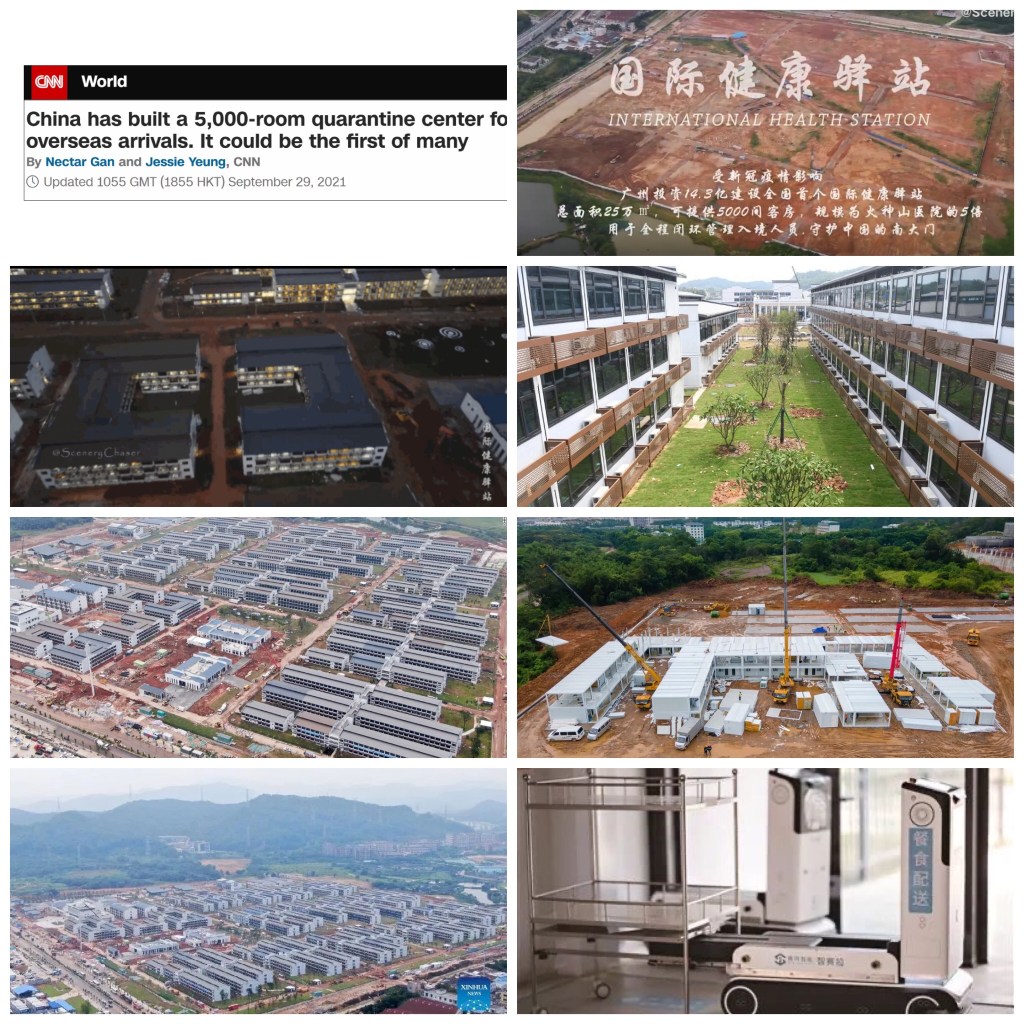
CNN: China has built a 5,000-room quarantine center for overseas arrivals. It could be the first of many By Nectar Gan and Jessie Yeung, CNN再叹:中国这项防疫措施,又是首创 “在遏制新冠病毒方面,似乎没有哪个国家愿意做得像中国那样极致.” CNN Wed Sept 29, 2021
当地时间9月29日,美国有线电视新闻网(CNN)在一篇报道中关注到了即将投入使用的广州国际健康驿站,并就中国在不到三个月建成足以为入境人员隔离提供5000多个房间的这一设施感到震撼,“这可能是许多类似隔离中心的第一个”。
报道还引述美国公共卫生专家评价称,“可以说,这是世界上最先进的隔离中心——非常高科技,非常复杂”,“像这样的设施是将(新冠)零容忍战略制度化的一种方式。”
公开资料显示,广州国际健康驿站于今年6月24日开工,总占地面积33.2万平方米,总建筑面积25万平方米,总投资额超过17亿元,总房间数5074个,将按照人员全流程闭环管理的防疫要求代替“隔离酒店”。同时,驿站还融入了5G通信、物联网、人工智能等技术以实现集中隔离的无接触、智能化。目前,首批184名医护人员已正式进驿站。
CNN在报道中还引述了新浪微博在油管平台上发布的一段介绍广州国际健康驿站修建过程的航拍视频。经检索,该视频来源于微博网友@SceneryChaser 9月16日在微博发布的视频《广州国际健康驿站10周建成记》。
目前,观察者网已向该网友获得视频使用授权。该网友表示,视频是自发前往现场拍摄的,主要是想进行一些宣传。
广州国际健康驿站的修建消息最早由钟南山院士透露。6月25日,钟南山在接受总台记者采访时表示,考虑到德尔塔变种病毒的感染强度非常高,普通酒店作为隔离酒店不太合格,“广州已经决定在郊区建立一个占地25万平方米的广州国际健康驿站,有5000个独立的空间,房间严格按照隔离(标准),不会互相传染,这样才叫隔离酒店。”
观察者网统计广州市新冠疫情每日情况通报数据后发现,自5月1日至9月28日,除7月30日外,广州市每日都有境外输入确诊病例或无症状感染者,最高单日新增数为8月5日的20例(12例境外输入确诊病例+8例境外输入无症状感染者)。
6月28日,广州市政府副秘书长高裕跃在当天的疫情防控新闻发布会上宣布国际健康驿站的修建计划,并表示将贯彻“安全、舒适、智慧”的设计建设理念,采用最先进的人工智能技术,将其打造成具有国际领先水平的智慧驿站。
综合《广州日报》、新华社报道与广州市政府网站信息,广州国际健康驿站项目位于广州市白云区钟落潭镇马沥地铁站105国道旁,距离市区中心、市第八人民医院(传染病医院)、白云国际机场车程则仅约30-40分钟。
该项目用地面积33.2万平方米,总建筑面积25万平方米,共建设5074个房间,分为5种房型,面积从18平方米到39平方米不等,另外还设置了11个无障碍房间与2000床医护及后勤用房。
值得注意的是,该项目于今年6月24日开工,建设期仅75天,施工作业峰值人员达7500人,中国速度再次彰显无遗。
除了硬件到位,人员也已经在驿站就位。9月17日上午8时, 广州市红十字会医院举行出征进驻仪式,首批184名医护人员正式进驻国际健康驿站,将在工作28天后隔离7天,再居家隔离14天。
When it comes to keeping Covid-19 at bay, few countries seem willing to go as far as China.
As countries around the world reopen borders and loosen coronavirus restrictions, Beijing is doubling down on its zero-Covid strategy. The latest example: a $260 million, 5,000-room quarantine facility for incoming travelers set to open in the southern metropolis of Guangzhou in the coming days.
Comprised of rows of three-story buildings topped with gray roofs in traditional Chinese style, the massive complex spans an area the size of 46 football fields and took less than three months to be built from scratch on the outskirts of the city.
It will replace designated hotels located throughout Guangzhou to quarantine Chinese and international travelers arriving from overseas — a move aimed at reducing residents’ exposure to imported cases.
Travelers will be transferred on buses directly from the airport, and confined to their rooms for at least two weeks. Each room is fitted with a video chat camera and an artificial intelligence-powered thermometer, with three meals a day delivered by robots — all designed to minimize direct contact with staff members.
“It’s arguably the most state-of-the-art quarantine center in the world, if you will — very high tech, very sophisticated,” said Yanzhong Huang, a senior fellow for global health at the Council on Foreign Relations.
The Guangzhou International Health Station — as it’s officially named — is the first of its kind in China. But experts say it could be the first of many as the Chinese government intensifies its uncompromising, zero-tolerance strategy toward the coronavirus.
Already, the manufacturing hub of Dongguan, about an hour’s drive from Guangzhou, is building its own “international health station” with 2,000 rooms. Further south, the technology hub of Shenzhen is also planning for such a facility.
“This is not just a stopgap measure. (Chinese leaders) hold the view that this pandemic is going to take a while to end, and China is going to continue this strict control of its borders,” Huang said. “Facilities like this serve as a way to institutionalize the zero-tolerance strategy.”
For more than 18 months, China has closed its borders to most foreigners. Those few who are allowed to enter, as well as returning Chinese citizens, are required to undergo at least two weeks of mandatory hotel quarantine, followed by at least another week of centralized quarantine or home isolation — including those who are fully vaccinated.
But the virus has repeatedly breached China’s defenses. In May, the highly infectious Delta variant caused an outbreak in the southern province of Guangdong, including in Guangzhou and Shenzhen. At that time, Guangdong was receiving 90% of all overseas travelers entering China, with about 30,000 people quarantined in its 300 centralized facilities on a daily basis, according to a provincial health official.
By late June, Guangdong had contained the outbreak — but authorities decided existing measures were not enough to shut the virus out. Zhong Nanshan, a top public health adviser to the government, told state media that Guangzhou would build a centralized quarantine facility for all overseas arrivals to enforce stricter rules.
The project kicked off quickly, with more than 4,000 workers assigned to the construction site. The facility was completed earlier this month and a first batch of 184 medical staff moved in last week to prepare for its official launch.
They face a tough job ahead. The complex is designed as a bubble to be isolated from the rest of the city — meaning not only travelers, but also workers will be placed under effective lockdown. Medical staff will work for 28 days at the facility, go through a week of quarantine themselves, and another two weeks of home quarantine before they’re allowed to go outside, an official told the Guangzhou Daily newspaper.
China’s move to tighten quarantine measures for overseas arrivals comes as a growing list of countries open up. Last week, the United States announced it would ease travel restrictions on all fully vaccinated foreign visitors starting in November.
But on Chinese social media, calls are growing for authorities to lengthen quarantine for overseas arrivals. Many blamed Chinese travelers returning from abroad for bringing the virus to China, especially following the latest outbreak in the southern province of Fujian.
Initially, experts advising the government identified a man who returned from Singapore more than a month ago as the likely source of the outbreak, despite him having completed 21 days of quarantine on arrival, during which he tested negative for the virus a total of nine times. The average incubation period for the Delta variant is about four days.
Later, health experts walked back that theory, saying the man was likely to have picked up the virus during centralized quarantine instead. But the clarification did little to calm online calls for tougher quarantine requirements.
China’s move toward stricter quarantine comes despite the country making huge strides in its vaccination drive. Earlier this month, officials announced that 1 billion people had been fully inoculated with domestically made vaccines, accounting for 71% of China’s 1.4 billion population — a rate higher than many countries that have opened their borders.
Guangzhou’s new quarantine facility will open just in time for the China Import and Export fair, which begins October 15. The biannual event, also known as the Canton Fair, is China’s largest trade exposition, typically attracting tens of thousands of companies from around the world.
Having been held online so far during the pandemic, next month marks a real-world return for the trade fair — but attendance will be limited to exporters and buyers already based in China.
Nevertheless, authorities in Guangzhou have stepped up quarantine requirements for all overseas arrivals, raising their mandatory quarantine from 14 days to 21 days.
Huang, the expert at the Council on Foreign Relations, says despite its enormous size, the facility would likely not be big enough to hold all foreign arrivals. “Just think about it. One international flight typically carries 300 people. They all need to be quarantined and stay at least 21 days. It’s going to fill up quickly,” he said.
https://www.cnn.com/2021/09/29/china/guangzhou-covid-quarantine-center-mic-intl-hnk/index.html
 Johnson Choi Biz