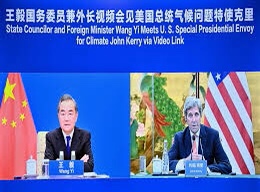
China told John Kerry to take care old scores first, “Three bottom lines” and “two lists” before bring up new items at the climate change meeting. There is no free lunch for US anymore.
“Three bottom lines” and “two lists”, China draws a red line to the United States
- The fundamental reason for the deadlock in Sino-US relations is that the United States regards China as an “imaginary enemy.”
- The eyes of the Chinese people are discerning. The United States’ suppression of China is the essence, cooperation is an expedient measure, and competition is a discourse trap. Whenever you want to ask for China, you will ask for cooperation. In areas where you have an advantage, in order to suppress China, you will not hesitate to conflict and confront.
- The so-called “maintenance of the rules-based” international order of the United States is to suppress China with its own rules.
Fourth, the United States should first resolve its own human rights issues, and it is not qualified to use global democracy and human rights as a spokesperson for itself. - China is willing to treat the United States on an equal footing and seek common ground while reserving differences. The United States should change its course, respect choices, respect each other with China, and coexist peacefully.
- Chinese culture advocates do not do to others what you do not want, but in the face of external interference, it will adopt reasonable and legal measures to counteract it.
“三條底線”“兩份清單”,中國給美國畫下紅線
一、中美關係陷入僵局,根本原因是美國把中國當作《假想敵》。
二、中國老百姓的眼睛是雪亮的,美國對中國壓制是本質,合作是權宜之計,競爭是話語陷阱。有求於中國時就要求合作,在有優勢領域上,為了壓制中國,不惜衝突對抗。
三、美國所謂「維護基於規則」的國際秩序,是想用自己規則打壓中國。
四、美國應先解決好自己的人權問題,沒資格用全球民主人權代言人自居。
五、中國願與美方平等對待、求同存異,美國應改轅易轍,尊重選擇與中方互相尊重,和平共處。
六、中國文化主張己所不欲勿施於人,但面對外來干涉,會採取合理合法方式反制。
In addition to the above six points, Xie Feng also proposed two lists:
The first is to require the US to correct the list of wrong words and deeds against China, including the removal of sanctions imposed on China by the US;
The other is the key list of China’s concerns, including approval of Chinese students to go to the United States as soon as possible.
China has only three requirements, that is, three bottom lines;
- The United States must not challenge, defame or even subvert China’s socialist road and system;
- The United States must not try to obstruct or even interrupt China’s development process;
- The United States must not infringe upon China’s national sovereignty and must not undermine China’s territorial integrity. Issues involving Xinjiang, Tibet, and Hong Kong have never been human rights and democracy issues. Instead, anti-Xinjiang independence, anti-Tibetan drugs, and anti-Hong Kong independence are all issues of right and wrong. The Taiwan issue is the most important issue.
除上述六點,謝鋒還提出兩份清單:
一是要求美方糾正對華的錯誤言行清單,包括美方撤銷對中方的制裁;
另一是中方關切的重點清單,包括盡快批准中國留學生赴美。
中方只有三點要求,即三條底線;
一、美國不得挑戰詆毀甚至顛覆中國社會主義道路和制度;
二、美國不得試圖阻撓甚至打斷中國發展進程;
三、美國不得侵犯中國的國家主權,不能破壞中國的領土完整。涉疆、涉藏、涉港等問題,從來不是甚麼人權民主問題,而是反疆獨、反藏毒、反港獨講都是大是大非問題,台灣問題更重中之重。
Wang Yi’s “three bottom lines” are very clear. It is China’s proposal to set up a “guardrail” between China and the United States. Of course, when Sherman and Xie Feng mentioned issues such as Hong Kong and Xinjiang, they have touched one of Wang Yi’s “three bottom lines.” After watching this Sino-US confrontation, I have a few observations:
- The United States has not been able to speak from its “power position.” Prior to Sherman’s visit to China, the United States kept trumpeting that it would start from its “power status” and hold talks with China. In this regard, China has expressed its opposition. This is why Wang Yi said before the meeting that he would “make up a lesson” for the United States. As a result, after the talks, US officials did not mention “power status.” In reality, Chinese officials “teaching” Sherman in this way do not see any “strength status” shown by the United States. China and the United States are only in contact on an equal footing.
- China clearly expresses its position, and the United States does not dare to replay the old tune. In reality, it is very difficult to ask Sherman not to mention issues related to Xinjiang and Hong Kong during her visit to China, because it is difficult for her to explain to American voters. When Wang Yi met her, she responded directly, but afterwards she couldn’t see Sherman vigorously refuting Wang Yi’s “three bottom lines.” It can be said that the US side’s tone is not high. From the perspective of diplomatic games, the United States lost a battle regardless of its momentum and content.
- The United States has what it wants. China revealed that the United States has sought China’s help on the North Korean nuclear issue and the Iranian nuclear issue. I believe this is only part of the US asking China for help. In addition, the United States hopes that Sino-US relations will be normalized. If the two countries send ambassadors to each other, they must return to normal and improve economic and trade relations. More importantly, the United States hopes that President Xi Jinping can meet with President Biden during the G20 summit. The U.S. asks for China, and China naturally requires the U.S. to be courteous to others. The definition of politeness in China and the United States may be different. The United States regards itself as a superpower, and feels that Sherman has been more restrained in expressing his position at the meeting, which is already an act of goodwill. China understands the posture of the United States, and of course it will not fully accept the goods.
王毅「三條底線」,十分清晰。就是中方建議設置中美之間的「護欄」。當然,舍曼與謝鋒會面時中提及香港、新疆等問題,已觸碰到王毅的「三條底線」其中一條。看完這次中美交鋒,我有幾點觀察:
一、美國並未能從「實力地位」說話。舍曼訪華前,美方不斷地吹要從「實力地位」出發,與中國會談。對此,中方大表反對,這也是王毅會前說要為美國「補上一課」的原因。結果,會談後,美方官員,再沒提「實力地位」。現實上,中國官員這樣給舍曼「上課」,亦看不到美國展示了甚麼「實力地位」,中美只是平起平坐地接觸。
二、中國清晰地表達立場,美國老調重彈不敢出位。現實上,要求舍曼訪華時不提涉疆涉港問題,難度很高,因她難向美國選民交代。王毅接見她的時候直接回懟,事後見不到舍曼大力反駁王毅的「三條底線」。可以說,美方調子不高。從外交對弈角度而言,美方無論氣勢上和內容上都輸了一仗。
三、美國有所求。中方透露,美國在朝鮮核問題、伊朗核問題上,都尋求中國幫助。相信這只不過是美國向中國要求幫忙的一部份。此外,美國希望中美關係正常化,如兩國互派大使須回復正常,改善經貿關係,更加重要的是,美國希望國家主席習近平能在G20峰會期間,與總統拜登會面。美國有求於中國,中國自然要求美國禮下於人。中美對有禮的定義,尺度或不同。美國以超級大國自居,覺得舍曼在會議上表述立場較為克制,已是一種示好行為。中國明白美國的姿態,當然不會全面收貨。
 Johnson Choi Biz