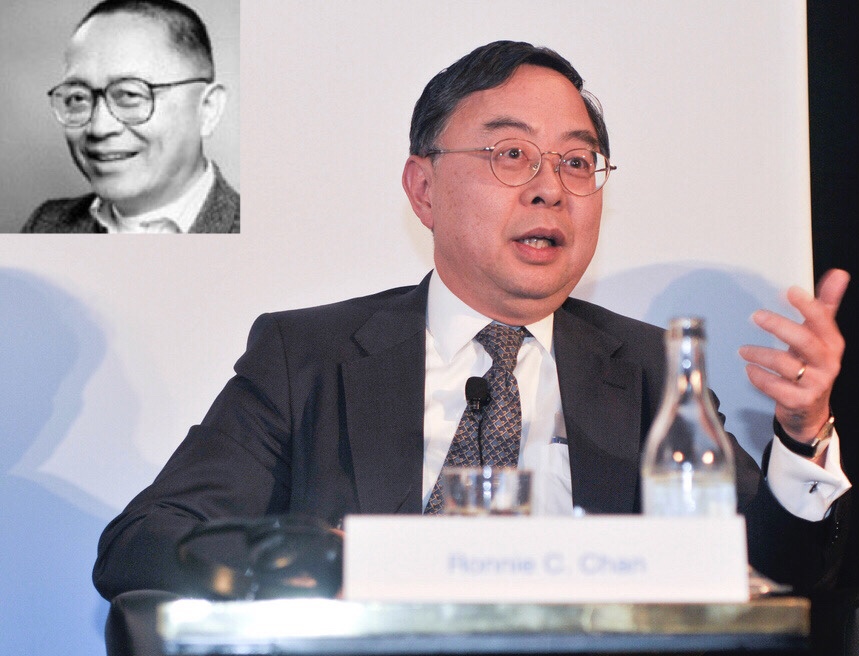
Johnson Choi: Why did Ronnie Chan gave almost US$400 millions to US Universities when made his money in Hong Kong and China? 蔡永強: 陳啟宗在香港和中國賺大錢,為什麼要捐近4億美元給美國大學?
Professor Ling-chi Wang of UC Berkeley: Hi, Johnson, Most wealthy Chinese make spectacular donations universities to achieve national or international visibility and/or personal glory and immortality. Unfortunately, very few donate for altruistic reasons. Even fewer make strategic donations toward specific intellectual or political purposes. 加州大學伯克利分校的王靈智教授:嗨, 蔡永強, 大多數富有的中國人都會向大學捐款,以實現國內或國際知名度和/或個人榮耀和不朽。 不幸的是,很少有人出於利他的原因捐款。 為特定的知識或政治目的做出戰略性捐贈的就更少了。
If you take a look at how wealthy Jewish donors in the past made their donations at a time when there was willful, pervasive anti-Semitism, you will find many of them made very strategic donations specifically for the advancement of better knowledge and understanding of Jewish people, their history and culture, meaning, use of their money to combat prejudice and ignorance. For example, the Ivy League universities were notoriously anti-Semitic. They were the ones that invented “Jewish Quota” and refused to admit qualified and superior students of Jewish origin. What did the wealthyJewish donors do? They donated money to these same universities for the Jewish studies to promote the production, proliferation, and appreciation of Jewish knowledge and understanding. They also established endowments for the appointments for great Jewish scholars in all fields. This way, knowledge and appreciation of Jewish intellectual achievements spread across the nation and throughout the world. Guess what? Slowly but surely, Jewish history, language, culture, religion, philosophy, etc., permeated the Western civilization, the curricula of great universities, and the teaching and research. Jewish quota was finally abolished in the mid-1950s. That was how important aspects of my old field of study, Semitic language and literature, flourished and got well entrenched among all the research universities throughout the world and how media became more sensitive about anti-Semitism.
In spite of China’s fame and claim as one of the greatest languages, cultures, religions, and philosophies of the world, China remains, to this date, the least understood and most feared. For centuries, Chinese studies was called Sinology, relegated to something rather exotic and mysterious, reserved only for very few willing to spend their lives to such an intellectual exotica. For those who don’t even know the world Sinology, the field was known as Oriental studies, also an exclusive exotica. Orientals were regarded popularly as a subhuman species. (Lt. Calley’s defense characterized the My Lai deaths from the massacre as “mere Oriental).” Sinology was devoted exclusively to the study of ancient, not current Chinese language, literature, religion, and philosophy. There was little or no interest in the study of real and living Chinese history, society, spoken languages, folk arts and cultures, politics, etc. Such study did not enter university research and curricula, if you can believe it, until the Cold War, better known as the International and Area Studies (IAS), driven mostly by the needs of the Cold Warriors, Western governments, intelligence, and corporations, whose primary interests were the East-West ideological and political conflicts and better military and economic domination of areas vital to the interests of the West or the Empire.
That is why to this date, China remains relatively unknown or worse, misunderstood, suspected, and feared. This is not an accident in history: it is done on purpose to enhance the interests of the Empire.
Johnson, in answer to your question, What is wrong with billionaires, like Ronnie C. Chan, who has been giving hundreds of millions to wealthy Euro-American universities, by donating money to the same universities with the same biased objectives of keeping the West ignorant and misled, these Chinese donors are perpetuating the same prejudice against and ignorance about China and its people. This is willful ignorance and stupidity. It is complicity of the worst kind. They need to donate money to advance true knowledge and understanding of China, its people and culture.
Universities in China and India are the leading feeder universities for the research universities in the U.S. Between the two, China is the most important feeder of graduate students in science and technology. I think many top American universities consider Beijing University and Qinghua Universities to be the top feeder universities for the best universities in the U.S. They are like community colleges transferring annually the better students to four-year colleges and universities.
As you said, many top students do not return to China upon completion of their graduate training. Chinese government considers this to be a serious brain-drain, depriving China the benefits of its best and brightest. I personally do not think so for several reasons. First and foremost, China has an abundance of bright and well-trained brains. That supply of bright and well-training students has been increasing quite sharply since Deng Xiaoping’s reform and opening up because of China’s massive investment in colleges and universities. That increase, in fact, reminds me of the massive post-war investment and expansion of higher education in the U.S., not just at the top, but also at the bottom, the feeder, community college level. Within California, for example, the UC system, the premiere research institution, had five campuses in 1960. By the end of the decade, UC had nine campuses, adding, San Diego, Santa Barbara, Santa Cruz, and Riverside. It was not until 2005 that a 10th campus – UC Merced – was added. In fact, the U.S. has been divesting in higher education since the 1980s. Between 1970 and 2005, UC system added only one campus, Merced, even though the California population doubled its population. The fight over affirmative action policy is a reflection of the divestment and the ensuing competition for admission. In the same period, China vastly expanded its high education and the trends has not led up. China, as you all know, has about 370,000 students studying in U.S. coll eges and universities.
Secondly, China sees education abroad as an investment in human resources. Since Europe and North America have the most developed systems of higher education and their systems excel in science and technology, China, for the time being, still sees benefits for its students in getting the kind of education China lacks at the present. In spite of brain-drain, I do not see the government interfering with the tread toward education abroad. China may talk about brain-drain, it also see benefits in the long run, at least for the time being. I do see China expanding is research and development. This, in the long run, will attract more and more its students to return to China upon completion of their education in Europe and N. America. In fact, as the conflict between China and U.S. intensify and anti-Chinese sentiment rises, more an more Chinese students will see better opportunity and support in China rather than the U.S. I think this trend is inevitable and it will be a loss to the U.S. in the competition for the best and the brightest and its competition with China.
 Johnson Choi Biz