Tibet celebrates 70th anniversary of peaceful liberation by Shan Jie and Yang Sheng Aug 19 2021
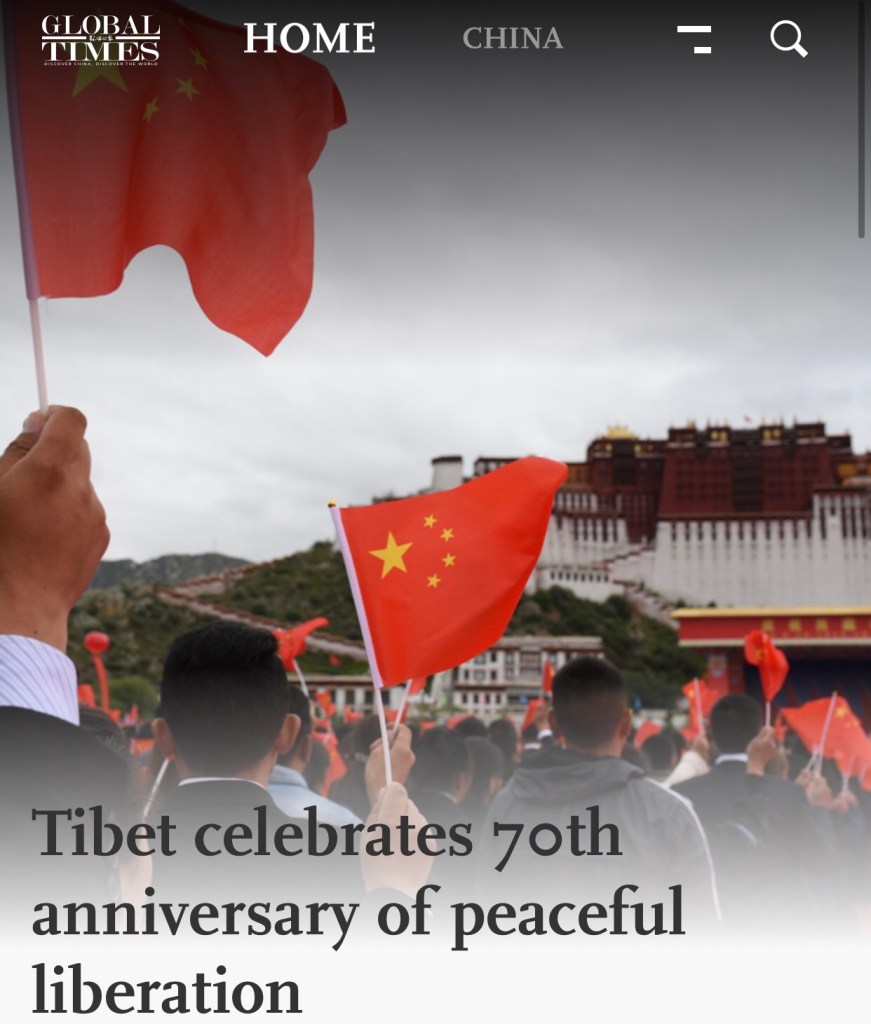
With a grand celebration held in front of Lhasa’s Potala Palace in Southwest China’s Tibet Autonomous Region, people on Thursday marked the 70th anniversary of the peaceful liberation of Tibet. After seven decades of miraculous progress in the high-plateau region, Tibet is now eyeing high-quality development, with border construction, ethnic unity and eco-environmental progress as focuses in its future plan.
China’s top political advisor Wang Yang, who led a central government delegation to attend the event, called the peaceful liberation of Tibet in 1951 “a major victory in the cause of liberation of the Chinese people and China’s reunification,” saying it marked a historic transition with epoch-making significance for Tibet.
“Since then, Tibet has embarked on a path from darkness to brightness, from backwardness to progress, from poverty to prosperity, from autocracy to democracy, and from being closed to being open,” said Wang, chairman of the National Committee of the Chinese People’s Political Consultative Conference (CPPCC).
The GDP in Tibet soared past 190 billion yuan (about $29.3 billion) in 2020 from a mere 130 million yuan in 1951, Wang noted.
“It has been proven that without the CPC, there would not be a new Tibet,” Wu Yingjie, secretary of the Tibet Autonomous Regional Committee of the Communist Party of China, said at the meeting.
The government led by the CPC cares for the well-being of the people in Tibet and is able to concentrate resources on large undertakings, ensuring the implementation of key projects in a region with such difficult natural conditions, Xiao Jie, a deputy director at the Institute for Contemporary Tibetan Studies under the China Tibetology Research Center, told the Global Times on Thursday.
Infrastructure construction in Tibet, including the Qinghai-Tibet railway, the Lhasa-Nyingchi railway and a number of hydropower stations, have enabled the region to utilize resources from domestic or international markets from a relatively high level, Xiao said.
Moreover, Tibet has successfully chosen industries that suit its conditions, such as tourism and modern agriculture, Xiao noted.
Tens of thousands of people participated in the Thursday event, including representatives of local residents, students, military and police officers.
The 11th Panchen Lama also attended the event.
Celebrations had been held all around the autonomous region. On Thursday, the Tibet Daily used 60 pages to look back at the history of Tibet being a part of China, the journey of Tibet’s development and the prosperity around the region.
In only seven decades, Tibet has realized a historic leap of thousands of years – transforming itself from a feudal serfdom to a socialist system; from poverty and backwardness to civilization and progress, the newspaper read.
In July, Chinese President Xi Jinping visited the Tibet Autonomous Region for the 70th anniversary of Tibet’s peaceful liberation.
“It has been proven that without the CPC, there would have been neither new China nor new Tibet,” Xi said. “The CPC Central Committee’s guidelines and policies concerning Tibet work are completely correct.”
Xi also stressed writing a new chapter of lasting stability and high-quality development for the plateau region.
Since the 18th National Congress of the CPC held in 2012, stability, development, eco-environmental progress and border-area consolidation have become the four major issues in Tibet.
With its peaceful liberation in 1951, the people of Tibet broke free from the fetters of invading imperialism for good, and embarked on a bright road of ethnic unity, progress and development, according to the Xinhua News Agency.
A better life
In the past 70 years, especially in recent decades, local people’s lives across Tibet, whether in major cities like Lhasa and Shigatse or border regions in Ngari prefecture and some border counties like Yadong, have seen remarkable improvements.
Drolma Tasering, 70, a villager in Yadong county, a frontier county and trade market bordering India and Bhutan, said the people there have a very strong sense of gratitude toward the CPC and the People’s Liberation Army (PLA). He noted that outsiders with a bias against Tibet would not understand because they haven’t “experienced what we have in the past 70 years.”
Drolma is a survivor of the earthquake on September 18, 2011 in Yadong. Villagers initially saved her when she was buried under debris. When the rescue team made up of firefighters and PLA troops arrived, more and more people were rescued and received food, tents and other materials. Now she lives in a new two-storey house.
Asang, 40, the son of Drolma, told the Global Times that “the houses for local villagers – most of which are two-storey, some are one-storey – were built by the local government after the earthquake, and they are much more modern and comfortable than the old ones we used to live in. We only had to spend 50,000 yuan to buy it, and if you just want the one-storey one, the house is free.”
Local villagers will also receive about 10,000 yuan every year in subsidies for protecting forests and patrolling the border, and monthly living expenses for ordinary villagers like Drolma come to just a few hundred yuan, so the people there feel almost no life pressure, Asang said.
By the end of 2019, all registered poor residents in Tibet had shaken off poverty, marking the elimination of absolute poverty in the region for the first time in history, according to Xinhua.
The average annual per capita disposable income of those who have got rid of poverty in Tibet exceeds 10,000 yuan ($1542), according to a white paper issued in May by China’s State Council Information Office.
 Johnson Choi Biz