US war crimes, crimes against humanity. Kiji Noh in San Francisco: Slaughtered by US-trained-and-led SK troops, women and children included. The third slaughter would have happened under direct US military control. These people were pre-emptively shot because the US believed they might have sympathies toward NK. The total length of the trenches where the bodies were dumped would be longer than 8 football fields. This massacre was one of hundreds leading up to, and during the Korean war of innocents. 美國戰爭罪,危害人類罪。 舊金山的 Kiji Noh:被美國訓練和領導的南韓部隊屠殺,包括婦女和兒童。 第三次屠殺會在美國直接軍事控制下發生。 這些人被先發製人地槍殺,因為美國認為他們可能對朝鮮表示同情。 傾倒屍體的戰壕總長度將超過 8 個足球場。 這場大屠殺是朝鮮戰爭之前和期間的數百起無辜者屠殺之一。
Researchers excavate remains of Korean War massacre victims in Daejeon By Choi Ye-rin, staff reporter Aug.13,2021
More than 7,000 people were killed in a series of massacres by the South Korean military and police in 1950
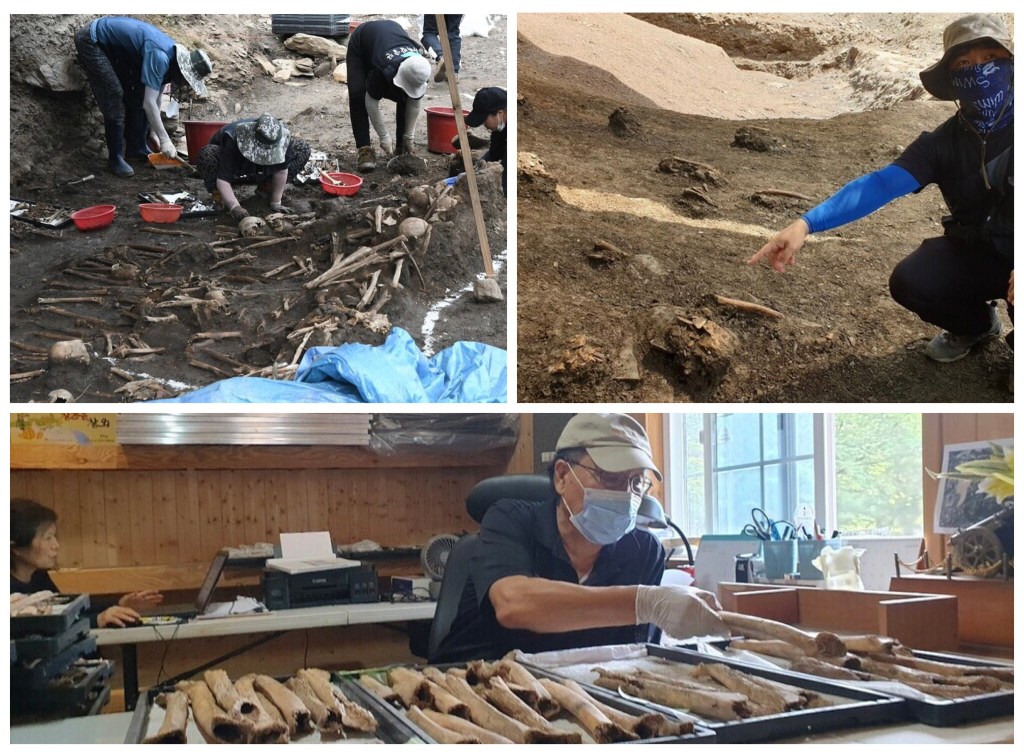
Researchers excavate the remains of the bodies of the victims of the Daejeon massacre by the South Korean military and police during the Korean war. (provided by the research team)
Seventy-one years have faded the countless bones that fill the floor of the building. These are the remains of the massacre site Sannae Gollyeonggol in Daejeon.
Researchers have been excavating the site for over two months, from June 1 to August 6, unearthing bones and classifying them by type. One of the researchers, Kim Tae-in, said “We’ve been pressed for time during this investigation because the remains to be excavated were much more than we expected. However, we’re doing our best to transfer the bones as carefully as possible.”
“During the work collecting the remains of the bodies, I went to the back of this building and saw the long rows of pits that were dug for excavation. I saw a leg bone inside one of the holes waiting to be excavated. Next to it was a broken hip bone,” he added.
Kim Gi-hyeon, another researcher, said, “Because the remains are entangled, we don’t know if the leg and posterior bones belong to the same person,” adding, “We’re doing this with a more respectful mindset than when excavating cultural heritage.”
Along with the remains, staff found shell casings, warheads and shoe soles in the pit. The most frequently found item was a white button that is presumed to be from the Daejeon prison uniform at the time.
A researcher points to the remains of a Daejeon massacre victim at an excavation site in Daejeon. (Choi Ye-rin/The Hankyoreh)
Shortly after the war broke out, Gollyeonggol, from June 28 to July 17 in 1950, was where prisoners from the Daejeon prison and left-wing civilians from both Daejeon and South Chungcheong Province were killed and buried. In late December 1992, declassified US documents exposed these atrocities to the world.
The first massacre from June 28 to 30 claimed an estimated 1,400 lives; the second — from June 3 to 5 — 1,800; and the third — from July 6 to 17 — 3,800 for a combined 7,000 who were known to be indiscriminately killed by the military or police. The eight pits they were buried in ranged in size from 30 to 180 meters and would collectively cover 1 kilometer.
News of the Gollyeonggol massacres, long a taboo topic in the country, began gaining prominence in 2007 when the first search for the victims’ remains found 34 sets in an operation led by the Truth and Reconciliation Commission.
In 2015, 12 sets of remains were recovered by a joint excavation team for the victims of civilian massacres in the war comprising civic organizations, an association of the victims’ families and experts.
Three rounds of excavations supervised by the Ministry of the Interior and Safety and Daejeon’s Dong (East) District Office last year found 234 sets of remains. This year, three teams assigned to cover 1,320 square meters of territory from June to next month have found 450-500 sets of remains.
Also, this year, nearly 200 volunteers went to the excavation site to carry soil from there.
A researcher examines the remains of Korean War massacre victims in a research post set up near an excavation site in Daejeon on Tuesday. (Choi Ye-rin/The Hankyoreh)
Park Sun-joo, an emeritus professor of archaeology and art history at Chungbuk National University who is the lead researcher of the excavations, said, “Bones smaller than others are seen in the identification process, but we can confirm whether the owner was a minor, woman or a male dwarf through anatomical knowledge and DNA testing. In the case of a minor’s remains, the molars in teeth are underdeveloped.”
“Various accounts and data mentioned stories of children and women being among the victims, and the findings and identification operations last year confirmed this,” Park added. “We’ve also found the bones of minors and women this year. The excavation of remains in Gollyeonggol will provide the basis for unveiling the truth of what occurred here in 1950.”
Jeon Mi-gyeong, head of an association for the relatives of the Daejeon massacre’s victims, said, “My heart shattered at the site where the remains were found. The scene was so miserable that I couldn’t bear to look at the remains. I couldn’t confirm my father’s remains, but I thought it could be him with each set found, making my heart ache.”
The excavated remains will be interred at the Forest of Truth and Reconciliation of Peace Memorial Park, which will be built in 2024 at Gollyeonggol.
https://english.hani.co.kr/arti/english_edition/e_national/1007646.html
 Johnson Choi Biz