Political connected company will get most of the infrastructure contracts with a portion of the money kicked back to elected officials at the City, State and Federal levels through legalized corruption. It will be mirrored behind how infrastructure projects being handled in Hawaii and California, expect 300% cost overruns and 3x exceeding projected completion date. 與政治有關的公司將獲得大部分合同,其中一部分資金通過合法化腐敗返還給市、州和聯邦各級民選官員。 它將反映在夏威夷和加利福尼亞處理基礎設施項目的方式,預計成本超支 300%,超出預計完工日期 3 倍.
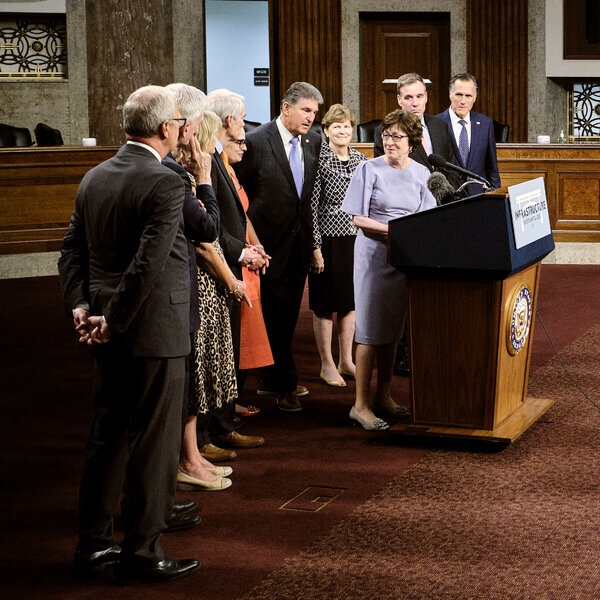
New York Times: A bipartisan group of senators spoke after a procedural vote on their infrastructure agreement on Wednesday. by T.J. Kirkpatrick for The New York Times
Happy Infrastructure Week!
What became a punchline among political reporters during the Trump administration — when many a week was called “infrastructure week” by the White House, which was rhetorically committed to funding roads and bridges out of the federal purse — moved a step closer to reality yesterday, when the Senate voted to take up a $1 trillion infrastructure bill.
What exactly is and isn’t in the infrastructure bill? The Upshot has you covered.
But also important are the terms under which it was hashed out and by which it will pass into law, if it does pass into law. For this bill is bipartisan, shaped by a core gang of senators, five Democrats and five Republicans, who were backed by six more Republican senators as well as by the Biden White House. Not for nothing is it known as the Bipartisan Infrastructure Framework.
Yesterday’s vote over whether to proceed to debating the bill had the support of two-thirds of the Senate: all 50 Democrats and independents, plus 17 Republicans — including Mitch McConnell of Kentucky, the minority leader, who has famously said his goal was to deny President Biden and, before him, President Barack Obama any significant legislative victories.
The House of Representatives, where Democrats hold a slim majority, still must go along with it. A separate, decidedly partisan $3.5 trillion Democratic spending bill looms as a complication. But all in all, the infrastructure plan has come further than many had expected. Here is what political scientists who study legislative compromise (and the lack thereof) have to tell us about how this happened.
 Johnson Choi Biz