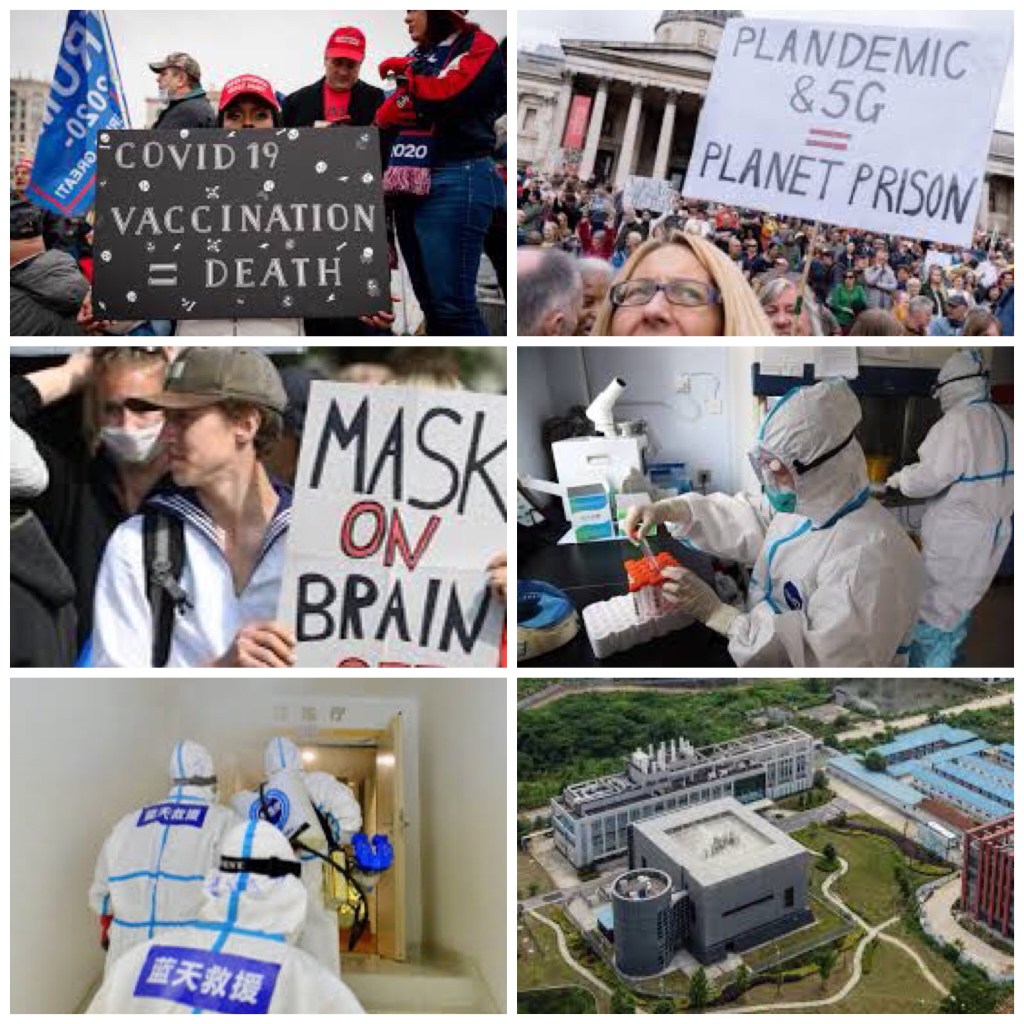
K.J. Noh: The 5 most common “arguments” that conspiracy theorists make are:
- Unusual or anomalous features show engineering:
unusual Furin cleavage site and codon sequence (double CGG) that signal engineering/lab work (Nick Wade; BAS: “The Wade Wank”; “Deigin Deceit”)–but it’s not at all unusual, so not a sign of engineering. Another proponent of this is Francis Boyle ( The Francis F*ckup)
- Gain of Function/serial passage: engineered, but engineered to hide traces of engineering (Sam Husseini, Salon “The Husseini Hustle”):
It was naturally engineered (passage through animals) to hide signs of engineering.
studies show a) it couldn’t be GOF because i) there is no backbone from which to do the GOF (argument made in Nature Medicine article (Kristian Andersen)) ii) standard GOF techniques do not preserve the Furin cleavage site iii) from the closest known progenitor, it would take a Manhattan-project level effort–and decades of passaging
- Virus looks like a “pre-adapted” virus (Alina Chan; MIT/Broad; “The Chan Chicanery”), hence engineered to attack humans:
Actually covid is not pre-adapted to (i.e. engineered to attack) humans: a) it is pantropic–it infects a wide variety of animals, as might be expected if it evolved naturally through many species b) it continues to evolve and improve its infectivity, so it’s clearly not engineered for maximal human infection c) there are further adaptations that could happen and seem to be happening
- 3 sick lab workers in November (Michael Gordon: WSJ; “The Gordon Grift”):
a) it’s not usual to be sick in winter
b) all workers at the lab tested seropositive
c) it’s impossible for three lab workers to get inadvertently sick without having a larger (hundreds of) asymptomatic population (remember, Covid transmits asymptomatically for up to 14 days).
- Live Leak (NYT: “The Ebright Error”)
Ebright argues that they had a live sample that was already SARS-Cov-2–that they didn’t record, classify, publish, but simply leaked.
a) This is unlikely, first because, if it’s already in nature, you can’t leak it out to nature. It’s already out there.
b) Second, there are millions of people who have frequent interactions with Coronavirus carrying bats–it’s much more likely that they would have been a vector rather than highly trained lab scientists taking precautions. Note also that Bats constitute 25% of all mammalian species. Coronavirus carrying bats are found all over the world, including Europe (northern Italy).
c) Third, it also doesn’t explain why the early outbreaks were at the market 17 miles away across a river, and why there were no outbreaks at the lab, unless you assume that the researcher got infected and then took a beeline to the market.
d) Fourth, Ebright knows as well as they do, that WIV, as a well-regarded scientific institution, any relevant studies would have been previously published.
The argument for a Chinese lab leak theory boils down to this: begged assumption + no evidence + tautological reasoning:
- The Chinese did it [begged assumption]
- [although there is no evidence that withstands scientific scrutiny–only innuendo]
- if we can’t find definitive proof that they did it, it’s because they are covering up [tautology].
Proponents often argue that it’s on the Chinese to disprove this by opening up their labs–as if a negative can be proved. It can’t.
Some people seem to think, it’s fine to attack science–and logic–if it helps us to attack China, that’s a cost worth it.
(This is what corporations did on tobacco, on global warming).
A very dangerous road to go down.
If you want to dig into the scientific details:
Scientific Article by some of the top virologists in the world (the selections are from the article)
https://zenodo.org/record/5075888#.YOnnFehKg2x
Weren’t there Covid cases at WIV? (Michael Gordon allegation, WSJ)
Despite extensive contact tracing of early cases during the COVID-19 pandemic, there have been no reported cases related to any laboratory staff at the WIV and all staff in the laboratory of Dr. Shi Zhengli were reported to be seronegative for SARS-CoV-2when tested in March 2020. During a period of high influenza transmission and other respiratory virus circulation reports of illnesses would need to be confirmed as caused by SARS-CoV-2 to be relevant. Epidemiological modeling suggests that the number of hypothetical cases needed to result in multiple hospitalized COVID-19 patients prior to December 2019 is incompatible with observed clinical, genomic, and epidemiological data
Did the WIV have SARS-Cov-2 or culture it through GOF? (Sam Husseini Allegation)
The WIV possesses an extensive catalogue of samples derived from bats and has reportedly successfully cultured three SARSr-CoVs from bats, all of which are genetically distinct from SARS-CoV-230–32. These viruses were isolated from fecal samples through serial amplification in VeroE6 cells, a process that consistently results in the loss of the SARS-CoV-2 furin cleavage site. It is therefore highly unlikely that these techniques would result in the isolation of a SARS-CoV-2 progenitor with an intact furin cleavage site.
Gain-of-function research would be expected to utilize an established SARSr-CoV genomic backbone, or at a minimum a virus previously identified via sequencing. However, past experimental research using recombinant coronaviruses at the WIV has used a genetic backbone (WIV1) unrelated to SARS-CoV-2and SARS-CoV-2 carries no evidence of genetic markers one might expect from laboratory experiments. There is no rational experimental reason why a new genetic system would be developed using an unknown and unpublished virus, with no evidence nor mention of a SARS-CoV-2-like virus in any prior publication or study from the WIV, no evidence that the WIV sequenced a virus that is closer to SARS-CoV-2 than RaTG13, and no reason to hide research on a SARS-CoV-2-like virus prior to the COVID-19 pandemic. Under any laboratory escape scenario SARS-CoV-2 would have to have been present in a laboratory prior to the pandemic, yet no evidence exists to support such a notion and no sequence has been identified that could have served as a precursor
However, early SARS-CoV-2 isolates were unable to infect wild-type mice While murine models are useful for studying infectionin vivo and testing vaccines, they often result in mild or atypical disease. These findings are inconsistent with a virus selected for increased pathogenicity and transmissibility through serial passage through rodents.
If SARS-CoV-2 resulted from attempts to adapt a SARSr-CoV for study in animal models, it would likely have acquired mutations like N501Y for efficient replication in that model, yet there is no evidence to suggest such mutations existed early in the pandemic. Both the low pathogenicity in commonly used laboratory animals and the absence of genomic markers associated with rodent adaptation indicate that SARS-CoV-2 is highly unlikely to have been acquired by laboratory workers in the course of viral pathogenesis or gain-of-function experiments
SARS-CoV-2 was pre-adapted for optimal human (ACE-2) transmission, thus implicating engineering (Alina Chan allegation)
Evidence from genomic structure and ongoing evolution of SARS-CoV-2
Considerable attention has been devoted to claims that SARS-CoV-2 was genetically engineered or adapted in cell culture or “humanized” animal models to promote human transmission. Yet, since its emergence, SARS-CoV-2 has experienced repeated sweeps of mutations that have increased viral fitness. The first clear adaptive mutation, the D614G substitution in the spike protein, occurred early in the pandemic. Recurring mutations in the receptor binding domain of the spike protein, including N501Y, K417N/T, L452R, and E484K/Q—constituent mutations of the variants of concern—similarly enhance viral infectivity, and ACE2 binding, refuting claims that the SARS-CoV-2 spike protein was optimized for binding to human ACE2 upon its emergence.
Further, some pangolin-derived coronaviruses have receptor binding domains that are near-identical to SARS-CoV-2 at the amino acid level40,64and bind to human ACE2 even more strongly than SARS-CoV-2, showing that there is capacity for further human adaptation65. SARS-CoV-2 is also notable for being a host generalist virus, capable of efficient transmission in multiple mammalian species, including mink, tigers, cats, gorillas, dogs, raccoon dogs, ferrets, and large outbreaks have been documented in mink with spill-back to humans67and to other animals68. Combined, these findings show that no specific human “pre” adaptation was required for the emergence or early spread of SARS-CoV-2, and the claim that the virus was already highly adapted to the human host57, or somehow optimized for binding to human ACE2, is without validity.
What about the suspicious Furin Cleavage Site and unusual Codon sequence that shows engineering? (Nicholas Wade allegation)
The genesis of the polybasic (furin) cleavage site in the spike protein of SARS-CoV-2 has been subject to recurrent speculation. Although the furin cleavage site is absent from the closest known relatives of SARS-CoV-240, this is unsurprising as the lineage leading to this virus is poorly sampled and the closest bat viruses have divergent spike proteins due to recombination15,16,18. Furin cleavage sites are commonplace in other coronavirus spike proteins, including some feline alphacoronaviruses, MERS-CoV, most but not all strains of mouse hepatitis virus, as well as in endemic human betacoronaviruses such as HCoV-OC43 and HCoV-HKU169–71.
There is no logical reason why an engineered virus would utilize such a poor furin cleavage site, which would entail such an unusual and needlessly complex feat of genetic engineering. The only previous studies of artificial insertion of a furin cleavage site at the S1/S2 boundary in the SARS-CoV spike protein utilized an optimal ‘RRSRR’ sequence in pseudotype systems. Further, there is no evidence of prior research at the WIV involving the artificial insertion of complete furin cleavage sites into coronaviruses; recurring P681H/R substitution in the proline (P) residue preceding the SARS-CoV-2 furin cleavage site improves cleavage of the spike protein and is another signature of ongoing human adaptation of the virus. The SARS-CoV-2 furin site is also lost under standard cell culture conditions, as is true of HCoV-OC4373. The presence of two CGG codons for arginines in the SARS-CoV-2 furin cleavage site is similarly not indicative of genetic engineering. Although theCGG codon is rare in coronaviruses, it is observed in SARS-CoV, SARS-CoV-2 and other human coronaviruses at comparable frequencies. Further, if low-fitness codons had been artificially inserted intothe virus genome they would have been quickly selected against during SARS-CoV-2 evolution, yet both CGG codons are more than 99.8% conserved among the >1,800,000 near-complete SARS-CoV-2 genomes sequenced to date,
What about Occam’s Razor (the principle of parsimony) of Lab leak theorists?
For the vast majority of human viruses, the most parsimonious explanation for the origin of SARS-CoV-2 is a zoonotic event. The documented epidemiological history of the virus is comparable to previous animal market-associated outbreaks of coronaviruses with a simple route for human exposure. The contact tracing of SARS-CoV-2 to markets in Wuhan exhibits striking similarities to the early spread of SARS-CoV to markets in Guangdong, where humans infected early in the epidemic lived near or worked in animal markets. Zoonotic spillover by definition selects for viruses able to infect humans.
There is currently no evidence that SARS-CoV-2 has a laboratory origin. There is no evidence that any early cases had any connection to the WIV, in contrast to the clear epidemiological links to animal markets in Wuhan, nor evidence that the WIV possessed or worked on a progenitor of SARS-CoV-2 prior to the pandemic. The suspicion that SARS-CoV-2 might have a laboratory origin stems from the coincidence that it was first detected in a city that houses a major virological laboratory that studies coronaviruses. Wuhan is the largest city in central China with multiple animal markets and is a major hub for travel and commerce, well connected to other areas both within China and internationally. The link to Wuhan therefore more likely reflects the fact that pathogens often require heavily populated areas to become established
K.J. Noh is a journalist, political analyst, educator, and peace activist. A veteran of the Republic of Korea (the South Korean Army or ROK) Army and a member of Veterans For Peace in the U.S., he is special correspondent on Asia for KPFA’s Flashpoints, and does political analysis for Loud & Clear, Critical Hour, and other progressive news shows. He also writes for Dissident Voice, Counterpunch, Black Agenda Report, Popular Resistance, MROnline, and the Asia Times. FFI: peacepivot.org
 Johnson Choi Biz