As predicted, a bunch of AngloSaxon racists plus a Japanese Banana put up a show good for nothing.
SCMP: In politics as theatre, symbols and allegory were everywhere. As home to the mythical 12th-century King Arthur, Cornwall provided a fine setting for a grand “round table”, even without a Merlin to work miracles.
The clearest symbols were Churchillian rather than Arthurian – fitting, given the role Winston Churchill plays in Johnson’s political psyche. They were articulated in the 604-word new Atlantic Charter released by Biden and Johnson ahead of the Carbis Bay meeting. Johnson was explicitly harking back 80 years to the August 1941 meeting between Franklin Roosevelt and Churchill in Placentia Bay in Newfoundland at which the original Atlantic Charter was agreed.
Churchill arrived aboard the HMS Prince of Wales, and it was no accident that Britain’s newest aircraft carrier, the £3.3 billion (US$4.7 billion) HMS Prince of Wales, stood guard over Carbis Bay as Biden and Johnson unveiled their new Atlantic Charter.
The original charter, drafted just four months before Japan’s attack on Pearl Harbour brought the US formally into World War II, not only sits at the heart of the UK-US “special relationship”, but forged many of the West’s foundational principles for the rest of the century. It led to the creation of Nato and the Gatt – the precursor to the World Trade Organization – and its call for self-determination began the process of dismantling the British Empire.
The new Atlantic Charter may not leave such an enduring legacy, but there is a nerve-jangling sense that it is firmly focused on a new and different war ahead – in defence of liberal democracy as a superior political model, and against China as a challenger to the liberal democracies that have led world affairs for the past 80 years.
The new Atlantic Charter may not leave such an enduring legacy, but there is a nerve-jangling sense that it is firmly focused on a new and different war ahead – in defence of liberal democracy as a superior political model, and against China as a challenger to the liberal democracies that have led world affairs for the past 80 years.
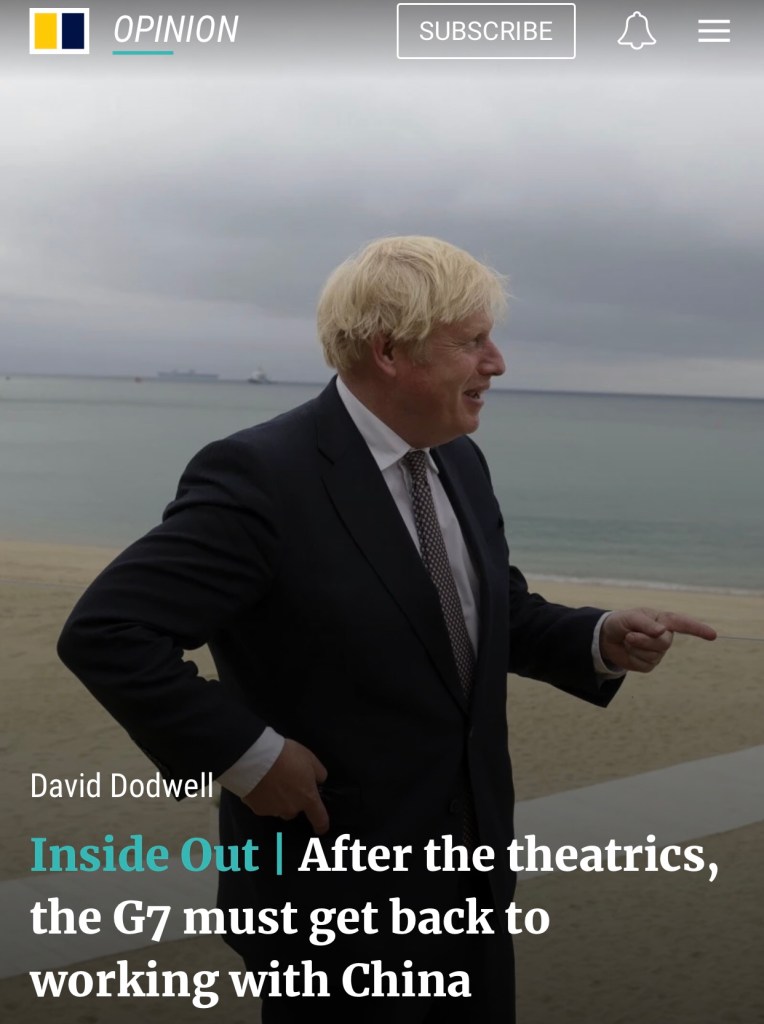
When it comes to politics as theatre, the UK is a hard act to follow. And Prime Minister Boris Johnson in Carbis Bay in Cornwall over the weekend was a class Shakespearean act. Or was it Churchillian? Or Arthurian?
In short, it is high on moral fervour and short on specifics, and anxiously self-aware that many regard the G7 as a yesteryear organisation, overshadowed by the G20.
Johnson choreographed a G7 summit that all will remember. He may not succeed in restoring the G7 to its original Cold War glory, when its members (the US, Britain, France, Italy, Germany, Japan and Canada) accounted for 59 per cent of world GDP (they account for 45 per cent today) and walked with a swagger, confident that they could shape the world in the image of Western liberal democracy. But he has given it a good shot.
He deserves credit for making the G7 summit a memorable, watershed event; a striking “coming out” celebration for Joe Biden in his first presidential sortie outside the US; an assertion of “Global Britain” as it sets out on its Brexit future; a surprisingly strong affirmation of the US-UK “special relationship”; and a fitting launch pad for the UK’s “main event” in November when, in Scotland, he will host the COP26 climate summit. Whether it provides foundations for a future “alliance of democracies” has yet to be seen.
For Biden, throw in a dinner with Queen Elizabeth, a summit with the European Union and Nato, and a snake-pit encounter with Vladimir Putin, and we are witnessing a striking repudiation of “America first” and a credible affirmation that Donald Trump’s wilderness years are firmly past.
As Biden told American troops at the Mildenhall Royal Air Force base after landing in the UK: “The United States is back and the democracies of the world are standing together to tackle the toughest challenges and issues that matter most to our future.”
 Johnson Choi Biz