Racist Government and lawmakers passed the 1882 Chinese Exclusion Act and in 1901 the Eight-Nation Alliance invaded China forced China to pay over US$4 billions in current dollars. 種族主義政府和立法者通過了 1882 年的排華法案,1901 年八國同盟入侵中國,迫使中國以現價計算支付超過 40 億美元 Today the Americans lead Eight-Nation Alliance under the disguise of Freedom, Democracy and Human Right has passed the NEW 1882 Chinese Exclusion Acts and fantasizing a repeat of the extortion acts of 1901 through fake news on Wuhan Laboratory, Xinjiang Cotton and Hong Kong by working with Western Governments mouthpiece media companies using Nazi Germany WWII tactics by repeating the same lies around the world 100s of times everyday to make it real. 今天,美國人領導的(新)八國同盟打著自由、民主和人權的幌子,已經通過了新的 1882 年排華法案,並幻想通過假新聞在武漢實驗室、新疆棉花和中國香港重演 1901 年的敲詐勒索行為。 西方政府的喉舌媒體公司使用納粹德國二戰的策略,每天在世界各地重複同樣的謊言 100 次,使其成為現實.
China is not the China of 1901. You want to play, let’s play. 中國不是1901年的中國,你想玩就玩吧。
China’s newly passed Anti-foreign Sanctions Law to bring deterrent effect against Western hegemony by Chen Qingqing and Liu Xin Jun 10 2021
Top lawmakers in China on Thursday voted to pass the highly expected Anti-Foreign Sanctions Law, providing a comprehensive legal basis for blocking illegal foreign sanctions and preventing Chinese individuals and entities from suffering the damage resulting from such illegal sanctions. The new law will also offer sufficient legal foundation for taking an equal position with the West by imposing necessary countermeasures, Chinese legal experts said.
The Standing Committee of the 13th National People’s Congress (NPC) convened its 29th session on Monday in Beijing, which is scheduled to conclude on Thursday, and draft version of the anti-foreign sanctions law was put to review for the second time on Monday. According to the rules and procedures of the legislative body, a draft law in the agenda of the NPC Standing Committee meeting should generally be reviewed three times before being put to a vote. However, if there is consensus on all aspects of the draft law, it can be reviewed twice.
Legal experts believed that the Anti-Foreign Sanctions Law, the first of its kind in China, will provide strong legal support and guarantees for the country against unilateral and discriminatory measures imposed by foreign countries, will also have a deterrent effect in the face of Western-led hegemony and demonstrate the collective determination of Chinese decision-makers in safeguarding China’s core interests.
Compared to the previous countermeasures issued by administrative institutions, the law underscores in a more comprehensive and systematic way the Chinese government’s attitude on the legal aspect when it confronts US government that has abused sanctions or long-arm jurisdiction to severely damage China’s sovereignty, security and development interests, some legal experts who took part in the consultation process for the law told the Global Times. The anti-foreign sanctions law will also enable China to strike a balance between countermeasures and negotiations in fixing divergences.
Necessary and timely move
The US government has been imposing sanctions on a growing number of Chinese entities such as high-tech firms Huawei and ZTE over the so-called national security risks, and sanctioned a number of senior Chinese officials under the US’ so-called Xinjiang and Hong Kong bills last year. In the eyes of legal experts, these have become regular moves for the US government in implementing illegal sanctions and carrying out long-arm jurisdiction against China. The Anti-Foreign Sanctions Law has also become a timely response to those unilateral moves, which may prompt more countries to follow suit.
The latest legislative progress was also in line with the top legislature’s annual work schedule, unveiled in March, which indicated that China will enhance legislation in foreign-related fields, when Li Zhanshu, chairman of the Standing Committee of the NPC, vowed to focus on moves against sanctions and interference and countering long-arm jurisdiction, as well as enriching the legal “toolbox” for coping with foreign-related challenges and preventing risks.
The law could have an influence in two fields – blocking illegal sanctions imposed by other countries and the damage brought by those sanctions; and taking countermeasures against these sanctions, Tian Feilong, a legal expert at Beihang University in Beijing, told the Global Times on Thursday.
“China can make reciprocal sanctions or take harsher countermeasures, for example, restricting entry, freezing bank assets, or imposing sanctions on relevant individuals or entities,” Tian said.
In response to the increasing unilateral moves made by the US government, Chinese authorities have also taken corresponding countermeasures since September 2020. For example, China’s Ministry of Commerce (MOFCOM) unveiled the provisions of China’s unreliable entity list, which has been viewed by some as a measure by Beijing to counter the US crackdown on Chinese companies. It also issued a new order on January 9 adopting necessary countermeasures against the unjustified extraterritorial application of foreign legislation.
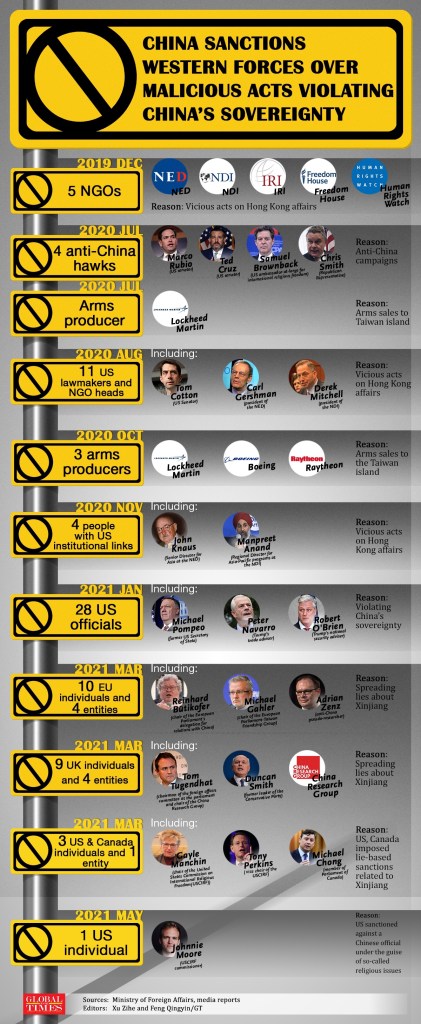
China’s Foreign Ministry also announced 11 rounds of countermeasures over Western countries’ interference in China’s internal affairs since last December such as Xinjiang and Hong Kong by sanctioning a number of NGOs, anti-China politicians, arms producers and entities, as well as lawmakers who helped spread lies about those matters.
“Previous sanctions are fragmented and without sufficient legal basis, and may incur negative feedback due to lack of sufficient legal basis. Now, we have complete legal basis, offering us the same position as the West in taking countermeasures,” Tian said, noting that it will also help integrate previous resources and forms to make China’s countermeasures against foreign sanctions more systematic, scientific and powerful.
China’s list of sanctions against Western forces over their meddling in China’s domestic affairs related to HK, Taiwan and Xinjiang. Graphic: Xu Zihe and Feng Qingyin/GT
Common practice
It’s also common practice for some Western countries to formulate similar laws in blocking foreign sanctions or opposing foreign interference. For example, the blocking statute, adopted in 1996, is an important achievement of unified EU action to protect EU operators, whether individuals or companies, from the extraterritorial application of third country laws, according to the EU website.
And an updated version of the blocking statute was implemented in 2018 to mitigate their impact on the interests of EU companies doing legitimate business in Iran.
Russia also passed a law in June 2018to counter the unfriendly behavior of the US and other countries to protect the interests, security, sovereignty and territorial integrity, as well as the rights of its citizens immune to the unfriendly behavior of the US.
When asked whether the law would affect China’s relations with foreign countries, Wang Wenbin, spokesperson of the Chinese Foreign Ministry, said at a routine press conference on Thursday that there is no need to worry about that.
“It’s necessary for China to formulate the Anti-Foreign Sanctions Law, as the law provides a strong legal basis and support for China to counteract foreign discriminatory measures,” Wang said.
The main purpose of China’s Anti-Foreign Sanctions Law is to authorize Chinese administrative agencies and judicial institutions to implement sanctions, and if there’s more demand in the practice, top authorities such as the State Council and the Supreme Court can issue corresponding detailed administrative regulations and judicial interpretations based on the authorization, and gradually refine a more specific legal system, Huo Zhengxin, a law professor at the China University of Political Science and Law, told the Global Times on Thursday.
Some senior officials, such as Carrie Lam, chief executive of the Hong Kong Special Administrative Region, hailed the law. Lam said the law will give the US and other countries “a taste of their own medicine,” because a number of central government and HKSAR government officials have been sanctioned by the US for the national security law for Hong Kong implemented in 2020.
“The HKSAR government lacked the resources to fight those sanctions in the past. With the implementation of the Anti-Foreign Sanctions law, they have the top authority’s legal support on their backs,” Tian said, noting that whether including the law into Annex III of the Basic Law or enabling the HKSAR government to revise or work on relevant anti-sanction local laws are both part of the consideration.
 Johnson Choi Biz